Learn Thai Vocabulary in Thailand: Vegetables & Herbs
Learn Thai vocabulary for vegetables, herbs and chillies in Thailand: market words in Thai script with transliteration, real photos and phrases to buy them.
The fastest place to learn Thai vocabulary in Thailand is not a classroom — it is the vegetable stall at the end of your soi. The words are short, the objects are in front of you, and the same twenty-five of them come round again every single day: in the market, on a menu, in the sentence a cook shouts across a kitchen. Better still, you can point. No other beginner Thai lesson gives you a free vocabulary test every time you buy dinner.
This guide covers the Thai vegetable and herb words that actually earn their place in your head, each one in Thai script, in Thai transliteration and with the literal meaning, because Thai plant names are quietly logical once you see inside them. มะเขือเทศ is “foreign aubergine” — a tomato. พริกขี้หนู is “mouse-dropping chilli”, which tells you the size and, by implication, the damage. Five real photographs from markets in Chiang Mai, Bangkok and Saraburi show you each group of words where it actually lives.
ตลาดสด: read Thai script on the gate first
Before the vegetables, the building. Almost every fresh market in Thailand announces itself with one word you can learn in about ninety seconds, and once you have it you will see it on hundreds of signs, bus destinations and shop names across the country. It is also the single best place to learn Thai vocabulary by accident, because the sign is right there above your head every time you go in.

- ตลาด (dtà-làat) — market, any market at all.
- ตลาดสด (dtà-làat sòt) — fresh market, literally “fresh market”. สด is the word you will also see on juice stalls and fish counters.
- ตลาดนัด (dtà-làat nát) — a market that appears on set days, literally “appointment market”.
- ผัก (phàk) — vegetable, and ผักสด (phàk sòt) — fresh vegetables, the sign above half the stalls inside.
- แม่ค้า (mâe kháa) — a female vendor, literally “trade mother”. You address her as พี่ (phîi), older sibling, not by that word.
Learn Thai vocabulary for everyday vegetables
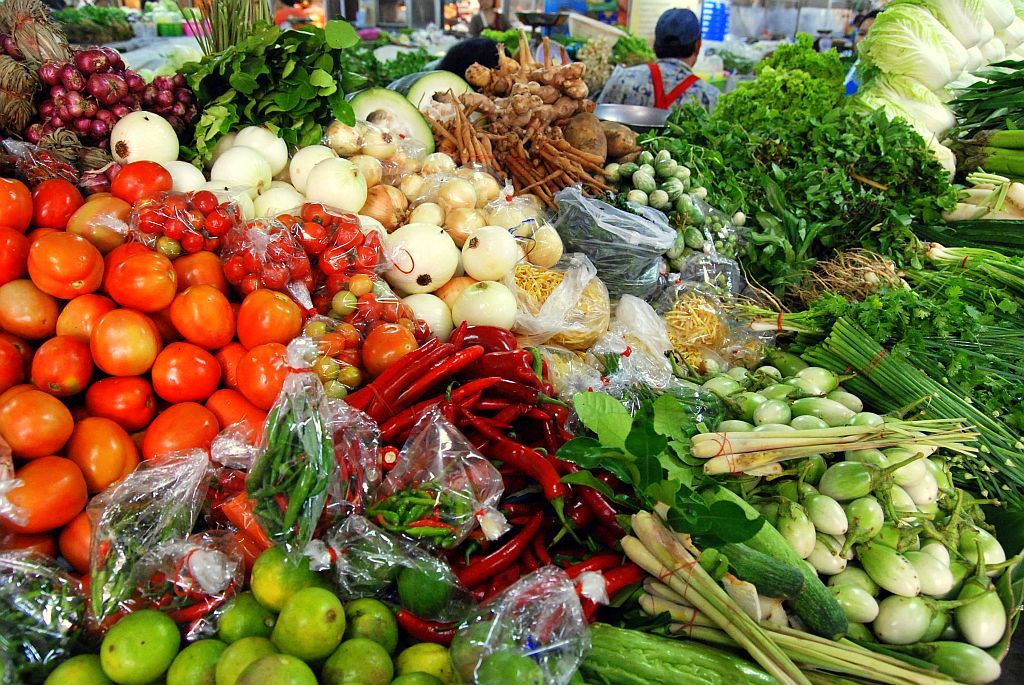
Start with the ones that appear in the dishes you already order. Each of these is one or two syllables, and several are compounds of words you will meet again elsewhere, which is exactly why vegetables are such efficient material for a beginner Thai lesson.
- ผักบุ้ง (phàk bûng) — morning glory, the stir-fried green of ผัดผักบุ้งไฟแดง.
- กะหล่ำปลี (gà-làm bplii) — cabbage, and กะหล่ำดอก (gà-làm dàwk) — cauliflower, literally “flower cabbage”.
- ถั่วฝักยาว (thùa fàk yaao) — yardlong bean, literally “long-pod bean”. ถั่ว covers every bean, pea and nut in the language.
- แตงกวา (dtaeng-gwaa) — cucumber, the thing that arrives uninvited beside your fried rice.
- มะเขือเทศ (má-khǔuea thêet) — tomato, literally “foreign aubergine”; เทศ marks anything imported.
- ข้าวโพด (khâao phôot) — corn, built on ข้าว, rice, the way many Thai staples are.
- เห็ด (hèt) — mushroom, and หน่อไม้ (nàw máai) — bamboo shoot, “wood sprout”.
- มะละกอ (má-lá-gaw) — papaya, which when green and shredded becomes ส้มตำ (sôm-dtam).
เครื่องแกง: the herbs inside every Thai curry
เครื่องแกง (khrûueang gaeng) means curry paste — literally “curry equipment”. Learn these six and you can read the ingredient list of most Thai dishes, which is the point at which Thai pronunciation starts paying you back: you hear a word in a cooking video, recognise it on a stall, and it sticks without a flashcard. Herbs are the most efficient way to learn Thai vocabulary in bulk, because each name turns up in a dozen dish names you already order.
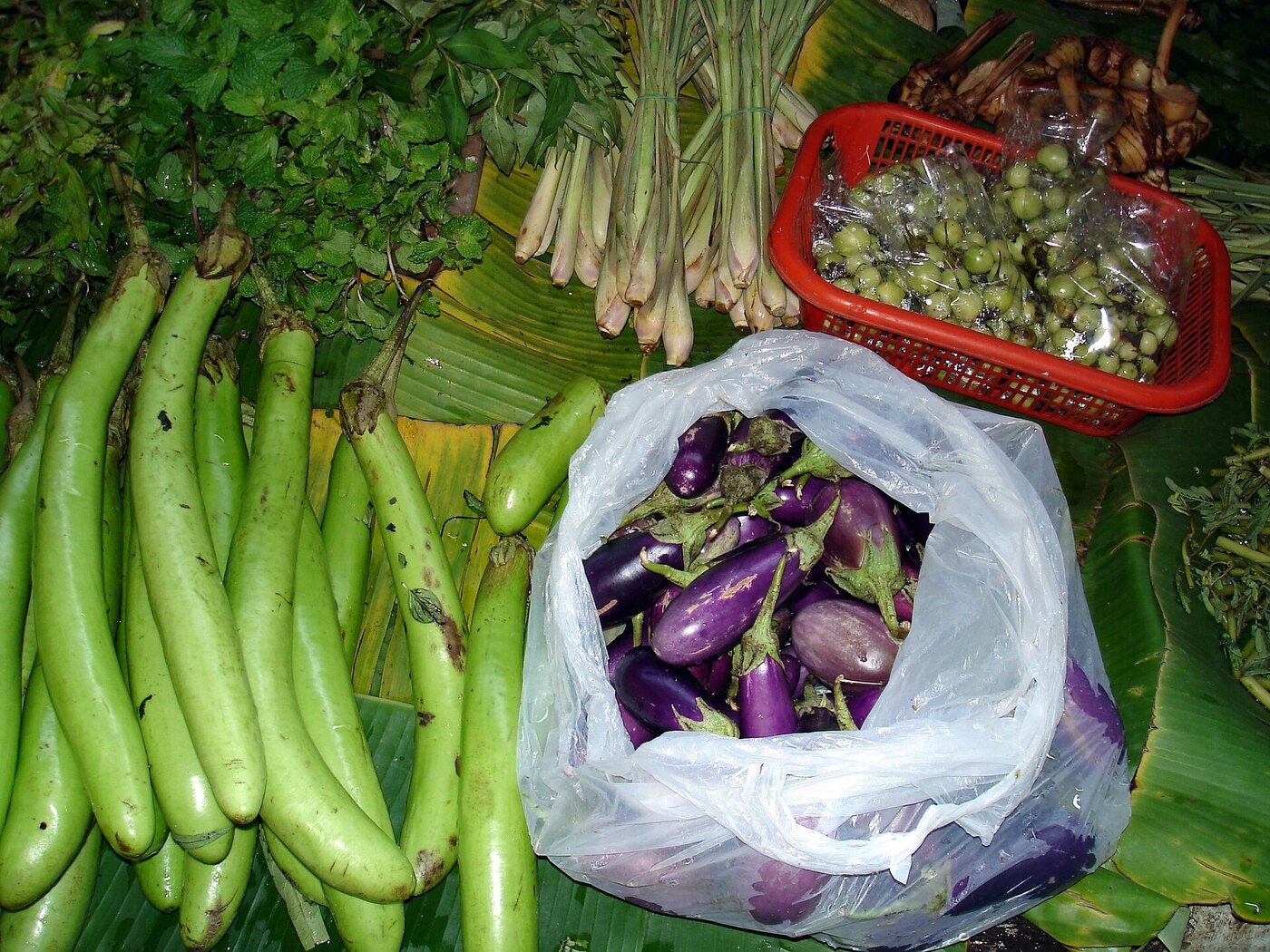
- ตะไคร้ (dtà-khrái) — lemongrass, bruised whole into tom yum and never eaten.
- ข่า (khàa) — galangal. One syllable, falling-ish low tone, and completely different from ขิง (khǐng) — ginger.
- ใบมะกรูด (bai má-grùut) — kaffir lime leaf. ใบ is “leaf”, so you now also have ใบโหระพา and ใบกะเพรา.
- กะเพรา (gà-phrao) — holy basil, the ผัดกะเพรา one — versus โหระพา (hǒo-rá-phaa) — sweet basil, the green-curry one.
- ผักชี (phàk chii) — coriander, and ต้นหอม (dtôn hǎwm) — spring onion, literally “fragrant stalk”.
- กระเทียม (grà-thiam) — garlic, and หอมแดง (hǎwm daeng) — shallot, “red fragrant”.
พริก: Thai pronunciation that protects your dinner
Of every word in this guide, พริก (phrík) is the one to get right first. It is also a small lesson in Thai consonants and vowels: พ is an aspirated “p” — a puff of air, closer to English “p” in pot than to “f” — and the ร that follows is often swallowed in everyday speech, so what you hear in a market is nearer phík.
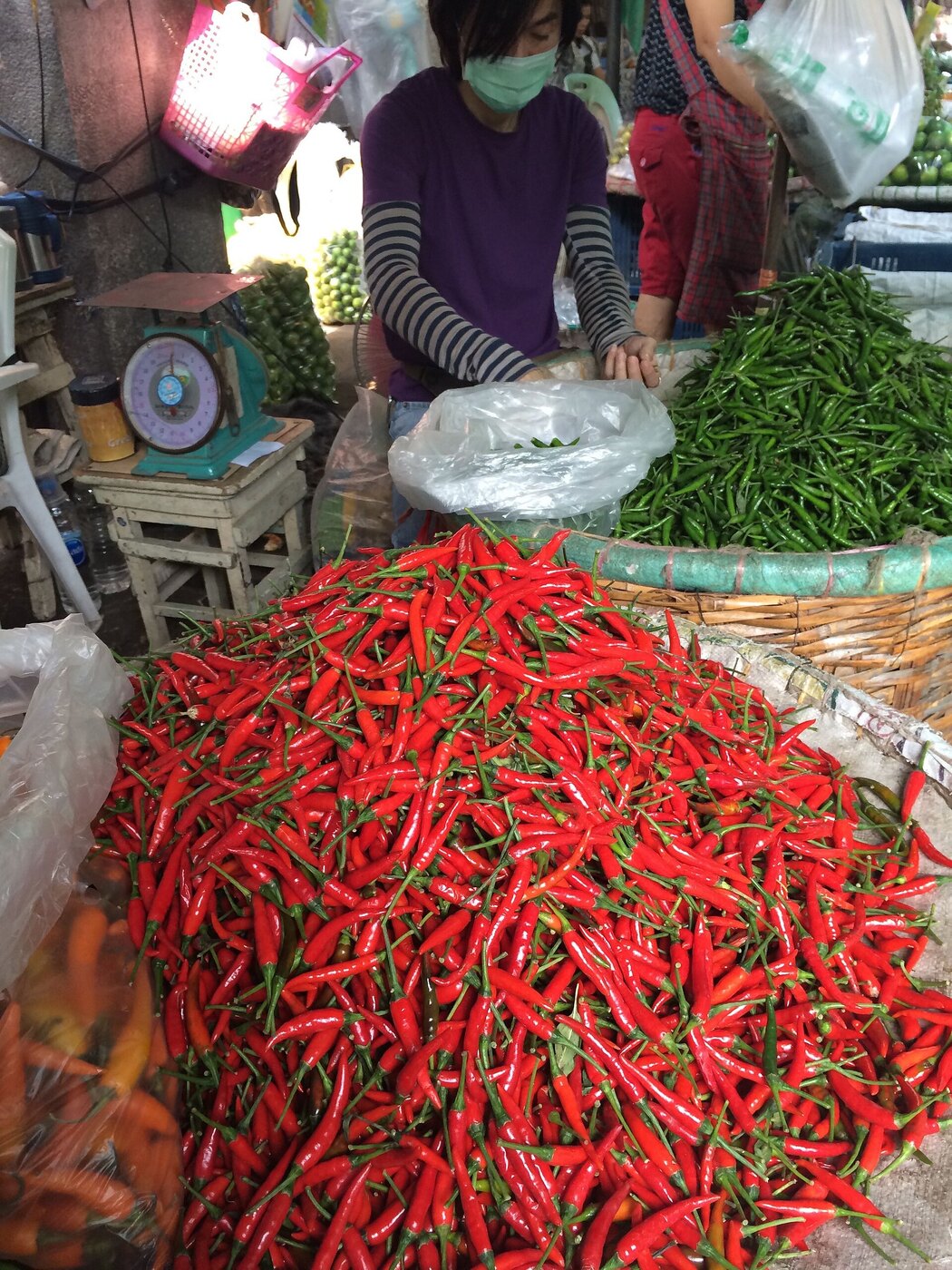
- พริกขี้หนู (phrík khîi nǔu) — bird’s eye chilli, literally “mouse-dropping chilli”. Small, and the hot one.
- พริกไทย (phrík thai) — black pepper, literally “Thai chilli”, which catches out every learner once.
- เผ็ด (phèt) — spicy, and ไม่เผ็ด (mâi phèt) — not spicy. Say it before you order, not after.
- เผ็ดน้อย (phèt náwy) — a little spicy, the realistic request; ไม่เผ็ด in a som tam stall is treated as a suggestion.
- น้ำพริก (nám phrík) — chilli dip, the bowl that arrives with a plate of raw vegetables.
Thai transliteration, prices and how much you are buying
Vegetable stalls rarely print anything. Prices are handwritten, shouted, or simply assumed, so the vocabulary that matters here is quantity rather than reading. Two words do most of the work — and if the romanised spellings you see elsewhere look inconsistent (kilo, gilo, kiloh), that is Thai transliteration for you: there is no single official system, which is the best argument for learning the Thai letters themselves. Quantity words are also where you stop reciting and start to speak Thai for a practical reason, because getting them wrong means going home with a kilo of chillies.
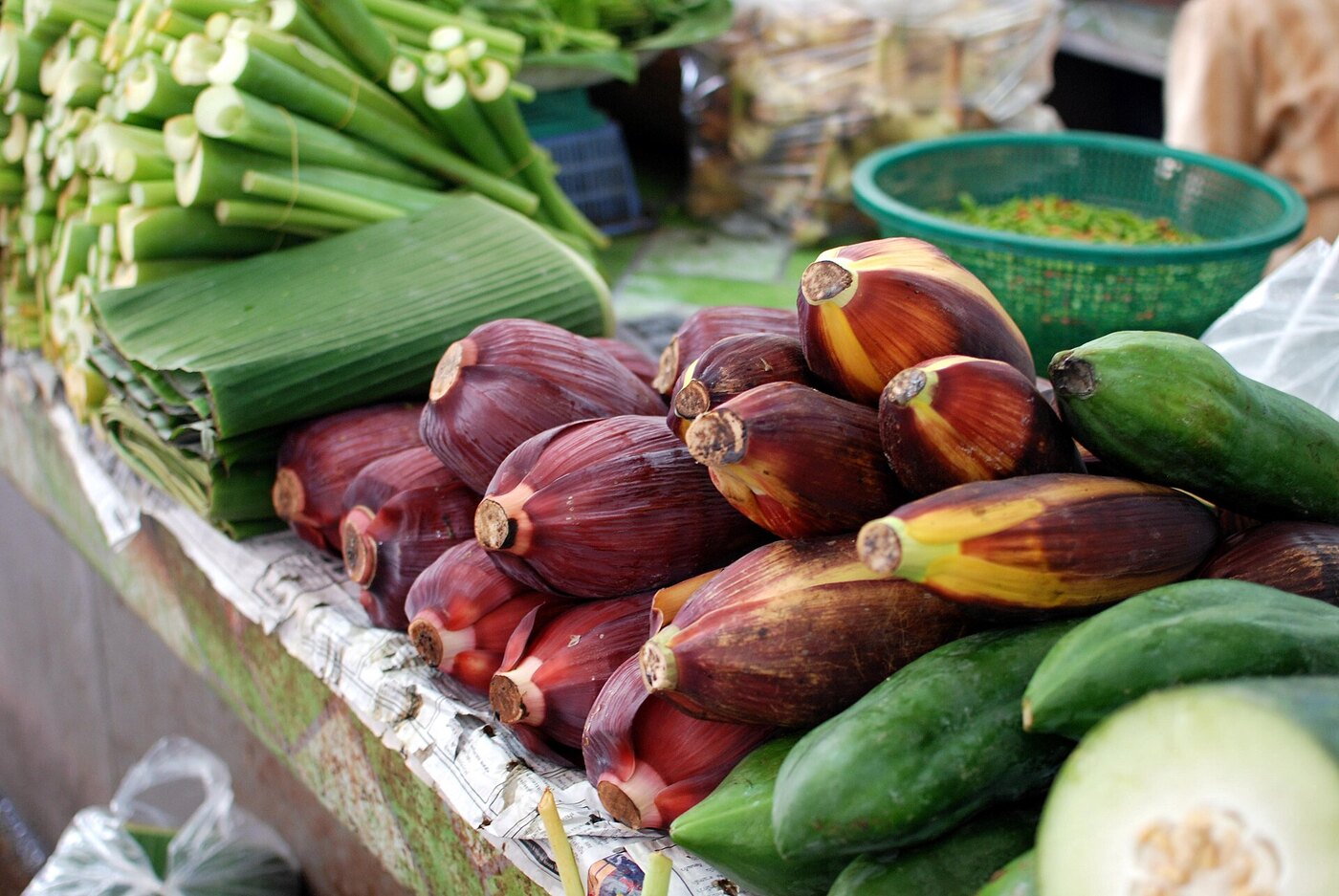
- กิโล (gì-loo) — kilo, usually shortened to โล (loo) in speech.
- ขีด (khìit) — 100 grams. ครึ่งโล (khrûeng loo) is half a kilo.
- กำ (gam) — a bunch, the unit for herbs; ถุง (thǔng) — a bag.
- เท่าไหร่ (thâo-rài) — how much, the single most useful question in any market.
- บาท (bàat) — baht. Prices come at you as spoken numbers, so pair this guide with our explainers on reading Thai numerals on price signs and Thai money words.
Speak Thai at the vegetable stall: six sentences
You do not need grammar to learn Thai vocabulary here, but you do need a handful of frames to hang it on. Market Thai is short Thai. Nobody expects a full sentence, and the politeness particle does most of the social work: men end with ครับ (khráp), women with ค่ะ (khâ) for a statement and คะ (khá) for a question. Drop the particle and a perfectly friendly request lands as an order — this is the one piece of Thailand expat language that is worth getting right on day one.
- อันนี้เท่าไหร่คะ (an níi thâo-rài khá) — “How much is this?” Point while you say it.
- ขอผักชีหนึ่งกำครับ (khǎw phàk chii nùeng gam khráp) — “One bunch of coriander, please.” ขอ is the polite “may I have”.
- เอาครึ่งโลค่ะ (ao khrûeng loo khâ) — “I’ll take half a kilo.” เอา is blunt but normal when buying.
- ไม่ใส่ผักชีนะครับ (mâi sài phàk chii ná khráp) — “No coriander, please.” ใส่ means “to put in”.
- สดไหมคะ (sòt mǎi khá) — “Is it fresh?” You will be told yes; ask anyway, it is friendly.
- ลดได้ไหมครับ (lót dâai mǎi khráp) — “Can you reduce it?” Fine at a tourist market, slightly rude at a village one where the price is already the price.
If those particles still feel slippery, our guide to khrap and kha takes five minutes, and the walk-through of a Thai fresh market covers the meat, fish and dessert aisles this guide skips.
A study tip: shop with five words, not fifty
Here is the drill that works, and it costs nothing extra because you were going to buy vegetables anyway. Before you leave the house, pick five words from this guide and write them on your hand or your phone. Buy only those five things. Say each one out loud at the stall, even badly — ขอผักบุ้งหนึ่งกำครับ — and let the vendor correct you, which she will, cheerfully and at speed. Tomorrow, keep two of yesterday’s words and add three new ones. Within a fortnight you will have forty vegetable words anchored to real objects you have held, which is worth more than two hundred words memorised from a list.
When you want the writing system behind the words, our free Thai alphabet chart is the quickest way to learn the Thai alphabet, with all 44 Thai consonants and vowels on one page, and the ThaiLetters flashcard trainer will drill the shapes ten minutes at a time. Start with ผ and ก: those two give you ผัก, and the sign above the stall where you just bought it suddenly stops being decoration and starts being a word. That is how you learn Thai vocabulary in Thailand — one stall, one bag, one sentence at a time.