Read Thai Script in Thailand: Opening Hours & Entry Signs
Read Thai script on opening-hours signs in Thailand: open, closed, the seven day names, Thai numerals and entry fees, with real photos and pronunciation.
You can read Thai script well enough to save yourself a wasted trip across town after about one evening of study, and the sign that proves it is bolted to the gate of almost every museum, temple office, bank branch and government building in Thailand. It is the opening-hours board. Two words tell you whether the place is open at all, seven more tell you which days, and a short row of numerals tells you until when. Miss them and you arrive at a locked gate on a Monday morning with a taxi receipt in your hand.
This guide reads four real opening-hours signs, photographed in Lamphun, Bangkok and Ban Chiang, line by line: the Thai letters, a Thai transliteration you can say out loud, and the literal meaning, because Thai signs are blunt and literal in a way that is unusually kind to a beginner. By the end you will know เปิด from ปิด at a glance, name all seven days, and read a time written in Thai numerals. It is a beginner Thai lesson with same-day payoff.
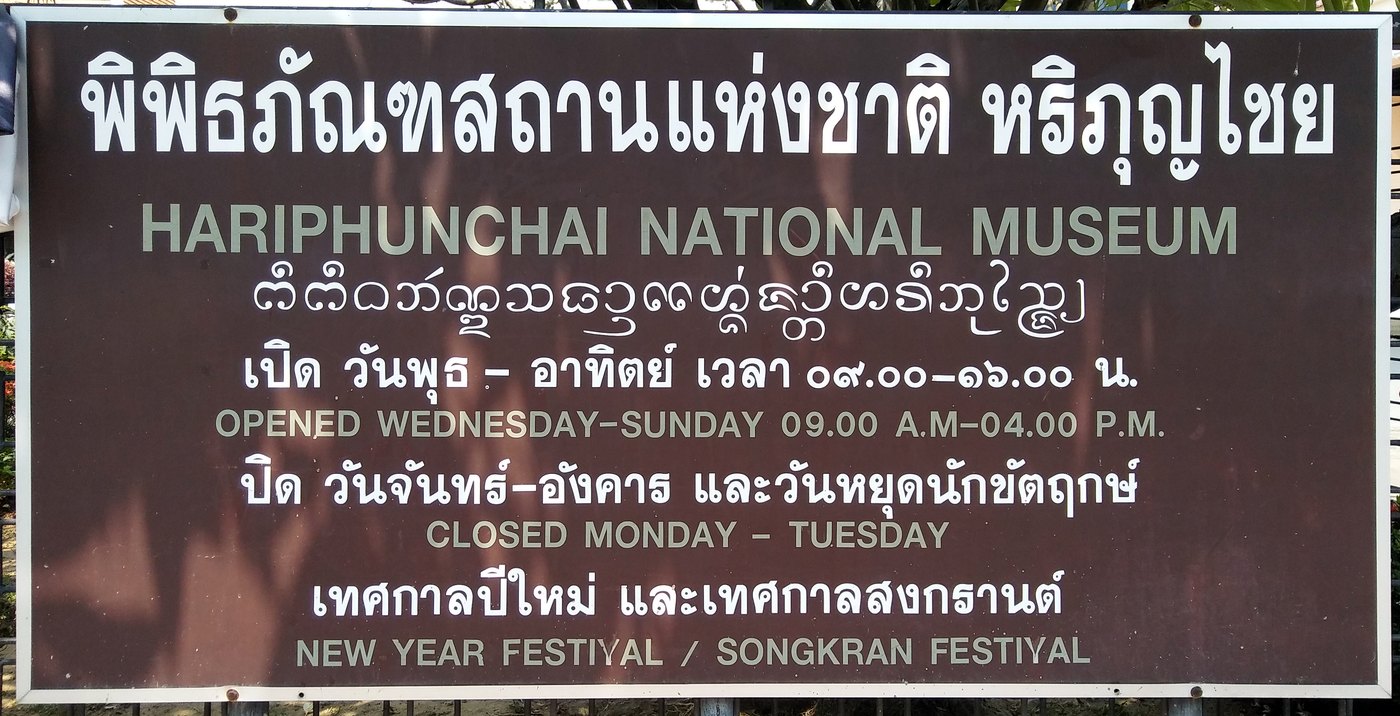
เปิด and ปิด: the first two words to read on any Thai sign
These two words are worth more to a new reader than any other pair in the language, and they are built from Thai consonants and vowels you meet on day one. เปิด and ปิด differ by a single leading vowel เ, which sits before the consonant it is pronounced after — one of the first surprises when you learn the Thai alphabet. Learn the shapes as a contrasting pair and you will read them on shutters, doors, ticket windows and hand-lettered cards for the rest of your life in Thailand.
- เปิด (bpòet) — open. Four letters, and the single most useful word on this page.
- ปิด (bpìt) — closed. Same word family, no leading vowel.
- เวลาทำการ (we-laa tham-gaan) — opening hours, literally “time of doing work”. The heading on half the signs in this guide.
- เปิดทำการ / ปิดทำการ (bpòet tham-gaan / bpìt tham-gaan) — open for business / closed for business. Offices and banks prefer these to the bare words.
- เปิดให้บริการ (bpòet hâi baw-rí-gaan) — open to the public, literally “open to give service”.
- ทุกวัน (thúk wan) — every day. The two best syllables on any sign.
- หยุด (yút) — to stop, and so “closed” when it is followed by a day; วันหยุดนักขัตฤกษ์ (wan yút nák-khàt-rüek) means public holidays.
- ปิดปรับปรุง (bpìt bpràp-bprung) — closed for renovation. Taped to more doors in Bangkok than anyone would like.
- ตลอด 24 ชั่วโมง (dtà-làwt yîi-sìp sëi chúa-moong) — around the clock, 24 hours.
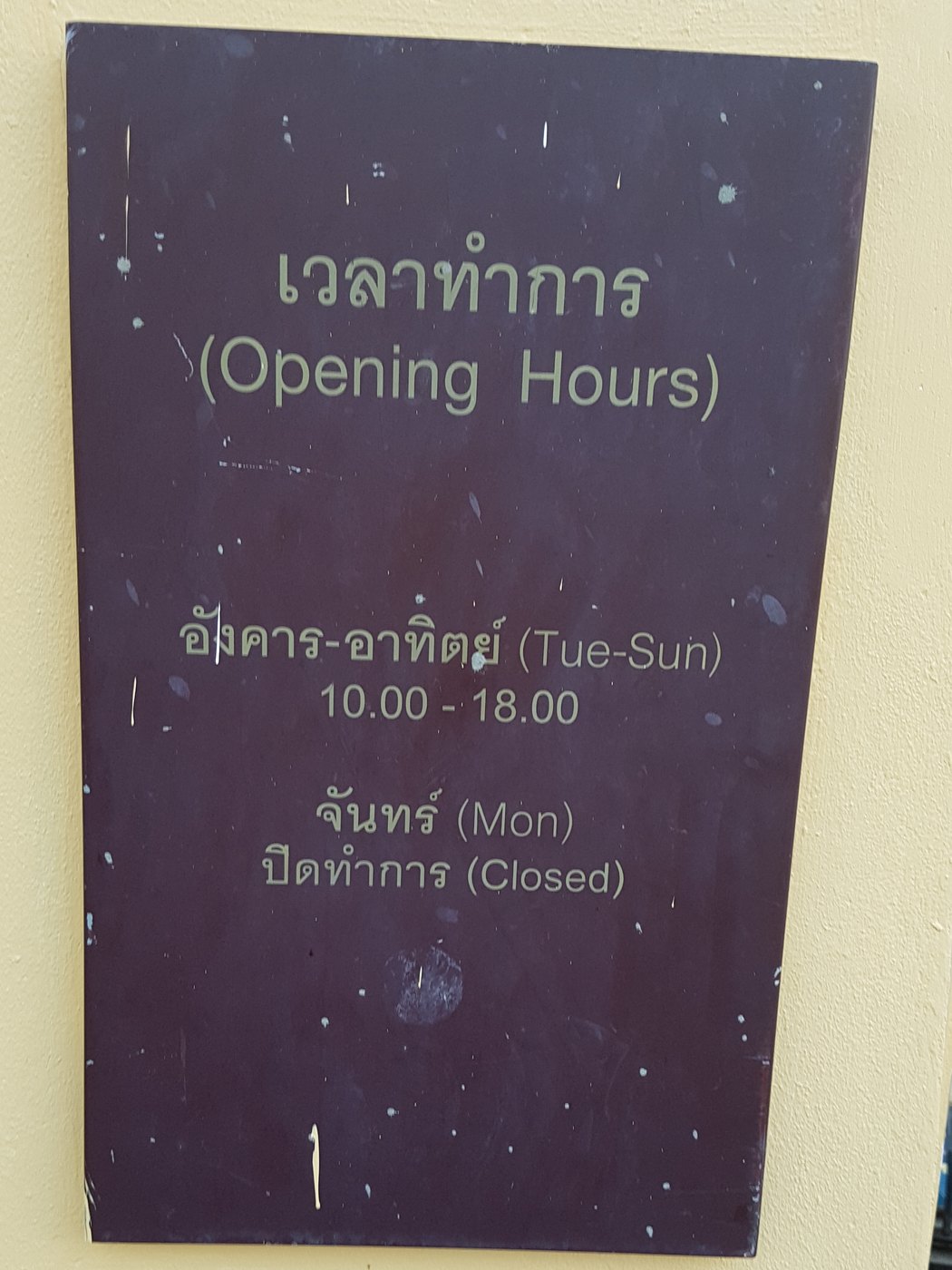
Read Thai script for the seven days of the week
Every Thai day name is วัน (wan), day, plus the name of a planet, borrowed from Sanskrit — the same system behind Monday being the moon’s day in English. That one fact turns seven separate memory items into one pattern plus seven short tails, which is exactly the kind of shortcut a beginner Thai lesson should hand you early. Each day also has a colour that Thai people genuinely use, and our guide to Thai time, dates and colours pairs them up.
- วันจันทร์ (wan jan) — Monday, the moon’s day. The ์ on the end is a silence mark: the final letter is written but not said.
- วันอังคาร (wan ang-khaan) — Tuesday, Mars.
- วันพุธ (wan phút) — Wednesday, Mercury.
- วันพฤหัสบดี (wan phá-rüe-hàt-sà-baw-dii) — Thursday, Jupiter. Mercifully shortened to วันพฤหัส in speech and on narrow signs.
- วันศุกร์ (wan sùk) — Friday, Venus.
- วันเสาร์ (wan sǎo) — Saturday, Saturn.
- วันอาทิตย์ (wan aa-thít) — Sunday, the sun. It is also the word for “week”.
Thai numerals, the 24-hour clock and that small น.
Official signs still love Thai numerals, and this is where many learners stall: the hours are right there, legible, and completely opaque. They are worth thirty minutes of your life. The ten shapes never change, they appear on banknotes, house numbers, temple donation boards and licence plates, and once they click you can read Thai script numbers faster than most Thai people read Roman ones. Our Thai numbers chart drills them, and the deeper guide to Thai numerals in prices and dates covers the fiddly cases.
- ๑ ๒ ๓ ๔ ๕ ๖ ๗ ๘ ๙ — 0 to 9. ๕ (five) is the one everyone learns first, because Thai people type it for laughter: 555 is hâa hâa hâa.
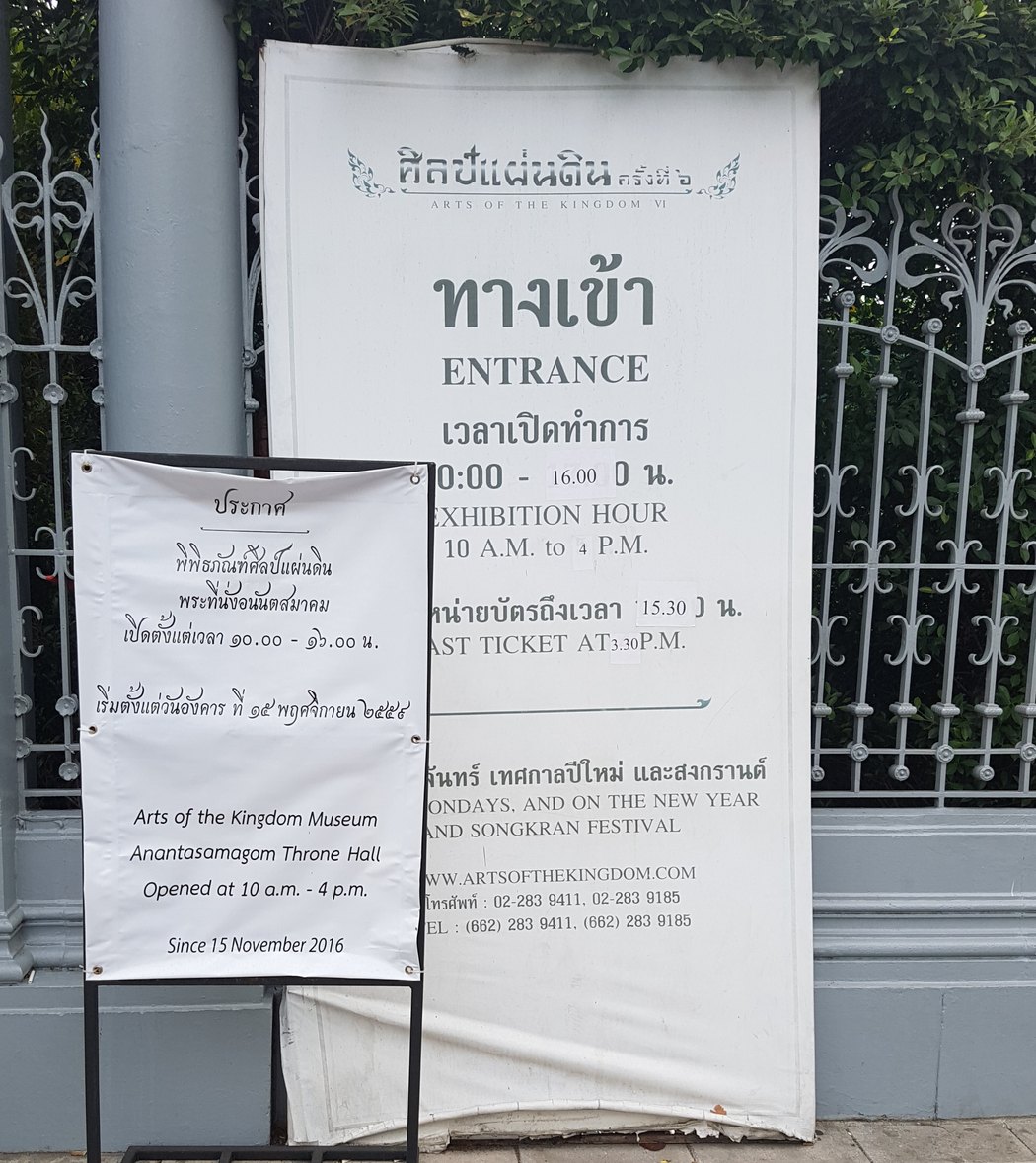
- น. — the abbreviation of นาฬิกา (naa-lí-gaa), o’clock. ๙. น. is simply 9am, and ๑๖. น. is 4pm.
- เวลา (we-laa) — time. It introduces the hours on hundreds of Thai signs.
- ถึง (thǔeng) — until, to. Often replaced by a simple dash.
- กี่โมง (gìi moong) — “what time?”, the question you say rather than read.
- พ.ศ. — Buddhist Era, the year numbering on official notices: add 543 to the Western year, or let our Thai Buddhist date calculator do it.
ค่าเข้าชม: reading entry fees and the two-price sign
Entry-fee lines are the other half of the board, and they are where reading Thai letters pays for itself in baht. Many state museums and heritage sites in Thailand print two prices: one for ชาวไทย and one for ชาวต่างชาติ. It is openly printed rather than hidden, and knowing the words is simply part of Thailand expat language — it also lets you ask, politely and in Thai, whether a work permit or student card changes the number.
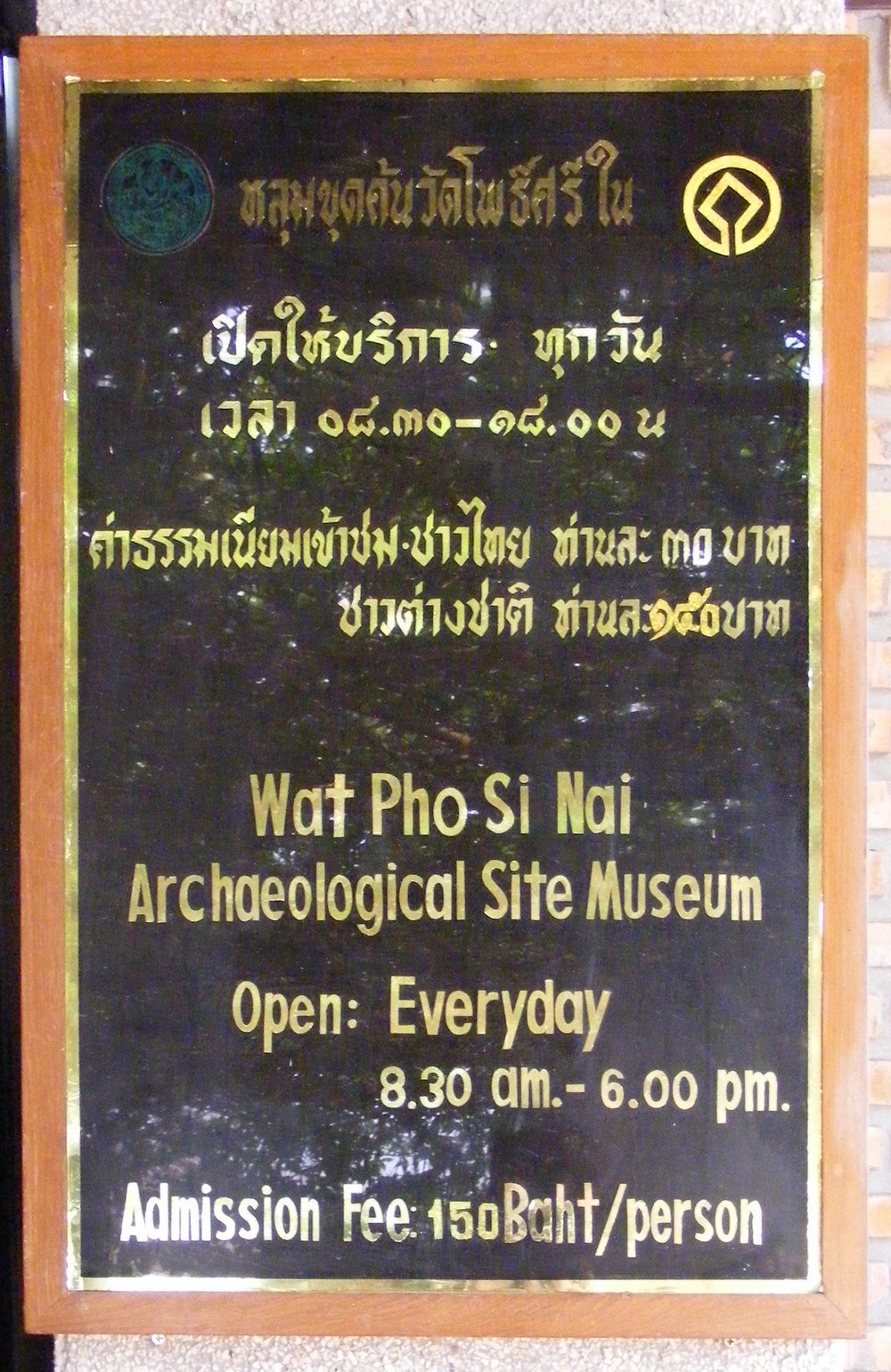
- ค่าเข้าชม (khâa khâo chom) — admission fee, literally “cost to enter and view”. ค่า is the “cost of” prefix on every fee in Thailand.
- ค่าธรรมเนียม (khâa tham-niam) — the official, paperwork word for a fee.
- ท่านละ (thân lá) — per person, in the polite register. The everyday version is คนละ (khon lá).
- ชาวไทย (chaao thai) — Thai nationals; ชาวต่างชาติ (chaao dtàang-châat) — foreigners, literally “people of another nation”.
- ผู้ใหญ่ (phûu yài) — adult; เด็ก (dèk) — child; นักเรียน (nák rian) — school student.
- ฟรี (frii) — free, an English loanword written in Thai letters. Worth spotting instantly.
- บัตร (bàt) — ticket or card; จำหน่ายบัตร (jam-nàai bàt) — ticket sales.
Speak Thai at the ticket window: five short sentences
Reading gets you to the right gate; a handful of spoken frames gets you through it. Thai politeness does most of the social work here, and it is carried by one syllable at the end: men say ครับ (khráp), women say ค่ะ (khâ) for a statement and คะ (khá) for a question. Leave it off and a perfectly reasonable question lands like an instruction — which is why it is the first thing anyone should learn before they try to speak Thai in public.
- วันนี้เปิดไหมครับ (wan níe bpòet mǎi khráp) — “Are you open today?”
- เปิดกี่โมงคะ (bpòet gìi moong khá) — “What time do you open?” Swap เปิด for ปิด to ask about closing.
- ค่าเข้าเท่าไหร่ครับ (khâa khâo thâo-rài khráp) — “How much is the entrance fee?”
- ขอบัตรสองใบค่ะ (khǎo bàt sǟng bai khâ) — “Two tickets, please.” ใบ is the counting word for tickets.
- พรุ่งนี้เปิดไหมครับ (phrûng níe bpòet mǎi khráp) — “Are you open tomorrow?” The question that saves the second wasted trip.
If those final particles still feel slippery, five minutes with our guide to khrap and kha will fix them, and the walk-through of Thai warning and no-entry signs covers the other half of what gets posted on a gate.
A study tip: one sign a day, photographed
Here is the drill, and it costs nothing. Photograph one opening-hours sign a day on your phone — the gym, the bank, the clinic on the corner, the shutter of the shop that is never open. That evening, copy out only the first line, letter by letter, and work out the day names. You are not translating the sign; you are training your eye to find the words you already know inside a block of unfamiliar shapes, which is the actual skill. A fortnight of that and you will catch ปิดวันจันทร์ from the back of a moving taxi.
When you want the writing system underneath all of this, our free Thai alphabet chart lays out the 44 Thai consonants and vowels on one page, and the ThaiLetters flashcard trainer will drill the letter shapes ten minutes at a time until they stop being decoration. Start with ป and the leading vowel เ: those two give you เปิด and ปิด, and from the moment you can read Thai script on a gate, Thailand stops telling you things you cannot hear.