Thai Money Words: Baht, Prices and Bargaining Phrases
Money words are the vocabulary you use every single day in Thailand. Here are baht and satang in Thai script, the six words that appear on every price sign, and the bargaining phrases that get you a better price without making anyone uncomfortable.
If you want to learn Thai vocabulary that you will use before lunchtime, start with money. You can go a month in Thailand without needing the word for hospital, but you will hear a price quoted eight or nine times a day — at the coffee stall, in the taxi, at the 7-Eleven counter, from the woman selling vegetables out of a crate. This Thai language guide covers the money words in Thai script, in plain Thai transliteration, and in literal English, plus how bargaining actually works in a country where getting loud about it is the fastest way to lose.

Why money makes such a good beginner Thai lesson
Prices are the one piece of Thai that comes with an instant answer key. If you hear a number, hand over a note and get the change you expected, you understood correctly. Nothing else in a beginner Thai lesson gives you that kind of immediate, unambiguous feedback — and feedback is what turns a word you have read into a word you own.
Money vocabulary is also small and closed. There are two currency units, about a dozen number words, and six or seven sign words. Learn that set once and it covers the market, the taxi, the pharmacy and the rent. Compare it with food vocabulary, which never stops expanding.
Baht, satang and what Thai actually calls money
The currency is the baht. The word you say and the word written on the sign are the same one.
| Thai | Pronunciation | English & notes |
|---|---|---|
| บาท | baht, low tone | baht — abbreviated on signs as บ. |
| สตางค์ | sa-tang | satang, 1/100 baht — survives only in 25 and 50 satang coins and at petrol pumps |
| เงิน | ngoen | money — also “silver”, the same word |
| ราคา | ra-kha | price |
| แพง | phaeng | expensive |
| ถูก | thuk, low tone | cheap — careful, this is not the same word as ทุก (thuk, “every”) |
| เงินทอน | ngoen thon | change — literally “returned money” |
| เศษ | set, low tone | small change, coins — มีเศษไหม = “do you have change?” |
| แบงก์ | baeng | banknote — แบงก์ร้อย is a 100-baht note |
| เหรียญ | rian | coin |
One habit worth building early: Thai names banknotes by their number plus แบงก์, so a 500 is แบงก์ห้าร้อย. When a vendor waves a note at you and says มีย่อยไหม (mee yoi mai), they are asking whether you have anything smaller. The answer is almost always the difference between a fast transaction and a slow one.
Thai numbers: enough to hear any price
You do not need to count to a million. You need to hear numbers fast, in the middle of a sentence, spoken by someone who is not slowing down for you.
- หนึ่ง สอง สาม สี่ ห้า (nueng, song, saam, see, haa) — one to five.
- หก เจ็ด แปด เก้า สิบ (hok, jet, paet, kao, sip) — six to ten.
- ยี่สิบ (yee-sip) — twenty. Note that 20 is yee-sip, not song-sip. This is the single most common beginner error.
- เอ็ด (et) — the “one” used at the end of a compound: 21 is ยี่สิบเอ็ด, 31 is สามสิบเอ็ด.
- ร้อย พัน หมื่น (roi, phan, muen) — hundred, thousand, ten thousand.
Put those together and 250 is สองร้อยห้าสิบ (song-roi haa-sip) — literally “two hundred five ten”. Thai builds numbers exactly the way you would if you were describing the digits out loud, which makes them far easier to learn than the vocabulary suggests. If you want the full ladder plus a converter, the Thai numbers reference has it.
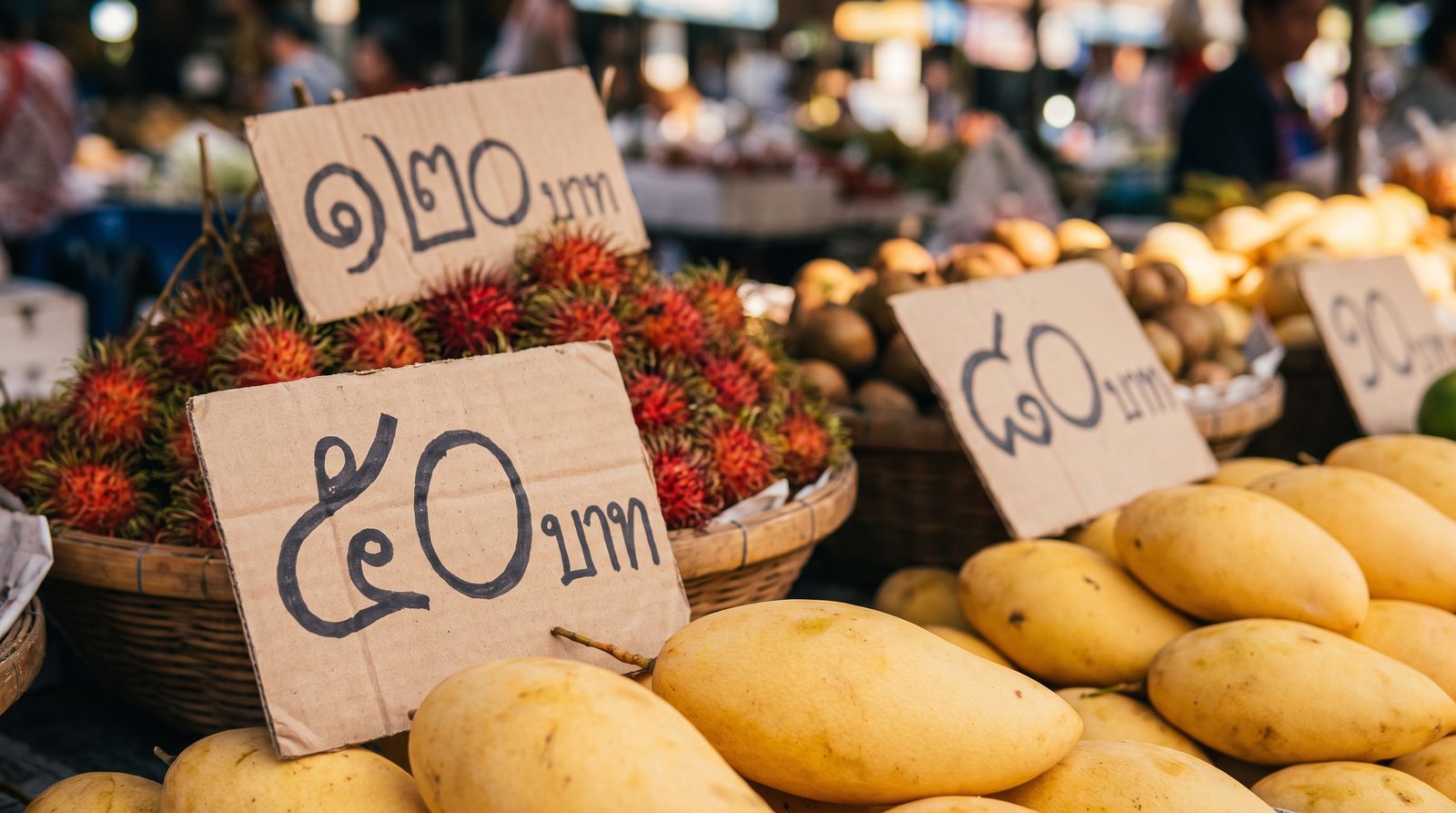
Read Thai script on a price sign
Handwritten signs use a tiny fixed vocabulary. These are the ones that repeat everywhere:
- ละ (la) — “per”. กิโลละ = per kilo, ชิ้นละ = per piece.
- ลด (lot) — reduced. ลดราคา is a price cut.
- เหมา (mao) — a flat, all-in price for the whole lot.
- ฟรี (free) — borrowed straight from English, and written phonetically.
- เริ่มต้น (roem ton) — “starting from”, the small print on menu boards.
- รวม (ruam) — total, the word at the bottom of a bill.
Thai abbreviates by keeping the first consonant and adding a full stop, which is why บาท shrinks to บ. and กิโลกรัม to กก. Being able to read Thai script at this level is a low bar with a high payoff — six words and ten numerals. If the letter shapes are still slow, the Thai alphabet chart lays out every one of the Thai consonants and vowels, and our guide to reading Thai numerals on prices and dates drills the digits specifically.
Asking the price: four sentences
Male speakers end with ครับ (khrap), female speakers with ค่ะ (kha). This is not decoration. Dropping the particle in a transaction with a stranger turns a request into an order, and the reply you get will change accordingly — our guide to speaking Thai politely explains the whole system.
- เท่าไหร่ครับ (thao-rai khrap) — “How much?” The workhorse.
- กิโลละเท่าไหร่ค่ะ (gi-lo la thao-rai kha) — “How much per kilo?”
- ทั้งหมดเท่าไหร่ครับ (thang-mot thao-rai khrap) — “How much altogether?”
- รับบัตรไหมคะ (rap bat mai kha) — “Do you take cards?”
Add one more if you buy from stalls: มีเศษไหมครับ (mee set mai khrap), “do you have change?” Handing a 1,000-baht note to someone selling 40-baht noodles at seven in the morning is the most common small rudeness foreigners commit without noticing.
Bargaining in Thai without losing face
Thai bargaining is quiet, brief and friendly. It is a negotiation between two people who both intend to end up smiling. Arguing, sighing, or announcing that you can get it cheaper elsewhere does not lower the price; it ends the conversation.
- ลดหน่อยได้ไหมครับ (lot noi dai mai khrap) — “Could you reduce it a little?” The standard opener, and the only one most people need.
- แพงไปหน่อย (phaeng pai noi) — “a bit too expensive”. Said lightly, never as a complaint.
- สองร้อยได้ไหมค่ะ (song-roi dai mai kha) — “Would 200 be possible?” Name a number rather than asking vaguely.
- ซื้อสองอัน ลดได้ไหมครับ (sue song an, lot dai mai khrap) — “If I buy two, can you come down?” Volume works better than pressure.
- ไม่เป็นไรครับ ขอบคุณครับ (mai pen rai khrap, khop khun khrap) — “No problem, thank you.” How you leave if the answer is no.
A realistic target is ten to twenty per cent off a market or souvenir price, not half. If the vendor says ราคาเดียว (ra-kha diao, “one price”) or ตายตัว (tai tua, “at cost”), that is a polite full stop. Push once more and you have crossed from negotiating into pestering.
Where you should not bargain at all
Fixed-price contexts are not negotiable and trying looks strange: convenience stores, supermarkets, chain restaurants, pharmacies, metered taxis, and any stall with printed prices. Food carts are generally fixed too. Bargaining belongs to markets, souvenir stalls, tuk-tuks, and anything sold by the pile.
Two Thai pronunciation traps worth knowing
Good Thai pronunciation matters more with money than with almost anything else, because the words are short and the stakes are numeric.
- สิบ (sip, ten) and ซิป (sip, zip) differ by tone and initial consonant. Context saves you, but the pair is a good reminder that Thai transliteration hides distinctions the script writes down clearly.
- ห้า (haa, five, falling tone) and หา (haa, to look for, rising tone) are the same letters apart from one tone mark. Say “five” flat and you have asked someone to search for something.
This is the everyday case for learning to read Thai letters rather than leaning on romanised spellings. Thai transliteration flattens tone and vowel length; the script does not. Ten minutes a day in the flashcard trainer closes that gap faster than any amount of listening.
A study tip that actually works
Give yourself one rule for a week: read the price before you ask it. Whatever the sign says — a market crate, a menu board, the shelf tag in a shop — work out the number and the currency word in Thai first, then let the answer confirm you. You will be wrong for two days and right by the fifth, and you will have learned it without a single flashcard session.
Then say the total back to the vendor before you hand over the note. It takes three seconds, it catches misunderstandings while they are still cheap, and it is the fastest way to learn Thai vocabulary for numbers under real conditions. Anyone building Thailand expat language skills gets more mileage out of that one habit than out of a month of apps. When you are ready for the aisle next door, our guide to Thai vocabulary at the fresh market covers the weights, produce and haggling words that sit alongside these.