Read Thai Script: Thai School & University Signs in Thailand
Read Thai script on school and university signs in Thailand: โรงเรียน, เทศบาล and มหาวิทยาลัย decoded with real photos, transliteration and translations.
Thailand has tens of thousands of schools, and every single one has a sign at the gate — usually a long slab of black granite with gold Thai letters across it. That makes school gates the best free classroom in the country for anyone learning to read Thai script. The signs are big, they hold still, nobody minds you staring, and almost all of them are built from the same three or four words. Learn that pattern once and thousands of gates across Thailand stop being decoration and start being readable.
This guide works through four real photographs — school and university signs from Uttaradit, Songkhla, Phitsanulok and a rural school in the Thai Rath network — and reads each one line by line. Everything is given in Thai script, with Thai transliteration and a literal translation wherever the literal meaning actually helps you remember the word. It is a beginner Thai lesson built around a sign you will walk past every day, and if you are raising children here it doubles as the Thailand expat language you need in week one of term.
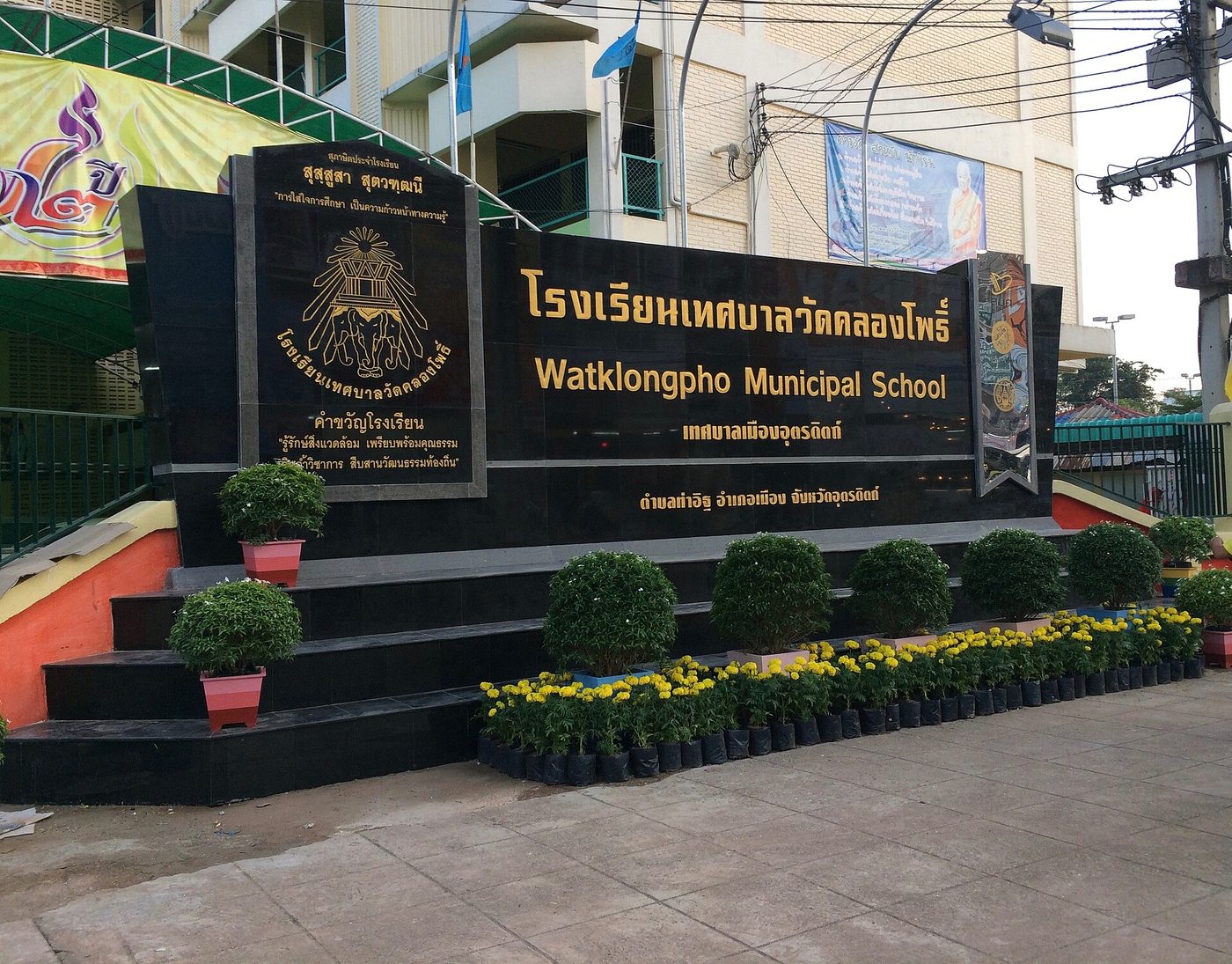
โรงเรียน — the one word that unlocks every Thai school sign
Start with the word that opens roughly nine signs in ten: โรงเรียน (roong rian), school. It is two ordinary words glued together — โรง (roong), a hall or shed, plus เรียน (rian), to study. A school in Thai is a "study hall", and once you have spotted that, a whole family of buildings comes free with it. This is the real reason to learn Thai letters rather than rely on romanisation: Thai builds long words out of short ones, and the parts repeat.
- โรงเรียน (roong rian) — school. Seven letters, and the first word on almost every sign in this guide.
- โรงพยาบาล (roong phá-yaa-baan) — hospital, literally "nursing hall".
- โรงแรม (roong raem) — hotel, literally "overnight hall".
- โรงหนัง (roong nǎng) — cinema, literally "film hall".
- โรงอาหาร (roong aa-hǎan) — canteen, literally "food hall". You will find this one painted inside the school gate.
- วัด (wát) — temple. Thousands of Thai schools began in a temple compound and still carry its name, as this one does.
Read Thai script on the address line: ตำบล, อำเภอ, จังหวัด
The small print at the bottom of a Thai school sign is the same address format used on every government building, letterhead and ID card in the country. Learn these four words and you can place any sign in Thailand on a map. In the photograph above the line reads ตำบลท่าอิฐ อำเภอเมือง จังหวัดอุตรดิตถ์ — Tha It subdistrict, the capital district, Uttaradit province.
- เทศบาล (thêet-sà-baan) — municipality. A school with this word in its name is run by the local council, not the Ministry of Education.
- เมือง (mueang) — town or city. เทศบาลเมือง is a town municipality; เทศบาลนคร (nák-khawn) is the bigger city grade.
- ตำบล (tam-bon) — subdistrict, the smallest unit on the line.
- อำเภอ (am-phoe) — district. อำเภอเมือง always means the province's own capital district.
- จังหวัด (jang-wàt) — province. The last word on the line, every time.
- ท่า (thâa) — a landing or pier, and อิฐ (ìt) — brick. ท่าอิฐ is "brick landing", a river wharf that gave the subdistrict its name.
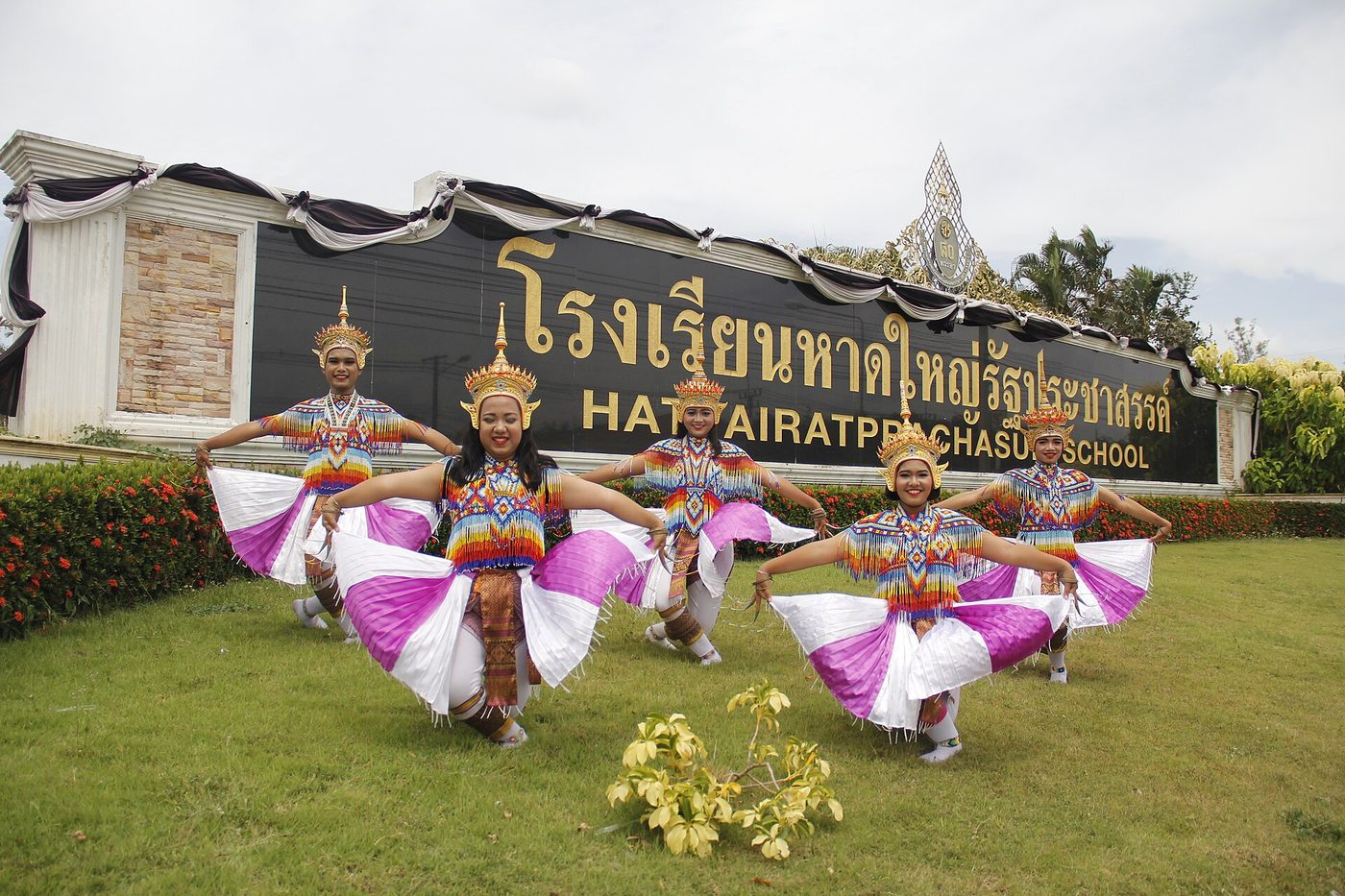
The romanised line: free Thai transliteration on the sign
Most Thai schools print their name twice — once in Thai letters, once in roman ones. For a learner that second line is a gift, because it turns every gate into a self-marking exercise. Read the Thai first, say it out loud, then drop your eyes and see how close you were. Two warnings, though. Thai romanisation does not write tones, so the roman line tells you nothing about Thai pronunciation beyond the rough shape of the syllables. And it is wildly inconsistent — the same sound may appear as ph, p or b on three signs in one street. The Thai letters are the reliable version; the roman line is only the answer key. Lean on it while you learn to read Thai script, then start covering it up.
- หาด (hàat) — beach, and ใหญ่ (yài) — big. หาดใหญ่, "big beach", is Hat Yai.
- รัฐ (rát) — the state. The ฐ at the end is silent, which is normal in words borrowed from Sanskrit and Pali.
- ประชา (bprà-chaa) — the people. You will meet it again in ประชาชน (bprà-chaa-chon), "citizens".
- สรรค์ (sǎn) — to create. The little ์ mark above the last letter is gaa-ran, and it means "do not pronounce this letter" — one of the most useful symbols in Thai script.
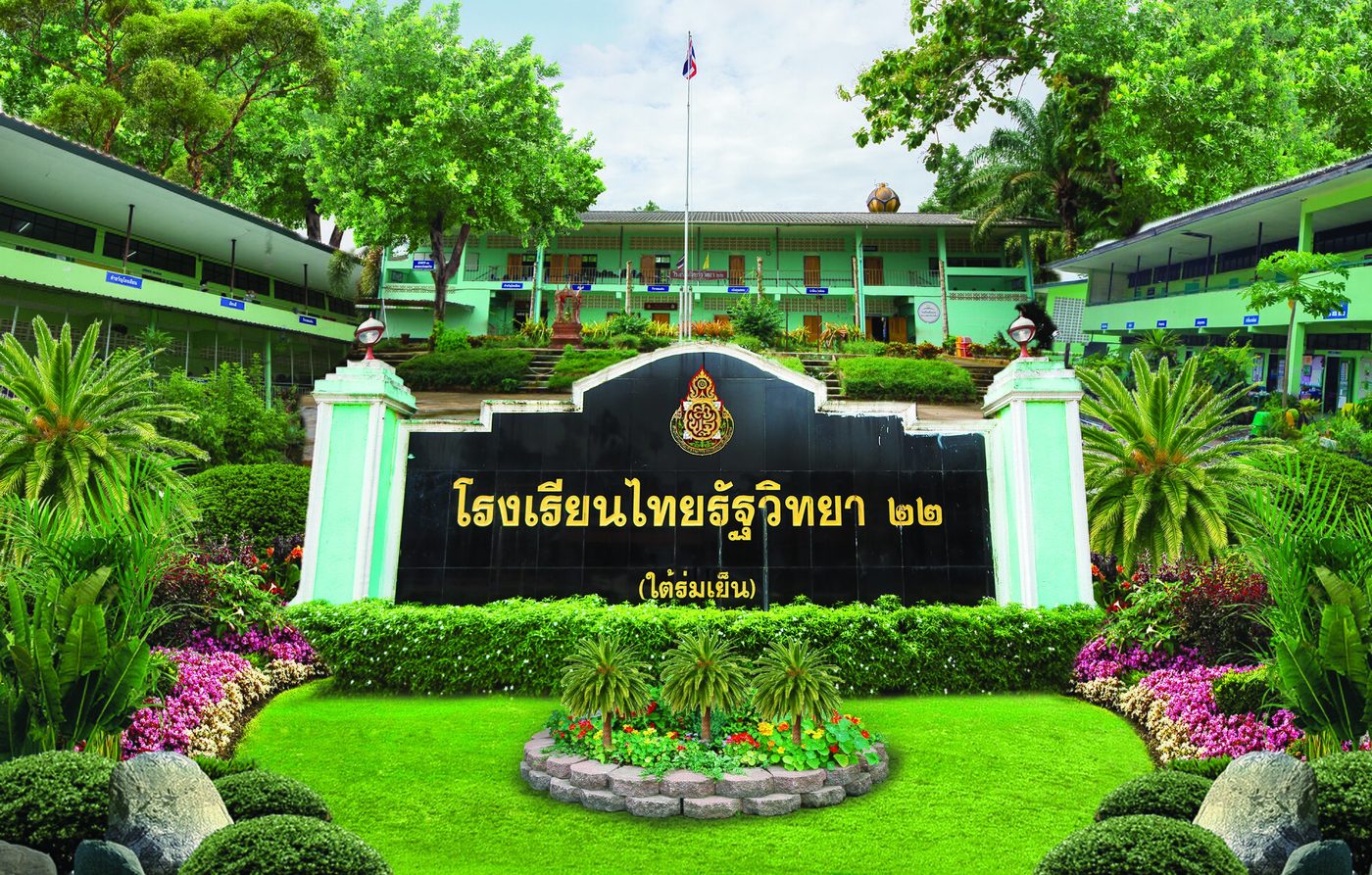
Thai numerals, and the words for each school level
Formal Thai signs still number things with Thai numerals, so ๒๒ above is twenty-two — yîi-sìp-sǎwng. The full set is ๐ ๑ ๒ ๓ ๔ ๕ ๖ ๗ ๘ ๙, and they are worth half an hour of your life because they turn up on school signs, temple gates, house numbers and government forms. The level words below are the other half of the sign, and they also tell you which gate you are standing at — read Thai script on this one line and you know whether the children inside are five or seventeen.
- อนุบาล (à-nú-baan) — kindergarten, roughly ages three to five.
- ประถม (bprà-thǒm) — primary. Written ป.๑ to ป.๖ for the six year groups.
- มัธยม (mát-thá-yom) — secondary, written ม.๑ to ม.๖.
- ศึกษา (sùek-sǎa) — education. ประถมศึกษา is "primary education".
- วิทยา (wít-thá-yaa) — knowledge, from Sanskrit. It is buried in dozens of school names.
- สาธิต (sǎa-thít) — "demonstration". A โรงเรียนสาธิต is a university training school.
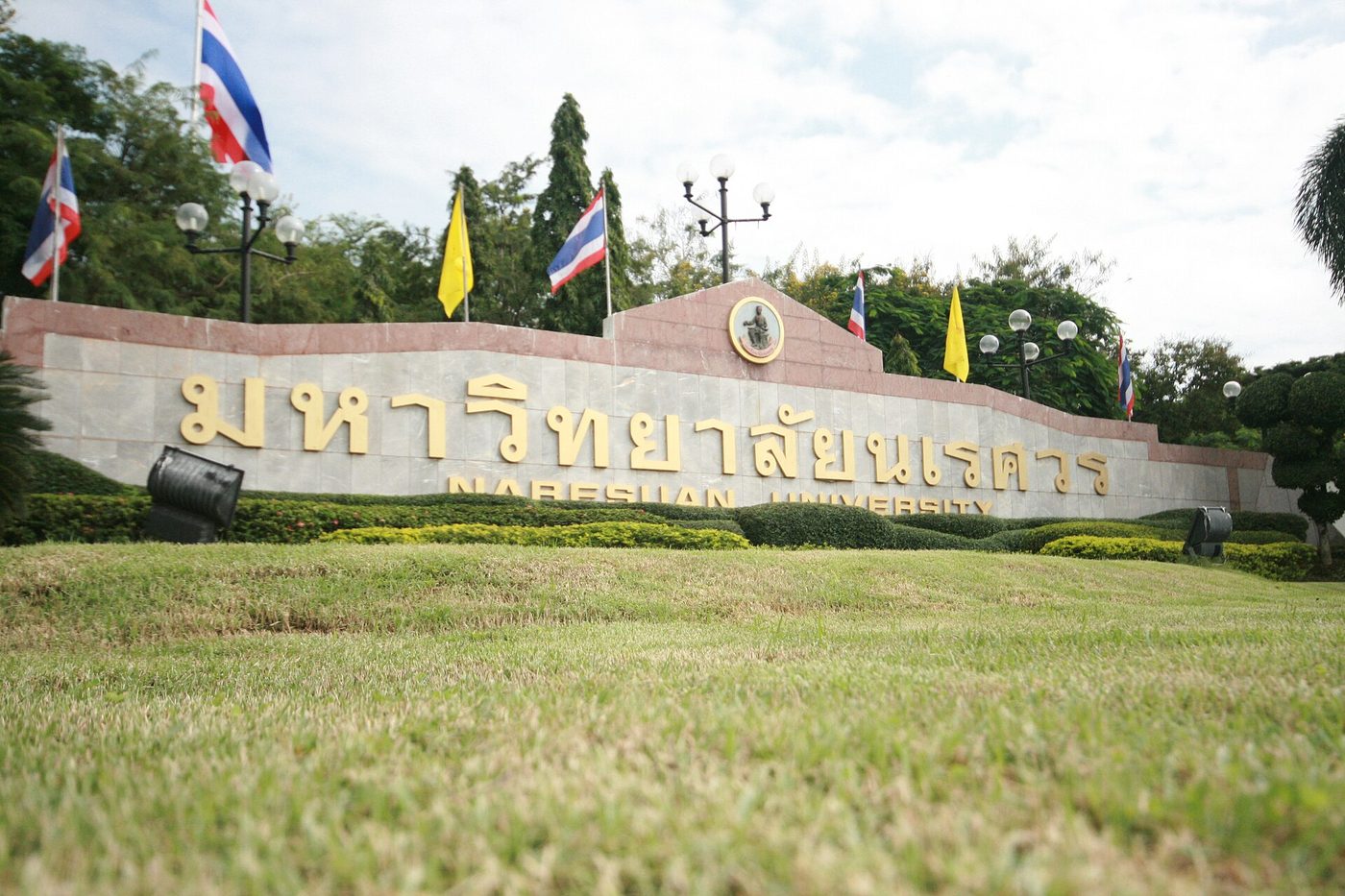
From โรงเรียน to มหาวิทยาลัย: reading a university sign
University signs follow the same grammar as school signs, just with a longer first word. มหาวิทยาลัย looks frightening until you break it: มหา (má-hǎa, great) + วิทยา (wít-thá-yaa, knowledge) + อาลัย (aa-lai, a place) — a great place of knowledge. Chop long Thai words into their pieces like this and your reading speed roughly doubles, which is the single most useful habit when you read Thai script on anything official.
- มหาวิทยาลัย (má-hǎa-wít-thá-yaa-lai) — university.
- วิทยาลัย (wít-thá-yaa-lai) — college, one rung below.
- ราชภัฏ (râat-chá-phát) — Rajabhat, the former teachers' colleges now found in nearly every province.
- คณะ (khá-ná) — faculty. Campus signposts are all คณะ this and คณะ that.
- นักศึกษา (nák-sùek-sǎa) — university student, against นักเรียน (nák-rian) for a school pupil. นัก marks a doer, like -er in English.
At the gate: Thai pronunciation, ครับ/ค่ะ and talking to a teacher
A few words will carry you through any conversation at the gate, and one habit matters more than all of them: finish your sentences with ครับ (khráp) if you are male or ค่ะ (khâ) if you are female. Thai schools are formal places, and that single syllable is the difference between sounding brusque and sounding like a parent who belongs there. Address a teacher as คุณครู (khun khruu) or, at a university, อาจารย์ (aa-jaan) — never by first name alone unless invited.
- ครู (khruu) — teacher, and อาจารย์ (aa-jaan) — lecturer or senior teacher.
- ห้องเรียน (hâwng rian) — classroom, literally "study room".
- การบ้าน (gaan bâan) — homework, literally "home work".
- ชุดนักเรียน (chút nák-rian) — school uniform, worn by nearly every pupil in the country.
- เปิดเทอม / ปิดเทอม (bpòet thoem / bpìt thoem) — term opens / term closes, the two dates every family watches.
- ไหว้ครู (wâi khruu) — the ceremony early each year where pupils pay respect to their teachers.
- ระวังเด็ก (rá-wang dèk) — "beware children", the yellow road sign outside every school zone.
A study tip: read one gate a day
Here is the drill. Pick the school nearest your flat and read one line off its sign each time you pass — the first word on Monday, the romanised line on Tuesday, the ตำบล on Wednesday. Say it aloud, then write it by hand that evening, because handwriting is what teaches you where each loop starts and it is the step almost everyone skips. Four or five gates in, you will notice you are no longer decoding letter by letter: you are recognising โรงเรียน as a shape, the way you recognise "school". That is the moment the Thai alphabet stops being a puzzle and starts being an alphabet, and the moment you can honestly say you read Thai script rather than decode it.
If you want the letters behind these words, begin with the free Thai alphabet chart — all 44 Thai consonants and vowels in one searchable page — and drill recognition with the ThaiLetters flashcard trainer until ข and ช stop looking alike. The Thai numbers page covers ๐–๙ properly, our guide to reading Thai place names takes the จังหวัด line further, and reading a Thai address finishes the job. Start with one word, โรงเรียน, and every gate in Thailand has something to say to you.