Khrap and Kha: How to Be Polite in Thai
Speak Thai politely: khrap and kha, greetings, pronouns and the wai, in Thai script with pronunciation and literal English, so you know which register fits.
Most beginners learn to speak Thai word by word and then discover that the words were never the hard part. Thai is a language where politeness is built into the sentence itself: a single syllable at the end of a line can be the difference between sounding warm and sounding rude, and there is no neutral setting to fall back on. This beginner Thai lesson covers the politeness system — ครับ and ค่ะ, the everyday greetings, the pronoun ladder and the wai — in Thai script, in plain Thai transliteration and in literal English, so you can use it correctly on your first day rather than your hundredth.
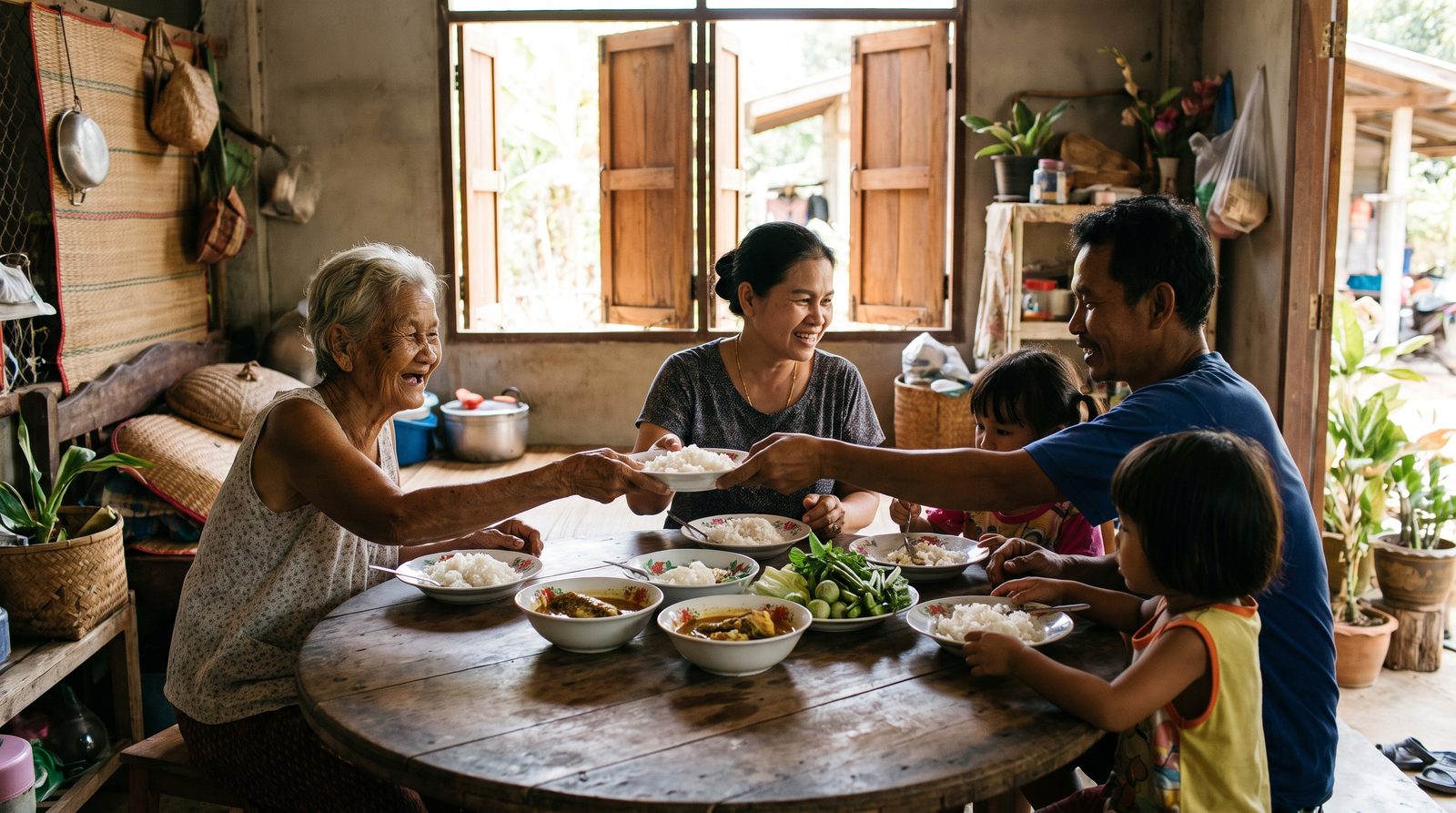
Politeness in Thai is grammar, not good manners
English marks politeness with hedging: could you possibly, would you mind. Thai marks it structurally, with a small closed set of particles and pronouns that attach to almost every sentence you say out loud. Drop them and your Thai is not casual — it is blunt in a way a native speaker would only use with a close friend, a small child, or someone they are annoyed with.
The good news for anyone learning to speak Thai is that this is a short list. Roughly a dozen items cover ninety per cent of daily use, and unlike Thai consonants and vowels, they need no memorised chart. You learn them by attaching them, over and over, until leaving them off feels wrong.
Khrap and kha: the two words that change everything
These are the polite ending particles. They carry no dictionary meaning of their own. They tell the listener that you are being respectful, and which gender you are speaking as.
- ครับ (khrap, high tone) — used by male speakers, on statements and questions alike.
- ค่ะ (kha, falling tone) — used by female speakers on statements.
- คะ (kha, high tone) — used by female speakers on questions, and on soft, coaxing sentences.
Look carefully at that second pair. ค่ะ and คะ are the same Thai letters apart from one tone mark, and they are not interchangeable. ค่ะ closes a statement: สวัสดีค่ะ (sawatdee kha) — “hello”. คะ opens the door for an answer: ไปไหนคะ (bpai nai kha) — literally “go where?”. If Thai pronunciation of tones is still new to you, our tone marks guide shows why one small mark rewrites the whole syllable.
Three mistakes almost every learner makes
Using the wrong one for your gender. Men say ครับ, women say ค่ะ — this follows the speaker, never the listener. A man thanking a woman still says ขอบคุณครับ.
Using them with close friends. Among friends of the same age the particles usually drop away, and reinstating them mid-conversation can sound cold or faintly sarcastic. Follow the other person’s lead.
Saying them too heavily. In real speech ครับ is often reduced to something closer to khap, quick and light. A loud, fully articulated khraap on every sentence is a reliable marker of a textbook learner.
The Thai greetings you will use on day one
Attach ครับ or ค่ะ to every line below and you have a working set of polite Thai for an entire ordinary day.
| Thai | Pronunciation | Literal English | Use it for |
|---|---|---|---|
| สวัสดี | sa-wat-dee | “auspiciousness” | Hello, and goodbye, at any hour |
| ขอบคุณ | khop khun | “edge of merit” | Thank you |
| ขอโทษ | khor thot | “ask punishment” | Sorry, and excuse me |
| ไม่เป็นไร | mai pen rai | “not be what” | No problem / never mind / you’re welcome |
| ยินดีที่ได้รู้จัก | yin dee tee dai roo jak | “glad that got to know” | Nice to meet you |
The literal column is worth studying rather than skipping. ขอโทษ literally asks for punishment, which is why it works both as an apology and as the “excuse me” you use to squeeze past someone on a crowded BTS carriage. And ไม่เป็นไร may be the single most useful phrase in Thailand expat language: it absorbs apologies, waves away small favours and closes awkward moments, all at once.
One note on thanking. ขอบคุณ is the polite standard. ขอบใจ (khop jai, “edge of heart”) is warmer and travels downward — to someone younger than you, or to a child. Used upward it sounds presumptuous, so when in doubt, use ขอบคุณ.
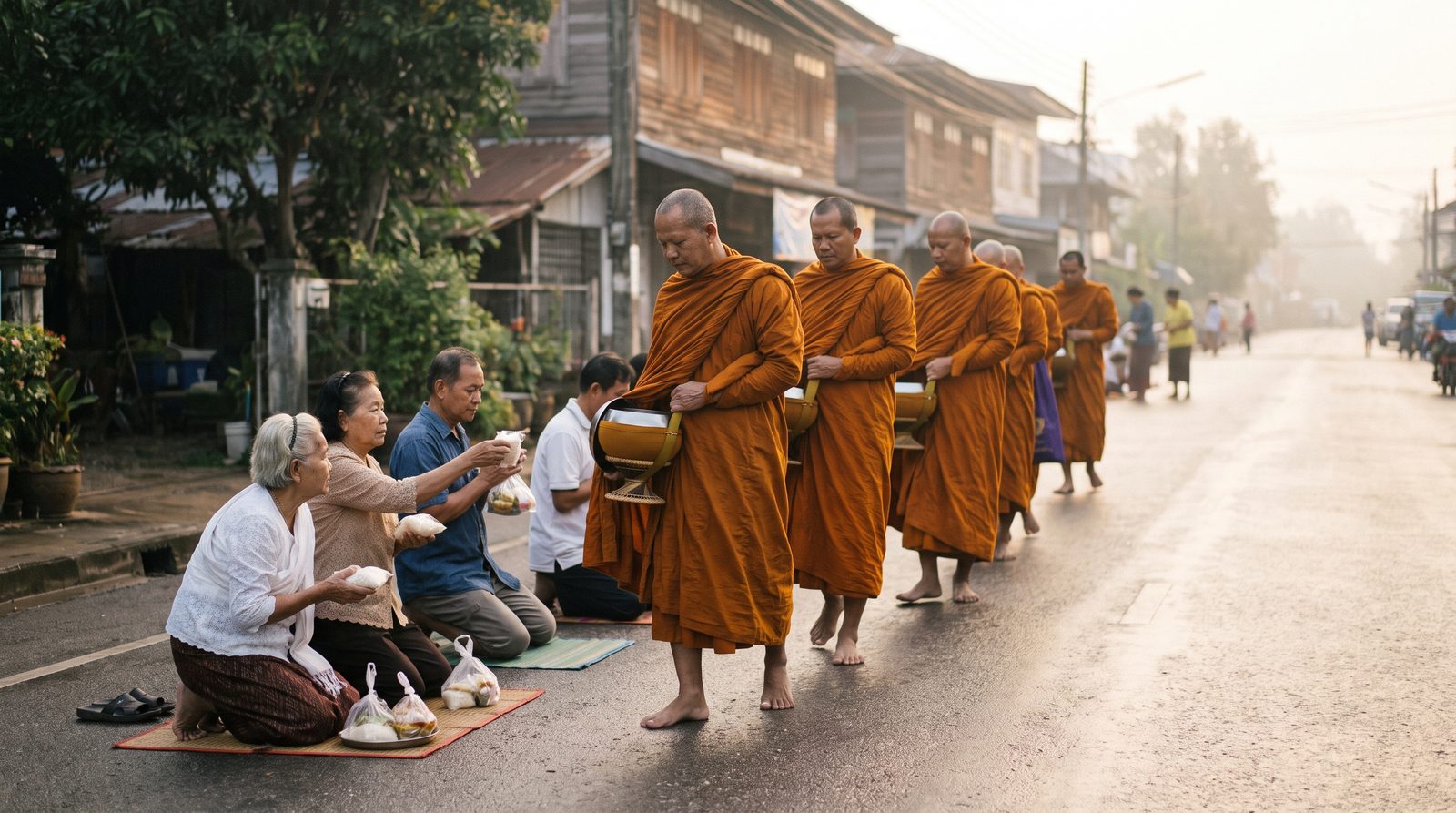
Thai pronouns and the politeness ladder
Thai has no single word for “I”. It has a ladder, and the rung you choose announces your gender, your age relative to the listener, and how formal the moment is.
- ผม (phom, rising tone) — “I” for male speakers. Safe everywhere.
- ดิฉัน (di-chan) — formal “I” for female speakers; offices, interviews, announcements.
- ฉัน (chan, rising tone) — everyday “I” for women, and casual generally.
- คุณ (khun, mid tone) — “you”, polite and always acceptable. Also the title before a first name: คุณสมชาย.
- ท่าน (than, falling tone) — a high-formality “you” for officials, monks and dignitaries.
In practice, Thai speakers often replace pronouns with kinship words: พี่ (phee) for someone a little older, น้อง (nong) for someone younger. Calling a waiter พี่ is friendlier than คุณ, and is what most Thais would actually say. Our guide to Thai family words works through that whole system.
The wai: when to return it, and when not to
The wai — palms together, head tipped forward — is a greeting, a thank-you and an apology depending on the moment. Three rules cover almost everything a visitor needs:
- The junior person wais first, and the senior returns it lower, sometimes with only a nod.
- The higher the hands, the more respect: fingertips at the chest for peers, at the nose for elders, at the forehead for monks and images of the Buddha.
- Do not wai service staff, children, or anyone clearly younger. A smile and a nod is the correct reply; a full wai back to a cashier reads as an over-correction, and a monk does not return a wai at all.
If you get the wai slightly wrong, nobody minds. Attempting it is read as respect, which is the entire point.
Softeners: the last five per cent
Once the particles and pronouns are automatic, two small words will do more for how you sound than another hundred vocabulary items.
- นะ (na, high tone) — a coaxing, softening tag. ไปนะครับ is “I’m off then, all right?” rather than a bare “I’m going”.
- หน่อย (noi, low tone) — literally “a little”, and the standard way to turn an order into a request: ขอน้ำหน่อยครับ — “may I have a little water”.
Notice that ขอ (khor, rising tone) is doing quiet work in that last example: it is the verb “to request”, and putting it in front of a noun is the politest way to ask for anything, from water to the bill. ขอ + the thing + หน่อยครับ is a template you can reuse for the rest of your life in Thailand. The site’s explainer on Thai particles goes further into how these endings stack.
Why the written form is worth learning too
Every word in this guide is short and high-frequency, which makes them ideal first targets if you also want to read Thai script. ครับ, ค่ะ and ขอ are two or three Thai letters each, and you will meet them on shop notices, in text messages and at the end of menus within your first week. Any Thai transliteration is a temporary crutch that will eventually mislead you about tone, so it pays to learn Thai alphabet shapes early. Our Thai alphabet chart lays out the consonants and vowels, and the free flashcard trainer drills them a few minutes at a time.
A study tip that actually works
Do not revise these words as a list. Revise them as pairs of people. Picture five specific relationships — the security guard in your building, a colleague ten years older, a friend your own age, a shopkeeper’s child, a monk at the local temple — and for each one decide in advance which pronoun you would use, whether you would wai, and whether the sentence ends in ครับ, in ค่ะ, or in nothing at all. Rehearse those five and you will have covered nearly every social situation you meet in a week.
That is the whole trick to learning to speak Thai politely: the vocabulary is tiny, and the real work is reading the room. Get the room right, and two syllables at the end of a sentence will do the rest.