Thai Market Words: Food, Prices and Weights in Thai
Learn Thai vocabulary the practical way: market food words, prices and weights in Thai script, four key sentences and the politeness rules that go with them.
The cheapest classroom in Thailand costs nothing to enter and opens at five in the morning. If you want to learn Thai vocabulary that you will actually use, the ตลาดสด (talat sot) — the fresh market — beats an app on almost every measure. The words repeat every single visit, the objects are sitting in front of you so nothing has to be translated, the prices are printed on cardboard as a free answer key, and the stakes of getting it wrong are about twenty baht. This guide gives you the vocabulary, the four sentences that carry most transactions, and the politeness rules that decide whether a vendor warms to you or just points at a calculator.
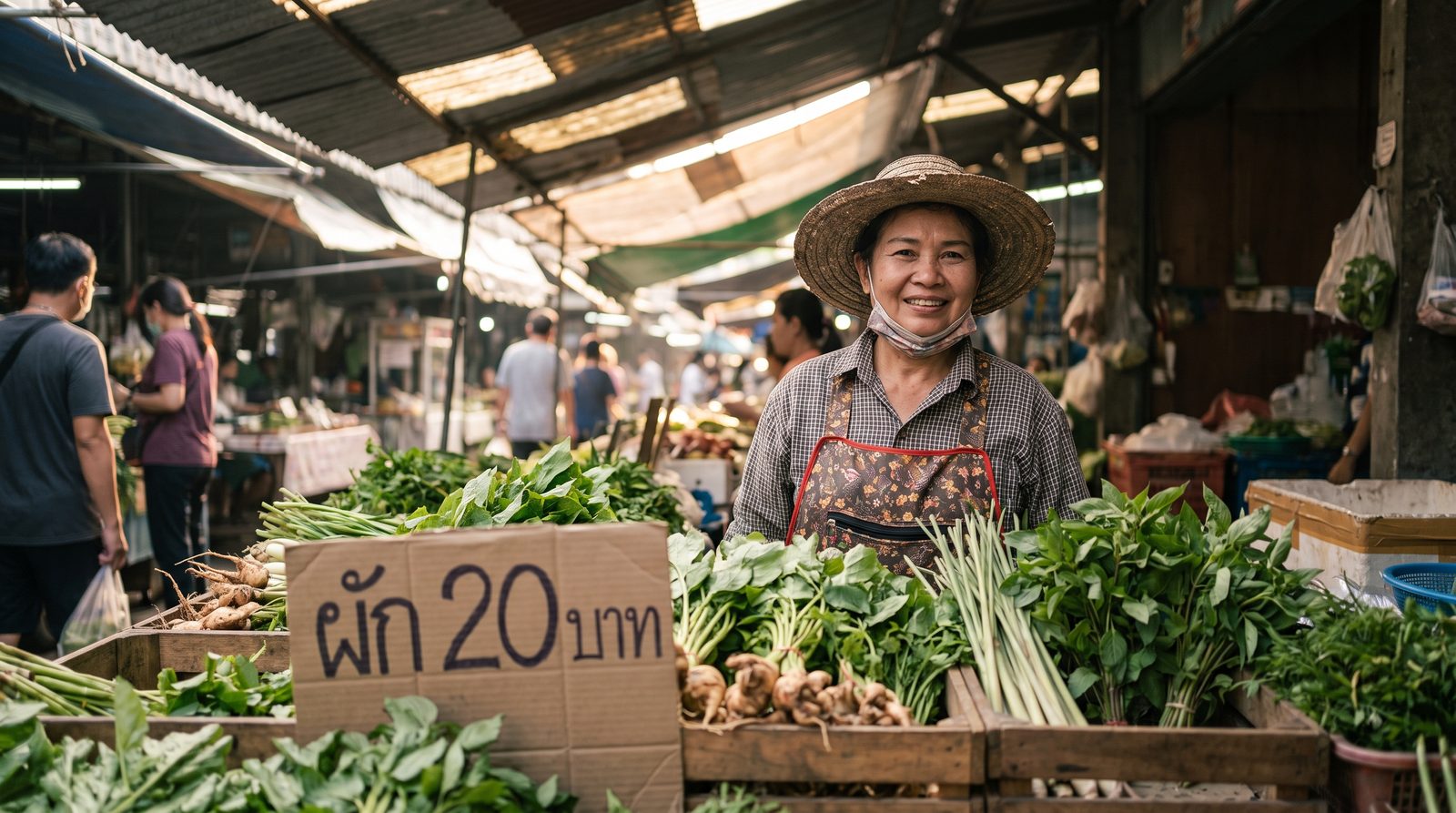
Start with the words written on the cardboard
Signs are the easiest place to begin a beginner Thai lesson, because they hold still. These five words appear on nearly every stall:
- ตลาด (talat, low tone) — market
- ตลาดสด (talat sot) — literally “fresh market”; the daily food market
- ตลาดนัด (talat nat) — literally “appointment market”; the weekend or set-day market where clothes and household goods appear
- บาท (baht, low tone) — baht, the currency; it closes almost every price
- กิโล (gi-lo) or just โล (lo) — kilogram
One unit catches out almost every foreigner: ขีด (kheet, low tone) is one hundred grams. Thai markets price small quantities of meat, chillies and herbs by the ขีด, so “สามขีด” (saam kheet) is 300 grams, not three of anything. Ask for a กิโล of bird’s eye chillies and you will be carrying home a bag you cannot finish in a year.
Prices themselves are usually written in Arabic numerals, but not always — handwritten signs still use Thai numerals, which are worth an hour of study on their own. Our guide to reading Thai numerals in the wild covers those shapes in detail.
Learn Thai vocabulary for the things actually in front of you
Do not learn a themed list of ninety food words. The fastest way to learn Thai vocabulary is to learn the twelve things you personally buy. Start here and add one item per visit:
| Thai | Pronunciation | English |
|---|---|---|
| ผัก | phak, low tone | vegetables |
| ผลไม้ | phon-la-mai | fruit |
| หมู | moo, rising tone | pork |
| ไก่ | gai, low tone | chicken |
| ปลา | bplaa, mid tone | fish |
| กุ้ง | goong, falling tone | prawn, shrimp |
| ไข่ | khai, low tone | egg |
| ข้าว | khao, falling tone | rice |
| มะม่วง | ma-muang | mango |
| เงาะ | ngo, high tone | rambutan |
| กล้วย | gluay, falling tone | banana |
| สับปะรด | sap-bpa-rot | pineapple |
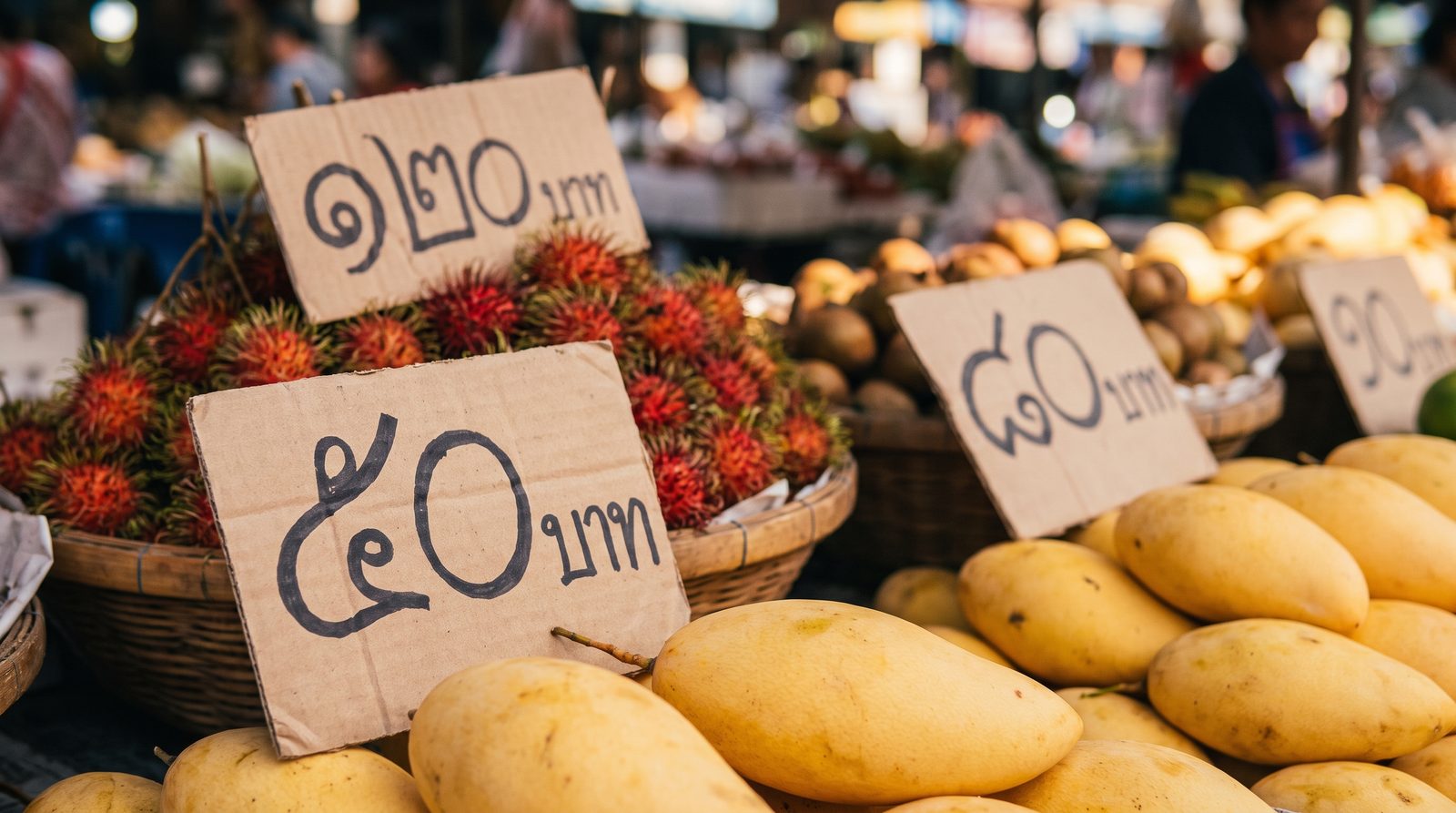
Four sentences that carry ninety percent of a transaction
You do not need conversational fluency to shop. You need four sentences, said clearly. Male speakers end with ครับ (khrap); female speakers with ค่ะ (kha).
- อันนี้เท่าไหร่ครับ (an-nee thao-rai khrap) — “How much is this one?” Point while you say it. This is the single most valuable sentence in the language.
- ขอครึ่งกิโลครับ (khor khrueng gi-lo khrap) — “Half a kilo, please.” ขอ (khor, rising tone) is the polite “may I have” that opens any request.
- ลดหน่อยได้ไหมครับ (lot noi dai mai khrap) — “Could you come down a little?”
- เอาแค่นี้ครับ (ao khae nee khrap) — “That’s all, thanks.” The signal that you are finished.
Two more worth having ready: ไม่เอาถุงครับ (mai ao thung khrap), “no bag, thanks”, which will earn you a genuinely pleased look, and แพงไป (phaeng bpai), “too expensive” — said with a smile, never a frown.
Thai pronunciation traps hiding in the food aisle
Market words are short, which means tone and aspiration do all the work. This is the part of learning Thai vocabulary that rewards slow, careful practice. Three pairs cause most of the confusion, and they are worth drilling before you go:
- ไก่ (gai) is chicken; ไข่ (khai) is egg. The difference is a puff of air. Hold a hand in front of your mouth: ไข่ should move it, ไก่ should not.
- หมู (moo, rising) is pork; หมา (maa, rising) is dog. Same tone, different vowel, extremely different order.
- ข้าว (khao, falling) is rice; ขาว (khao, rising) is white; ข่าว (khao, low) is news. Only the tone separates them.
This is exactly why Thai transliteration is a crutch you should plan to throw away. Written in the Latin alphabet those last three words are identical; written in Thai script they are visibly different, because the Thai letters themselves carry the tone — Thai consonants and vowels encode it directly. Working through the Thai alphabet chart and drilling the shapes on the free flashcard trainer pays for itself the first time a vendor understands you without a second attempt.
Politeness: who you are talking to changes the word
Thai does not have a neutral “excuse me” for strangers. You pick a kinship term based on the person’s apparent age relative to yours, which is why market Thai and family Thai are the same vocabulary:
- พี่ (phee, falling tone) — someone modestly older than you. The safe default for most vendors.
- ป้า (bpaa) and ลุง (lung) — a woman or man of your parents’ generation. Warm, not rude.
- น้อง (nong, high tone) — someone clearly younger.
So พี่ครับ อันนี้เท่าไหร่ครับ is a complete, polite opening: “Older sibling — how much is this?” The full system is set out in our guide to Thai family words. Dropping ครับ or ค่ะ is not offensive, but it lands the way a bare “how much” does in English: efficient and slightly cold. For anyone settling into Thailand expat language habits, attaching the particle automatically is the highest-value reflex you can build.
One note on bargaining, because visitors often overdo it. At a ตลาดสด the food prices are effectively fixed and already thin; haggling over ten baht of morning glory reads as mean rather than shrewd. At a ตลาดนัด, buying clothes, bags or souvenirs, a polite ลดหน่อยได้ไหม is entirely expected. Learn the difference and you will be treated as a regular rather than a tourist.
A study tip: one stall, one word, one week
The mistake is trying to learn Thai vocabulary in bulk and remembering none of it. Do the opposite. Each visit, buy one thing you have never bought before and get its name from the vendor — point, say อันนี้เรียกว่าอะไรครับ (an-nee riak waa a-rai khrap, “what is this called?”), and write the answer down in Thai script the same day, not in romanisation.
Twelve visits gives you twelve food words anchored to a real object, a real price and a real conversation, which is worth more than a hundred flashcards reviewed on a sofa. Photograph the price signs as you go; reading them back later is the single best way to learn Thai vocabulary and Thai numerals at the same time, and it costs you nothing but the walk to the market.