Learn Thai Vocabulary: Loi Krathong & Yi Peng Words Thailand
Learn Thai vocabulary for Loi Krathong and Yi Peng in Thailand: krathong, lantern and wish words in Thai script, with pronunciation and five real photos.
If you want to learn Thai vocabulary that you can use within the month, start here. Loi Krathong falls on the full moon of the twelfth lunar month — the night of 24–25 November in 2026 — and for about two weeks beforehand the whole of Thailand fills up with the same two dozen words. They are on stall signs, on banners across the road, on temple noticeboards and in every second conversation. Learn them now and the festival stops being a pretty blur and starts being something you can actually read and join in with.
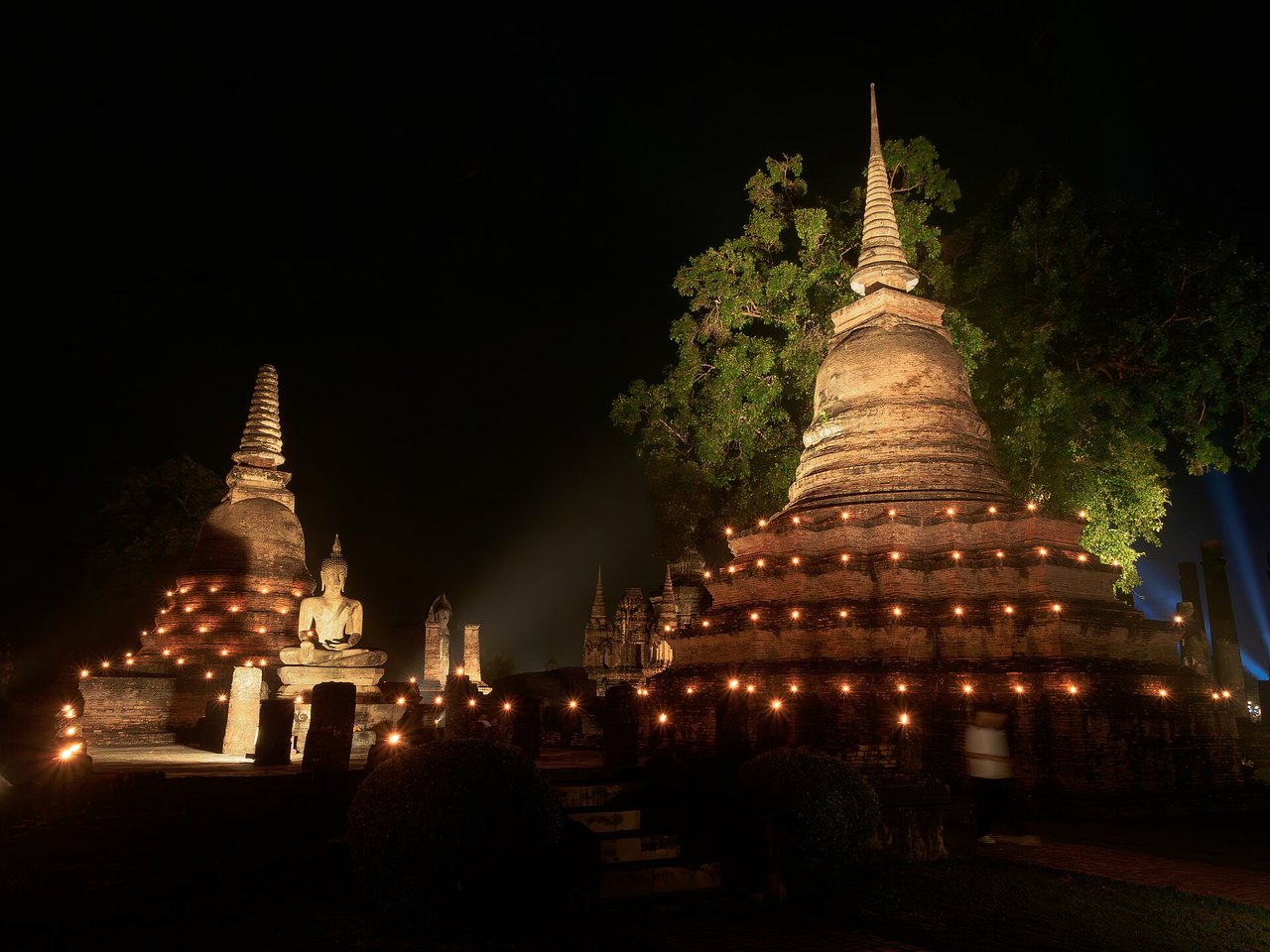
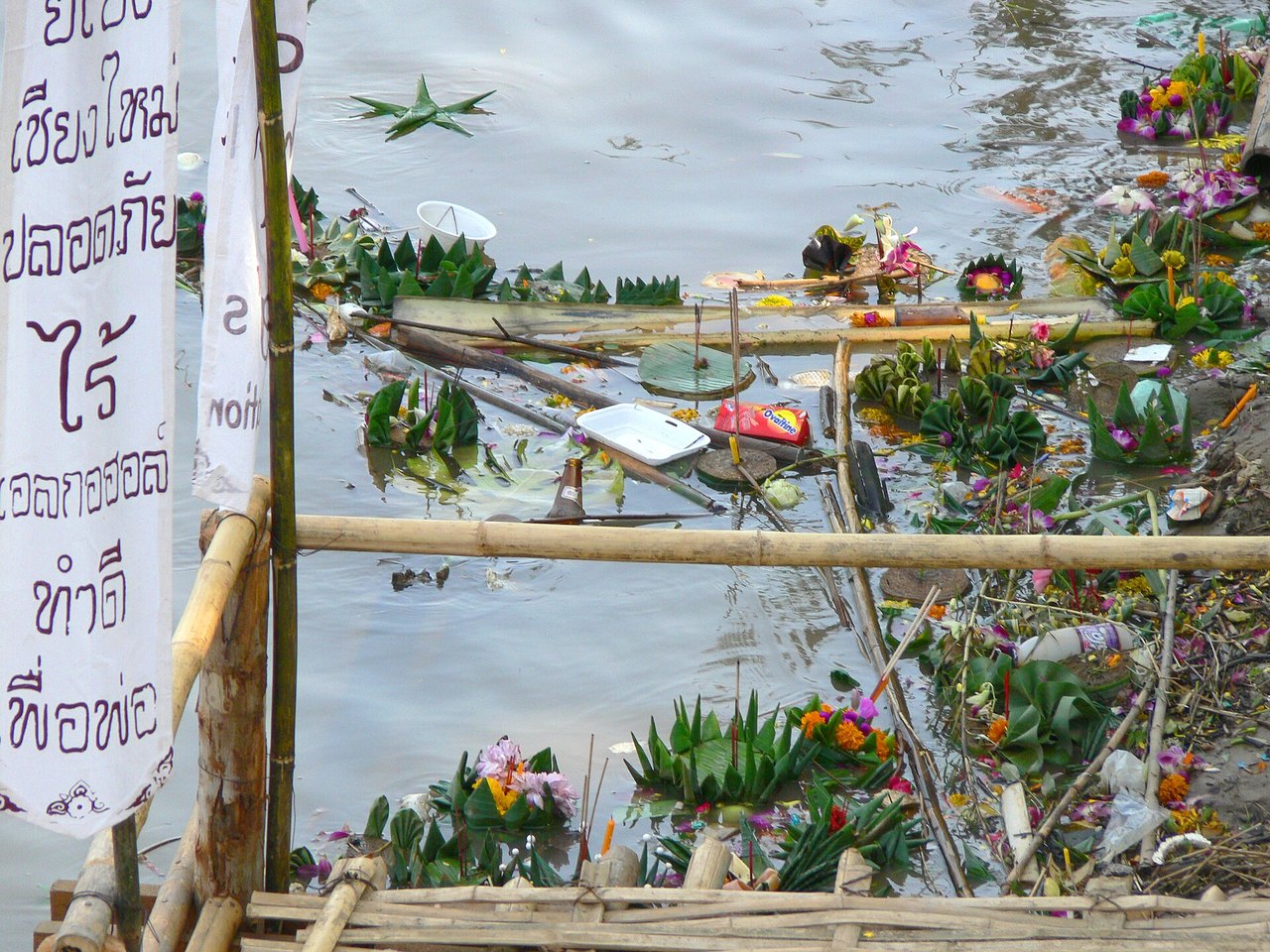
Everything below comes three ways: Thai script, a Thai transliteration you can say out loud, and the literal meaning, because with these particular words the literal meaning is the memory hook. Every photograph is a real one taken in Thailand — a family on a bamboo raft, a krathong on a boat table, the lantern field at San Sai, Sukhothai lit for the night, and the river the morning after.
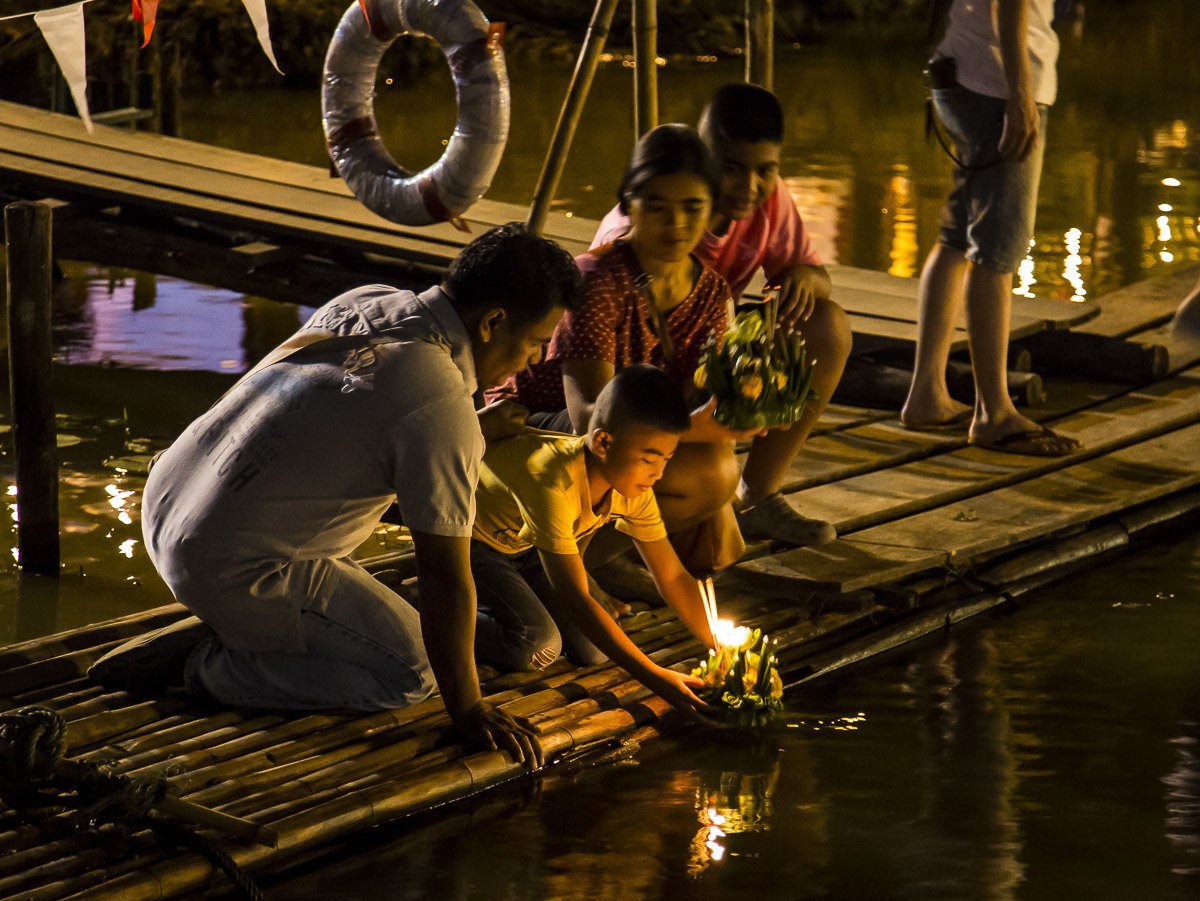
ลอยกระทง: the two words in the festival's name
The name is not a proper noun, it is a verb and its object, and taking it apart is the fastest beginner Thai lesson on this page.
- ลอย (loi) — to float. Mid tone, long vowel. The same word is used for anything drifting: a boat, a cloud, a lantern
- กระทง (grà-thong) — a small container made of folded leaves. Long before the festival, it was the word for a leaf cup you served food in
- วันลอยกระทง (wan loi grà-thong) — Loi Krathong day. วัน (wan) means “day”, and it starts the name of every festival and every weekday in Thai
So ลอยกระทง means, flatly, “float a leaf basket”. You will also see it romanised as Loy Krathong, Loi Kratong and Loy Krathong on posters in the same street, all of them correct, because Thai has no single official spelling in Latin letters — the reason our guide to Thai romanisation on road signs exists at all. Learn the Thai letters and the problem disappears: ลอยกระทง is spelled one way only.

Krathong parts: learn Thai vocabulary you can hold
This is the best kind of list to learn Thai vocabulary from, because you can pick every item up and turn it over. Buy a krathong from a street table for 30–60 baht, or make one at a hotel workshop, and name the parts as you go.
- ใบตอง (bai dtong) — banana leaf. ใบ is “leaf”, and it is also the classifier you count sheets and containers with
- หยวกกล้วย (yùak glûay) — the soft banana trunk used as the float’s base
- ดอกไม้ (dàwk máai) — flowers · ดอกดาวเรือง (dàwk daao-rueang) — marigold, literally “glowing-star flower”
- กล้วยไม้ (glûay máai) — orchid, literally “banana-wood”
- เทียน (thian) — candle · ธูป (thûup) — incense stick
- จุดเทียน (jùt thian) — to light the candle. จุด is the everyday verb for lighting a flame
- เหรียญ (rǐan) — coin. Many people tuck one in, and a nail clipping or a strand of hair, so that something of themselves goes with it
Two small notes that will save you from a puzzled stallholder. ดอกไม้ and กล้วยไม้ both end in ไม้ (máai, wood or plant), and they are easy to confuse with ไหม (mǎi), the little question word at the end of a sentence. That pair is pure tone, nothing else — if it sounds impossible right now, twenty minutes on our Thai tone marks guide is the fix, and it is the single highest-value hour of Thai pronunciation practice a beginner can do.
What to say at the water: speak Thai on the night
The floating itself is quiet and fairly quick, and only a handful of phrases are in play. Keep ครับ (khráp, if you are a man) and ค่ะ (khâ, if you are a woman) on the end of anything you say to a stranger — the politeness rule that runs through all of Thai manners.
- สุขสันต์วันลอยกระทง (sùk-sǎn wan loi grà-thong) — “Happy Loi Krathong”. The one greeting to have ready
- ขอโทษ (khǎw thôot) — sorry · ขอขมา (khǎw khà-mǎa) — to ask formal forgiveness, the word used for what the festival is for
- พระแม่คงคา (phrá mâe khong-khaa) — the goddess of water, literally “holy mother Ganges”
- อธิษฐาน (à-thít-thǎan) — to make a wish or a vow
- ลอยเคราะห์ (loi khrɔ́) — to float your bad luck away
- แม่น้ำ (mâe náam) — river, literally “mother water” · ตลิ่ง (dtà-lìng) — riverbank
The idea underneath the vocabulary is worth knowing too — context is what makes you learn Thai vocabulary rather than memorise it — because it explains why people look serious for a moment before they let go. The krathong is an apology to the water — for the year’s washing, drinking and dumping — and a way of sending off the year’s bad luck with it. Say thank you, say sorry, make a wish, push. If you want to say nothing at all, nobody minds.
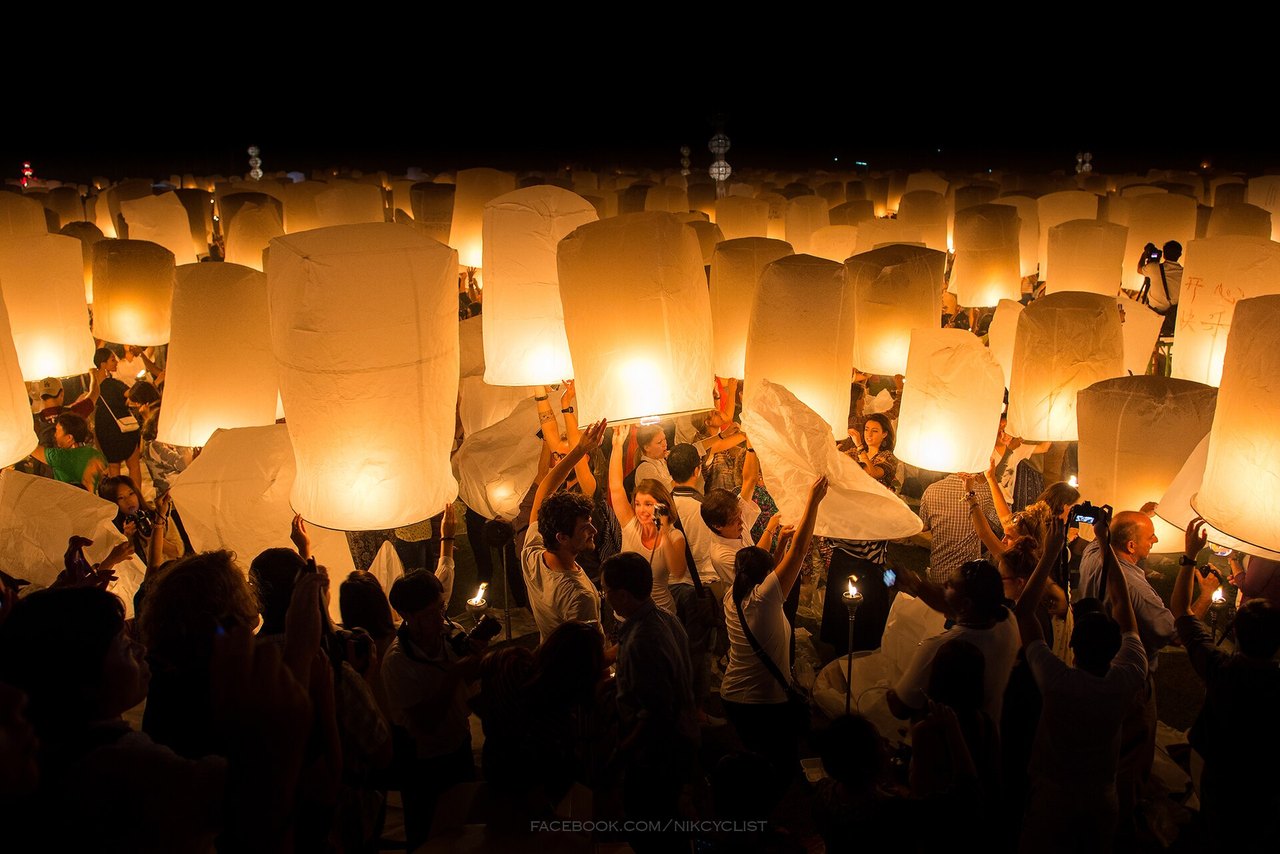
ยี่เป็ง and โคมลอย: the northern lantern words
Here is the distinction most visitors get wrong, and getting it right marks you out instantly. The lanterns in the sky and the baskets on the water are two different festivals that fall on the same full moon. In the north, in the old Lanna kingdom around Chiang Mai, the festival is ยี่เป็ง (yîi peng) — Lanna for “second month full moon”, because the old northern calendar counted the months differently.
- โคม (khoom) — lantern · โคมลอย (khoom loi) — sky lantern · โคมไฟ (khoom fai) — a hanging lamp or lantern
- ปล่อยโคม (bplàwy khoom) — to release a lantern. ปล่อย is “to let go”, and you will meet it again on signs about dogs and boats
- ล้านนา (láan-naa) — Lanna, the northern kingdom, literally “a million rice fields”
- พระจันทร์เต็มดวง (phrá jan tem duang) — full moon · เทศกาล (thêet-sà-gaan) — festival · งานวัด (ngaan wát) — temple fair
One practical warning in plain Thai: sky lanterns are tightly controlled near airports, and every November there are notices reading ห้ามปล่อยโคมลอย (hâam bplàwy khoom loi) — “releasing sky lanterns prohibited”. ห้าม (hâam) is the single most useful word to read Thai script for anywhere in Thailand, and our guide to Thai warning and no-entry signs is built around it. Release lanterns only at a licensed event, on the nights the city sets.
Reading the festival: Thai script on signs and banners
November is the easiest month of the year to practise reading, because the same phrases are repeated on a thousand banners and you already know what they say. That is exactly the condition you want when you are training recognition rather than translation. Cover the English, read the Thai, check yourself. If the shapes are still slow, keep our free Thai alphabet chart on your phone — the quickest way to learn Thai alphabet forms and the Thai consonants and vowels that make them — and drill them afterwards in the ThaiLetters flashcard trainer.
Four phrases cover most banners: เทศกาลลอยกระทง (Loi Krathong festival), ประเพณี (bprà-phee-nii, tradition), ขบวนแห่ (khà-buan hàe, procession) and ประกวดนางนพมาศ (bprà-gùat naang nóp-phá-mâat), the Nang Nopphamat pageant named after the legendary court lady credited with the first krathong. Dates are given in the Buddhist era, so a banner saying ๒๕๖๙ means 2026 — our Thai Buddhist date calculator converts both ways.
The morning-after words every expat ends up using
That photograph is the part of the festival the brochures leave out, and it has produced its own small vocabulary. It is useful enough to turn up in ordinary Thailand expat language all year round, so learn Thai vocabulary from this group even if you never float anything.
- ขยะ (khà-yà) — rubbish · เก็บขยะ (gèp khà-yà) — to pick up rubbish
- ย่อยสลายได้ (yôi sà-lǎai dâai) — biodegradable, literally “able to break down”
- โฟม (foom) — polystyrene foam, the material banned from krathongs in most cities
- กระทงขนมปัง (grà-thong khà-nǒm bpang) — a bread krathong, which the fish eat
- สิ่งแวดล้อม (sìng wâet-láwm) — the environment
If you buy one on the night, the useful question is ทำจากอะไรครับ/คะ (tham jàak à-rai khráp/khá) — “what is it made of?”. Answers you want to hear are ใบตอง or ขนมปัง. One krathong per family is the normal, quiet custom, and in many towns it is now encouraged outright.
A study tip: learn it the week before, not on the night
Here is the method that works. Pick five words from this page — ลอย, กระทง, เทียน, ธูป, ใบตอง — and use them out loud this week, at the stall where you buy fruit, with the woman folding leaves outside the temple, with a colleague. Five words said badly to a real person will stick harder than fifty read silently, and in the weeks around the festival every Thai you try them on knows exactly what you are attempting.
Then go to the water on the night with nothing to look up. You will hear สุขสันต์วันลอยกระทง a dozen times before you reach the bank, and because you already own the words, you will hear them as words instead of music. That is the whole trick to learn Thai vocabulary properly in Thailand: meet the word on a page first, then meet it in the street a few days later. If this one worked for you, our guides to Thai festival and calendar words and temple and wat signs use exactly the same method on the rest of the Thai year.