Read Thai Script in Thailand: Warning & No-Entry Signs
Read Thai script on Thailand's warning signs: decode haam, rawang and garuna on real photos, with Thai pronunciation, transliteration and literal translations.
Thailand is a country that tells you what not to do, and it almost always starts the sentence the same way. Learn to read Thai script well enough to recognise one four-letter word at the front of a line and you have already understood half of every prohibition sign in the country — the rest is just a verb. This beginner Thai lesson takes five real signs photographed in Thailand and pulls them apart character by character, with Thai script, Thai pronunciation and literal English translations, so that red paint on a Bangkok wall stops being decoration and starts being a sentence.
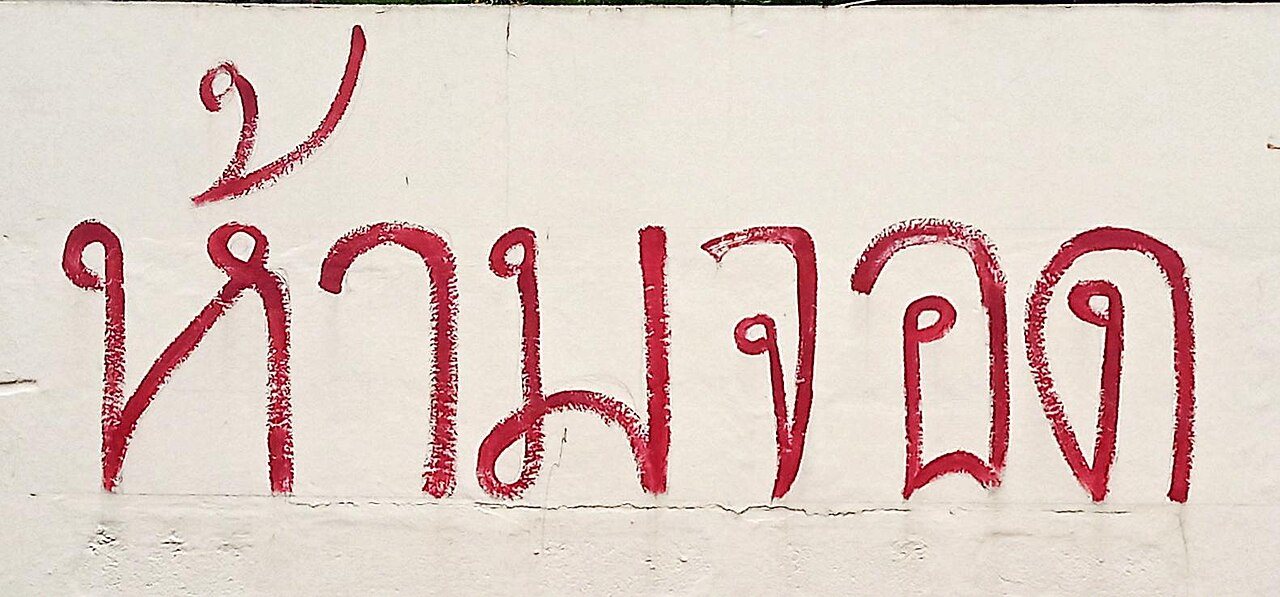
One Thai word does all the forbidding: ห้าม
ห้าม (hâam) means “to forbid”. Thai does not bolt a “no” onto a noun the way English does with no parking; it simply puts the ban in front of the action. The pattern could not be simpler:
ห้าม + the thing you must not do
- ห้ามจอด — hâam jɔ̀ɔt — “forbid park”, no parking
- ห้ามเข้า — hâam khâo — “forbid enter”, no entry, staff only
- ห้ามถ่ายรูป — hâam thàai rûup — “forbid take-picture”, no photography
- ห้ามจับ — hâam jàp — “forbid touch”, do not handle
- ห้ามทิ้งขยะ — hâam thíng khà-yà — “forbid throw rubbish”, no littering
- ห้ามสูบบุหรี่ — hâam sùup bù-rìi — “forbid smoke cigarette”, no smoking
One thing trips up every beginner: Thai puts no spaces between words. ห้ามจอด looks like a single six-character blob, and your eye has to learn to slice the first four off the front. The good news is that you only have to learn the slice once. After a week in Thailand you will see ห้าม coming the way you see a red octagon at a junction.
Learn the Thai alphabet inside one word
ห้าม is four pieces of the Thai writing system in a row, and they are four of the most useful pieces there are:
- ห — hɔ̌ɔ hìip — the consonant h, and a high-class letter, which matters for the tone
- ้ — mái thoo — the second tone mark, the little curl that sits above the line
- า — sà-rà aa — the long vowel aa, written to the right of its consonant
- ม — mɔɔ máa — the consonant m, closing the syllable
Put them together and you get a falling tone: hâam, said like you are disappointed in someone. That falling tone is not decoration — a high-class consonant carrying mái thoo always falls, and that one rule will correctly pronounce hundreds of Thai words for you. If the classes and tone marks are still a fog, our free Thai alphabet chart lays out all the Thai letters, consonants and vowels with Thai pronunciation for each, the guide to Thai tone marks explains the rule above in full, and the flashcard trainer will drill these four characters in an afternoon.
The sign you will meet most in Thailand: no smoking
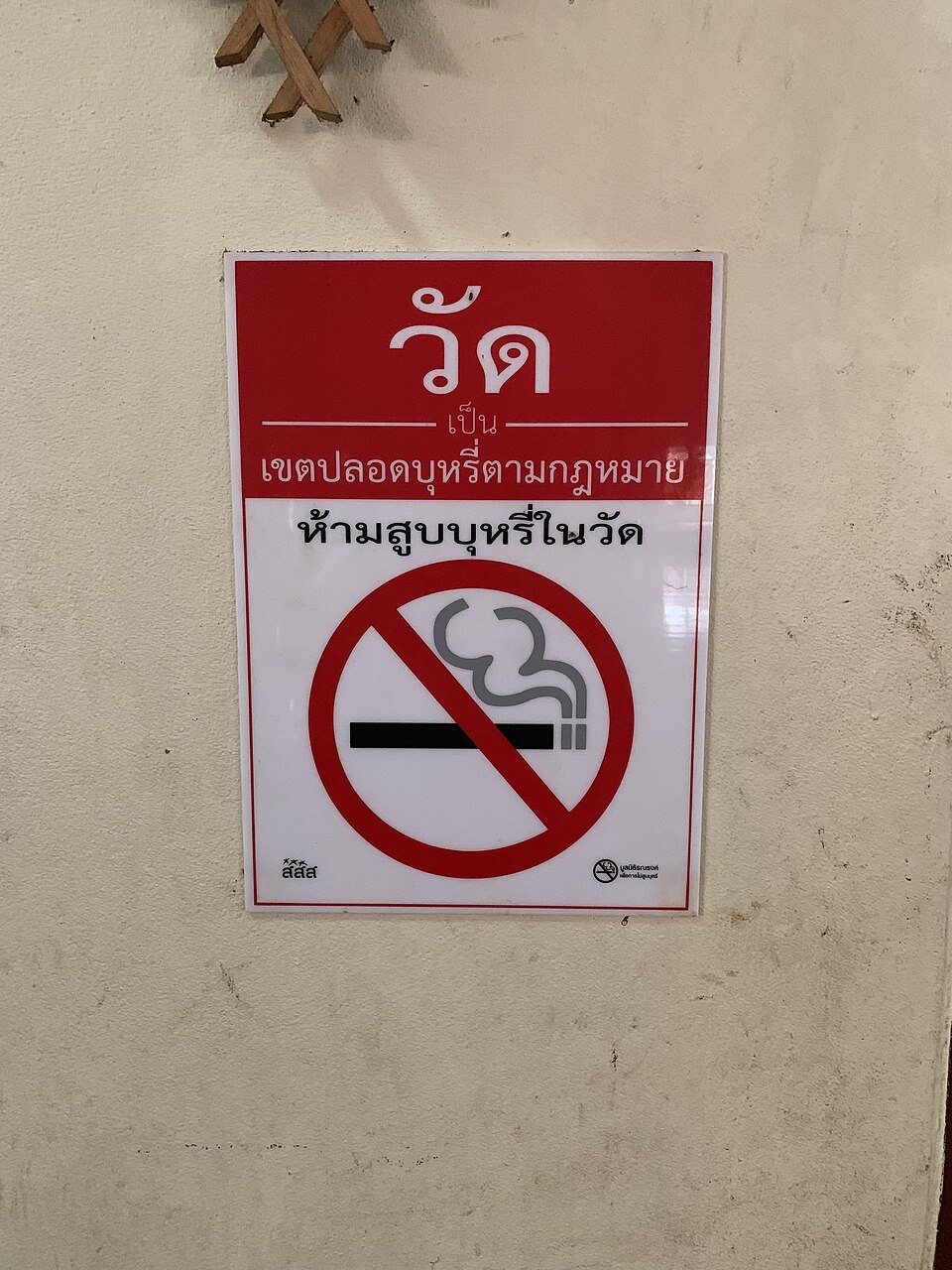
Thailand's smoking rules are strict and enforced, so if you only ever learn to read Thai script on one sign, make it this one. The temple version above stacks three lines, and each one is worth having:
- วัด — wát — temple
- เขต — khèet — zone, district
- ปลอด — bplɔ̀ɔt — free of, safe from
- ตามกฎหมาย — dtaam gòt-mǎai — according to the law
- ใน — nai — in, inside
So the red band reads วัดเป็นเขตปลอดบุหรี่ตามกฎหมาย — literally “temple is zone free-of cigarette according-to law” — and the white band underneath gives the plain instruction, ห้ามสูบบุหรี่ในวัด, “no smoking in the temple”. Thai signage loves this two-step: the legal framing first, the human instruction second.
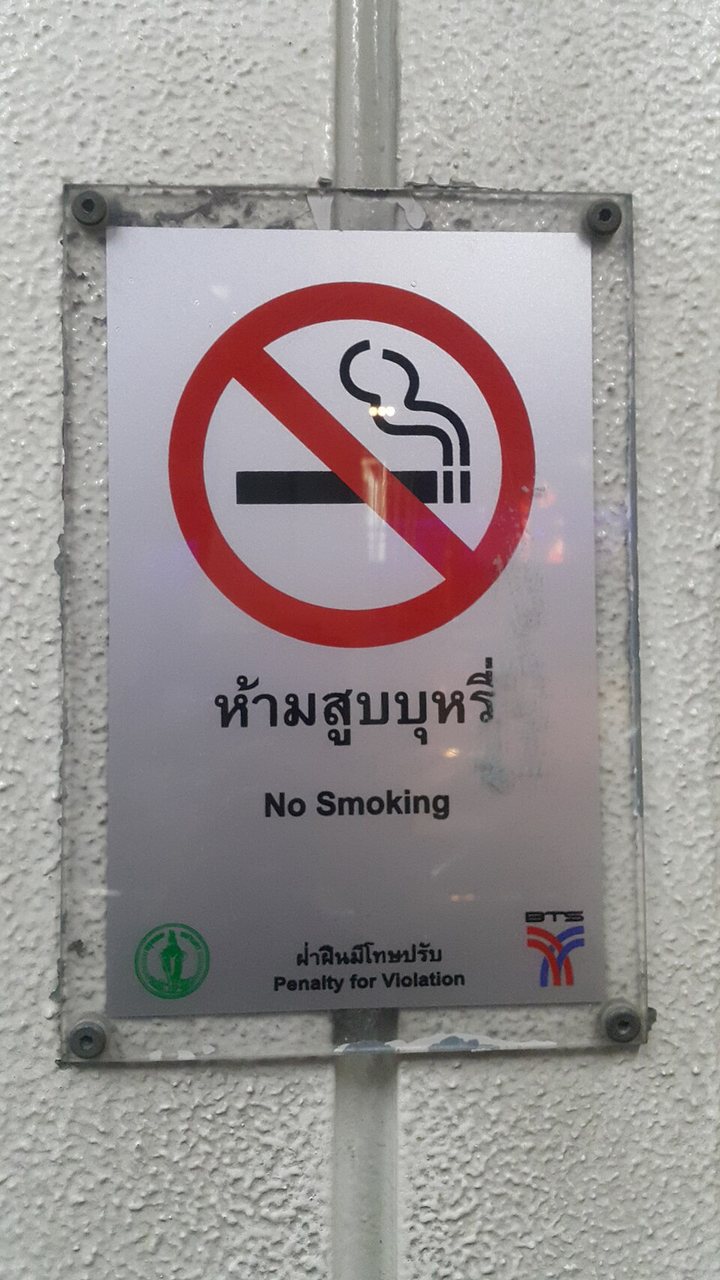
The small print that costs money
The line at the bottom of the Skytrain sign, ฝ่าฝืนมีโทษปรับ (fàa-fʉ̌ʉn mii thôot bpràp), is four words that appear on signs all over Thailand: ฝ่าฝืน is “to violate”, มี is “to have”, โทษ is “punishment” and ปรับ is “a fine”. If you see a number followed by บาท (bàat) nearby, that number is what it will cost you.
Yellow signs warn, red signs forbid: ระวัง
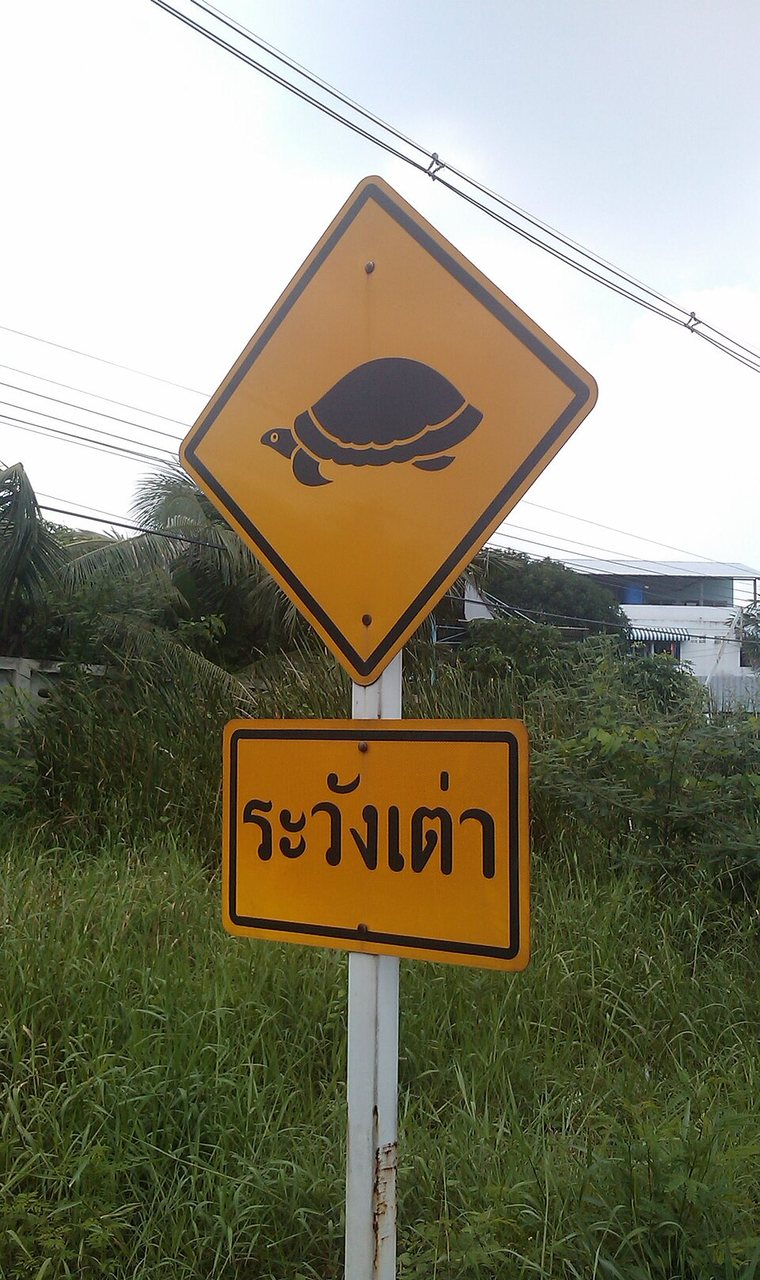
Not every sign is a ban, and a learner who can read Thai script well enough to tell the two colours apart is already safer on the road. The yellow diamonds carry ระวัง (rá-wang), “be careful of”, and it works exactly like ห้าม — whatever follows it is the hazard. This is one of the friendliest patterns in the language for a learner, because the second word is almost always a concrete noun you can look up:
- ระวังสุนัข — rá-wang sù-nák — beware of the dog
- ระวังลื่น — rá-wang lʉêʉn — caution, slippery — the wet-floor cone in every mall
- ระวังศีรษะ — rá-wang sǐi-sà — mind your head
- ระวังรถไฟ — rá-wang rót fai — beware of the train
- ระวังกระเป๋า — rá-wang grà-bpão — watch your bag
Shouted rather than written, ระวัง is also what someone will call out when you are about to walk into a motorbike. Learn it as a spoken word as well as a written one.
The polite register: กรุณา and โปรด
Thai has a softer way of telling you what to do, and the difference in register is something foreigners should notice, because it tells you who is speaking to you. กรุณา (gà-rú-naa) and the more formal โปรด (bpròot) both mean “please” in the sense of a polite request:
- กรุณาถอดรองเท้า — gà-rú-naa thɔ̀ɔt rɔɔng tháo — please remove your shoes
- โปรดเงียบ — bpròot ngîap — please be quiet
- กรุณารอสักครู่ — gà-rú-naa rɔɔ sàk khûu — please wait a moment
Here is the practical point for anyone living the Thailand expat language life: ห้าม is institutional. It is what a government, a temple or a landlord says to the public. You should read it constantly and say it almost never. Telling a Thai person ห้าม to their face is blunt to the point of rudeness unless you are a parent, a teacher or a police officer. When you need someone to stop doing something, reach for กรุณา instead, and finish the sentence with the politeness particle: ครับ (khráp) if you are a man, ค่ะ (khâ) if you are a woman. The particle goes on the end of the whole utterance, and with strangers and staff it is close to compulsory.
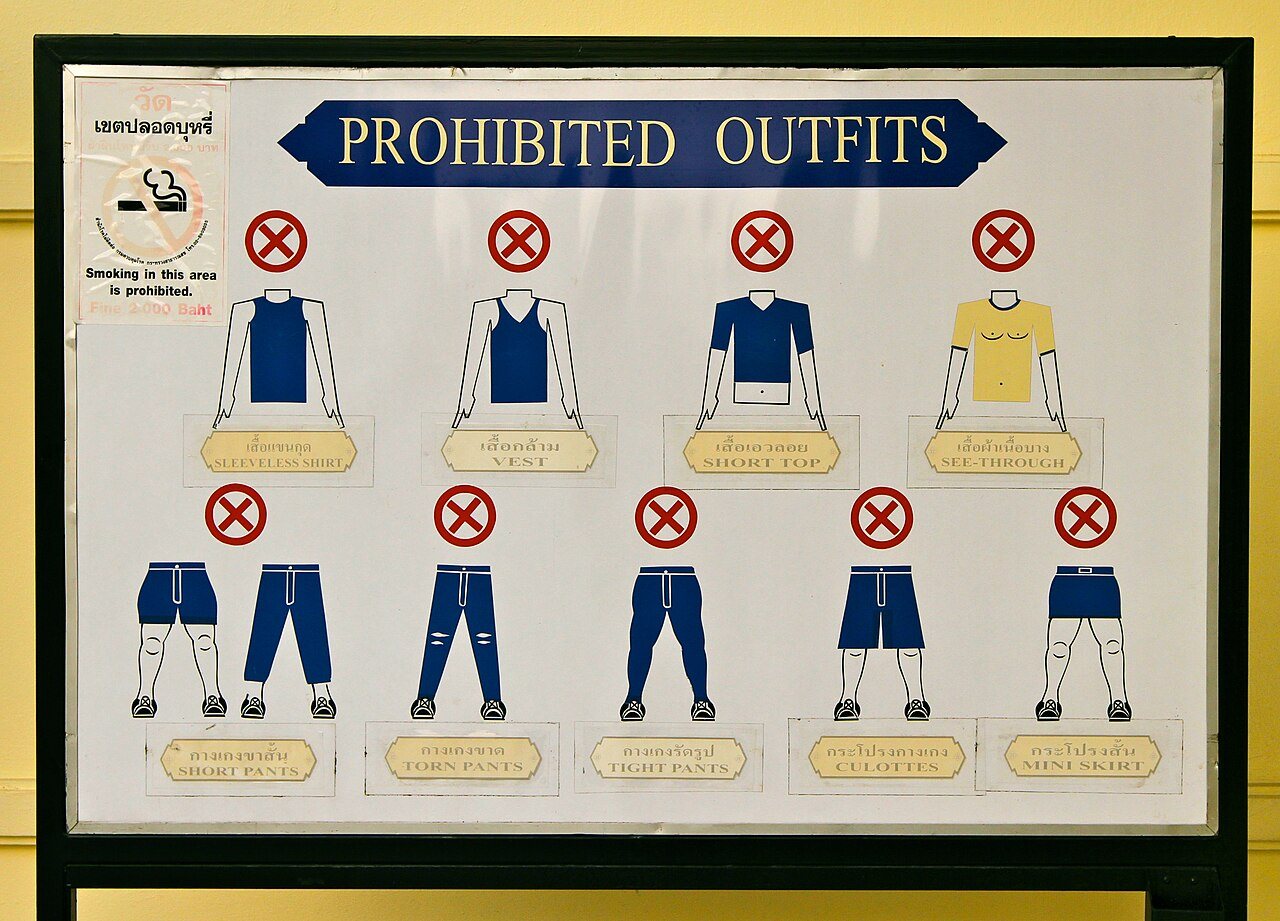
Bonus vocabulary: a dress-code board
Temple and palace entrances post boards like the one above, and they are a gift to anyone learning to read Thai script, because the Thai and the English sit side by side. เสื้อ (sʉêa) is a top, กางเกง (gaang-geeng) is trousers and กระโปรง (grà-bproong) is a skirt. Then the describing word follows the thing it describes, which is the normal Thai order: กางเกงขาสั้น (gaang-geeng khǎa sân) is “trousers leg short”, and กางเกงขาด (gaang-geeng khàat) is “trousers torn”.
Say it, don't just read it
Reading a ban is one thing; asking whether something is allowed is the phrase that actually saves you. Thai does it with ได้ไหม (dâai mǎi), “can I?”, tacked onto the end of the action:
- ถ่ายรูปได้ไหมครับ — thàai rûup dâai mǎi khráp — “may I take a photo?”
- จอดตรงนี้ได้ไหมคะ — jɔ̀ɔt dtrong níi dâai mǎi khá — “can I park here?”
- ได้ / ไม่ได้ — dâai / mâi dâai — “you can” / “you can't”, the two answers you will get
If the answer is ไม่ได้, accept it cheerfully and move on. Thai social life runs on not making anyone lose face, and a guard who has said no twice is not going to say yes the third time.
A study tip for learning to read Thai script
Do not try to memorise a list of signs. Learn two words cold — ห้าม and ระวัง — until you can spot them at ten metres from a moving tuk-tuk. Then let Thailand supply the rest. Every sign that starts with one of those two words hands you a free, correctly spelled vocabulary card, with a pictogram underneath to mark your own answer.
Give yourself one job on your next walk: photograph every red or yellow sign you pass, and that evening write out only the word that comes after ห้าม or ระวัง. Ten signs is ten verbs and nouns you will meet again tomorrow, learned in context and anchored to a real place — which is why people who learn to read Thai script on the street remember it, and people who only learn it from an app do not.