Thai Temple Words: Reading Wat Signs and Merit Terms
Read Thai script at any Thai temple: the wat words, entrance signs and merit vocabulary in Thai letters, transliteration and literal English, plus a study plan.
A Thai temple is the best free classroom in the country. Every วัด has its rules, its buildings and its donation boxes labelled in Thai — and unlike a restaurant menu, nobody is standing over you waiting for an order while you sound the letters out. If you want to read Thai script somewhere real, at a pace you control, a temple courtyard is where to start. This guide gives you about forty words you will see on temple signs and hear in temple conversation: Thai script, plain Thai transliteration, and the literal meaning that makes each one stick. It also explains the one spelling quirk that makes temple vocabulary look far harder than it actually is.
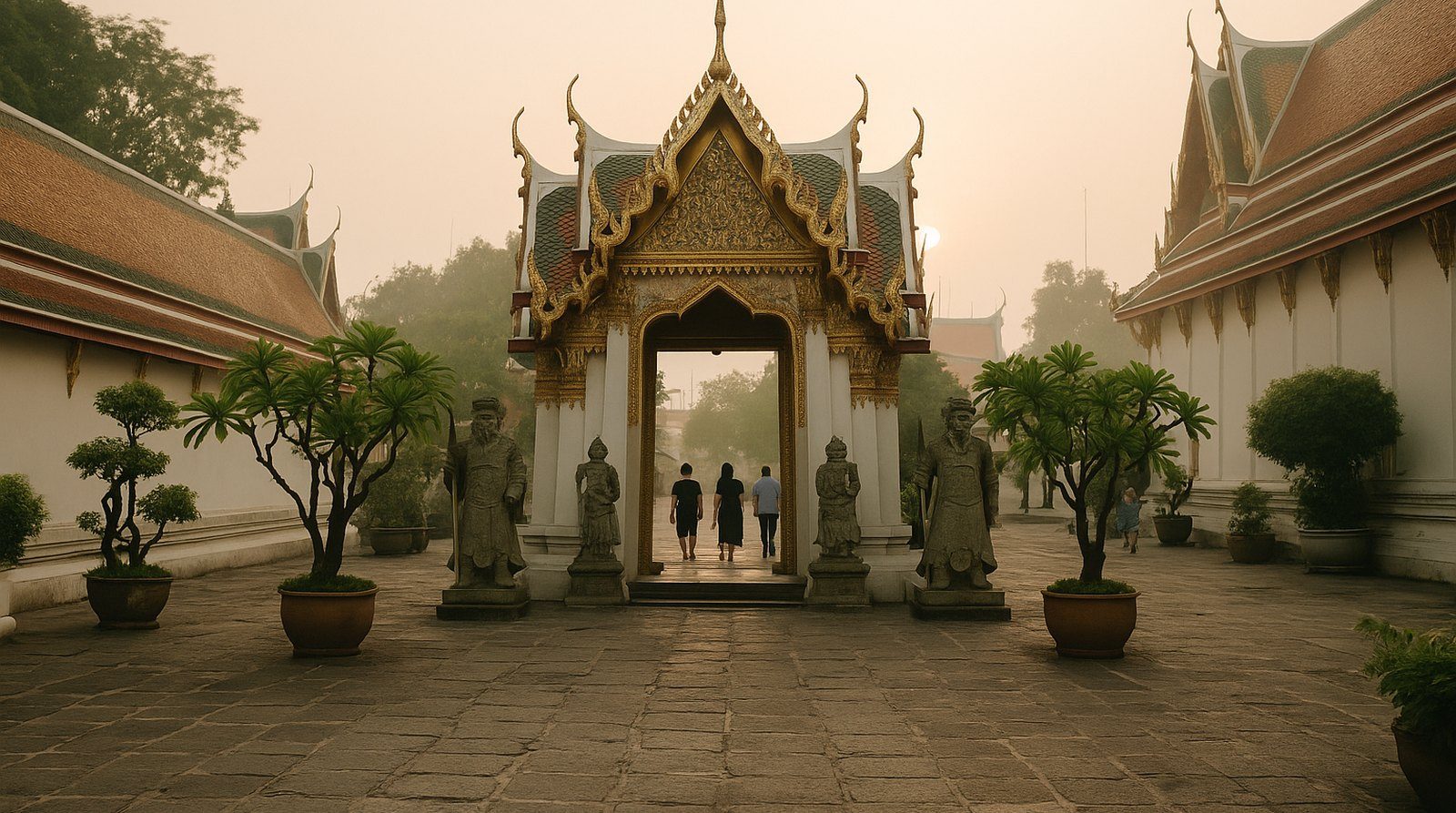
Read Thai script on the gate itself
วัด (wat, high tone) is three Thai letters — ว, the vowel ั and ด — and it means temple, or more precisely the whole walled monastery compound: halls, stupas, monks' quarters, stray dogs and all. It opens the name of almost every temple in Thailand, in exactly the same position that ถนน (tha-non) opens the name of almost every road. So วัดโพธิ์ is Wat Pho, วัดอรุณ is Wat Arun, and the moment you can read those three letters you can read the first word of a few thousand signs. That is the whole trick to learning to read Thai script in public: find the word that repeats, and let it carry you.
Learn it with its two closest neighbours and you have the whole religious frame:
- วัด (wat) — temple compound.
- พระ (phra) — monk, and the honorific prefix stuck to anything sacred. Worth recognising on sight.
- พระพุทธรูป (phra-phut-tha-ruup) — Buddha image; literally “sacred Buddha form”.
Two words that unlock every temple sign
Thai public signage is built from a small vocabulary of instruction words, and temples use them more than anywhere else. Learn these two and the rest of the sign becomes a guessing game you can usually win:
- ห้าม (haam, falling tone) — forbidden. Whatever follows it is the thing you must not do.
- กรุณา (ga-ru-naa) — please, in the formal written sense. Whatever follows it is a polite request. You will also see โปรด (bproht), which does the same job.
Now the signs themselves. These six cover the overwhelming majority of what is posted at a temple entrance:
| Thai | Pronunciation | Literal meaning |
|---|---|---|
| กรุณาถอดรองเท้า | ga-ru-naa thot rong-thao | “Please remove shoes.” รองเท้า is literally “support-foot”. |
| แต่งกายสุภาพ | dtaeng gaai su-phaap | “Dress politely.” Shoulders and knees covered. |
| ห้ามถ่ายรูป | haam thaai ruup | “No photography.” Common inside ordination halls. |
| ห้ามสูบบุหรี่ | haam suup bu-rii | “No smoking.” |
| ห้ามเข้า | haam khao | “No entry.” Often on monks' quarters. |
| ทางเข้า / ทางออก | thaang khao / thaang ork | “Way in” / “way out”. |
The politeness is in the grammar, not just the tone
Notice that Thai signs do not shout. กรุณา at the front of a sentence is the written equivalent of the particles ครับ (khrap, male speaker) and ค่ะ (kha, female speaker) that you attach when you speak. Leaving those off sounds curt in a place where nobody is ever curt — our guide to Thai politeness particles covers when each one changes shape.
Why temple words are full of silent Thai letters
Here is what trips up every learner in a temple and almost nowhere else. Temple vocabulary came into Thai from Pali and Sanskrit, and Thai kept the original spellings even after it stopped pronouncing the ends of the words. So the writing system added a small hook above the offending letter — ์, called than-tha-khaat or gaa-ran — meaning “this letter is silent”.
- โบสถ์ (boht) — the ordination hall. Spelled with a final ถ that you do not say, from Pali uposatha.
- เจดีย์ (jay-dee) — the bell-shaped stupa. The final ย is silenced, from Pali cetiya.
- วัดโพธิ์ (wat poh) — Wat Pho. Two letters at the end, both silent.
This is good news. It means that when you learn Thai letters you are not learning a broken system — you are learning one that flags its own exceptions. Once you know the hook means “stop reading here”, long temple names collapse into short, sayable words, and you can read Thai script that looked impossible ten minutes earlier. It is the same historical layer that makes Thai transliteration on signage look so strange, which we unpack in our guide to Thai romanisation on road signs.
Temple name plaques are the best place to hunt for that hook. Scan the end of each word first: if the mark is there, drop the letter under it and the name is suddenly shorter than it looked.
The buildings inside the wat
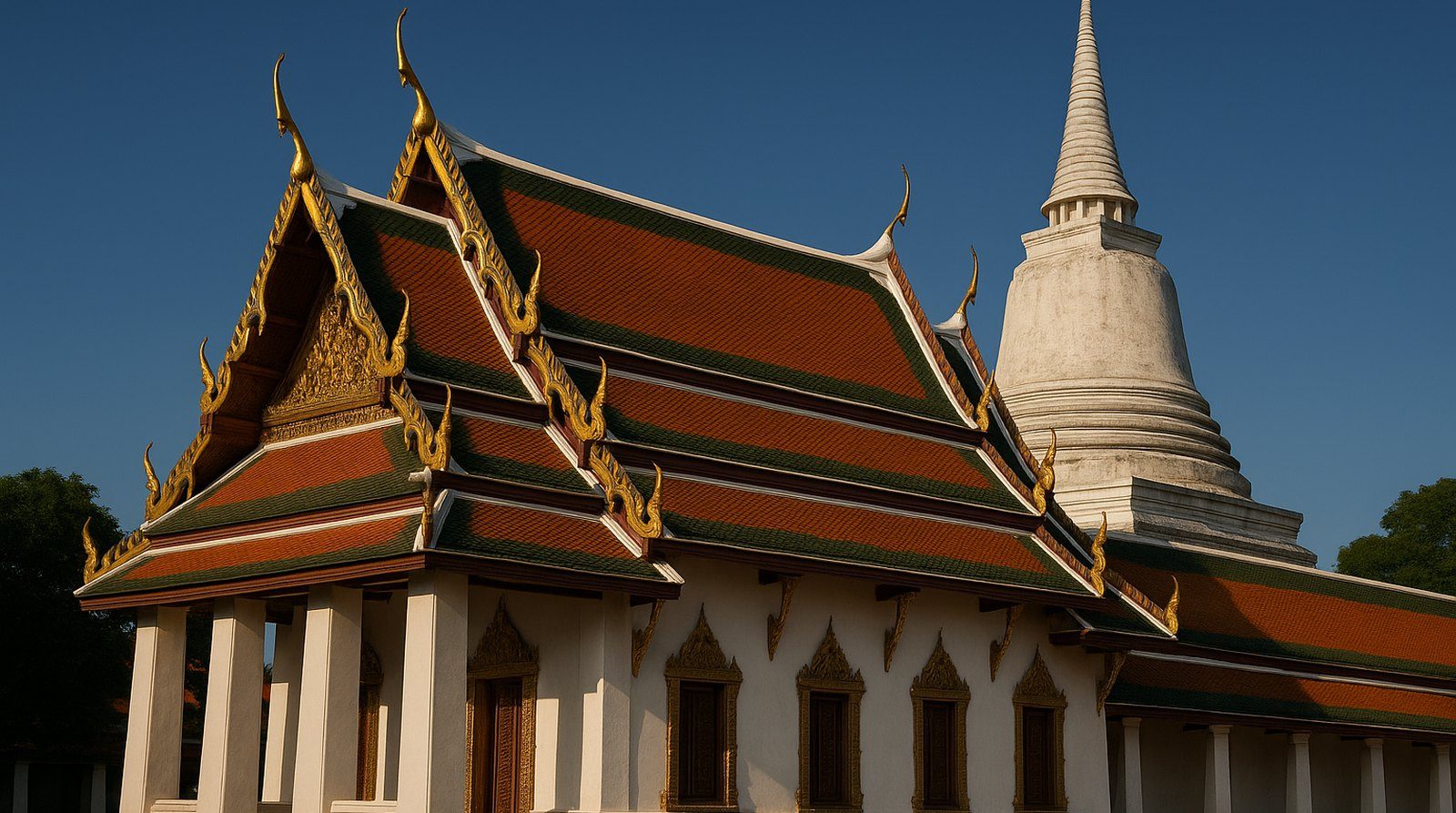
A wat is a compound, not a building, and each structure is labelled. Learning these turns an aimless wander into a beginner Thai lesson with a map:
- โบสถ์ (boht) — the ordination hall, the most sacred building. Marked at its corners by boundary stones.
- วิหาร (wi-haan) — the assembly hall, usually where the main Buddha image sits and where visitors are welcome.
- เจดีย์ (jay-dee) — the stupa or chedi, the tapering tower.
- ศาลา (saa-laa) — open-sided pavilion, for shade, ceremonies and waiting.
- กุฏิ (gu-dti) — the monks' living quarters. This is the building the ห้ามเข้า sign is usually attached to.
- ตู้บริจาค (dtuu bor-ri-jaak) — donation box; literally “cabinet of donation”.
Monks, novices and how to address them
Thai social language runs on relative status, and inside a temple that hierarchy is explicit rather than implied. A few words keep you on the right side of it:
- พระ (phra) — a fully ordained monk.
- สามเณร (saam-ma-nen), shortened to เณร (nen) — a novice, typically a boy or teenager.
- หลวงพ่อ (luang phor) — literally “royal father”, the warm and respectful way to refer to a senior monk.
- พระอาจารย์ (phra aa-jaan) — “monk teacher”, for a monk who instructs.
- แม่ชี (mae chee) — a white-robed nun.
One rule no sign will spell out: women do not hand objects directly to a monk. Place the item down, or pass it via a man or a cloth the monk holds out. This is monastic discipline, not a slight, and Thai people quietly appreciate a visitor who already knows it. For anyone settling in, this unwritten context is the real Thailand expat language curriculum — the words are the easy half.
Merit words: what everyone around you is actually doing
If you can attach these five words to what you can see, temple visits stop being scenery and start being comprehensible:
- ทำบุญ (tam bun) — to make merit; literally “to do good”. This is the umbrella term for almost every activity in the compound.
- ไหว้ (wai, falling tone) — the palms-together gesture of respect, and the verb for doing it.
- ธูป (thuup) — incense stick, usually held in threes.
- เทียน (thian) — candle.
- ดอกไม้ (dok-mai) — flowers, generally a lotus bud here.
Those last three travel together: ธูปเทียนดอกไม้ is the standard offering set sold at the gate, and you will hear it said as one run-on word.
Thai pronunciation traps in a quiet building
Thai is tonal, and a temple is exactly the wrong place to be repeating yourself loudly. Three worth drilling before you go:
- ห้าม (haam) falls; หาม (haam) rises. The first is “forbidden”, the second is “to carry between two people”. Identical letters apart from one tone mark — which is exactly what that mark is there to tell you.
- ไหว้ (wai, falling) is not ไว (wai, mid, “quick”). Same vowel, different tone, completely different word — the clearest argument there is for learning Thai consonants and vowels as a tone-marking system rather than as an alphabet.
- พระ has a short, clipped vowel. Stretching it out is the single most common giveaway in this whole vocabulary set.
The study tip: one visit, one job
Do not try to absorb this list in a single afternoon. Give yourself one job per visit. On the first visit, read only the entrance board: find ห้าม and กรุณา and work out what each line forbids or requests. On the second, name the buildings — โบสถ์, วิหาร, เจดีย์, ศาลา — before you look at any English label. On the third, hunt only for the silent-letter hook and count how many words it appears in. Three short visits teach you more than three hours with a list, because each word arrives attached to a thing you can point at.
All of it rests on the letters. If the shapes are still slowing you down, learn Thai alphabet forms properly before you go: spend a fortnight with our Thai alphabet chart, then drill the letters with the free ThaiLetters flashcard trainer. Fifteen minutes a day is enough to read Thai script on a temple gate rather than photograph it and hope.