Read Thai Script: Emergency & Tsunami Signs Thailand
Read Thai script on Thailand's emergency signs: tsunami evacuation routes, hazard zones and hospital words, with Thai letters, pronunciation and meaning.
Most of the Thai you meet on a sign can wait. This set cannot. Learning to read Thai script on Thailand’s emergency signage takes about twenty minutes, and the words you pick up — escape route, hazard zone, high ground, hospital — are the ones you want already in your head rather than in a phrasebook at the bottom of a bag. If you live on a Thai coast, walk a beach road, or simply like knowing what the blue-and-white boards along the sand are telling you, this is one of the most useful half hours a beginner can spend.
Everything below is given three ways: Thai script, a Thai transliteration you can actually pronounce, and the literal meaning, because with these particular words the literal meaning is what makes them stick. Every photograph is a real sign standing in Thailand — no mock-ups, no illustrations — so what you practise on here is exactly what you will see from the road.
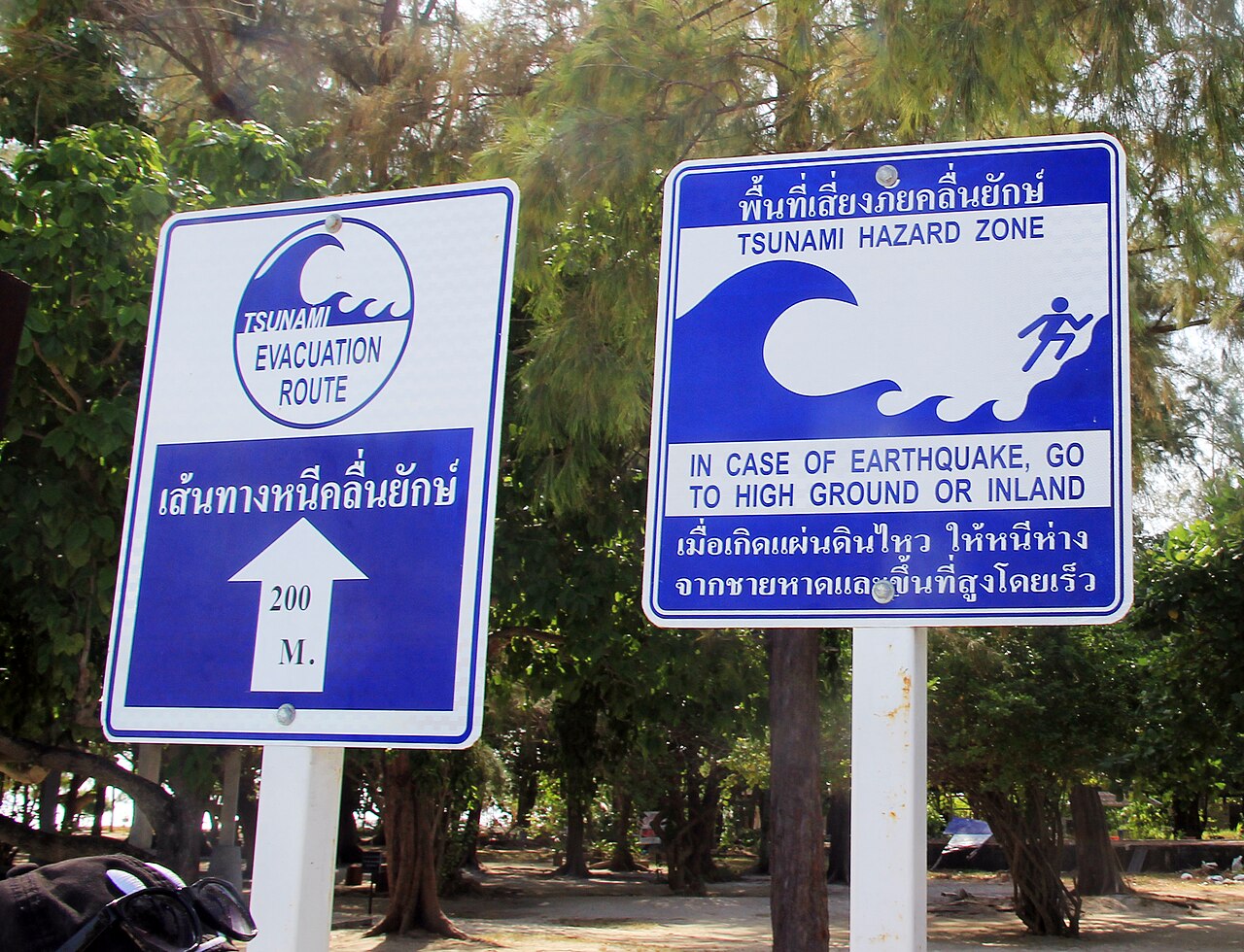
เส้นทางหนีคลื่นยักษ์: the one phrase to learn first
If you memorise a single string of Thai letters from this guide, make it this one. เส้นทางหนีคลื่นยักษ์ (sên thaang nǐi khlüen yák) is what every tsunami evacuation sign in the country says, and it breaks into four ordinary words that you will reuse far from the beach.
- เส้นทาง (sên thaang) — route, literally “line-way”. เส้น is the same “strand, line” you meet on a noodle menu
- หนี (nǐi) — to flee, to escape
- คลื่น (khlüen) — wave
- ยักษ์ (yák) — giant, ogre — the same ยักษ์ as the giant guardian figures at temple gates
So the sign literally reads “escape route — giant wave”. Thai also borrows the international word, สึนามิ (sù-naa-mí), and you will meet it in news reports, but the painted signs overwhelmingly use คลื่นยักษ์. One spelling point is worth banking as a beginner Thai lesson: the small ์ on the end of ยักษ์ is thanthakhat, the silencer, and it switches off the letter beneath it. Spot it once and you stop trying to pronounce that final ษ — a habit that will serve you on hundreds of words borrowed from Pali and Sanskrit.
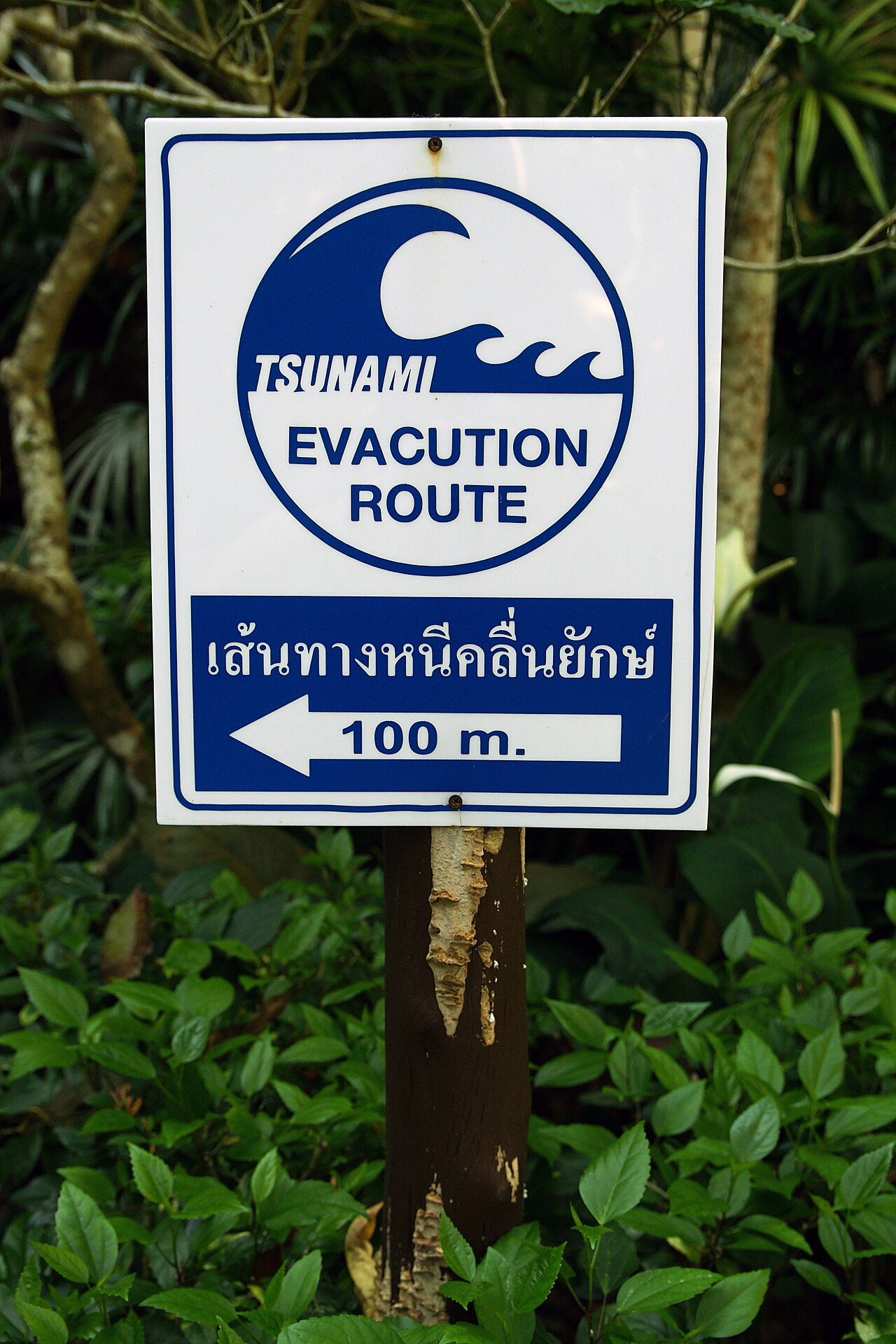
Same words, different boards: how to read Thai script in the wild
Here is the part that catches out learners who have only practised on flashcards. Thai signage has no single house style. The phrase above appears in white on blue and blue on white, in a rounded sans-serif and in a narrow condensed face, with the arrow above the text, beside it or beneath it. The Thai consonants and vowels are identical every time — only the dressing changes. Learning to see through the dressing is most of what people mean when they say they can read Thai script.
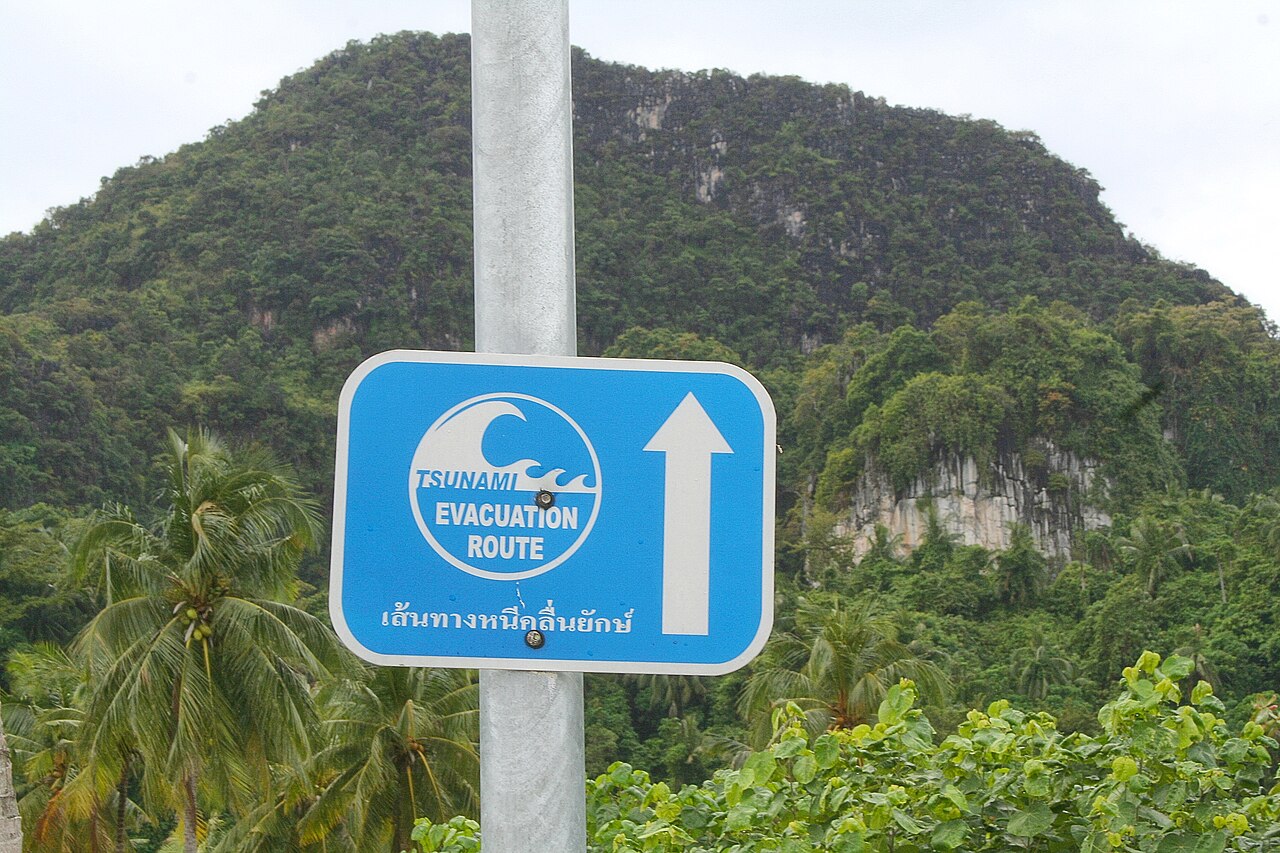
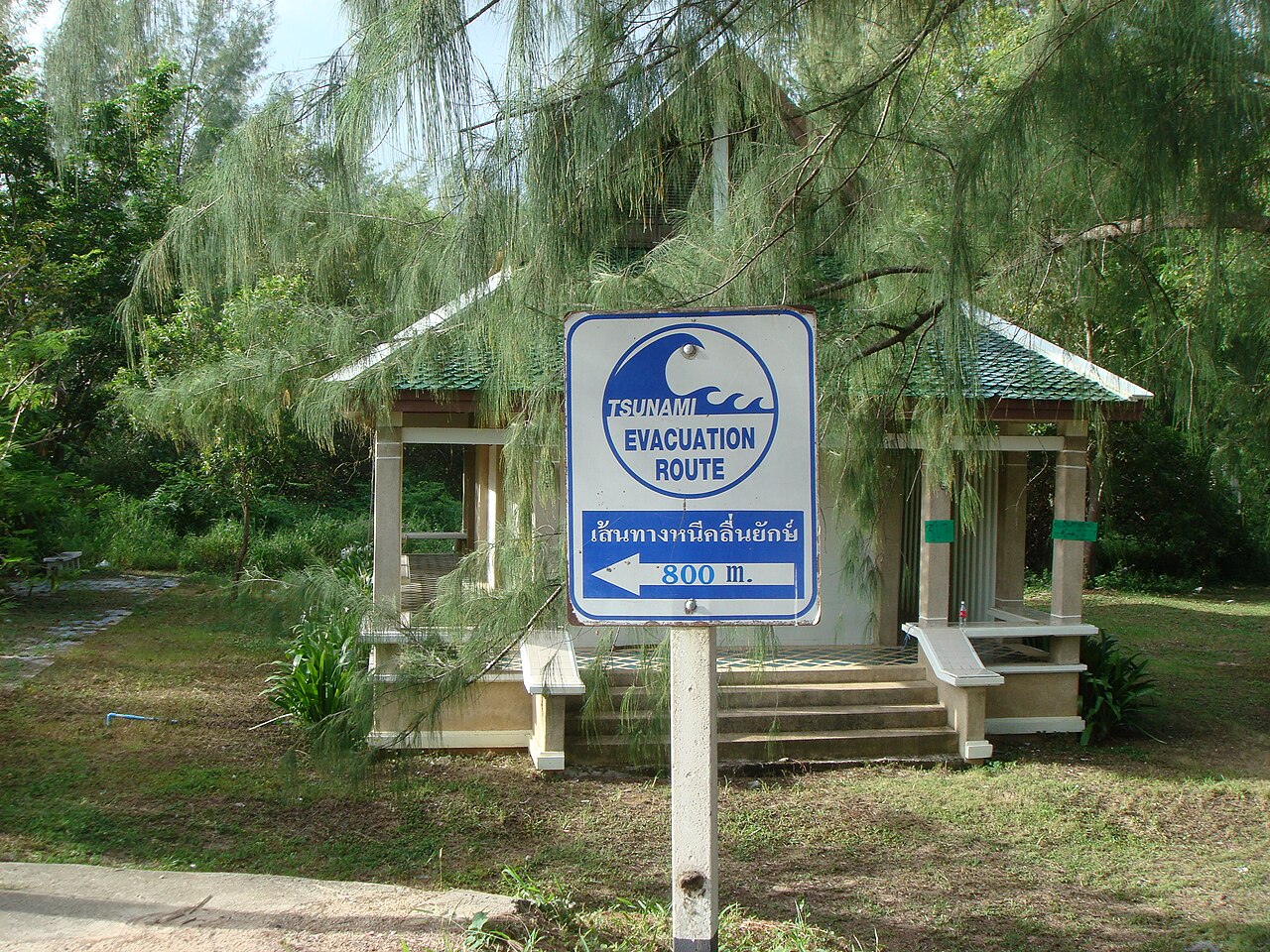
Two practical details about the numbers — the one part of these boards you do not need to read Thai script to use. Distances on these boards are given in Arabic numerals and metres almost without exception, so you do not need Thai numerals to use them — though they are well worth learning anyway for prices and house plates. And the distance counts down as you follow the arrows, so a board reading 800 m and then one reading 200 m means you are going the right way.
พื้นที่เสี่ยงภัย: reading the hazard-zone sentence
The second board in the first photograph carries a full Thai sentence, and it rewards taking apart, because nearly every word in it earns its keep elsewhere. The heading is พื้นที่เสี่ยงภัยคลื่นยักษ์ (phüen thîí sîang phai khlüen yák) — tsunami hazard zone — and the two lines under it are the instruction.
- พื้นที่ (phüen thîí) — area, zone
- เสี่ยง (sîang) — to risk · ภัย (phai) — danger, peril
- เมื่อเกิดแผ่นดินไหว (müea gèrt phàen din wǐi) — “when an earthquake happens”. แผ่นดิน is “sheet of earth” and ไหว is “to shake”
- ให้หนีห่างจากชายหาด (hâi nǐi hàang jàak chaai hàat) — “get away from the beach”
- และขึ้นที่สูงโดยเร็ว (láe khüen thîí sǔung dooy reo) — “and go up to high ground quickly”
Read that sentence twice and you have collected หนี (flee), ชายหาด (beach), ขึ้น (to go up), ที่สูง (high ground) and เร็ว (fast) — five everyday words that turn up in taxis, weather bulletins and conversations about hills. That is the quiet argument for using signs to learn Thai vocabulary: the sentences are short, repeated nationwide, and anchored to something physically in front of you.
It is also worth knowing why the network exists. Thailand’s coastal warning signs, towers and marked routes were built after the Indian Ocean tsunami of December 2004, which struck the Andaman coast with almost no warning. The boards are maintained by the authorities alongside the national warning sirens, and reading them is simply part of living on that coastline — the same way knowing where the fire stairs are is part of living in a tower block.
Emergency words to say out loud
Reading is half of it. These are the words to be able to speak Thai with under pressure, without hunting for a translation app. Keep them short: in a genuine emergency Thai drops politeness particles without anybody minding, though ครับ (khráp, men) and ค่ะ (khâ, women) still soften a request to a stranger who is not themselves in danger — the pharmacist, the hotel desk, the neighbour you are asking for directions to the clinic.
- ช่วยด้วย (chûay dûay) — “Help!” The single most important phrase on this page
- ไฟไหม้ (fai mâi) — “Fire!”, literally “fire burns”
- เรียกตำรวจ (rîak dtam-rùat) — “Call the police”
- เรียกรถพยาบาล (rîak rót phá-yaa-baan) — “Call an ambulance”. รถ is “vehicle”, so an ambulance is a “hospital vehicle”
- มีอุบัติเหตุ (mii ù-bàt-dtì-hèet) — “There’s been an accident”
- ฉุกเฉิน (chùk-chǒrn) — emergency · เจ็บ (jèp) — it hurts
- พูดไทยไม่เก่ง (phûut thai mâi gèng) — “I don’t speak Thai well”, which buys you patience
Then there is the question that actually gets help sent to you: where you are. Thai addresses run largest-to-smallest, and in a phone call the useful units are the ซอย (soi, side street) number and the nearest landmark — a temple, a 7-Eleven, a pier, a hotel. “อยู่ที่...” (yùu thîí…, “I’m at…”) followed by that landmark is usually enough. Our guide to Thai addresses and soi numbers sets out the whole pattern, and it is worth ten minutes before you need it.
Tones matter less when you are shouting than the textbooks imply, but a couple of these are worth drilling properly, because ไฟไหม้ (fai mâi, fire) and ไหม (mǎi, the question particle) sit uncomfortably close for an untrained ear. Our guide to Thai tone marks is the twenty-minute fix, and it doubles as Thai pronunciation practice for everything else on this page.
The four numbers worth saving before you need them
- 191 — police and general emergencies
- 199 — fire and rescue
- 1669 — medical emergency and ambulance, run by the National Institute for Emergency Medicine
- 1155 — Tourist Police, with English-speaking operators; the number most Thailand expat language guides suggest calling first while your Thai is still finding its feet
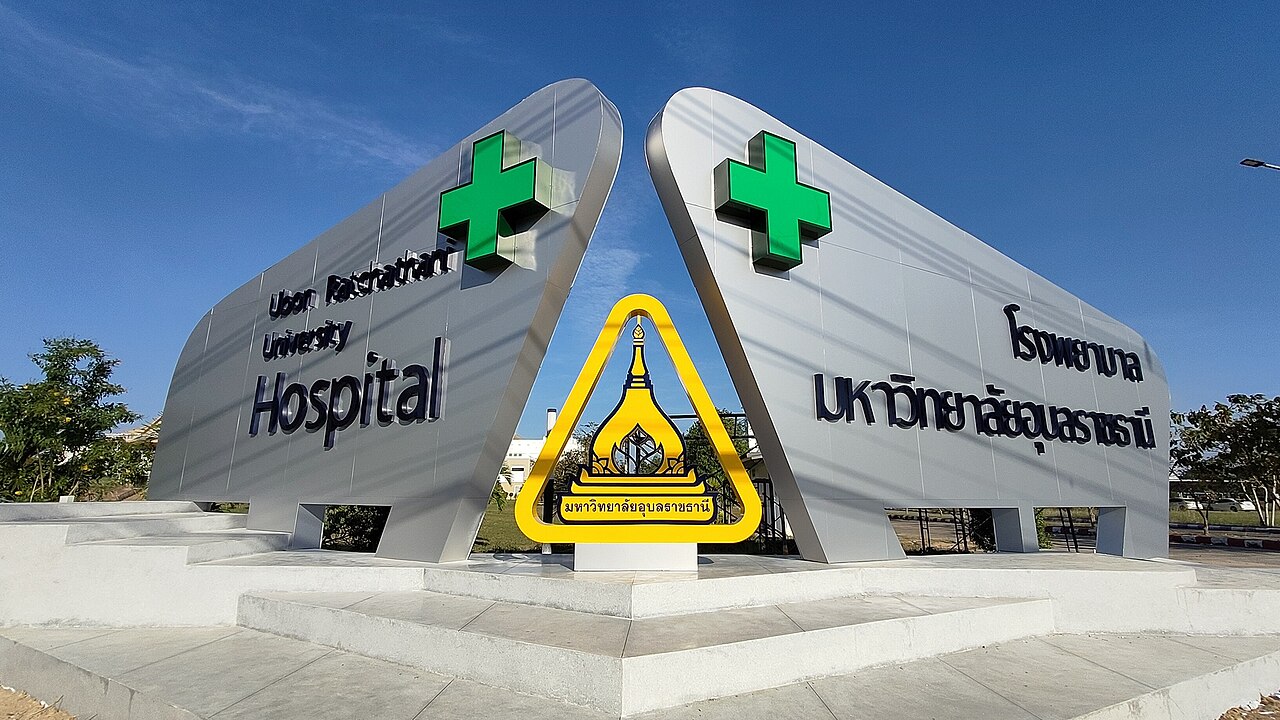
โรงพยาบาล and the words around it
โรง (roong) is a building put to a purpose — it starts โรงเรียน (school), โรงแรม (hotel) and โรงหนัง (cinema), so one โรง word quietly unlocks a dozen more. These are the companions you want on the same page as it, and together they cover most of what you will need to read Thai script on a hospital frontage, a pharmacy shutter or a stairwell door.
- โรงพยาบาล (roong phá-yaa-baan) — hospital · คลินิก (khlí-ník) — clinic
- ห้องฉุกเฉิน (hâwng chùk-chǒrn) — emergency room
- ร้านขายยา (ráan khǎai yaa) — pharmacy, literally “shop sells medicine”
- สถานีตำรวจ (sà-thǎa-nii dtam-rùat) — police station
- ทางออก (thaang àwk) — exit · ทางหนีไฟ (thaang nǐi fai) — fire escape
- จุดรวมพล (jùt ruam phon) — assembly point · อันตราย (an-dtà-raai) — danger · ระวัง (rá-wang) — beware
Notice how often ทาง (thaang, way) and หนี (nǐi, flee) keep reappearing. Thai builds its signage out of a small stock of roots, which is why a hundred different boards only cost you about thirty words. If the shapes themselves are still slow going, start with our free Thai alphabet chart — the quickest way to learn Thai alphabet forms before you take them outdoors — and then drill them in the ThaiLetters flashcard trainer until recognition is automatic.
A study tip: read the sign on a calm day
Nobody learns vocabulary during an emergency. So make it ordinary. Next time you walk a beach road, stop at the first blue board you pass, cover the English with your hand, and sound the Thai out. You already know what it says, and that is exactly why it is good practice — you are training recognition, not translation. Then walk the arrows for two minutes and see where they take you, because the point of being able to read Thai script here is not the reading, it is knowing the way without having to ask.
Do that three or four times and the phrase stops being a picture and starts being words. When it does, take the habit to the rest of the street: our guides to Thai warning signs, beach and national park signs and Thai doctor and hospital vocabulary apply the same method to the boards and situations you are most likely to meet next. Read it before you need it, and the sign has done its job long before the day it matters.