Learn Thai Vocabulary in Thailand: Train Station Signs
Learn Thai vocabulary at Thailand's train stations: platform, ticket and timetable words in Thai script with transliteration, real photos and four phrases.
If you want to learn Thai vocabulary somewhere that rewards you immediately, buy a train ticket. A Thai railway station is slower than an airport, quieter than a market, and almost every sign in it is printed twice — once in Thai script and once in roman letters directly underneath. That second line is an answer key. You read the Thai first, guess, then drop your eyes two centimetres to find out whether you were right, and a forty-minute wait on a platform turns into a beginner Thai lesson with real stakes attached to it.
This guide walks through five real photographs from stations around Thailand: the old Bangkok terminus, a tiny rural halt north of Ayutthaya, a provincial ticket hall in the south, a working long-distance ticket, and a wooden ticket window on the Mae Klong line. Everything appears in Thai script, in Thai transliteration and with the literal meaning underneath, because railway Thai is built from a small set of blocks that reappear on road signs, pier signs and bus boards for the rest of your time in Thailand.
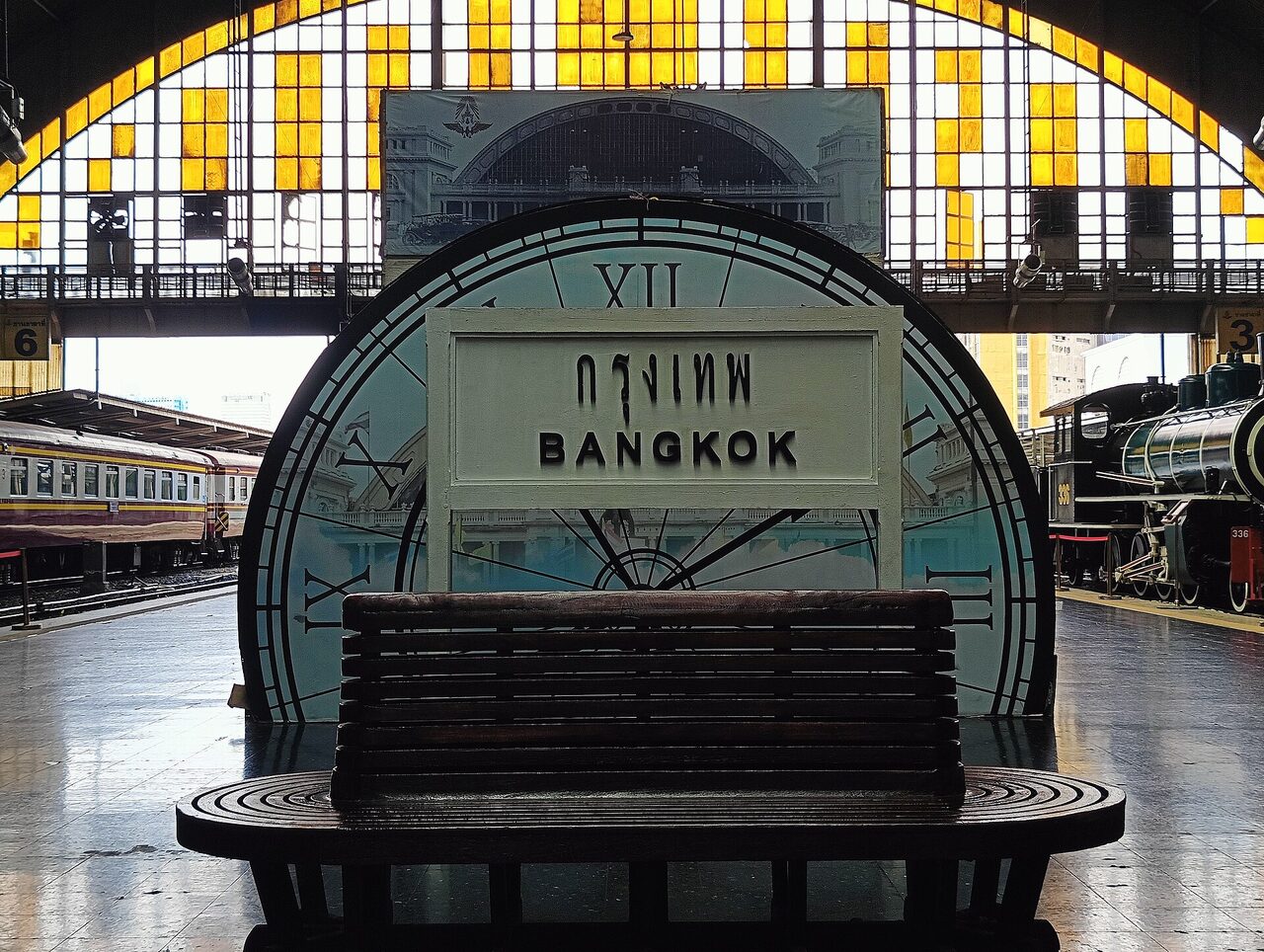
Start with the building: สถานีรถไฟ and the railway’s own name
Four words get you oriented anywhere on the network, and all four are compounds — which is the real reason a station is such a good place to learn Thai vocabulary. Thai builds long words out of short ones you already know, so each sign hands you two or three words for the price of one.
- สถานีรถไฟ (sà-thǎa-nii rót-fai) — train station. สถานี is any station, and รถไฟ is literally “fire vehicle”: รถ (rót) vehicle plus ไฟ (fai) fire.
- การรถไฟแห่งประเทศไทย (gaan-rót-fai hàeng prà-thêt-thai) — the State Railway of Thailand, printed across the top of every ticket. The last word is simply ประเทศ (country) plus ไทย (Thai).
- ชานชาลา (chaan-chaa-laa) — platform. This is the word on the overhead signs and the one you will say out loud most often.
- ชุมทาง (chum-thaang) — junction, literally “gathering of ways”. Stations such as ชุมทางทุ่งสง (Thung Song Junction) carry it in their official name.
- ที่หยุดรถ (thîî yùt rót) — a halt: ที่ place, หยุด to stop. Smaller than a station, and usually just a shelter and a sign.
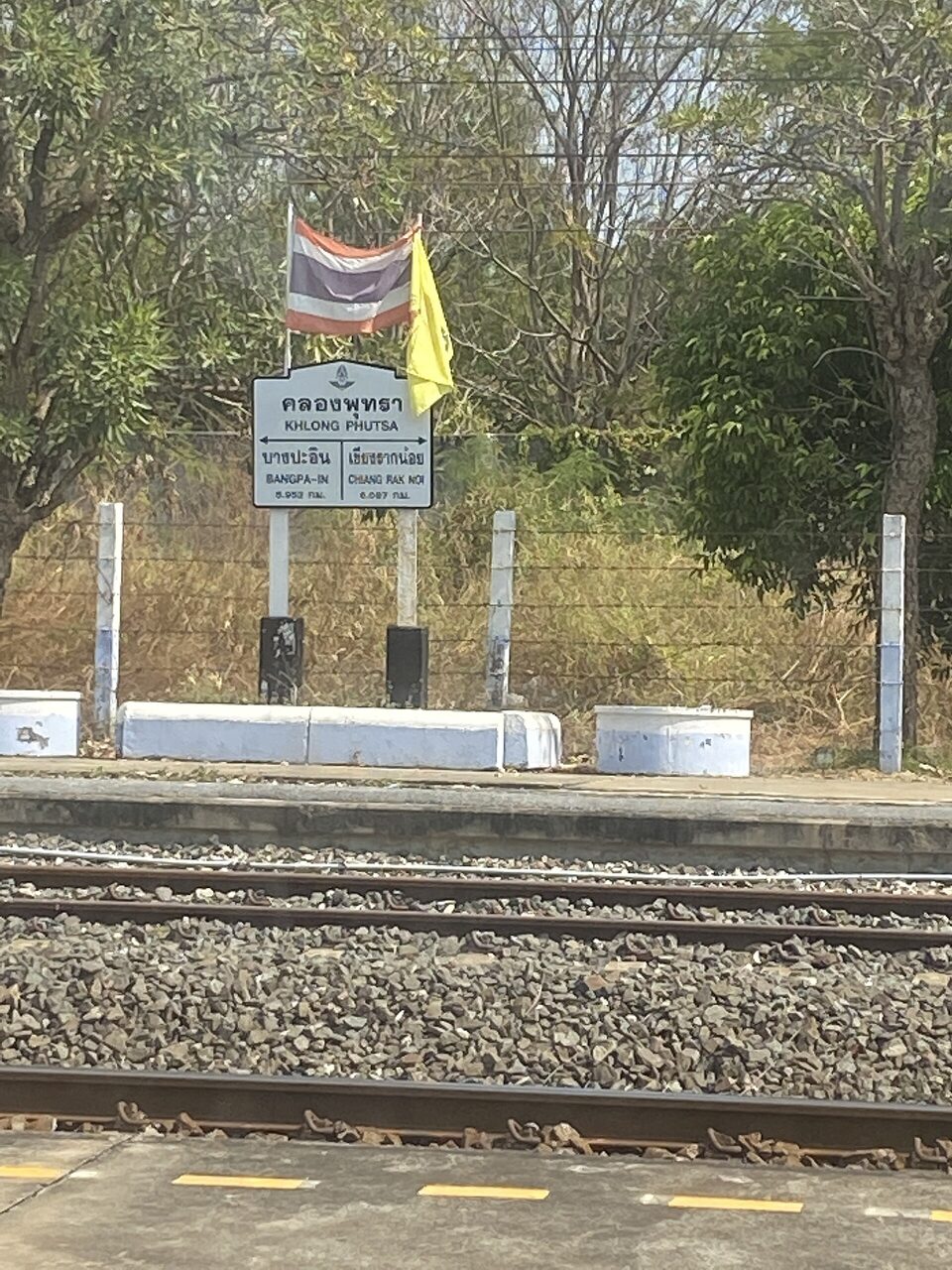
Read Thai script on the station nameboard
Every nameboard in Thailand follows the same three-panel pattern, which makes it the single best place to learn Thai vocabulary and practise reading Thai letters at the same time: you always know roughly what the words mean, so you can concentrate on the shapes. The station you are standing in is on top, the neighbours are underneath, and the roman line below each Thai name is a transliteration rather than a translation — which is why spellings wander from sign to sign.
- คลองพุทรา (khlawng phút-saa) — Khlong Phutsa. คลอง is a canal, and it opens hundreds of Thai place names.
- บางปะอิน (baang pà-in) — Bang Pa-in. บาง marks a village by water; the sign romanises it as one word, “BANGPA-IN”.
- เชียงรากน้อย (chiang râak nói) — Chiang Rak Noi, with น้อย (small) doing the same job as “Little” in an English place name.
- กม. — km, short for กิโลเมตร (gì-loo-mét). Thai abbreviates by keeping the first letter of each syllable and adding a full stop.
- รฟท. — the railway itself, abbreviated the same way from การรถไฟแห่งประเทศไทย.
If the roman spellings look inconsistent to you, they are: the same Thai vowel can appear as u, oo or ou depending on who painted the sign. Our guide to why Thai signs spell words differently explains the system behind the mess, and it is the strongest argument there is for learning the Thai consonants and vowels instead of trusting the English line.
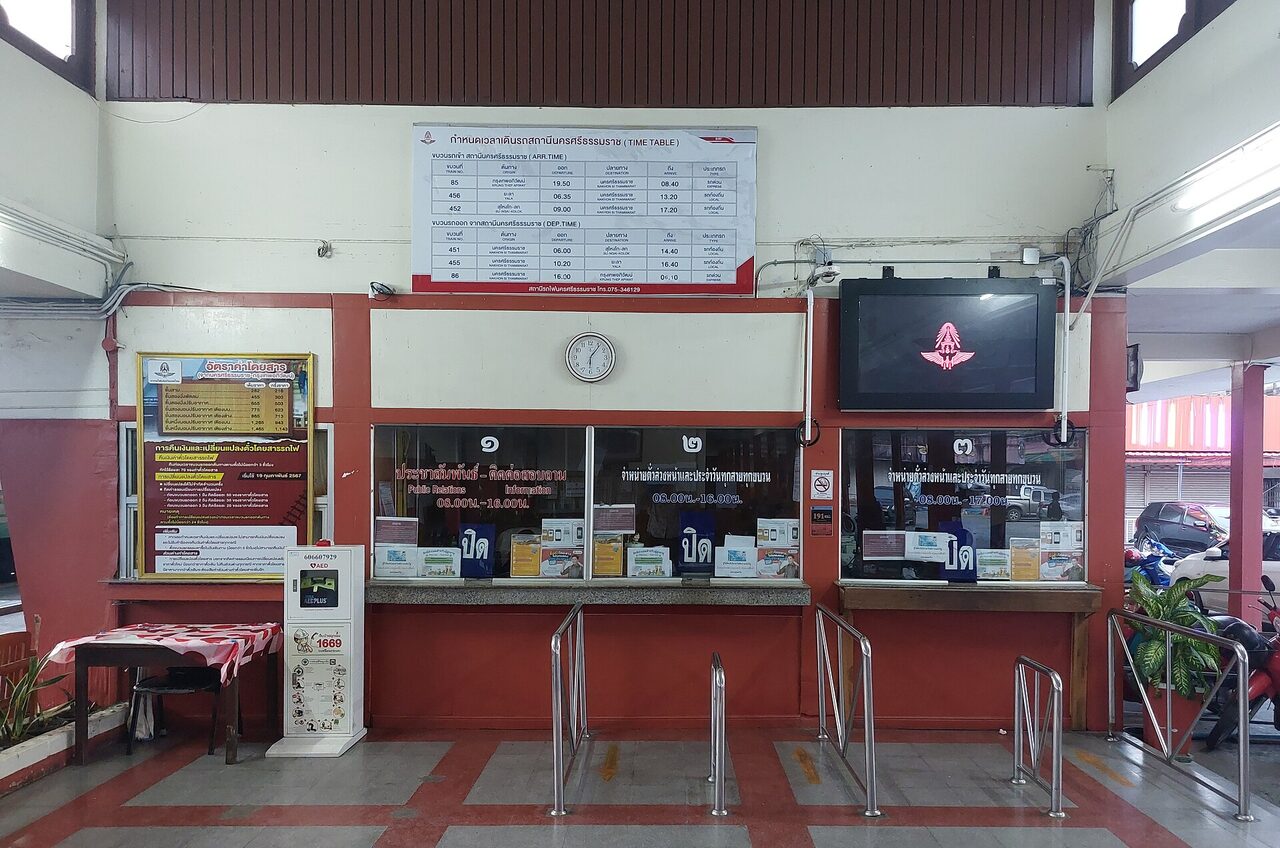
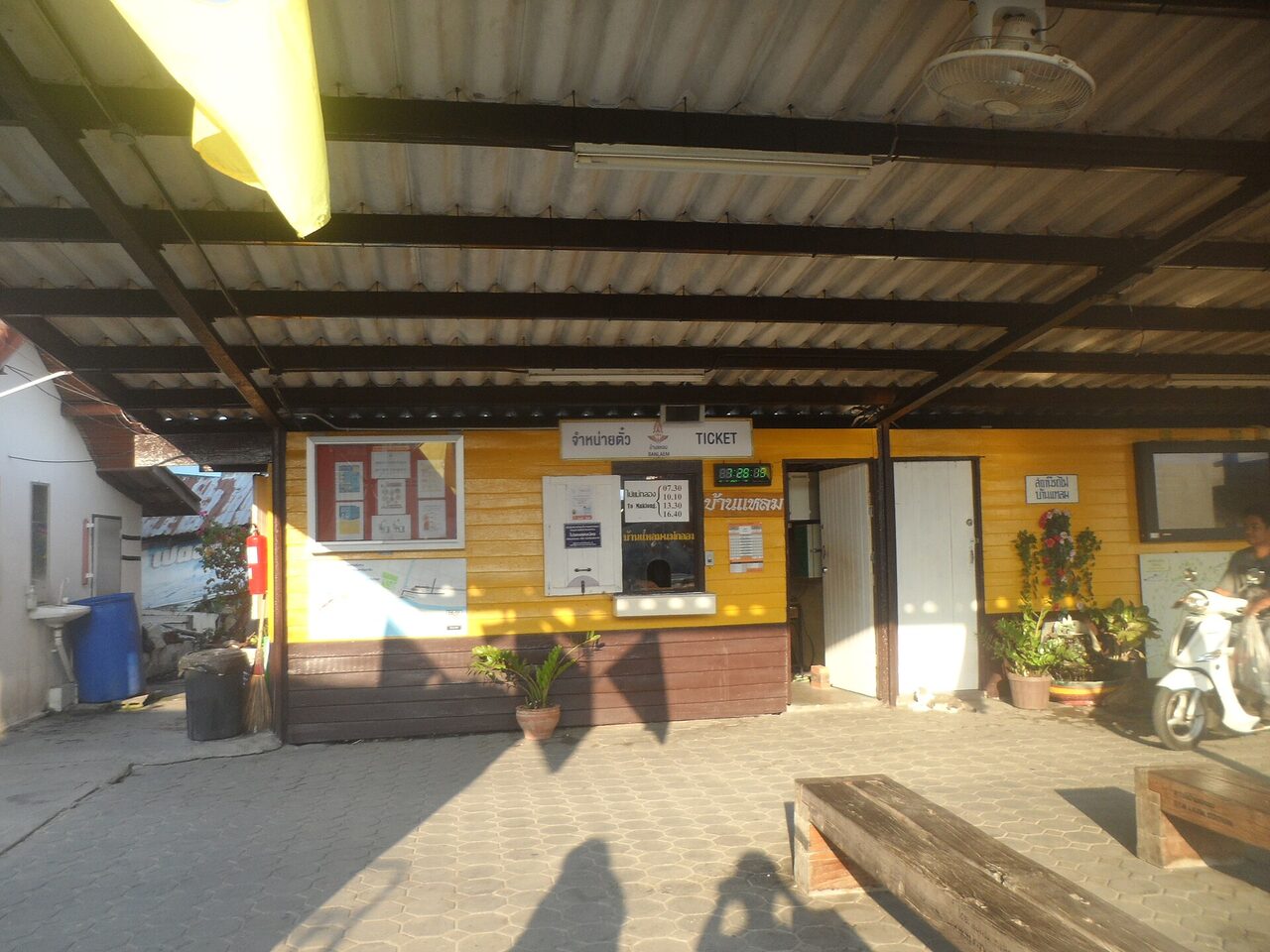
Learn Thai vocabulary at the ticket window: จำหน่ายตั๋ว and ปิด
The windows are where a little reading saves you a long queue in the wrong place. One window sells tickets, another answers questions, and in a provincial station nobody will stop you joining the wrong one.
- จำหน่ายตั๋ว (jam-nàai tǎa) — ticket sales. จำหน่าย is the formal “to sell” you see on signs; in speech people say ขาย (khǎai).
- ตั๋ว (tǎa) — ticket. The classifier is ใบ (bai), so two tickets is ตั๋วสองใบ — see our Thai classifiers guide for why that little word is compulsory.
- ล่วงหน้า (lûang-nâa) — in advance; ประจำวัน (prà-jam wan) — same-day. Windows are often labelled for one or the other.
- ประชาสัมพันธ์ (prà-chaa-sǎm-phan) — information, and สอบถาม (sàwp-thǎam) — to enquire.
- ปิด (pìt) closed and เปิด (pèrt) open — two words apart on the page, two words apart on the street, and worth burning into memory early.
- น. — the clock marker after a time, short for นาฬิกา (naa-lí-gaa). “08.00 น.” is simply 8am.
Learn Thai vocabulary from the timetable board
Thai timetable boards split arrivals and departures into two blocks and use the same six headings nationwide, so this is a beginner Thai lesson you only have to sit through once. Learn the headings once and you can read any board in the country, including the ones with no English on them at all.
- ขบวนที่ (khà-buan thîî) — train number. ขบวน is the word for a whole train.
- ต้นทาง (tôn-thaang) origin and ปลายทาง (plaai-thaang) destination — literally the “start of the way” and the “end of the way”.
- ออก (àwk) departs and ถึง (thǒeng) arrives — the same two verbs you use when speaking.
- ประเภทรถ (prà-phêt rót) — train type, filled in with ด่วนพิเศษ (special express), ด่วน (express), เร็ว (rapid) or ธรรมดา (ordinary — the one that stops everywhere).
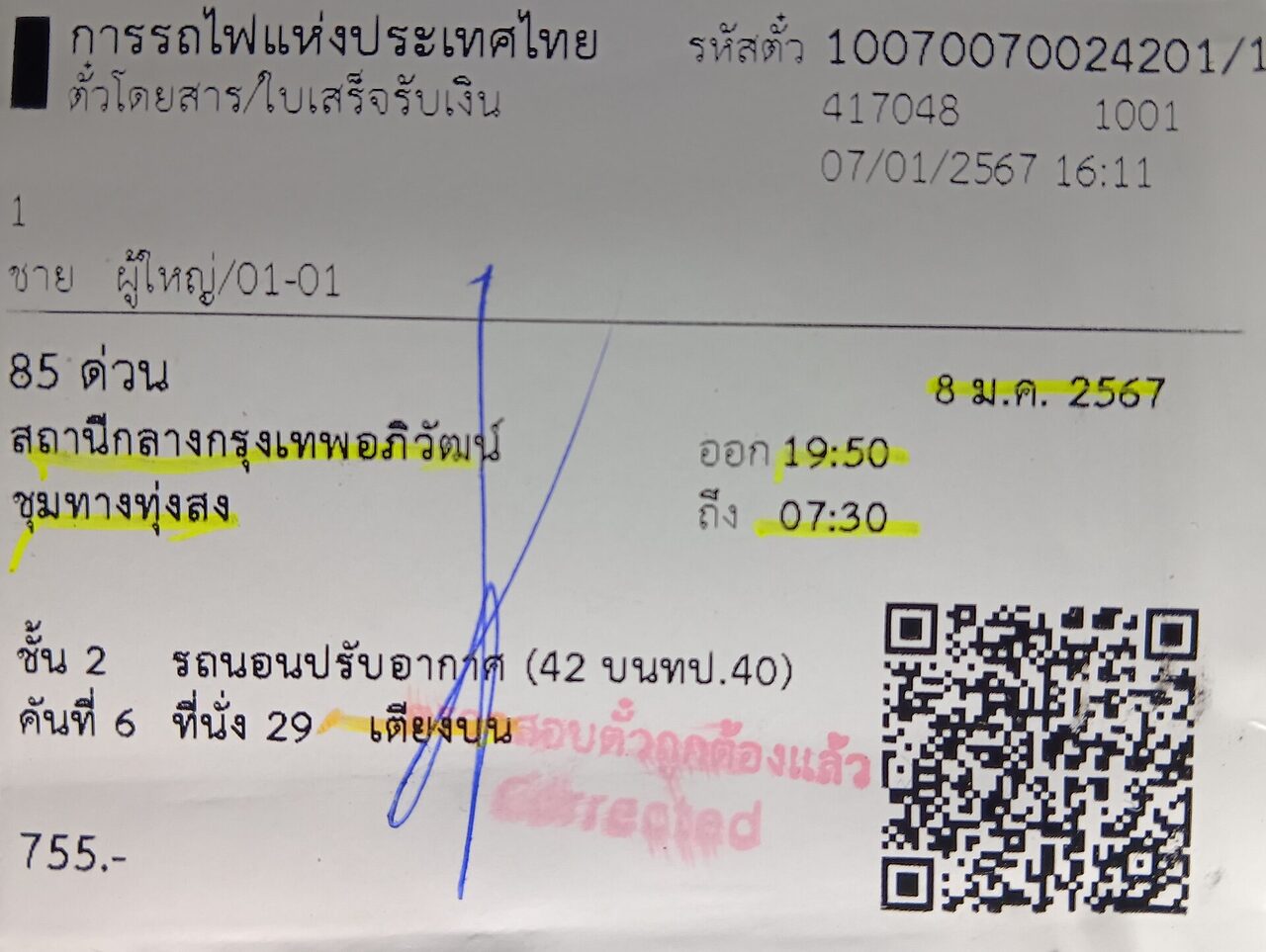
Thai transliteration practice on a real ticket
A ticket is the densest piece of Thai you will be handed all week and the fastest way to learn Thai vocabulary you will genuinely reuse, because unlike a sign it stays in your pocket where you can keep rereading it. Here is the bottom half, which is where the comfort of your night is decided.
- ชั้น (chán) — class. ชั้น 1, ชั้น 2, ชั้น 3; the same word means “floor” in a building.
- รถนอน (rót nawn) — sleeper, literally “lie-down vehicle”, and ปรับอากาศ (pràp aa-gàat) — air-conditioned, literally “adjusted air”.
- คันที่ (khan thîî) — carriage number, and ที่นั่ง (thîî-nâng) — seat.
- เตียงบน (tiang bon) upper berth and เตียงล่าง (tiang lâang) lower berth. The lower one costs more and has the window.
- ผู้ใหญ่ (phûu-yài) adult and เด็ก (dèk) child — printed beside ชาย (male) or หญิง (female).
The date is the part that unsettles people: 8 ม.ค. 2567 is 8 January 2024. ม.ค. abbreviates มกราคม (January) and 2567 is the Buddhist Era year, 543 ahead of the Western one. Our Thai Buddhist date calculator converts them instantly, and the guide to reading Thai numerals covers the digits ๐–๙ that still appear on older boards and window numbers.
Speak Thai at the window with four sentences
Station staff hear the same four questions all day, which makes this the safest place in Thailand to try speaking. Men end a sentence with ครับ (khráp), women with ค่ะ (khâ); leaving the particle off is the single most common way foreigners sound rude without meaning to.
- ขอตั๋วไปเชียงใหม่หนึ่งใบครับ (khǎw tǎa pai chiang mài nèung bai khráp) — “One ticket to Chiang Mai, please.” Swap the station name and this sentence works for the rest of your life.
- รถไฟออกกี่โมงครับ (rót-fai àwk gìì moong khráp) — “What time does the train leave?”
- ชานชาลาไหนครับ (chaan-chaa-laa nǎi khráp) — “Which platform?” Three words, and it saves you a sprint.
- ชั้นสองมีไหมครับ (chán sǎwng mii mǎi khráp) — “Is there second class?” Answer comes back as มี (there is) or ไม่มี (there isn’t).
Keep the sentences short and let the ticket clerk fill in the gaps; this is not the moment for a long run-up. If the politeness particles still feel slippery, our explainer on khrap and kha is a five-minute read and it fixes most of what goes wrong in exchanges like these.
A study tip: copy the nameboard, not the whole station
Here is a method that works on any platform in Thailand. Photograph the nameboard of every station you pass through and write the Thai name out by hand that evening — just the name, nothing else. Three things happen. You meet the same Thai letters again and again, because station names recycle a small pool of words: คลอง canal, บ้าน village, บาง waterside settlement, หนอง marsh, เมือง town. You get instant feedback from the roman line underneath. And you build a personal list that is tied to places you actually stood in, which is the kind of Thai vocabulary that survives the flight home — the ordinary Thailand expat language problem is almost always a memory problem, not a talent one.
When you want the letters behind the words, our free Thai alphabet chart lays out all 44 Thai consonants and vowels on one page, and the ThaiLetters flashcard trainer will drill the shapes ten minutes at a time until they stop looking like decoration. Start with ร, ถ and ช — between รถไฟ, สถานี and ชานชาลา, you have already read them a dozen times before the train has even moved.