Learn Thai Vocabulary at Bangkok Airport in Thailand
Learn Thai vocabulary at Bangkok airport in Thailand: departures, gates, baggage and rail-link signs in Thai script with transliteration and real photos.
If you want to learn Thai vocabulary in Thailand, the airport is the first classroom you walk into and the one almost everybody wastes. Every sign hanging over your head at Suvarnabhumi or Don Mueang is printed twice — once in Thai script, once in English — which makes a Thai airport the only building in the country that hands you a free answer key to the writing system. Read the Thai line first, check yourself against the English underneath, and a dull two-hour transit turns into a beginner Thai lesson with about forty useful words in it.
This guide works through five real photographs taken inside Bangkok’s two airports: the departures hall, an overhead gate sign, a left-baggage counter, a red restricted-area warning and an Airport Rail Link platform. Everything is given in Thai script, in Thai transliteration and with the literal English meaning underneath, because almost all airport Thai is assembled from small, reusable pieces you will meet again on street signs, menus and train platforms for the rest of your time in Thailand.
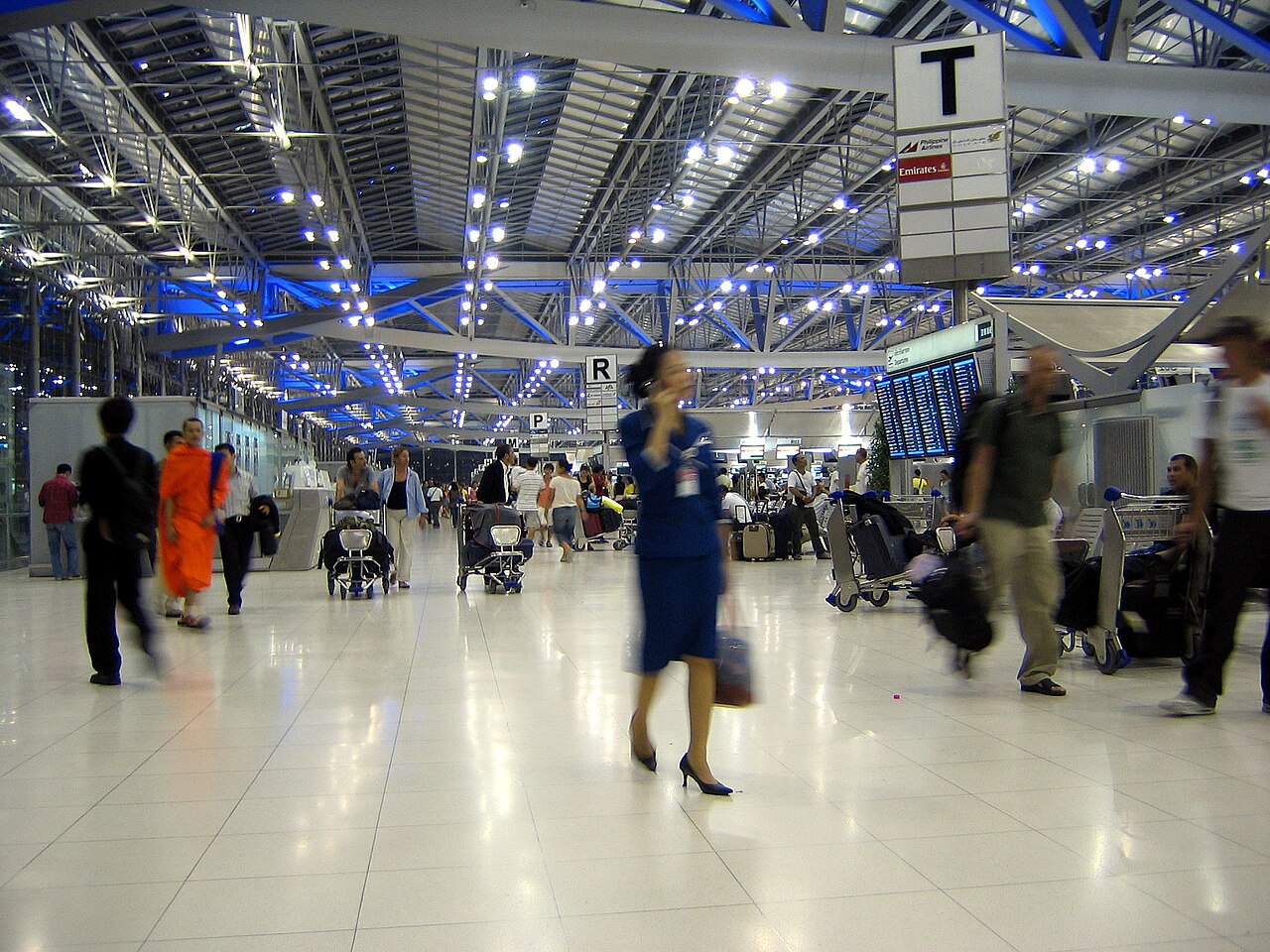
Two Thai words for “airport”: สนามบิน and ท่าอากาศยาน
Thailand labels its airports with one everyday word and one formal word, and both are worth taking apart rather than memorising whole — this is where learning to read Thai script starts paying you back in families of words instead of single ones.
- สนามบิน (sà-nǎam bin) — airport, literally “flying field”. สนาม is a field or ground, so you also get สนามหลวง (sà-nǎam lǔang, the royal field) and สนามกีฬา (sà-nǎam gii-laa, a sports stadium).
- ท่าอากาศยาน (thâa aa-gàat-sà-yaan) — the official term on the building itself. ท่า is a landing place or pier, which is the same ท่า you see on every river pier sign in Bangkok.
- เครื่องบิน (khrûeang bin) — aeroplane, literally “flying machine”. เครื่อง means machine or device.
- สุวรรณภูมิ (sù-wan-ná-phuum) — Suvarnabhumi, “the golden land”: สุวรรณ gold plus ภูมิ land.
- ดอนเมือง (dawn mueang) — Don Mueang, roughly “town on high ground”. เมือง (town, city) turns up in half the place names in Thailand.
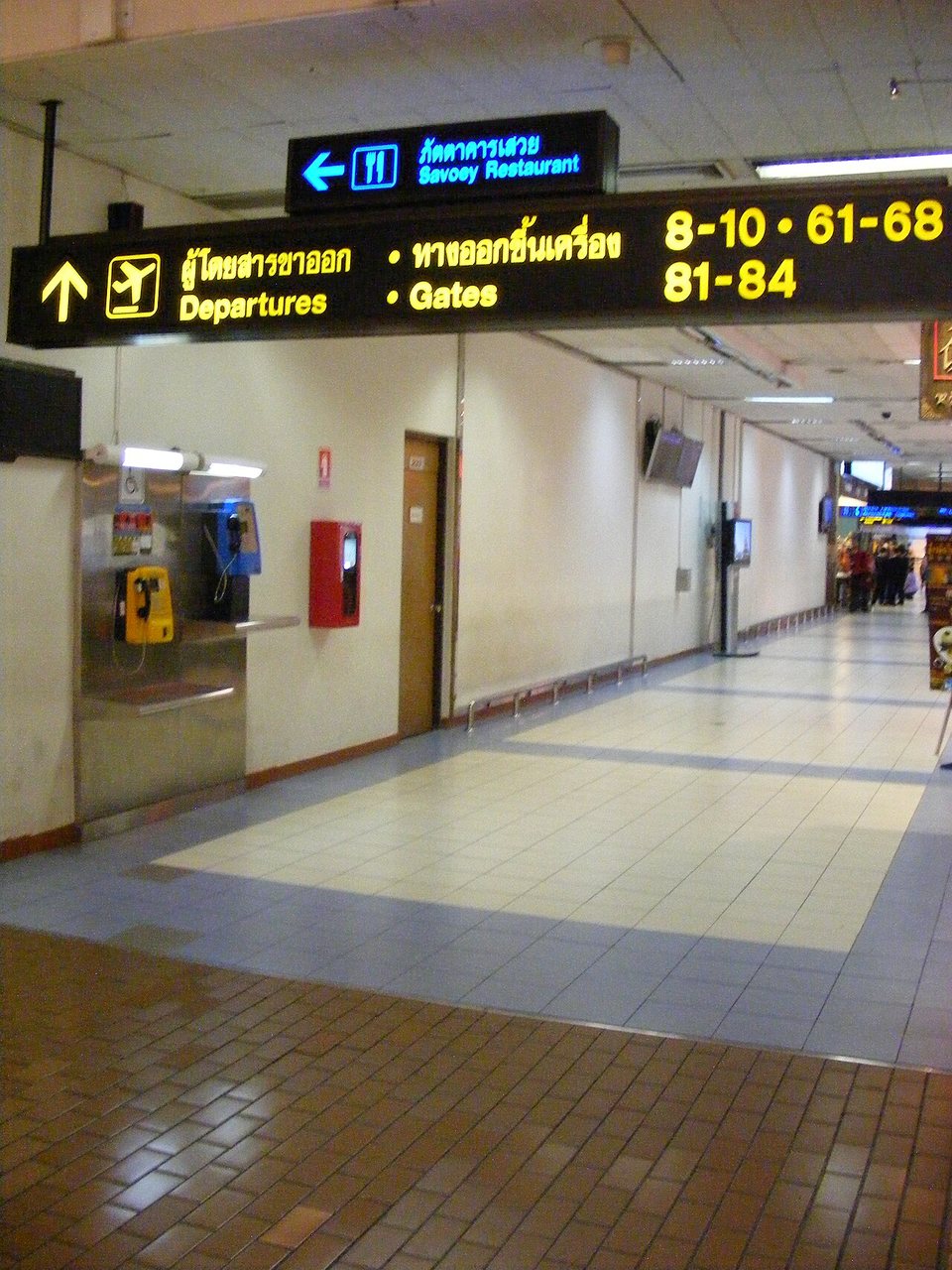
Learn Thai vocabulary on the departures sign: ขาออก and ขาเข้า
Two short words decide which way you walk, and they are the single best pair of Thai words an arriving traveller can own. ขา (khǎa) literally means “leg”, and Thai uses it exactly the way English uses “a leg of a journey”.
- ขาออก (khǎa àwk) — outbound, departures. ออก means to go out or exit.
- ขาเข้า (khǎa khâo) — inbound, arrivals. เข้า means to enter.
- ผู้โดยสาร (phûu doi-sǎan) — passenger. ผู้ marks a person, so ผู้ใหญ่ (phûu yài) is “a big person”, an adult.
- ทางออก (thaang àwk) — exit; ทางเข้า (thaang khâo) — entrance. ทาง is a way or path.
- ประตู (bprà-dtuu) — door, and also a boarding gate: ประตู ๑๒ is gate 12.
Check-in, passport and the flight board: Thai transliteration you can scan
These eight words cover nearly everything written on a boarding pass or flashing on the departure board. Say each one aloud once — Thai pronunciation rewards you for speaking before you memorise, and the fastest way to learn Thai vocabulary is to meet it attached to something you actually need.
| Thai | Thai transliteration | Meaning |
|---|---|---|
| เช็คอิน | chék-in | check-in (borrowed straight from English) |
| หนังสือเดินทาง | nǎng-sǔe dern-thaang | passport — literally “travel book” |
| บัตรขึ้นเครื่อง | bàt khêun khrûeang | boarding pass — “card for boarding the aircraft” |
| เที่ยวบิน | thîao bin | flight (a “flying trip”) |
| ปลายทาง | bplaai thaang | destination — “the far end of the way” |
| ตรงเวลา | dtrong we-laa | on time |
| ล่าช้า | lâa cháa | delayed |
| ยกเลิก | yók lôek | cancelled |
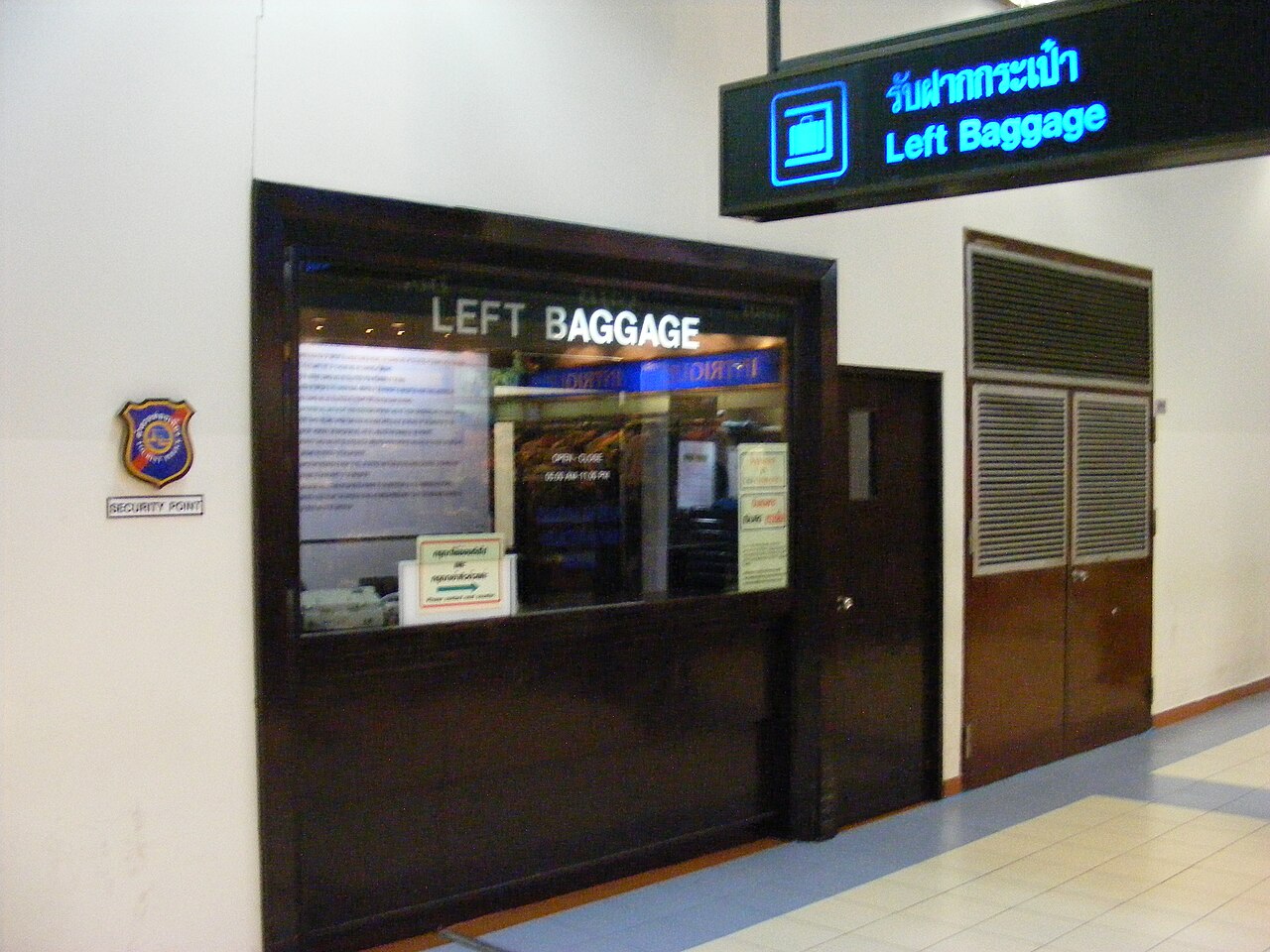
Thai letters on the baggage signs: กระเป๋า and สายพาน
Baggage is where most airport conversations actually happen, so these are worth owning before you reach the counter. They are also a tidy example of how you learn Thai vocabulary in bulk: one short root, several compounds hanging off it.
- กระเป๋า (grà-bpǎo) — bag, of any kind: handbag, backpack, suitcase, even a pocket.
- กระเป๋าเดินทาง (grà-bpǎo dern-thaang) — suitcase, literally “walking-the-road bag”.
- รับฝาก (ráp fàak) — to take something into safekeeping. ฝาก on its own means to entrust, and you will hear it constantly in everyday Thai.
- สายพานรับกระเป๋า (sǎai-phaan ráp grà-bpǎo) — baggage carousel. สายพาน is a conveyor belt.
- รถเข็น (rót khěn) — trolley, “a pushed vehicle”. รถ is the word for almost anything with wheels.
- น้ำหนัก (nám-nàk) — weight, the word on every baggage-allowance notice in Thailand.
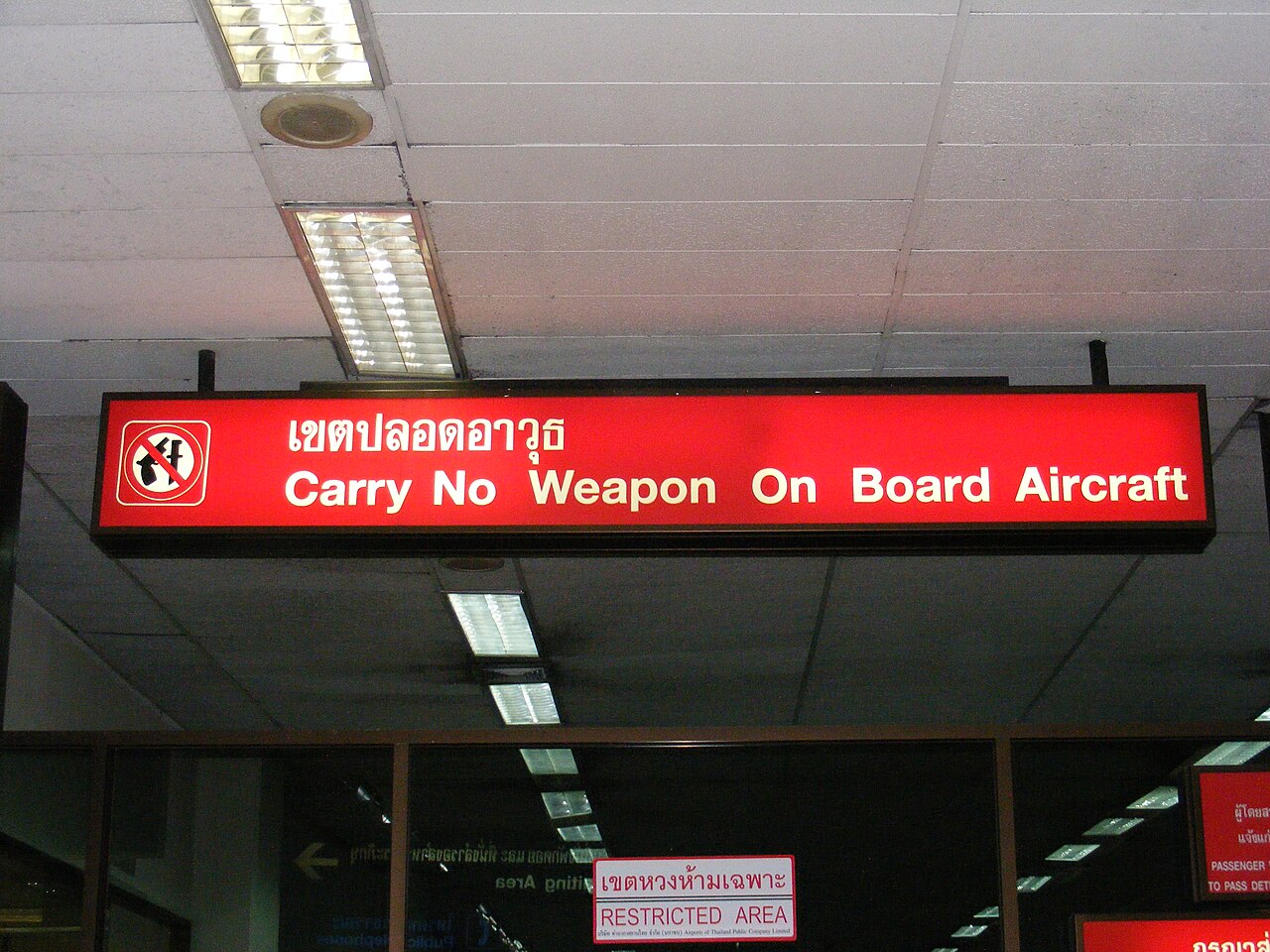
Read Thai script on warning signs: เขต, ปลอด and ห้าม
Three Thai words carry nearly every prohibition in the country, and the airport is where you are most likely to meet all three in one glance.
- เขต (khèet) — a zone or district. The same word labels Bangkok’s city districts.
- ปลอด (bplàwt) — free of, clear of. It gives you the most reassuring word in the language, ปลอดภัย (bplàwt phai) — “free of danger”, safe.
- ห้าม (hâam) — forbidden, do not. ห้ามสูบบุหรี่ (hâam sùup bù-rìi) is “no smoking”, and ห้ามเข้า (hâam khâo) is “no entry”.
- อาวุธ (aa-wút) — weapon; เฉพาะ (chà-pháw) — only, specific, restricted to.
Immigration and customs in Thai
The two counters that decide how your trip starts are labelled with long, formal compounds, but each is built from ordinary parts. ตรวจคนเข้าเมือง (dtrùat khon khâo mueang) is Immigration — literally “inspect people entering the country”, usually shortened in speech to ตม. (dtaw maw). ศุลกากร (sǔn-lá-gaa-gaawn) is Customs, and the two lanes beneath it are ช่องเขียว (châwng khǐao, green channel) and ช่องแดง (châwng daeng, red channel). ช่อง means a slot or channel, and it reappears on every ticket window in Thailand.
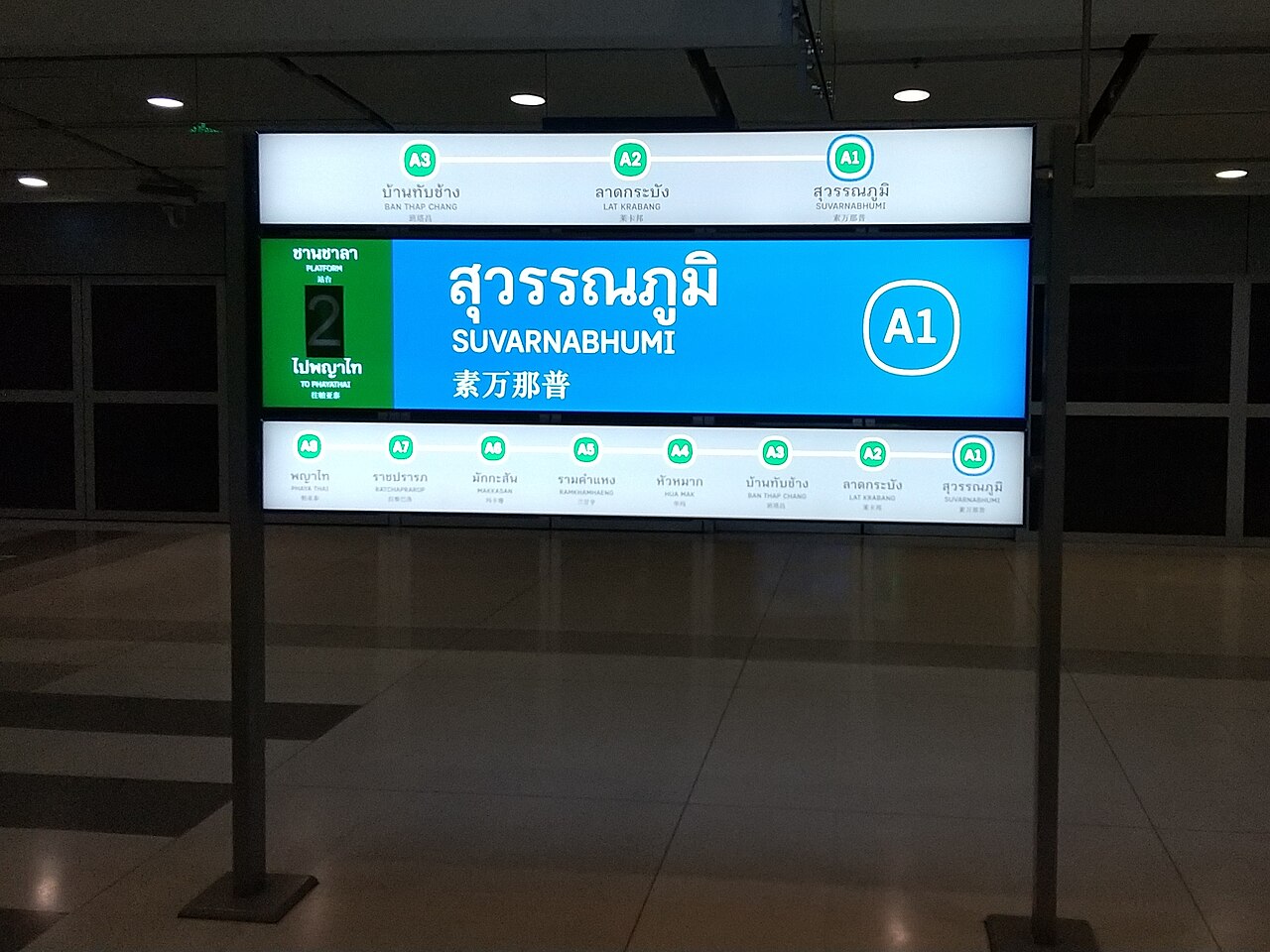
Speak Thai on the way out: trains, taxis and five useful phrases
Getting out of the terminal is the first time you will actually speak Thai rather than read it. Four words cover the transport signs: รถไฟฟ้า (rót fai fáa) — the electric train, literally “electric-fire vehicle”; ชานชาลา (chaan-chaa-laa) — platform; ไป (bpai) — to, towards; and แท็กซี่ (thǽk-sîi) — taxi.
Then these five phrases, which are the ones travellers reach for again and again. End every one with ครับ (khráp) if you are male and ค่ะ (khâ) if you are female — in Thailand those particles are not decoration, and leaving them off makes a reasonable question sound blunt.
- เช็คอินที่ไหนครับ (chék-in thîi nǎi khráp) — “Where do I check in?”
- ขึ้นเครื่องประตูไหนครับ (khêun khrûeang bprà-dtuu nǎi khráp) — “Which gate do I board at?”
- กระเป๋าผมหายครับ (grà-bpǎo phǒm hǎai khráp) — “My bag is missing.” A woman says กระเป๋าดิฉันหายค่ะ.
- รถไฟฟ้าไปพญาไทขึ้นที่ไหนครับ (rót fai fáa bpai phá-yaa-thai khêun thîi nǎi khráp) — “Where do I get the train to Phaya Thai?”
- ห้องน้ำอยู่ที่ไหนครับ (hâwng náam yùu thîi nǎi khráp) — “Where is the toilet?” The most-used sentence in any polite Thai phrasebook.
A study tip: read the Thai line before you read the English
Here is the whole method, and it costs you nothing extra. For the rest of your journey through the airport, make a rule that your eyes go to the Thai line first. Sound it out, guess, and only then drop down to the English to mark your own answer. You will be wrong for the first hour and increasingly right after that, because airport Thai recycles the same twenty or thirty syllables — ทาง, ออก, เข้า, ขึ้น, ห้อง, รถ — in new combinations. That is a far better use of a layover than a vocabulary app for anyone trying to learn Thai vocabulary from scratch, and the Thailand expat language problem usually starts to dissolve exactly here — on signs that mark your own answers for you.
When you want the letters behind the words, our free Thai alphabet chart lays out all 44 Thai consonants and vowels on a single page, and the ThaiLetters flashcard trainer will drill them ten minutes at a time until the shapes stop looking like decoration. Start with ท, อ and ข — between ทางออก and ขาเข้า, you have already read them a hundred times today without noticing.