Learn Thai Vocabulary in Thailand: Bus and Songthaew Signs
Learn Thai vocabulary at Thailand's bus stops: route, destination and songthaew words in Thai script, with transliteration, real photos and phrases to use.
The cheapest place in Thailand to learn Thai vocabulary costs eight baht and comes with a seat. A city bus is slower than the sky train, which means you spend twenty minutes staring at a destination board instead of two, and almost every word printed on it is a word you will meet again on a road sign, a pier, a shopping mall directory or a taxi driver's map. Bus Thai is not specialist Thai. It is ordinary Thai, written large, in high-contrast paint, next to a picture of where you are going.
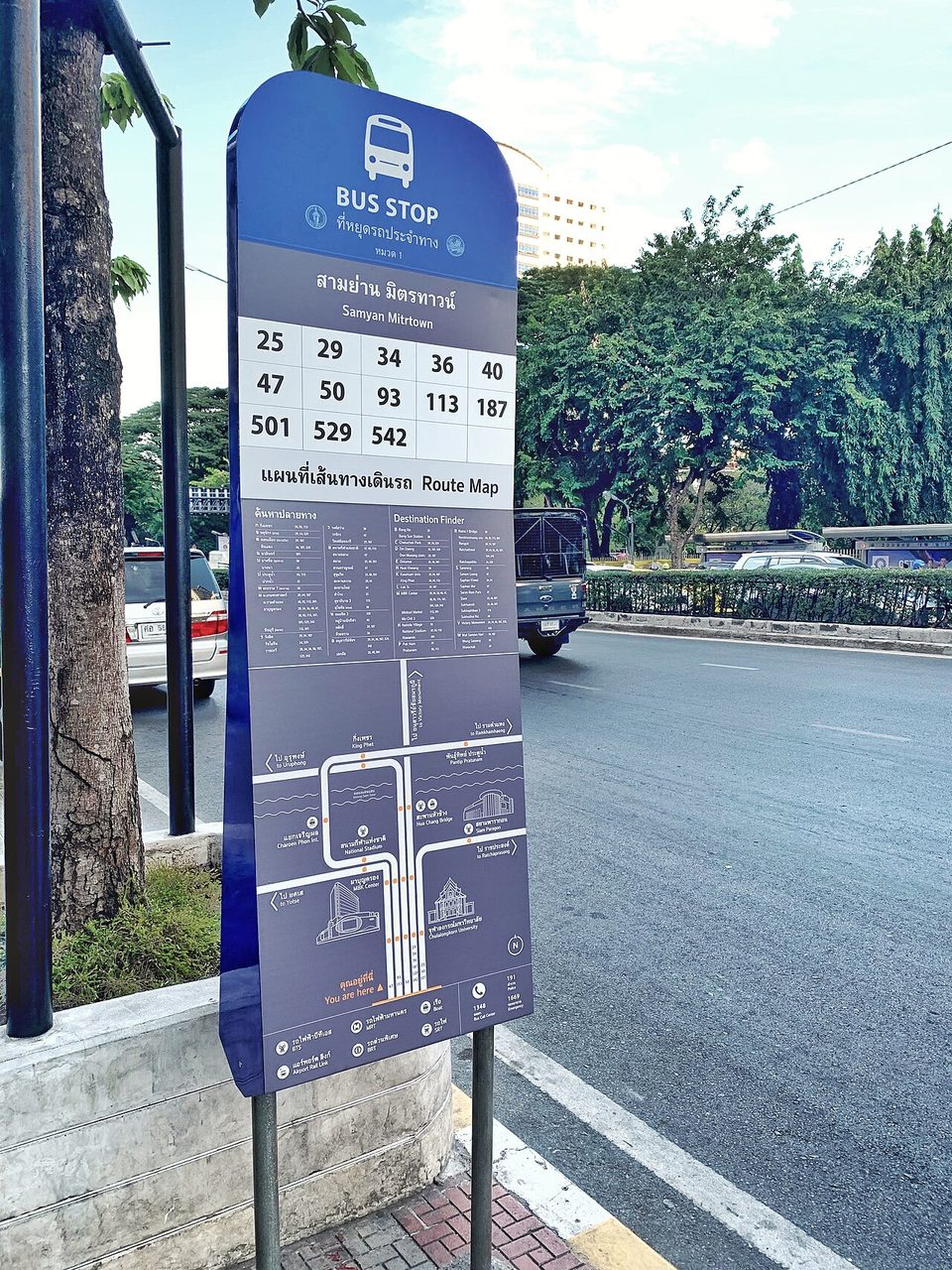
This guide works through five real photographs — a Bangkok bus stop pillar, a second stop outside a shopping centre, the destination board painted on the side of route 3, the windscreen card of an air-conditioned bus, and a yellow songthaew in Chiang Mai. Everything appears in Thai script, in Thai transliteration and with the literal meaning underneath, because the useful thing about bus signage is that it recycles a tiny pool of words. Learn those words once and you can read half the public transport in the country.
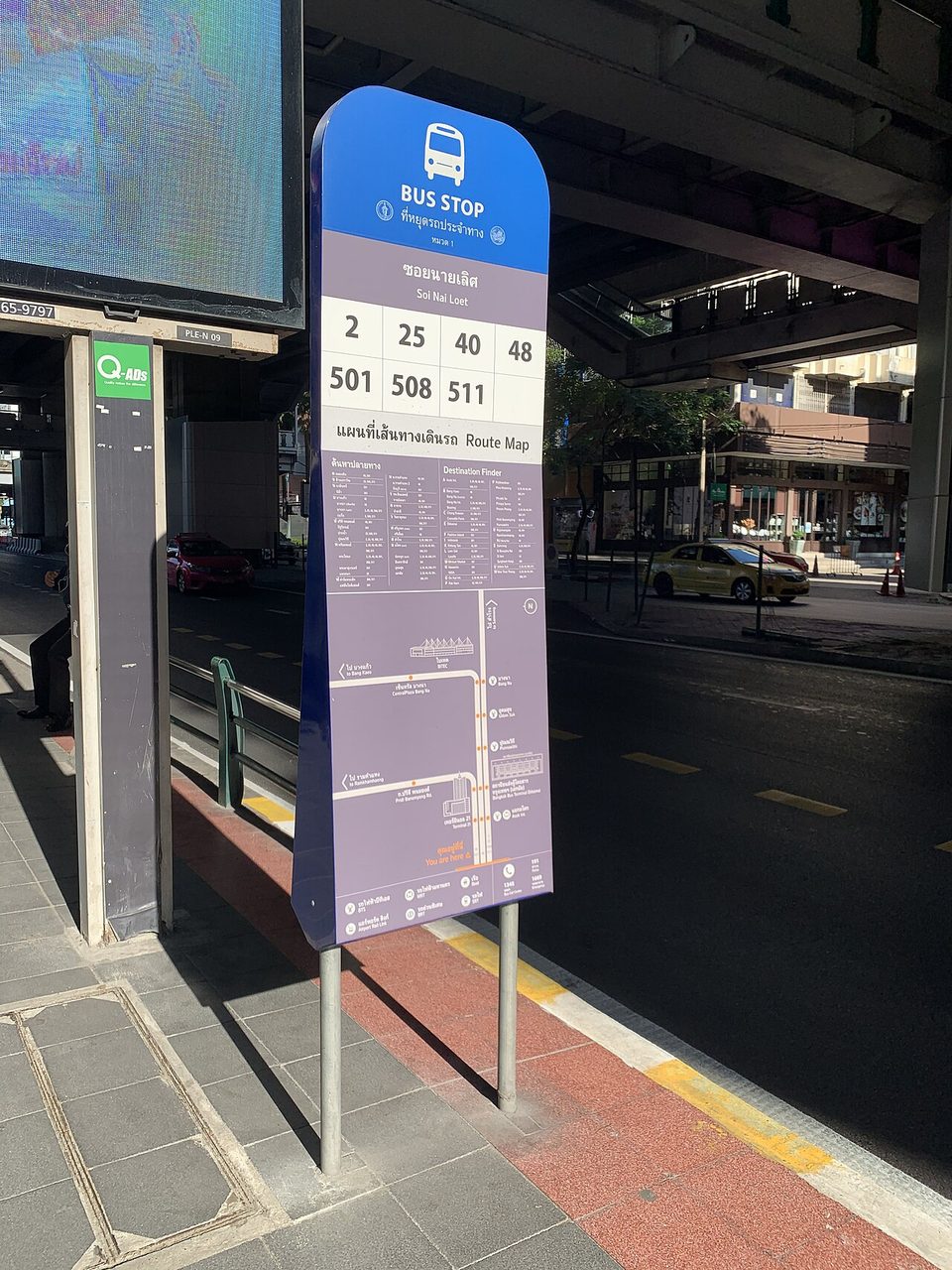
Learn Thai vocabulary from a bus stop sign in Thailand
Five compounds cover the whole pillar, and each one is built from shorter words you will reuse elsewhere. That is the real reason a bus stop is such an efficient place to learn Thai vocabulary — Thai stacks small words into big ones, so one sign quietly teaches you three or four entries at a time.
- รถเมล์ (rót-mee) — city bus, the word everyone actually says. รถ (rót) is any vehicle; เมล์ came into Thai from the English “mail”, from the old mail coaches.
- รถประจำทาง (rót prà-jam thaang) — the formal term: literally “vehicle regular route”. This is the one on signs and announcements.
- ป้าย (bpâai) — a sign, a board, and by extension the stop itself. ป้ายรถเมล์ is what a Thai person calls the place you are standing.
- สาย (sǎai) — line or route. สาย 3 is route 3; the same word labels train lines and phone lines.
- ต้นทาง / ปลายทาง (dtôn thaang / bplaai thaang) — origin and destination, literally “the start of the way” and “the end of the way”. Learn this pair properly; it appears on buses, boats, parcels and flight boards.
Read Thai script on the side of the bus
Bangkok's older buses carry a blue panel along the flank listing the places the route passes through — and that panel is usually Thai only, with no roman letters anywhere. This is the moment the alphabet stops being homework. You do not need to understand the names to use them; you need to recognise the shape of the one you want, which is a much easier task and the fastest way to read Thai script under real pressure.
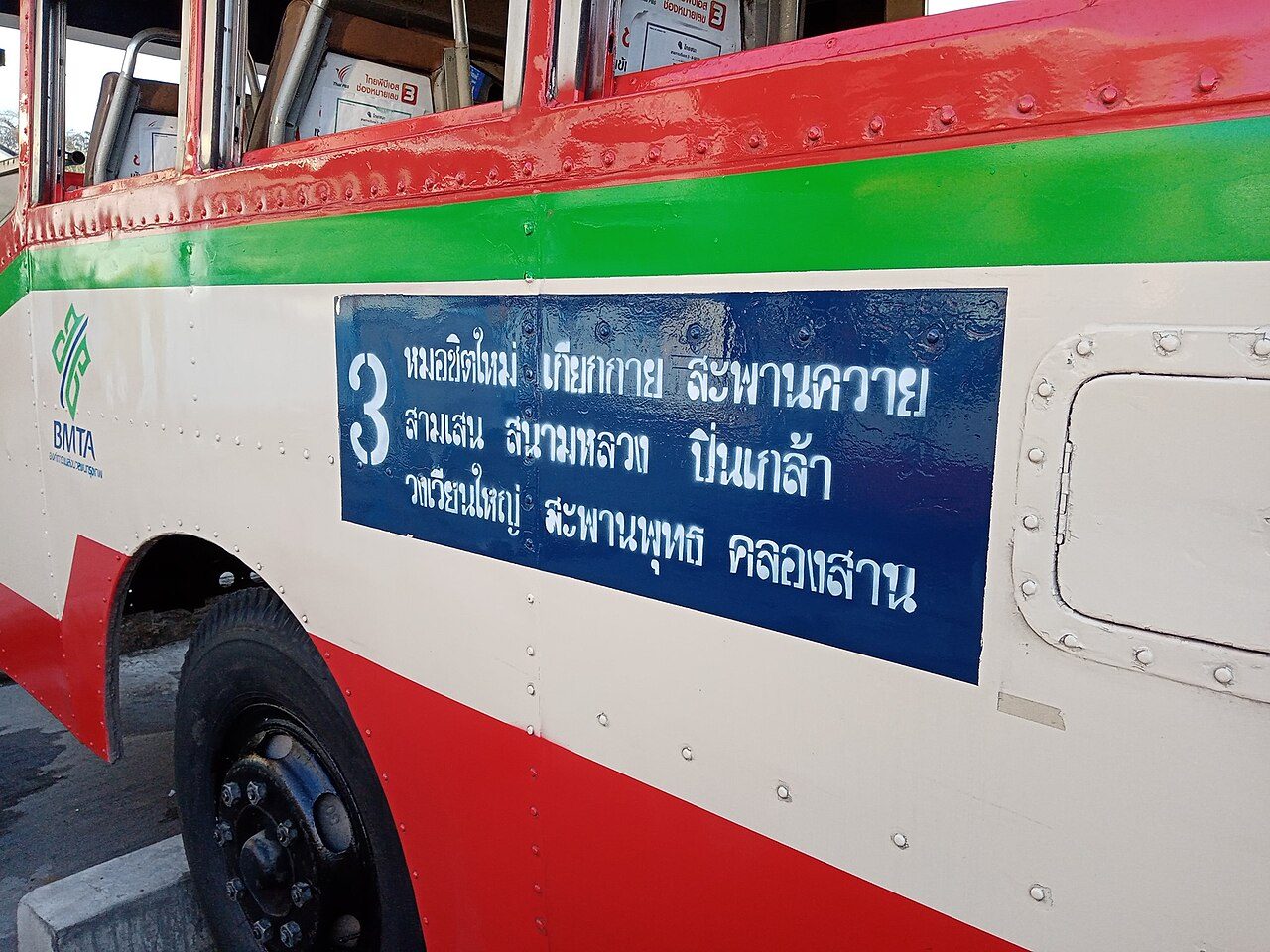
Pull that list apart and most of it turns out to be plain description. Thai place names are rarely abstract; they are a bridge, a canal, a field, a roundabout, plus an adjective.
- สะพานควาย (sà-phaan khwaai) — Saphan Khwai, literally “buffalo bridge”. สะพาน is bridge, ควาย is water buffalo.
- สะพานพุทธ (sà-phaan phút) — the Memorial Bridge, literally “Buddha bridge”. Same first word, new second word.
- สนามหลวง (sà-nǎam lǔang) — the royal ground: สนาม field or ground, หลวง royal.
- วงเวียนใหญ่ (wong-wian yài) — Wongwian Yai, “big traffic circle”. ใหญ่ (big) is one of the first adjectives worth memorising.
- คลองสาน (khlawng sǎan) — Khlong San. คลอง means canal and opens hundreds of Thai place names across the country.
Bus numbers, bus types and Thai pronunciation
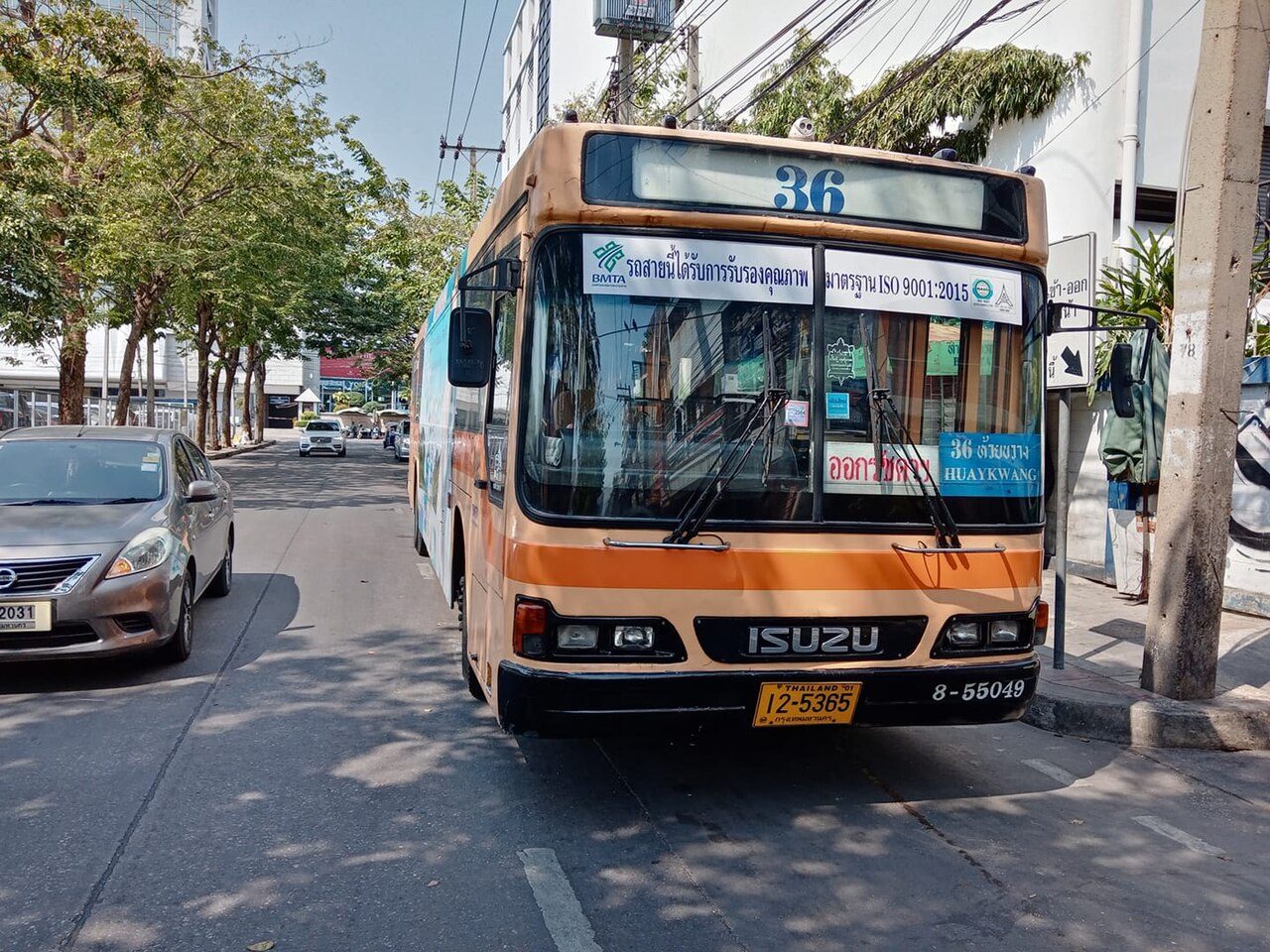
Route numbers are printed in the same digits you already read, so the number is never the hard part. The hard part is the two or three Thai words stuck around it, which tell you what kind of bus is coming and how much it will cost — five more entries for anyone trying to learn Thai vocabulary that gets used daily.
- รถร้อน (rót rórn) — literally “hot bus”: the fan-cooled ones with the windows open, and the cheapest fare on the road.
- รถแอร์ (rót ae) — air-conditioned bus. แอร์ is the English “air”, written in Thai letters, and you will see it on hotel rooms and taxis too.
- ค่าโดยสาร (khâa doi-sǎan) — the fare. ค่า means “cost of”, and it prefixes nearly every price word in Thai.
- กระเป๋า (grà-bpǎo) — the conductor. The word means “bag”, after the metal fare tube they carry; on an older bus, this is the person you pay.
- ตั๋ว (dtǔa) — ticket. Short, awkward for beginners, and worth drilling for the vowel alone.
Songthaew Thai: the pickup truck with two rows
Outside the capital, the bus is often not a bus. A สองแถว (sǎawng thǎew) is a pickup with a roof and two bench seats facing each other down the back — and the name says so literally: สอง is “two”, แถว is “row”. In Chiang Mai they are red and known as รถแดง (rót daeng), “red cars”; in other provinces they are yellow, blue or green by route. There is no timetable and frequently no stop. You wave, you climb in, and you press the buzzer when you want out — and the four verbs below are the ones that learn Thai vocabulary lists always put last and travellers need first.
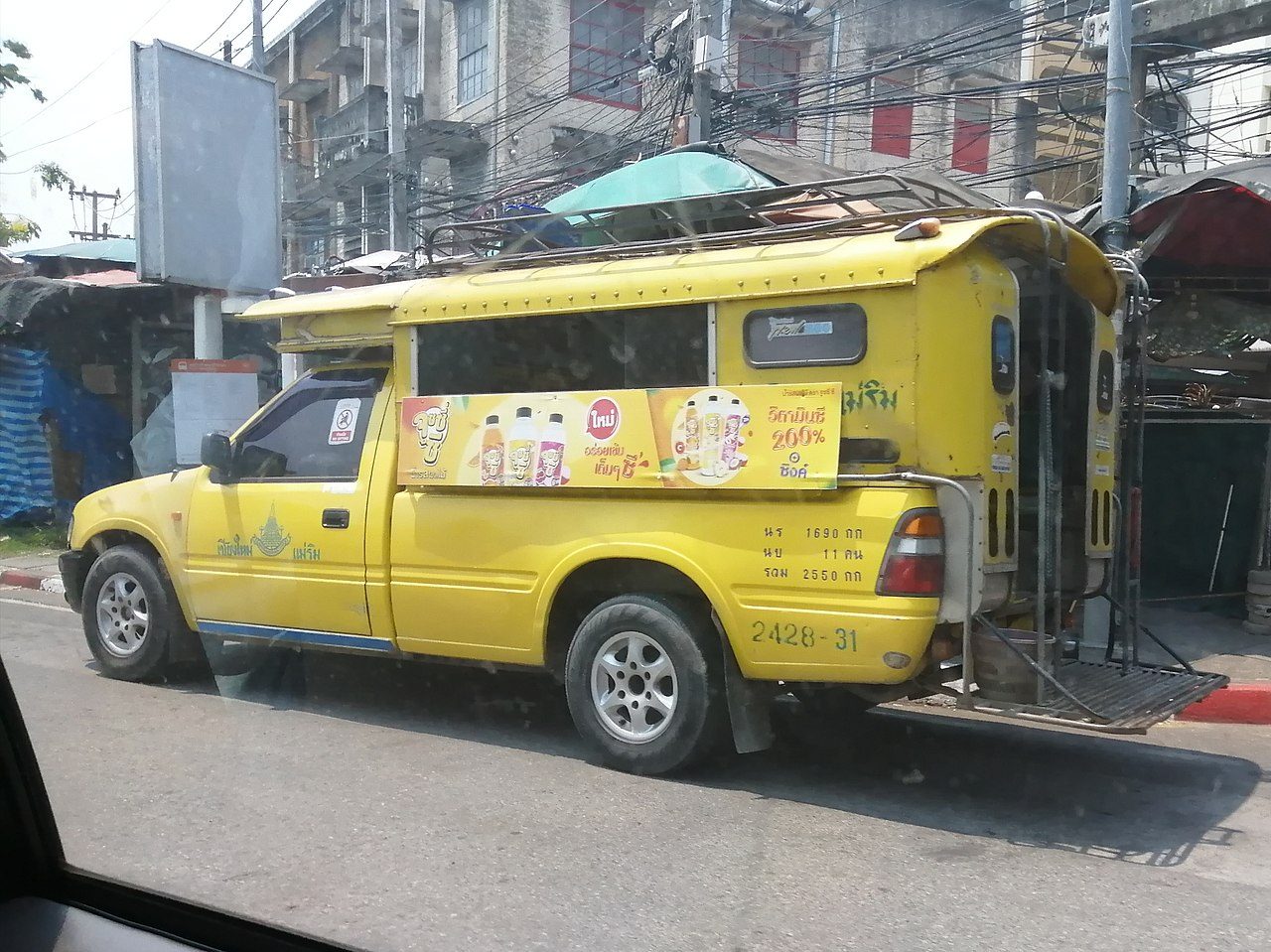
- ขึ้น (khûen) — to get on, to board. Also “to go up”, which is how to remember it.
- ลง (long) — to get off, to go down. These two verbs run the whole transport system.
- จอด (jàwt) — to stop, to park. The word you will hear shouted from the back of a songthaew.
- เหมา (mǎo) — to hire the whole vehicle rather than share it. Useful, and expensive if you say it by accident.
Speak Thai on board: five phrases that get used
Bus Thai is short Thai. Nobody expects a sentence; they expect a place name and a polite particle, so this is the cheapest possible place to turn the words you learn Thai vocabulary lists give you into speech. Men end a phrase with ครับ (khráp) and women with ค่ะ (khâ), and on a loud bus that final syllable does most of the work of sounding friendly rather than abrupt. Leave it off and you are not being rude exactly, but you will sound like you are reading from a card.
- ไปสนามหลวงไหมครับ (bpai sà-nǎam lǔang mǎi khráp) — “Does this go to Sanam Luang?” Swap in any destination; ไหม turns a statement into a question.
- ลงป้ายหน้าค่ะ (long bpâai nâa khâ) — “Getting off at the next stop.” Literally “go down sign next”.
- จอดตรงนี้ครับ (jàwt dtrong níi khráp) — “Stop right here.” The standard songthaew phrase.
- เท่าไหร่ครับ (thâo-rài khráp) — “How much?” Two syllables and it works everywhere in Thailand.
- ขอโทษครับ ลงครับ (khǎw-thôot khráp, long khráp) — “Excuse me, I'm getting off.” Said while moving toward the door, not before.
A study tip: one stop sign a day
Here is a method that costs nothing and works anywhere in the country. Photograph one bus stop sign a day, and that evening copy out the stop's name by hand — just the name, nothing else. You will keep meeting the same Thai letters, because stop names reuse a small pool of words: สะพาน bridge, คลอง canal, ซอย side street, แยก junction, ตลาด market. You get instant feedback from the roman line underneath. And you end up with a personal list of Thai vocabulary tied to places you physically stood in, which is the kind that survives — the usual Thailand expat language problem is a memory problem, not a talent one.
When you want the letters behind the words, our free Thai alphabet chart lays out all 44 Thai consonants and vowels on one page, the Thai numbers guide covers the digits on the fare board, and the ThaiLetters flashcard trainer will drill the shapes ten minutes at a time. Start with ร, ถ and ป — between รถเมล์, รถประจำทาง and ป้าย, you have already read them a dozen times before the bus has even arrived.