Thai Fruit Names: 20 Fruits in Thai Script with Prices
Learn Thai vocabulary at a fruit stall: twenty fruit names in Thai script, the words on the price sign, the classifier for round things and four sentences that get you served.
The fastest place to learn Thai vocabulary is a fruit stall. Everything you need to name is sitting in front of you, the price is written on a piece of cardboard, and nobody minds if you take three attempts at the word. This Thai language guide gives you twenty fruit names in Thai script, in plain Thai transliteration and in literal English, plus the handful of words that turn a scribbled price sign into a sentence you can read. Twenty minutes of this beats an hour of flashcards, because every word here has an object attached to it.
Why a fruit stall makes such a good beginner Thai lesson
Vocabulary sticks when the word, the object and the moment of use arrive together. A fruit stall gives you all three in about ninety seconds. You point, the vendor names it, you repeat it, you hand over forty baht, and the word is now attached to a memory rather than to a list. That is why a beginner Thai lesson built around fruit outperforms a themed word dump: you are not memorising, you are labelling things you can see.
It is also low-stakes. Getting the tone wrong on มะม่วง costs you nothing but a smile, and a vendor who hears a foreigner trying will almost always repeat the word slowly. Compare that to a pharmacy or a government office, where the pressure to be understood first time is real.
Learn Thai vocabulary: twenty fruits worth knowing
Start with what you actually eat. Learn five, use them this week, then add five more. The general word for fruit is ผลไม้ (phon-la-mai) — literally “fruit of the tree”.
| Thai | Pronunciation | English & notes |
|---|---|---|
| กล้วย | gluay, falling tone | banana — sold by the hand, not the piece |
| มะม่วง | ma-muang | mango — green ones are for dipping, not waiting |
| มะละกอ | ma-la-ko | papaya — the green one becomes som tam |
| สับปะรด | sap-pa-rot | pineapple |
| แตงโม | taeng-mo | watermelon — แตง is the whole melon family |
| ส้ม | som, falling tone | orange — also the word for the colour |
| ส้มโอ | som-o | pomelo — the huge one sold in halves |
| มะพร้าว | ma-phrao | coconut |
| ฝรั่ง | farang | guava — and yes, the same word as the informal one for a Westerner |
| องุ่น | a-ngun | grapes |
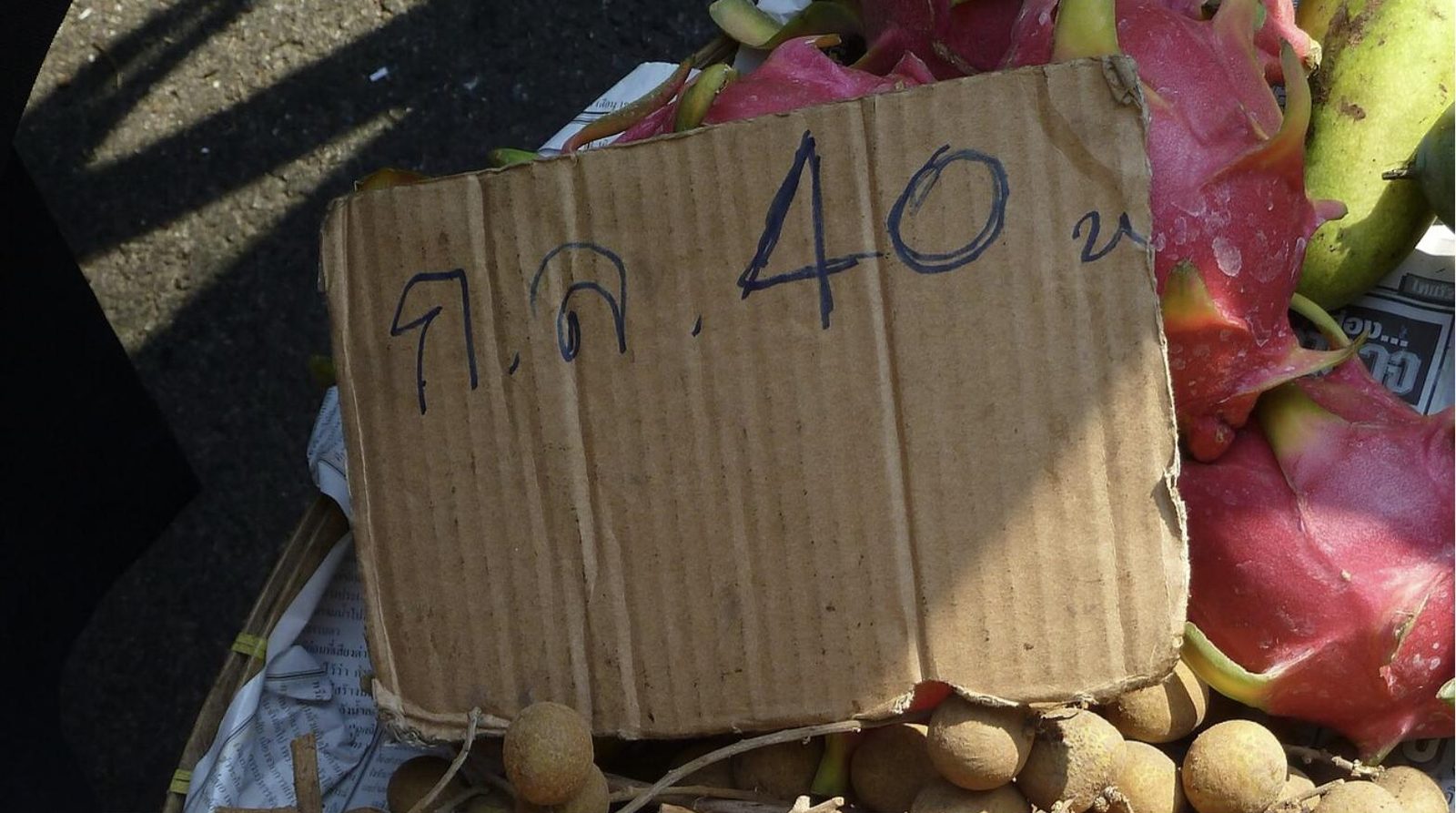
| ลำไย | lam-yai | longan — the small brown-shelled ones in the photo above |
| ลิ้นจี่ | lin-chi | lychee |
| เงาะ | ngo | rambutan — the red hairy one |
| ทุเรียน | thu-rian | durian — the king of fruit |
| มังคุด | mang-khut | mangosteen — the queen |
| แก้วมังกร | kaeo-mang-kon | dragon fruit — literally “dragon crystal” |
| ขนุน | kha-nun | jackfruit |
| น้อยหน่า | noi-na | custard apple |
| ชมพู่ | chom-phu | rose apple — crunchy, faintly sweet |
| มะขาม | ma-kham | tamarind — sweet or sour depending on the pod |
The มะ pattern that unlocks half the list
Read down the table and something jumps out: มะม่วง, มะละกอ, มะพร้าว, มะขาม. That opening มะ (ma-) is a worn-down form of หมาก (mak), an old word for fruit or nut. It survives on the front of a long list of produce names, including มะนาว (ma-nao, lime) and มะเขือเทศ (ma-khuea-thet, tomato — literally “foreign eggplant”).
This matters for reading, not just for speaking. Once you know the มะ prefix, you can spot the boundary between syllables on a handwritten sign instead of trying to sound out an unbroken row of Thai letters. Thai does not put spaces between words, so every reliable pattern you learn is a free set of spaces. If the shapes are still slow for you, the Thai alphabet chart lays out all the Thai consonants and vowels in one place, and the free flashcard trainer is built for exactly this kind of ten-minute drilling.
The king and the queen: ทุเรียน and มังคุด
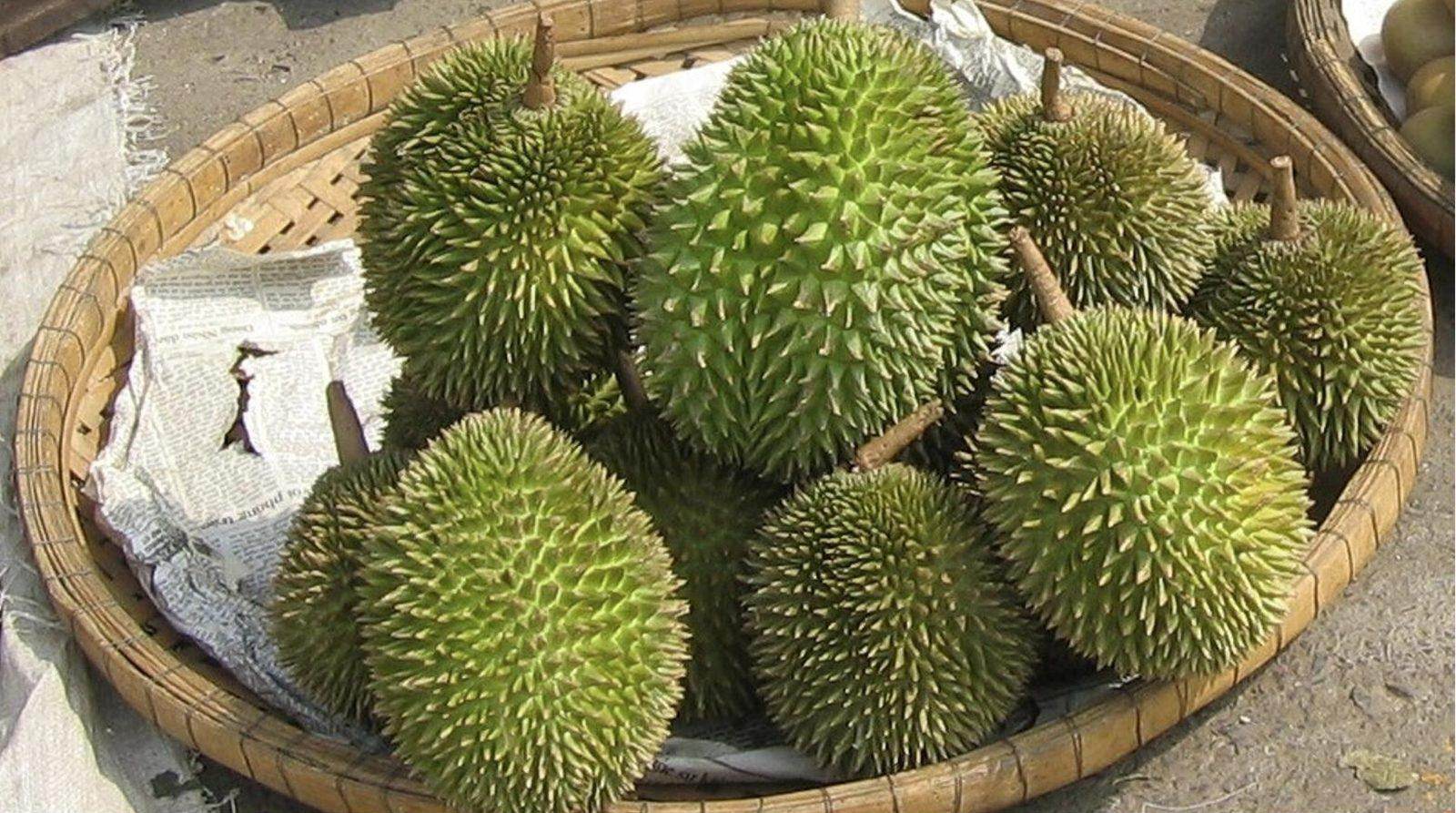
Thai gives durian and mangosteen royal titles: ราชาผลไม้ (ra-cha phon-la-mai, king of fruit) and ราชินีผลไม้ (ra-chi-nee phon-la-mai, queen of fruit). Both peak roughly between April and August, which is when stalls appear on street corners that were selling something else in January.
There is a practical reason to learn ทุเรียน in Thai letters rather than just in sound. Hotels, buses and the Bangkok metro post signs reading ห้ามนำทุเรียนเข้า (ham nam thu-rian khao) — literally “forbidden to bring durian in”. That is not a joke sign; the smell lingers for days. Our guide to Thai vocabulary for the BTS and MRT covers the rest of the words on those station notices.
Read Thai script on the price sign
Fruit signs use a tiny, fixed set of words. Learn these six and you can read almost any stall in the country:
- บาท (baht) — baht, usually abbreviated to บ.
- กิโล / โล (gi-lo / lo) — kilogram, abbreviated on signs as กก.
- ขีด (kheet) — one hundred grams. สามขีด is 300 g, not three of anything.
- ละ (la) — “per”. กิโลละ = per kilo, ลูกละ = per fruit.
- ลด (lot) — reduced, on sale.
- หวาน (waan) — sweet. It appears on signs as a promise.
Thai abbreviates by keeping the first consonant of each part and adding a full stop, which is why กิโลกรัม shrinks to กก. and บาท to บ. Prices are usually written in Arabic numerals, but handwritten signs still use Thai numerals often enough to be worth an hour of study — our explainer on reading Thai numerals in the wild covers those shapes.
Four sentences that get you served
Male speakers end with ครับ (khrap), female speakers with ค่ะ (kha). At a stall this is not optional politeness theatre; it is the difference between a request and a demand. The full logic is in our guide to speaking Thai politely.
- อันนี้อะไรครับ (an-nee a-rai khrap) — “What is this?” The single most productive sentence in this article.
- กิโลละเท่าไหร่ครับ (gi-lo la thao-rai khrap) — “How much per kilo?”
- ขอครึ่งกิโลค่ะ (kho khrueng gi-lo kha) — “Half a kilo, please.”
- หวานไหมครับ (waan mai khrap) — “Is it sweet?” Expect an honest answer.
One more that earns its keep: ขอชิมได้ไหมครับ (kho chim dai mai khrap), “may I try a piece?” Tasting before buying is normal at a fruit stall, and asking in Thai gets a warmer response than reaching for a sample.
Counting fruit needs a classifier. Round fruit take ลูก (luk), so เอาสองลูกครับ is “I’ll take two.” Bananas take หวี (wee) for a whole hand. The written and formal classifier is ผล (phon), which you will see on labels rather than hear at a stall. Our classifiers guide explains why Thai insists on this.
Thai pronunciation traps at the fruit stall
Three pairs cause most of the confusion, and good Thai pronunciation here is what separates being understood from being handed a calculator.
- ฝรั่ง (farang) is guava and the everyday word for a white foreigner. Context decides. Asking for a kilo of ฝรั่ง at a fruit stall is unambiguous and no vendor will blink.
- แตงโม (taeng-mo, watermelon) and แตงกวา (taeng-kwa, cucumber) share the opening แตง. Listen for the second syllable, not the first.
- มะม่วง (ma-muang, mango) sits one small step away from ม่วง (muang, purple) — a handy memory hook, and a reminder that in Thai the tone mark is doing as much work as the letters.
This is the strongest everyday argument for learning to read Thai letters rather than leaning on romanisation. Thai transliteration flattens tones and vowel lengths that the script writes down precisely, which is why the same fruit is spelled three ways on three menus. Work through the Thai consonants and vowels once and the ambiguity disappears.
A study tip that actually works
Do not try to learn all twenty. Pick the five fruits you would genuinely buy this week, write them in Thai script — not in transliteration — on a note in your phone, and use one sentence from this guide each time you pass a stall. Next week, add five more. That habit is how you learn Thai vocabulary that survives past Friday, and it is the same method that works for anyone building Thailand expat language skills from scratch rather than from a textbook.
Then read every cardboard sign you walk past, even the ones for things you are not buying. กก. and บ. and ละ repeat on every stall in the country, and after a week you will stop decoding them and simply read them — which is the whole point. For the vegetables, weights and haggling words that sit one aisle over, our guide to Thai vocabulary at the fresh market picks up where this one stops.