Learn Thai Vocabulary in Thailand: Post Office & Parcels
Learn Thai vocabulary for Thailand's post offices: read the signs, decode postbox collection times, size a parcel box and send it in Thai, with pronunciation.
There is one Thai word printed in metre-high letters in every district of the country, and most foreigners walk past it for years without reading it. It sits on a red sign outside a low building with a motorbike parked in front, and it says ไปรษณีย์. If you want to learn Thai vocabulary that actually gets something done in Thailand, the post office is a better classroom than most: the signs repeat nationwide, the transaction is short, and nobody minds if you take two attempts at it.
This is a beginner Thai lesson for people who know a handful of Thai letters and want to use them somewhere real. Everything below appears in Thai script, in Thai transliteration, and with the literal English underneath, because Thai postal words are built from ordinary pieces you will meet again on forms, parcels and shop fronts.
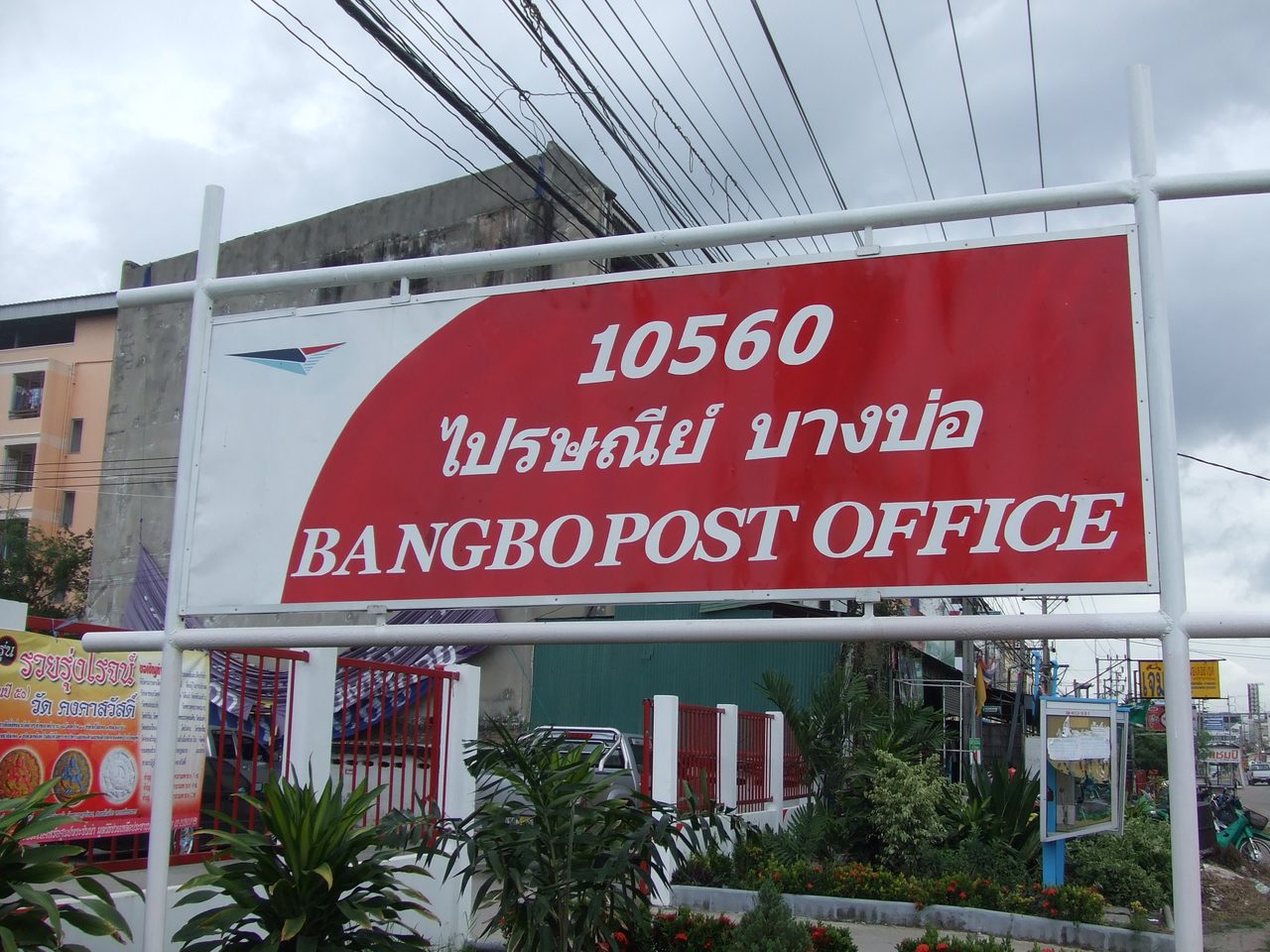
ไปรษณีย์: the word to read first
Eight Thai letters, four sounds, one silent ending. Pulling this word apart is a short course in why Thai spelling looks harder than it is:
- ไปรษณีย์ (prai-sà-nii) — post, postal, the mail.
- The vowel ไ is written before the consonants it is pronounced after, so ไปร reads prai, not ai-por-ror.
- ษ and ณ are two of the rare Sanskrit-borrowed Thai consonants. They sound exactly like the common ส (s) and น (n) — the extra letters mark the word’s foreign ancestry, not a new sound.
- The little hook on the final ย์ is thanthakhat, and it means “do not pronounce this letter”. Thai keeps the original spelling and simply switches the sound off.
Build on it and you have the rest of the signage for free: ไปรษณีย์ไทย (prai-sà-nii thai), Thailand Post, the national operator; ที่ทำการไปรษณีย์ (thîi-tham-gaan prai-sà-nii), “the place where postal work is done”, the formal name on maps; and รหัสไปรษณีย์ (rá-hàt prai-sà-nii), the postcode — the number you will be asked for every time you fill in a Thai address. Our guide to reading a Thai address covers the rest of that line.
Read Thai script on a red postbox
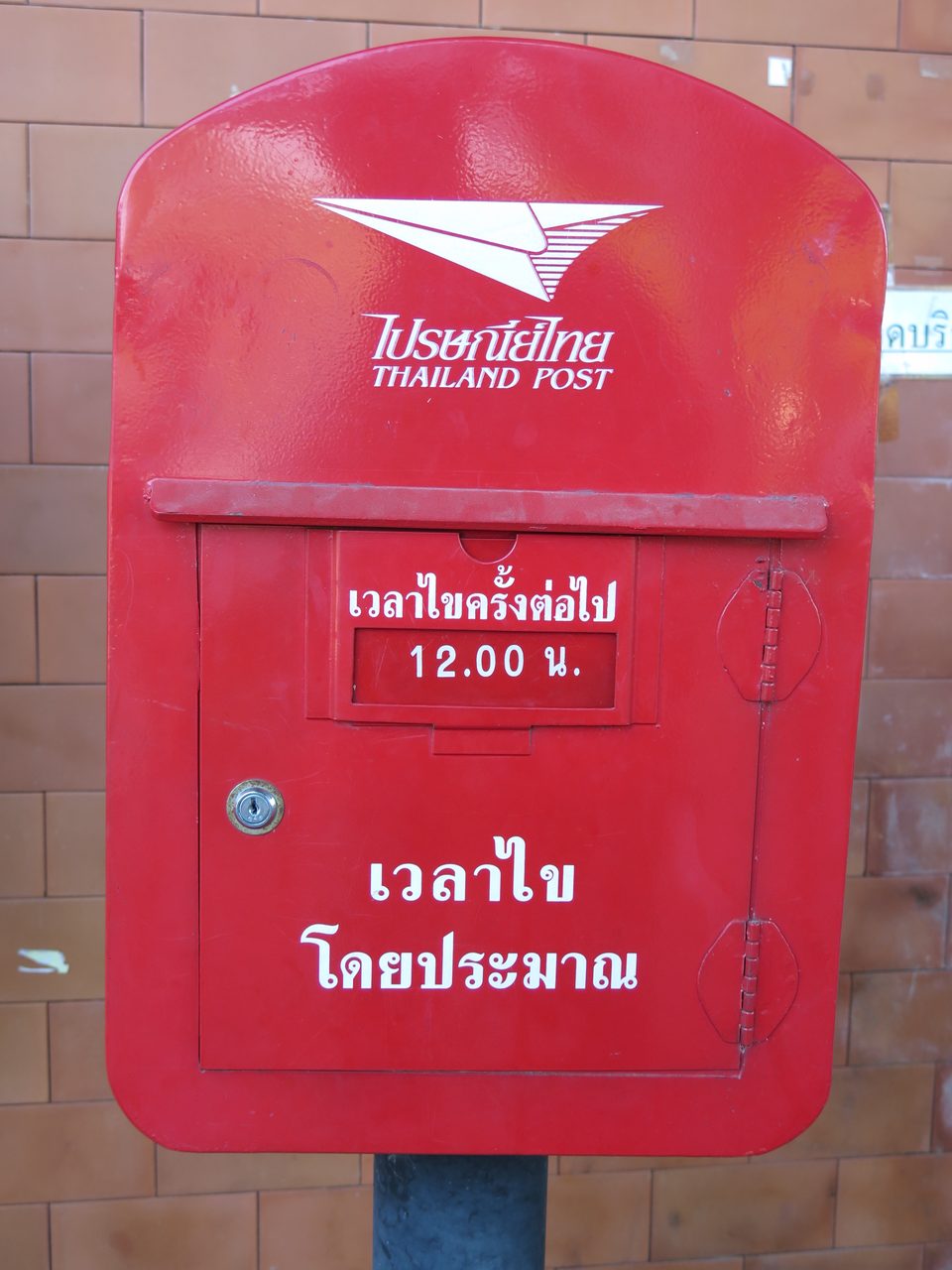
A postbox is the kindest place in Thailand to learn Thai vocabulary by reading, because you already know roughly what it has to be telling you:
- เวลา (we-laa) — time. It opens hundreds of Thai signs.
- ไข (khǎi) — to unlock, to open up. Here it means the collection: a postal worker unlocks the box and empties it.
- ครั้งต่อไป (kráng dòr-bpai) — next time round. ต่อไป on its own means “onwards, next” and turns up constantly in conversation.
- น. — the abbreviation for นาฬิกา (naa-lí-gaa), o’clock. So 12.00 น. is twelve hundred hours.
- โดยประมาณ (dooi brà-maan) — approximately. A very Thai piece of hedging, and worth knowing before you plan a day around a posted time.
Learn Thai vocabulary for what you are sending
Say the right noun and the counter staff will do the rest. These eight cover almost everything that crosses a Thai post office counter:
| Thai | Thai transliteration | Meaning |
|---|---|---|
| จดหมาย | jòt-mǎai | Letter |
| พัสดุ | phát-sà-dù | Parcel, package |
| กล่อง | glòng | Box |
| ซอง | sorng | Envelope |
| แสตมป์ | sà-dtaem | Stamp (English, in Thai letters, with a silent final) |
| ไปรษณียบัตร | prai-sà-nii-yá-bàt | Postcard |
| ลงทะเบียน | long tá-bian | Registered post |
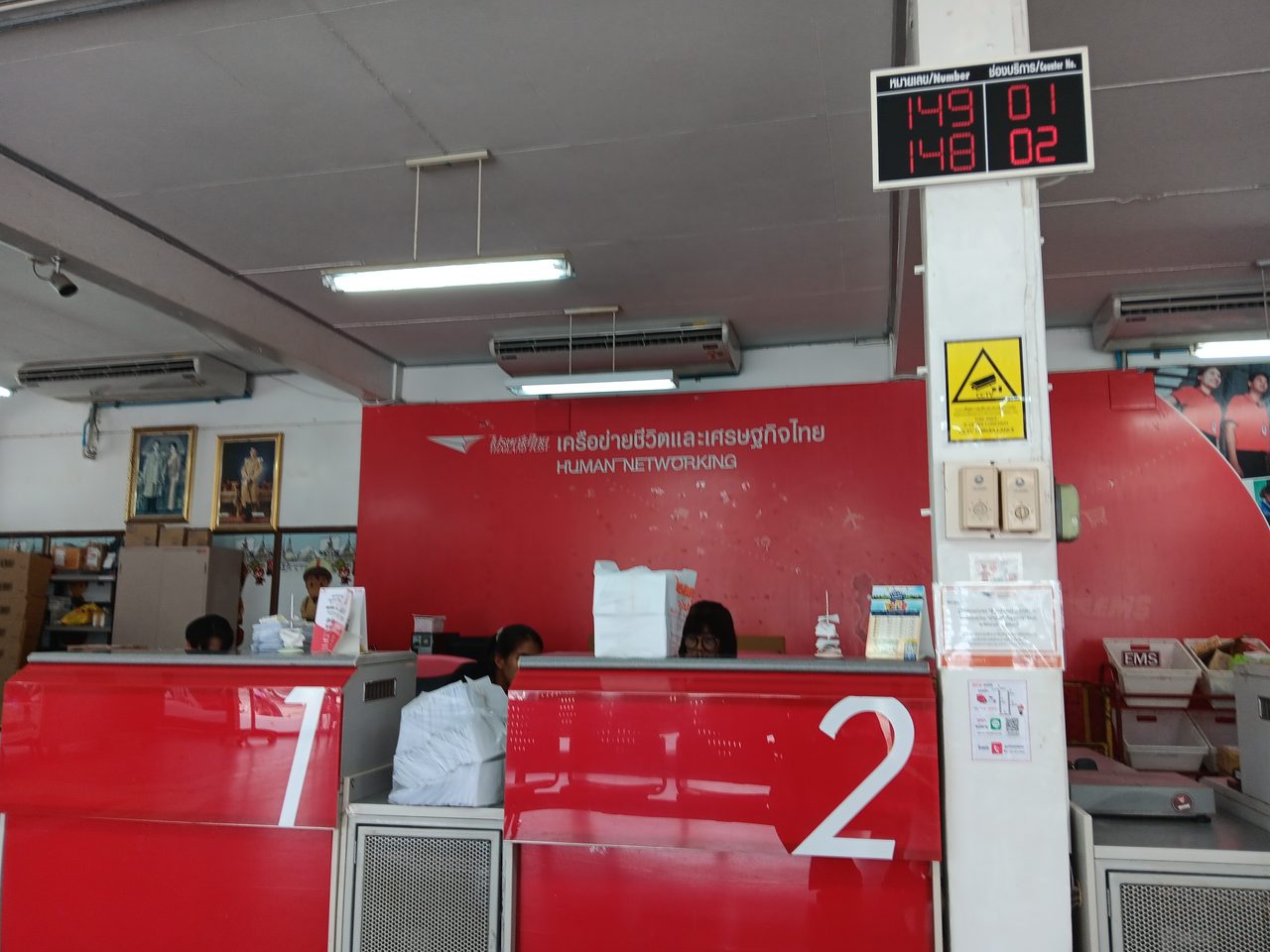
| ด่วนพิเศษ | dùan phí-sèt | EMS — literally “special express” |
Two of these teach a rule rather than a word. แสตมป์ is English “stamp” wearing Thai clothes, with the same silent-letter hook you met in ไปรษณีย์. And ด่วนพิเศษ is what the red EMS trays behind the counter are called in Thai, even though the staff will cheerfully say “EMS” back to you. If the letter shapes are still slowing you down, our Thai alphabet chart lays out the Thai consonants and vowels in a single screen.
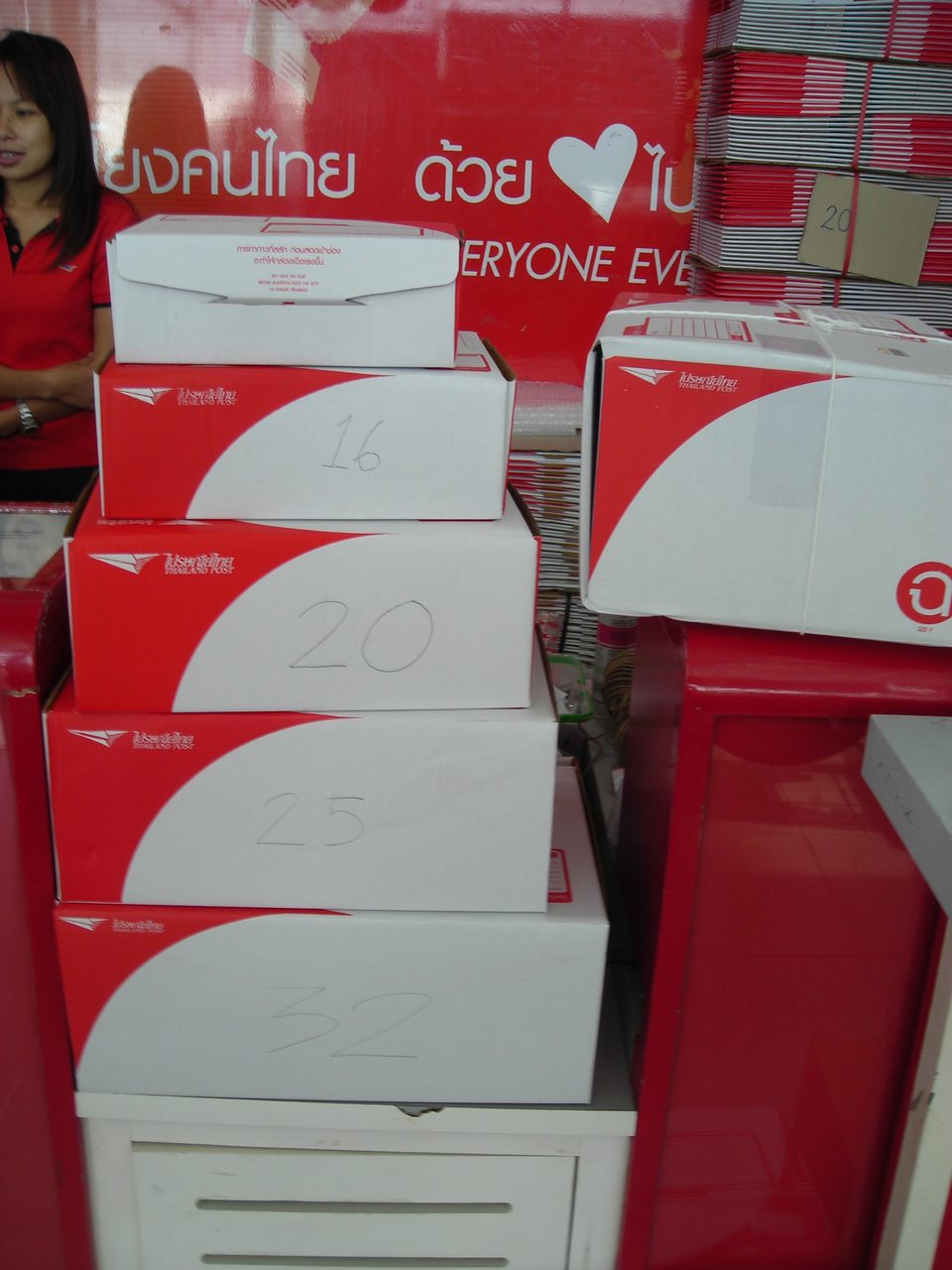
Speak Thai at the counter: five sentences
A Thai post office transaction is short and it is the same every time, which makes it an ideal place to speak Thai out loud without an audience. Learn these five and you can post anything:
- ส่งไปอเมริกาครับ (sòng bpai à-mee-rí-gaa khráp) — “Sending to America, please.” Swap in any country. ส่ง is “to send”, ไป is “to go”.
- ทางอากาศหรือทางเรือคะ (thaang aa-gàat rǔe thaang ruea khá) — “By air or by sea?” This is the question you will be asked. ทาง means “by way of”.
- กี่วันถึงครับ (gîi wan thǔeng khráp) — “How many days until it arrives?”
- ค่าส่งเท่าไหร่คะ (khâa sòng thâo-rài khâ) — “How much is the postage?” ค่า in front of a verb makes it “the fee for”.
- ขอแสตมป์สามดวงครับ (khǝr sà-dtaem sǎam duang khráp) — “Three stamps, please.” ดวง is the classifier Thai uses for stamps.
The particle on the end is not decoration. Men finish with ครับ (khráp) and women with ค่ะ (khâ), and you use the one that matches you, not the person you are talking to. Dropping it turns a request into an instruction. It is the first habit of Thailand expat language, and our guide to speaking Thai politely takes it apart properly.
ผู้ส่ง and ผู้รับ: filling in the slip
The form is where a little Thai pronunciation practice turns into something you can actually read, and where you learn Thai vocabulary that reappears on every delivery app and visa form in the country. Five labels do the whole thing:
- ผู้ส่ง (phûu sòng) — sender. Literally “person who sends”.
- ผู้รับ (phûu ráp) — recipient. “Person who receives”.
- ที่อยู่ (thîi yùu) — address. Literally “place of being”.
- รหัสไปรษณีย์ (rá-hàt prai-sà-nii) — postcode.
- เบอร์โทร (boe thoh) — phone number. Thailand Post will not take an international parcel without one.
That ผู้ (phûu) prefix is the real prize. Stick it in front of a verb and you get the person who does it: ผู้จัดการ (phûu jàt-gaan) a manager, ผู้โดยสาร (phûu dooi-sǎan) a passenger, ผู้ป่วย (phûu bùai) a patient. One prefix, a hundred nouns — which is the sort of return that makes learning to read Thai script worth the early weeks.
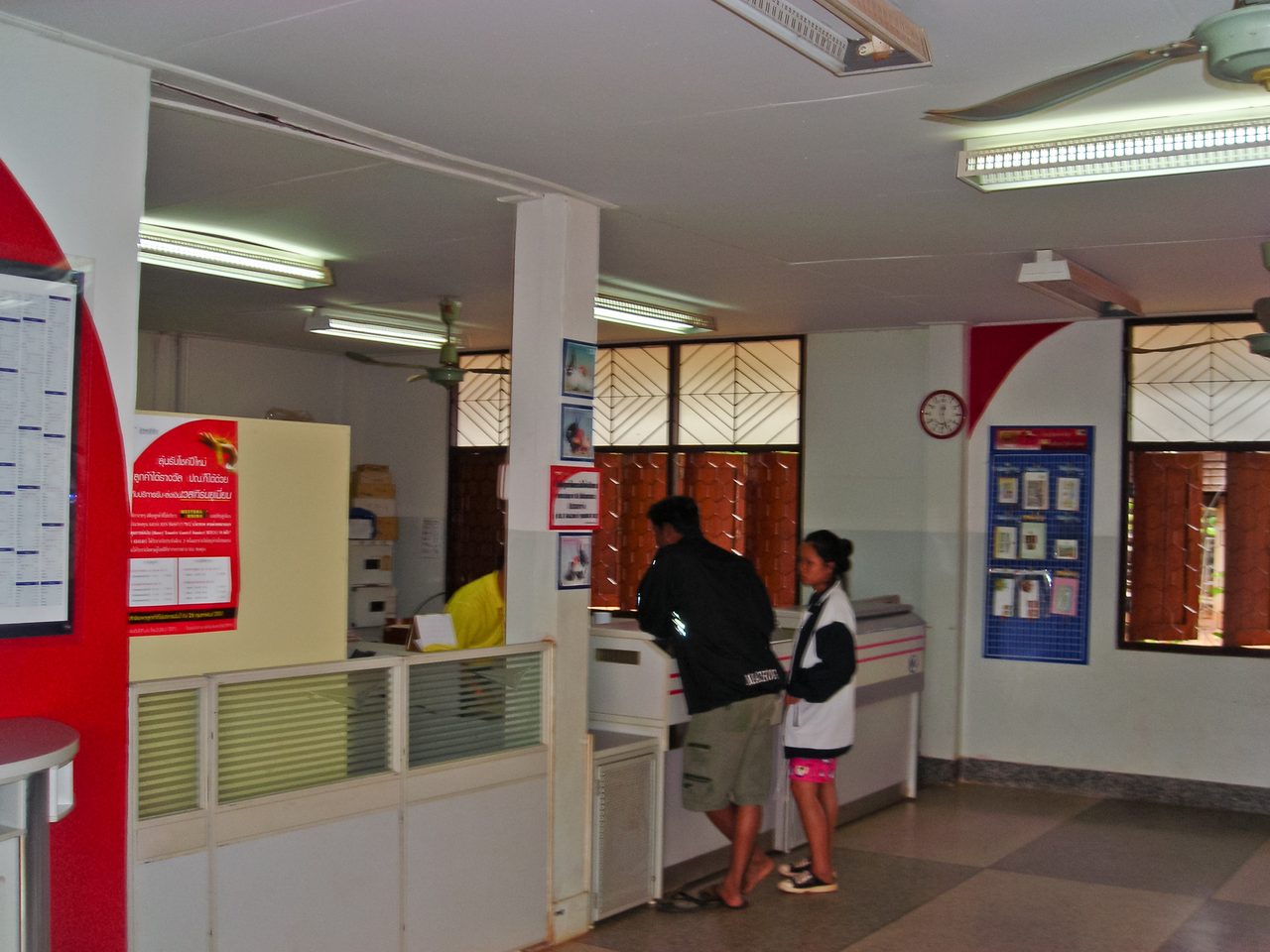
A study tip: post one thing, badly
Do not revise this page. Go and post something small and cheap — a postcard home, a book to a friend in Chiang Mai — and use exactly two of the sentences above. You will mangle a tone, the clerk will repeat the word back correctly, and that single correction will stick harder than an hour of flashcards. Then photograph the postbox on your way out and copy its four lines into a notebook by hand that evening. Handwriting is what moves a word from “I have seen that shape” to “I can read that word”.
The post office is a good place to learn Thai vocabulary precisely because it repeats: the same red sign, the same five form labels, the same question about air or sea, in every province. Once ไปรษณีย์ stops being a shape and starts being a word, take the habit somewhere harder — try our guide to reading Thai numerals, or drill the Thai alphabet itself with the free ThaiLetters flashcard trainer.