Read Thai Script in Thailand: Toilet & Bathroom Signs
Read Thai script on Thailand's toilet signs: hong nam, sukha, chai and ying, plus how to ask where the bathroom is, with pronunciation and real photos.
Of all the places to start when you want to read Thai script in the wild, the door of a public toilet is the most useful one in Thailand. There are only ever a handful of words on it, the same words repeat in every province, and the stakes are high enough that you will remember them after one try. Learn six short words and you will never again stand in a corridor in Chiang Mai guessing which door is yours.
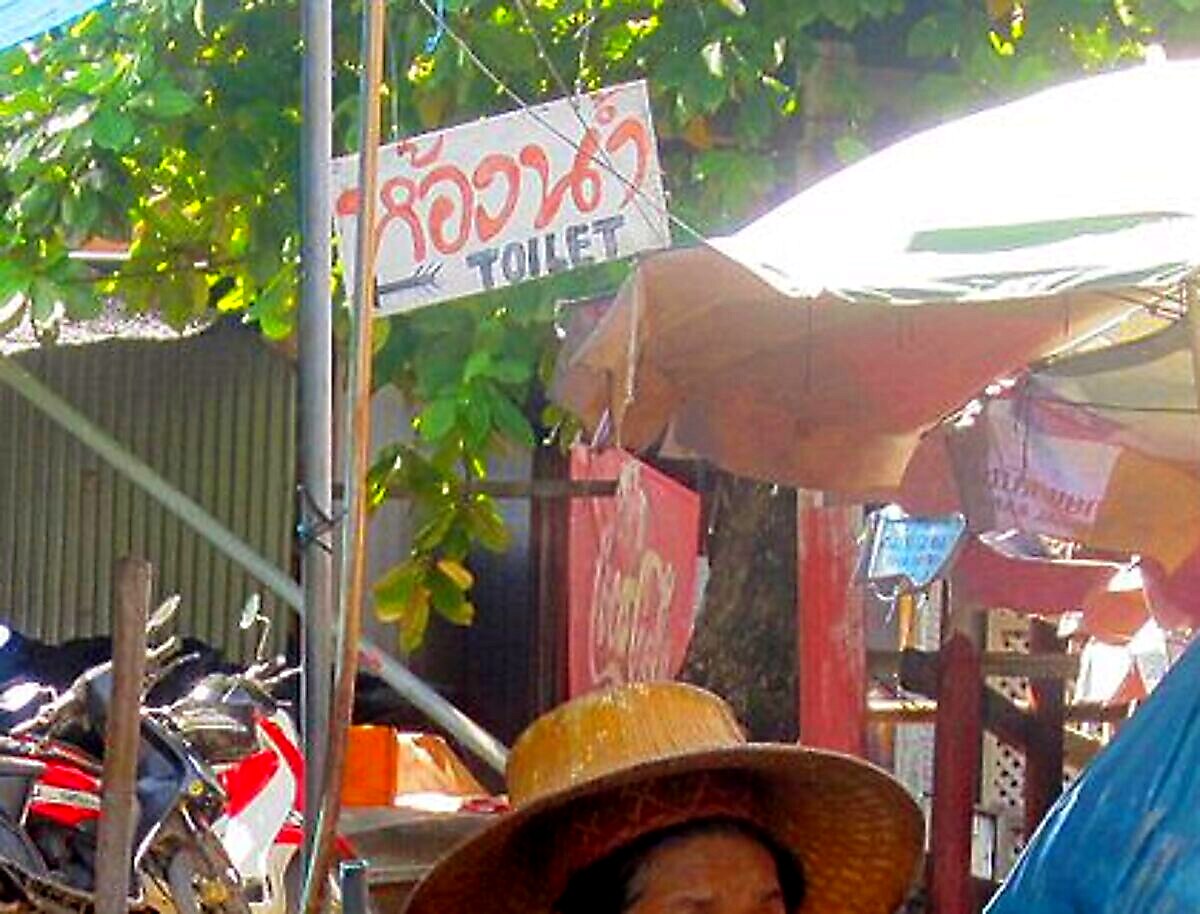
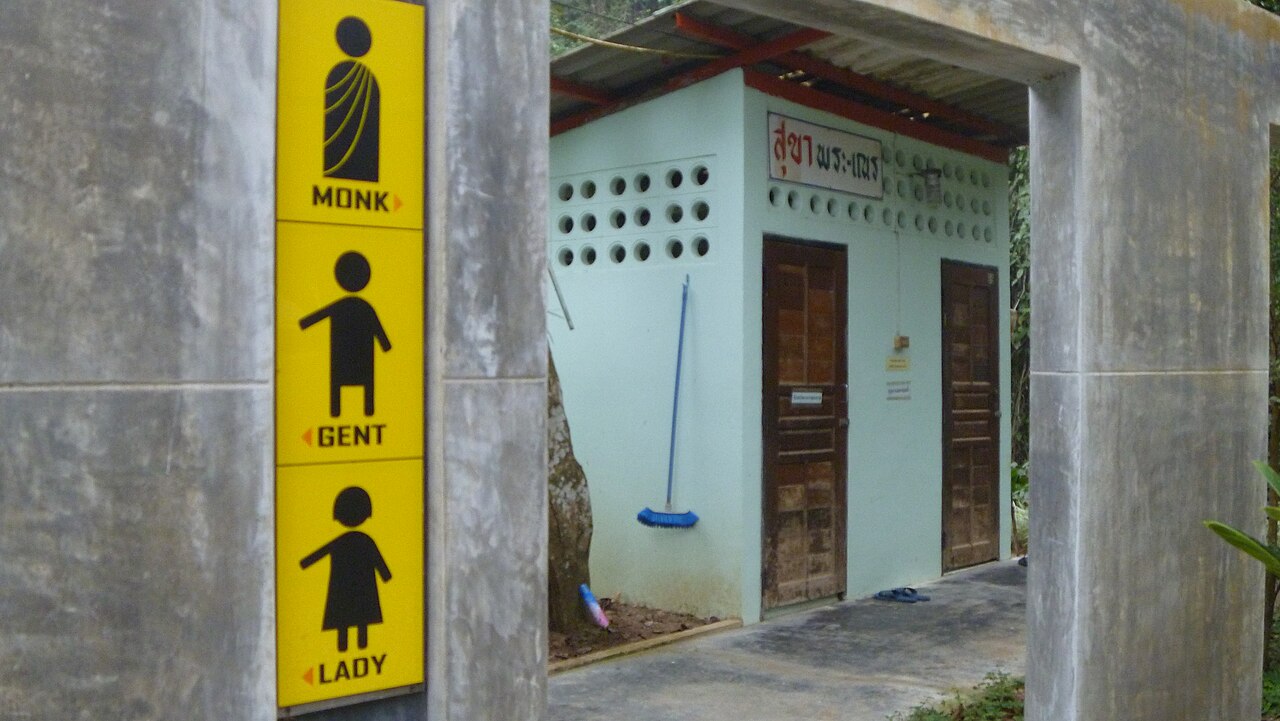
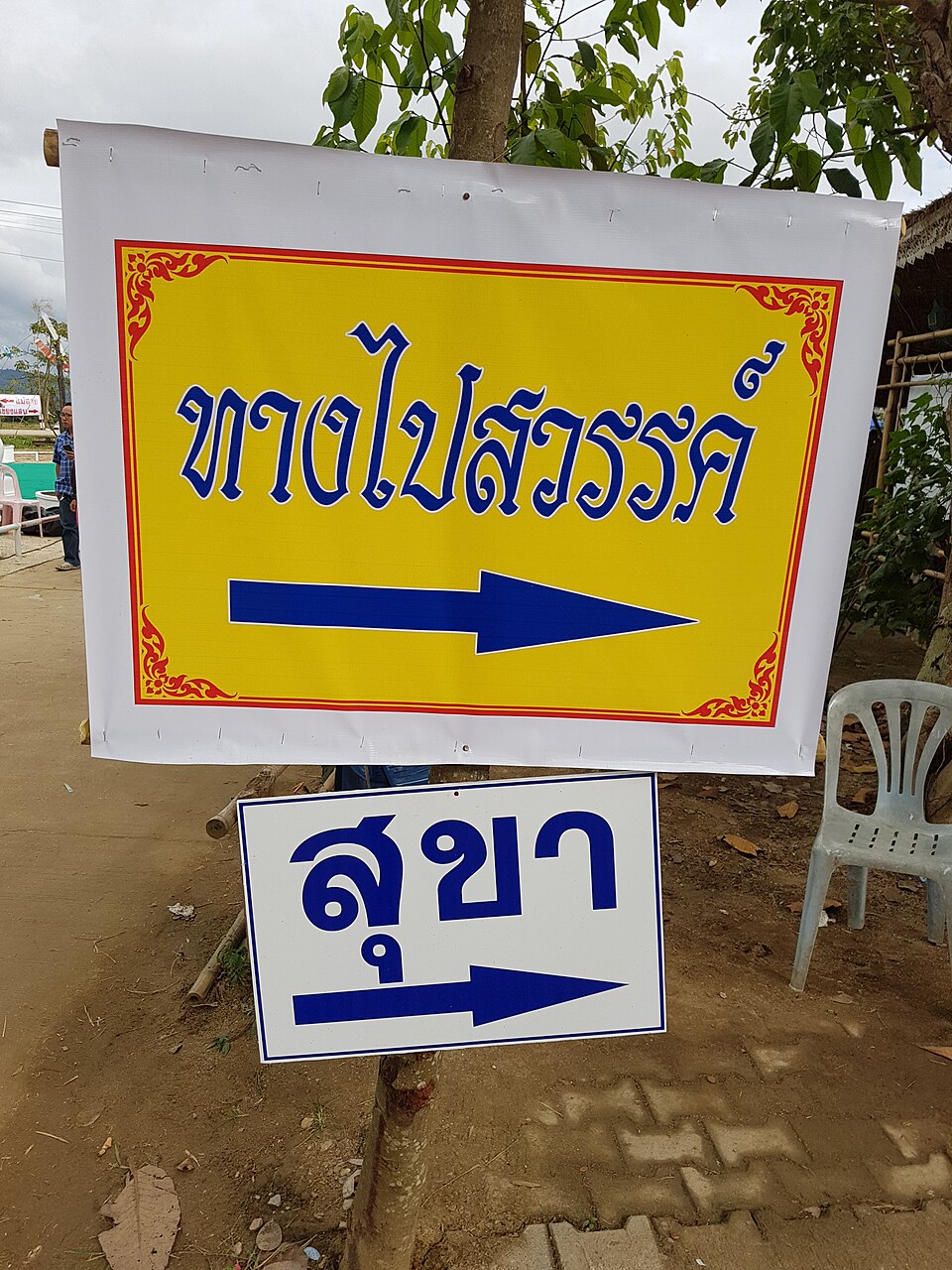
This is a beginner Thai lesson built around four real signs — an airport corridor, a floating market, a temple in the hills and a roadside banner in Chiang Rai. Everything below is given in Thai script, in Thai transliteration, and with the literal English underneath, because Thai toilet vocabulary is assembled from ordinary pieces you will meet again on hotel doors, menus and maps. If you have been learning to read Thai script from a chart, this is where the chart starts paying rent.
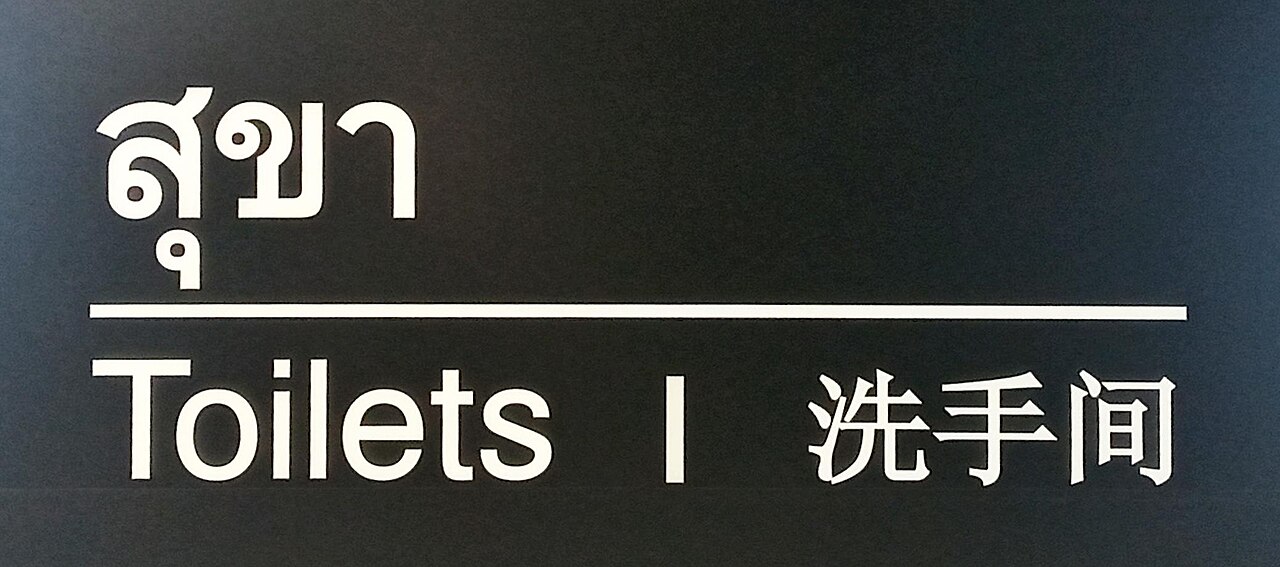
ห้องน้ำ: the word you will see most
This is the everyday word, the one Thai people actually say, and the one hand-painted on plywood at the back of markets. ห้องน้ำ (hôrng-náam) is two words glued together, and neither of them means “toilet”:
- ห้อง (hôrng) — room. Four Thai letters: ห + the tone mark ้ + อ + ง.
- น้ำ (náam) — water.
- Together, literally “water room” — which is exactly what a traditional Thai bathroom is: a tiled room with a tap, a scoop and a drain in the floor.
Both halves are worth a minute of your time, because this is where Thai consonants and vowels start paying you back. In ห้อง, the อ is not a consonant at all here — it is carrying the “or” vowel. In น้ำ, the little circle-and-tail ำ is the vowel am, written after the consonant and pronounced after it too, which is a mercy; many Thai vowels are not so polite. Once you can see ห้อง you get a shelf of free vocabulary: ห้องพัก (hôrng phák, a hotel room), ห้องครัว (hôrng khrua, kitchen), ห้องเรียน (hôrng rian, classroom). And น้ำ gives you น้ำแข็ง (náam khǎng, ice) and น้ำตก (náam dtòk, waterfall — literally “falling water”).
สุขา: the formal word on public buildings
Airports, train stations, museums, national parks and temple grounds tend to use สุขา (sù-khǎa) instead. It is a borrowed word, from the same root as the Pali sukha, “ease” or “comfort”, and it has the faintly official ring of “lavatory” in English. Nobody says it over lunch — you read it, you do not need to say it. It is also a soft early win when you read Thai script on official signage: three letters, no tone marks, nothing stacked.
- สุขา (sù-khǎa) — lavatory, public convenience.
- ห้องสุขา (hôrng sù-khǎa) — the same thing with ห้อง bolted on the front.
- ส้วม (sûam) — the blunt word, closer to “latrine”. You will read it on plumbing notices, not on doors.
Thai letters on the two doors: ชาย and หญิง
Here is the pair that actually decides which handle you pull, and the best single argument for learning to read Thai script instead of hunting for a pictogram. Most Thai signage uses the plain words for male and female; smarter hotels and older government buildings use a politer pair that looks completely different. Learn all four and you are covered.
| Thai | Thai transliteration | Meaning |
|---|---|---|
| ชาย | chaai | male, men |
| หญิง | yǐng | female, women |
| บุรุษ | bù-rùt | gentlemen (formal) |
| สตรี | sà-trii | ladies (formal) |
| พระ-เณร | phrá-neen | monks and novices |
| คนพิการ | khon phí-gaan | people with disabilities |
A trick for telling the first two apart at ten paces, before your Thai pronunciation is anywhere near reliable: ชาย is short, flat and open, three letters with nothing hanging below the line. หญิง has ญ in the middle, the letter with the curly tail that drops below the baseline, and a small vowel mark sitting on top. Tails below the line, ladies. It is crude, it is not grammar, and it works at a petrol station at midnight.
Speak Thai: how to ask where it is
Reading gets you through the door; one sentence gets you to the building. This is a good first sentence to speak Thai with, because the answer is usually a pointed finger, so you cannot really fail:
- ขอโทษครับ (khǎaw-thôot khráp) — “Excuse me.” Literally “I ask for forgiveness.”
- ห้องน้ำอยู่ไหนครับ (hôrng-náam yùu nǎi khráp) — “Where is the toilet?” Word for word: “toilet is-located where.”
- ใช้ห้องน้ำได้ไหมครับ (chái hôrng-náam dâi mǎi khráp) — “May I use the toilet?” For cafes and shops where it is somebody’s private one.
Then listen for four replies, which between them cover almost every answer you will get: ตรงไป (dtrong bpai, straight on), เลี้ยวซ้าย (líao sáai, turn left), เลี้ยวขวา (líao khwǎa, turn right) and ข้างหลัง (khâang lǎng, round the back), which in Thailand is where it usually is. The particle on the end of your question is not optional decoration: men close with ครับ (khráp) and women with ค่ะ (khâ), and leaving it off makes a reasonable question sound like an order. We pull that apart in the guide to speaking Thai politely with khrap and kha.
The small print: free, ten baht, out of order
Once the door is found, the rest of the Thai on it is short and worth knowing. This is the stuff that separates a tourist from somebody settling into Thailand expat language — none of it is hard, and all of it is written in the same common Thai letters you are already learning. These five are the point at which you stop translating and simply read Thai script.
- ฟรี (frii) — free. An English loanword, spelled out in Thai letters.
- ๑๐ บาท (sìp bàat) — 10 baht. Market and bus-station toilets often charge, and often write the price in Thai numerals. Our guide to reading Thai numerals on prices and dates covers the ten digits in about five minutes.
- ชำรุด (cham-rút) — broken, out of order.
- ปิดปรับปรุง (bpìt bpràp-bprung) — closed for repairs.
- กรุณาทิ้งกระดาษลงถัง (gà-rú-naa thíng grà-dàat long thǎng) — “please put paper in the bin”. Thai plumbing is narrow; this one is not a suggestion.
A study tip: read the door before you push it
Do not revise this page. Instead, make a rule for the next week: you are not allowed to open a door in Thailand until you have read what is painted on it out loud. A shopping mall will give you หญิง and ชาย twenty times in an afternoon. A temple will add สุขา. A market will hand you a crooked, hand-painted ห้องน้ำ that looks nothing like the typeface in your textbook, which is precisely the version you need to be able to read.
That is the whole method, really. You read Thai script fastest where the words are few, the context is obvious and you will be back tomorrow — and nowhere fits that better than a toilet door. When you want the letters themselves rather than the words they build, our free Thai alphabet chart lays out all 44 consonants and the vowel signs in one place, and the ThaiLetters flashcard trainer will drill them into you ten minutes at a time. Start with ห, น, ช and หญ. You have already met them today.