Learn Thai Vocabulary in Thailand: Petrol Station Signs
Learn Thai vocabulary for petrol stations in Thailand: fuel names in Thai script, pronunciation, the pillar safety sign and the phrases that fill a tank.
A Thai petrol station is the most forgiving classroom in the country. You are standing still, the words are printed in letters a metre high, and the person serving you is not in a hurry. If you want to learn Thai vocabulary that pays for itself in your first week in Thailand, start on a forecourt: six fuel words, three sentences, and one safety notice that appears, almost unchanged, at every station from Chiang Rai to Betong.
This is a beginner Thai lesson for people who can pick out a few Thai letters and not much more. Everything below comes in Thai script, in Thai transliteration, and with the literal English underneath — because Thai fuel words are built from ordinary parts you will meet again on menus and road signs.
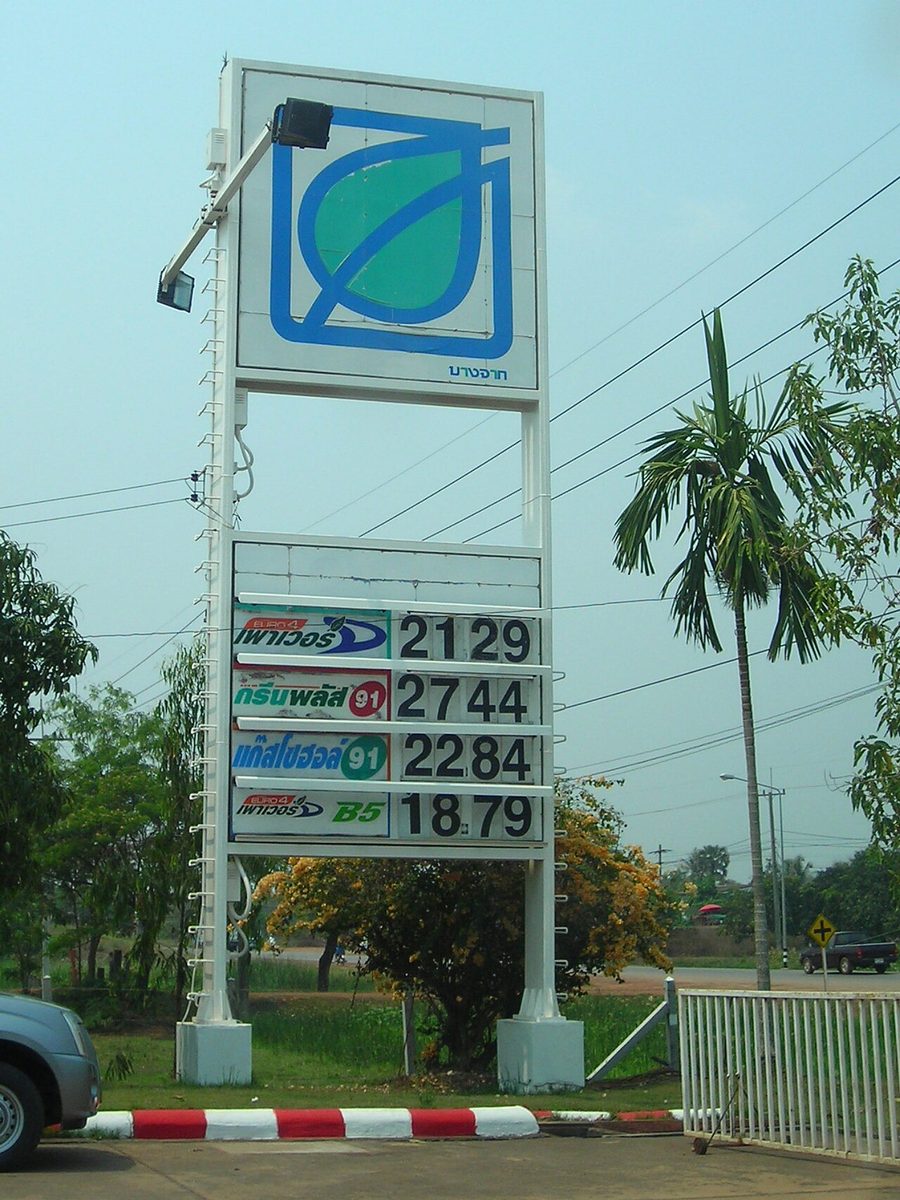
น้ำมัน: the one word holding the forecourt together
Nearly every sign on a Thai forecourt is a variation on a single word. Learn it once and the rest fall into place:
- น้ำมัน (nám-man) — fuel, and also cooking oil, engine oil, any oil at all. Literally น้ำ (nám, water) + มัน (man, grease). “Grease-water”.
- ปั๊มน้ำมัน (pám nám-man) — a petrol station. ปั๊ม is the English word “pump” in Thai letters. This is what everybody actually says.
- สถานีบริการน้ำมัน (sà-thǎa-nii bor-rí-gaan nám-man) — “fuel service station”, the formal version printed on road signs.
- เติม (toem) — to fill, to top up. Used for fuel, for tyre air, and for phone credit.
- เต็มถัง (tem thǎng) — a full tank. เต็ม is “full”, ถัง is a tank or a bucket.
Note how close เติม (toem, to fill) and เต็ม (tem, full) look: one small mark apart. That is the sort of pair that rewards learning to read Thai script properly instead of guessing from shape. น้ำมัน is tidy practice in itself, with two vowels that never touch the baseline — the ำ ending of น้ำ, and the curl above the ม in มัน.
Learn Thai vocabulary for every grade on the board
Thai stations sell more grades than most countries, and the wrong one in a rental car is an expensive mistake. Almost all the names are English borrowed into Thai letters, so this table is a reading exercise with a practical payoff.
| Thai | Thai transliteration | What it is |
|---|---|---|
| ดีเซล | dii-sen | Diesel |
| เบนซิน | ben-sin | Plain petrol, no ethanol |
| แก๊สโซฮอล์ | gáet-soh-hol | Gasohol — petrol blended with ethanol |
| แก๊สโซฮอล์ 91 / 95 | gáet-soh-hol gâo-sìp-èt / gâo-sìp-hâa | Gasohol at 91 or 95 octane |
| อี 20 | ii yîi-sìp | E20, twenty per cent ethanol |
| บี 7 | bii jèt | B7 diesel, seven per cent biodiesel |
| พรีเมียม | phrii-miam | Premium, in either fuel family |
| ลิตร | lít | Litre |
| บาท | bàat | Baht |
Two entries teach rules worth thousands of other words. In ดีเซล the vowel เ is written before the consonant it is pronounced after, and the final ล comes out as an n. In แก๊สโซฮอล์ that last ล wears a tiny hook, ์, meaning “this letter is silent”. Thai consonants and vowels behave this way everywhere; petrol is simply where you meet them at billboard size. If the shapes are still unfamiliar, start with our Thai alphabet chart.
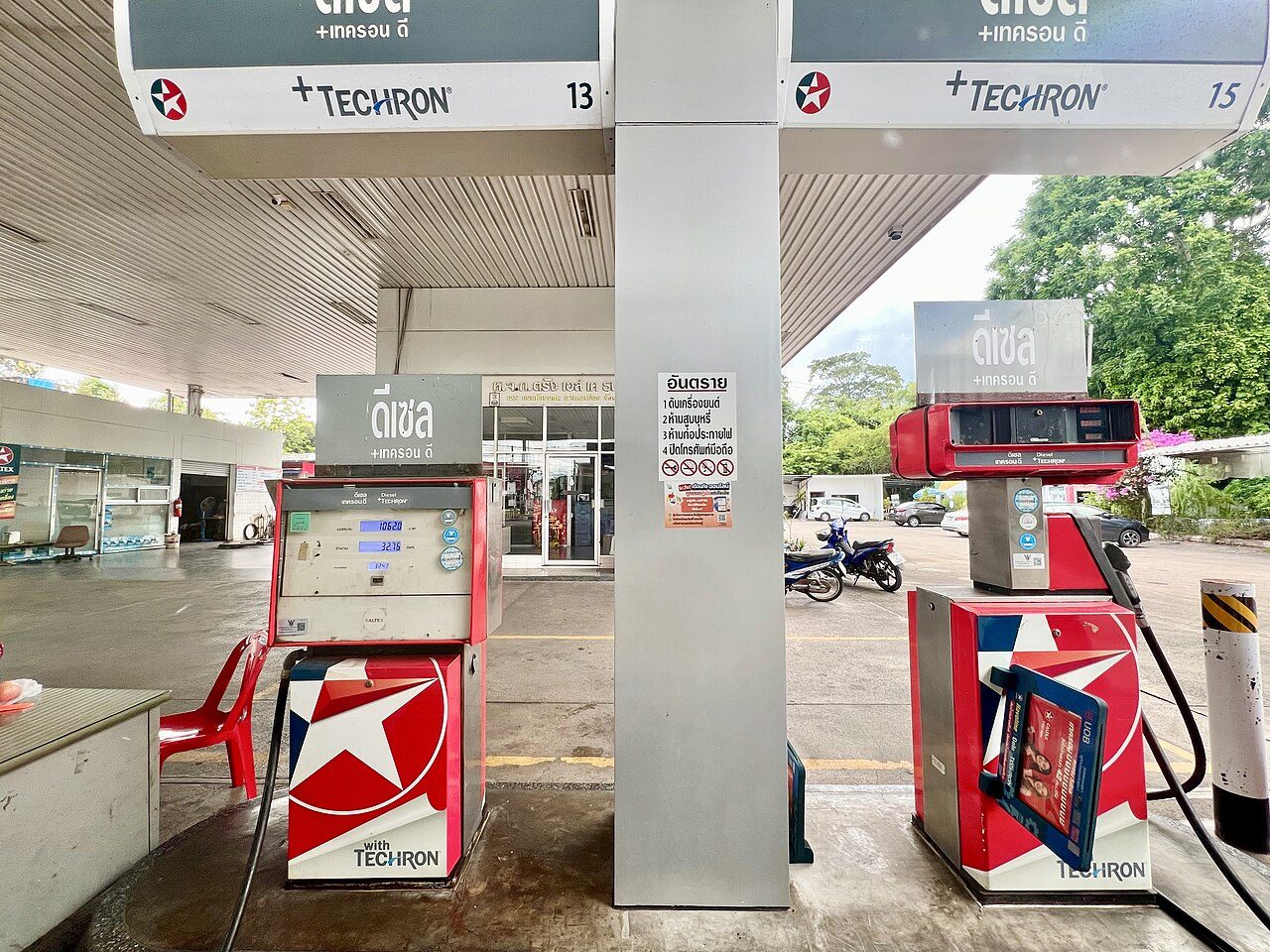
Speak Thai at the pump: three sentences do everything
Thai stations are full service. You stay in the car, an attendant comes to the window, and the whole transaction is one sentence long — which makes it the easiest place in the country to learn Thai vocabulary by using it. The attendant is a เด็กปั๊ม (dèk pám), literally “pump kid”, used regardless of age.
- เต็มถังครับ (tem thǎng khráp) — “Full tank, please.” The most useful three syllables on this page.
- เติมร้อยนึงค่ะ (toem rói nueng khâ) — “A hundred baht’s worth, please.” Swap in any number; on a motorbike this is the normal order.
- ดีเซล เต็มถังครับ (dii-sen tem thǎng khráp) — fuel type first, then the amount. That is the whole grammar of it.
- ขอใบเสร็จด้วยครับ (khǒr bai sèt dûai khráp) — “A receipt as well, please.”
- เท่าไหร่ครับ (thâo-rài khráp) — “How much?”
The particle at the end is not optional politeness in Thailand — it is the difference between a request and an order. Men say ครับ (khráp), women say ค่ะ (khâ), and you use your own, not the one matching the person you are speaking to. It is the first habit of Thailand expat language, covered fully in our guide to speaking Thai politely.
The danger notice: free Thai reading practice, every time
The notice on the pillar above is standard and repeated at thousands of stations. Because you already know roughly what it must say, it is unusually kind text to decode.
- อันตราย (an-dtà-raai) — Danger. The heading, always in red.
- 1. ดับเครื่องยนต์ (dàp khrûeang-yon) — Switch off the engine. ดับ is the verb for extinguishing a flame.
- 2. ห้ามสูบบุหรี่ (hâam sùup bù-rìi) — No smoking. ห้าม means “forbidden”.
- 3. ห้ามก่อประกายไฟ (hâam gòr prà-gaai fai) — No sparks. Literally “forbidden to cause spark fire”.
- 4. ปิดโทรศัพท์มือถือ (pìt thoh-rá-sàp mueu-thǔeu) — Turn off your mobile phone. Literally “close the hand-held telephone”.
That one word ห้าม is the takeaway. Once it is in your eye you will see it on park gates, temple doors, lift walls and beaches, and you will know the sign forbids whatever is pictured beside it. Our guide to Thai warning signs takes the same word through a dozen more settings.
The village pump, and the bottles on the rack
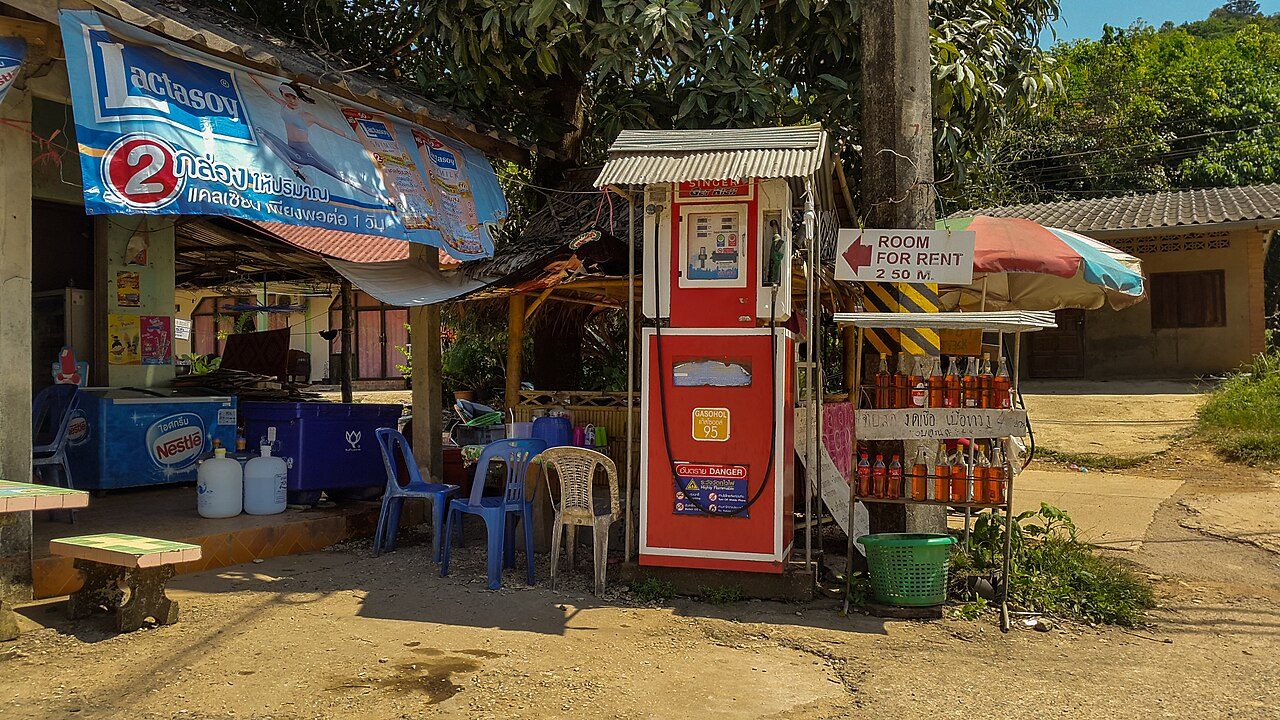
Away from the highways, fuel is sold by the bottle from a rack outside a shop — usually a one-litre spirit bottle, enough to get a motorbike to a real station. Ask for น้ำมันขวด (nám-man khùat); ขวด is “bottle”, and expect a small premium over pump prices.
When the sign says หมด
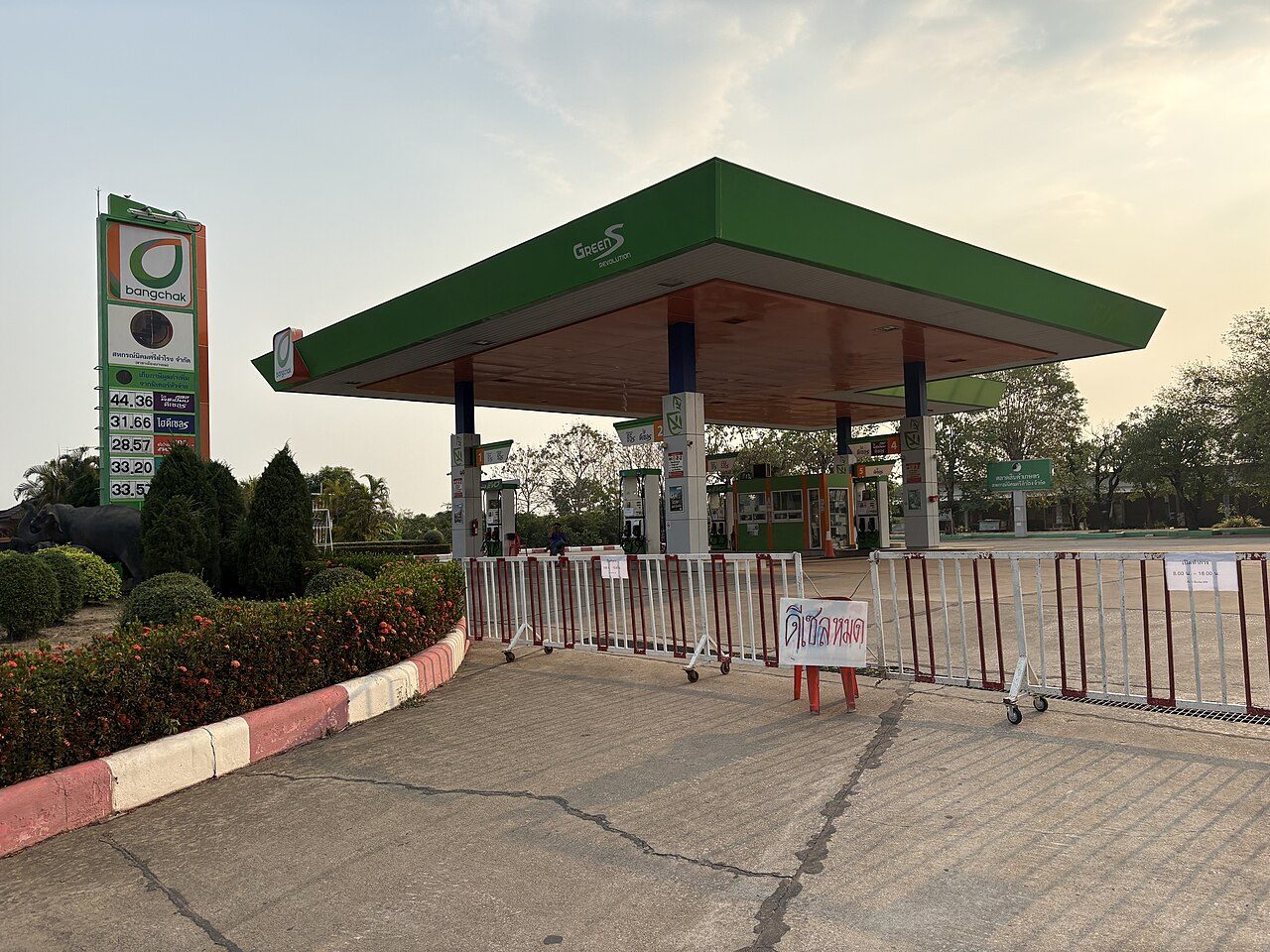
หมด (mòt) means used up, finished, none left — and it is not limited to fuel. It is what you hear when a dish is off, when a size is out of stock, when the last bus has gone. Put it after a noun and it needs no other grammar: ข้าวหมด (khâao mòt), the rice is finished. Three letters, and a whole category of disappointment becomes readable.
The rest of the forecourt
A Thai station is a small town, and the buildings around the pumps are more free chances to learn Thai vocabulary while you wait:
- เติมลม (toem lom) — free tyre air, literally “fill wind”. ยาง (yaang) is the tyre itself.
- ล้างรถ (láang rót) — car wash. รถ is any vehicle.
- ห้องน้ำ (hông-nám) — toilet, literally “water room”. Every station has one, usually free.
- ร้านสะดวกซื้อ (ráan sà-dùak súeu) — convenience store, literally “convenient-to-buy shop”.
- เงินสด (ngoen sòt) — cash, still the default at small stations.
A study tip: one forecourt, one photograph
Do not try to swallow the tables above in one sitting. Next time you fill up, photograph exactly one sign — a pump hood, the pillar notice, the price board — and that evening copy the Thai letters out by hand, saying each syllable aloud as you write. Handwriting is what moves a word from “I have seen that shape” to “I can read that word”, and a fuel sign is short enough that you will finish it.
The forecourt is a good place to learn Thai vocabulary precisely because it repeats: the same handful of words, in the same places, every time you stop. When the pump hoods stop looking like decoration and start looking like language, take the habit somewhere busier — our guide to asking for directions in Thai, or drill the letters themselves with the free ThaiLetters flashcard trainer.