Thai Address Words: Soi, Thanon, Moo and House Numbers
A Thai address is not an English address in a different alphabet. It runs small to large, it hangs off a numbered lane rather than a street, and half of it appears on the blue plate screwed to somebody’s gatepost. Here is the whole system in Thai script, with pronunciation and literal English.
The fastest way to learn Thai vocabulary that pays for itself is to learn the words in your own address. You will write them on a hotel form, say them to a taxi driver, type them into a delivery app and read them back off a utility bill — all in the first week. This Thai language guide takes a real address apart piece by piece, shows you the words in Thai script with plain transliteration, and explains why ซอย (soi) is the single most important word on any Bangkok street sign.

Why a Thai address runs backwards
An English address starts small and ends large, but only loosely. A Thai address is strictly small to large, every time: house number, then lane, then road, then sub-district, then district, then province, then postcode. Nothing is optional and nothing swaps places. Once you know the order, you can read any address on any envelope in Thailand even if you only recognise three of the words — the position tells you what the rest must be.
Here is a typical one written the Thai way, then the same address in English:
- 123/5 หมู่ 4 ซอยสุขุมวิท 31 ถนนสุขุมวิท แขวงคลองตันเหนือ เขตวัฒนา กรุงเทพฯ 10110
- 123/5, Village 4, Sukhumvit Soi 31, Sukhumvit Road, Khlong Tan Nuea sub-district, Watthana district, Bangkok 10110
The eight words in every Thai address
This is a small, closed set. Learn these eight and you have learned the entire structure, because Thai addresses never introduce a ninth element.
| Thai | Pronunciation | English & notes |
|---|---|---|
| บ้านเลขที่ | baan lek thee | house number — literally “house number-at”; often shortened to เลขที่ on forms |
| หมู่ | moo, falling tone | village cluster — abbreviated ม.; rural and suburban addresses only |
| ซอย | soi | lane branching off a main road — abbreviated ซ. |
| ถนน | tha-non | road — abbreviated ถ. |
| แขวง / ตำบล | khwaeng / tam-bon | sub-district — แขวง inside Bangkok, ตำบล (ต.) everywhere else |
| เขต / อำเภอ | khet / am-phoe | district — เขต inside Bangkok, อำเภอ (อ.) everywhere else |
| จังหวัด | jang-wat | province — abbreviated จ.; Bangkok is never called this, it is just กรุงเทพฯ |
| รหัสไปรษณีย์ | ra-hat prai-sa-nee | postcode — literally “postal code”, always five digits |
The Bangkok / everywhere-else split catches people out constantly. If a form asks for ตำบล and อำเภอ and you live in Bangkok, write your แขวง and เขต in those boxes — they are the same tier of administration under different names.
Read Thai script on a street sign
Thai street signs are bilingual almost everywhere a foreigner is likely to stand, which makes them the friendliest possible place to practise. The Thai line and the English line say the same thing, so the sign is its own answer key.
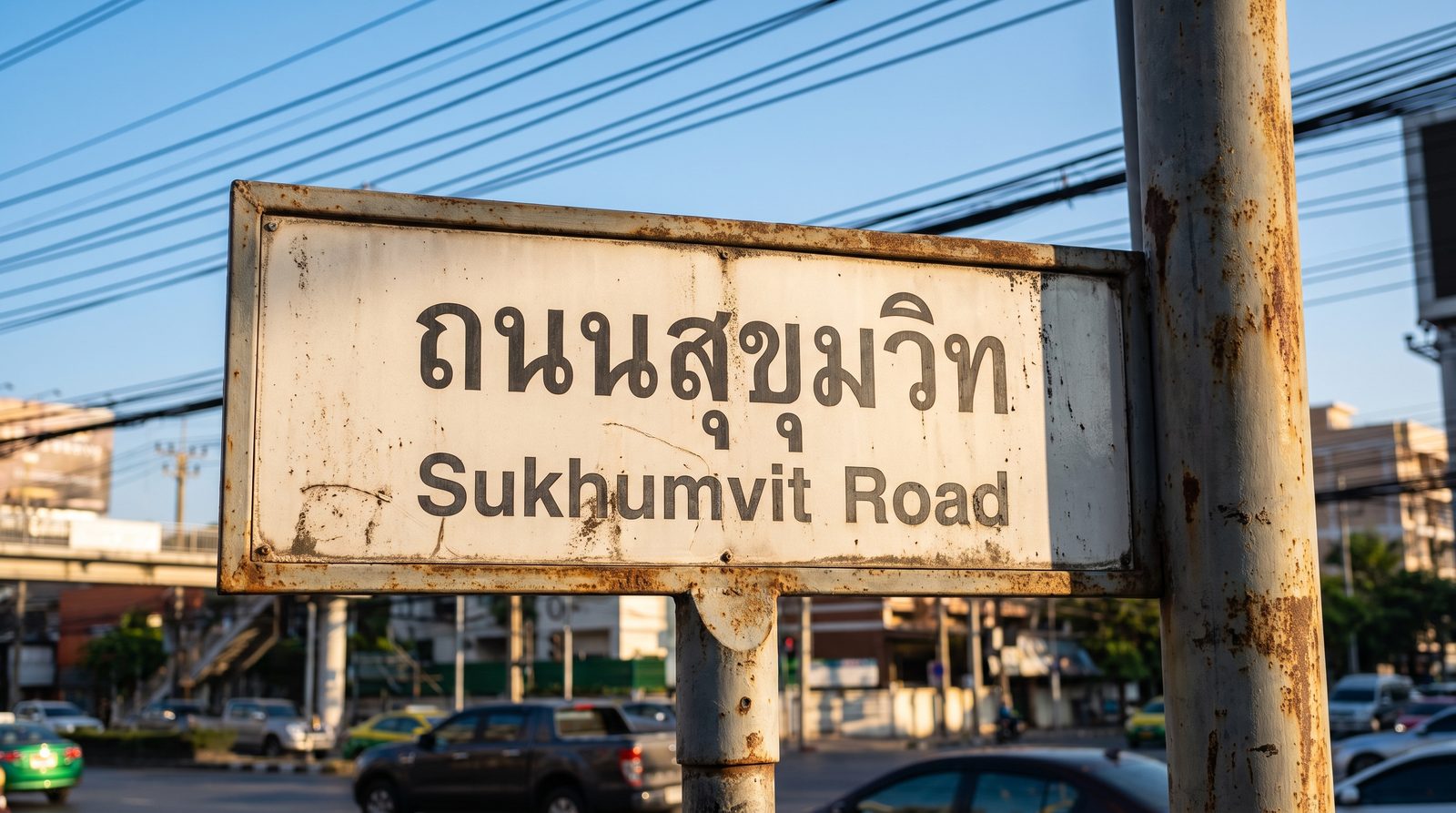
Four more sign words are worth having on sight:
- แยก (yaek) — a junction or intersection. Bangkok landmarks are often junctions: แยกอโศก is Asok intersection.
- ตรอก (trok) — an alley narrower than a ซอย, usually in the old quarters.
- สะพาน (sa-phaan) — bridge; ใต้สะพาน (tai sa-phaan) means “under the bridge”, a real landmark in traffic directions.
- ทางเข้า / ทางออก (thang khao / thang ok) — entrance / exit, literally “way in” and “way out”.
If the letter shapes are still slow, the Thai alphabet chart lays out every one of the Thai consonants and vowels in one searchable page, and our guide to Thai romanisation on road signs explains why the English line so often spells the same name three different ways.
How soi numbers actually work
A ซอย is a lane hanging off a main road, and it takes the road’s name plus a number: Sukhumvit Soi 31 is ซอยสุขุมวิท 31. The numbering alternates by side — odd numbers run down one side of the road, even numbers down the other. On Sukhumvit the odd sois are on the north side. Knowing that saves you a fifteen-minute walk to the wrong pavement.
Many sois also carry a nickname that everyone uses instead of the number. Soi 55 is ทองหล่อ (Thonglor); Soi 63 is เอกมัย (Ekkamai). A taxi driver may not react to “Soi 55” but will know Thonglor immediately. Sois also branch: ซอยแยก (soi yaek) is a sub-lane, which is why addresses sometimes read ซอย 31 แยก 2.
Speak Thai: saying your address out loud
Male speakers end with ครับ (khrap), female speakers with ค่ะ (kha). In a taxi this is not politeness theatre — it is the difference between a request and an instruction, and drivers respond to the difference. Our guide to speaking Thai in a Bangkok taxi covers the rest of the ride.
- ไปสุขุมวิท ซอย 31 ครับ (pai Sukhumvit soi saam-sip-et khrap) — “To Sukhumvit Soi 31, please.” Literally just “go Sukhumvit soi 31”; Thai needs no “take me”.
- เข้าซอยได้ไหมคะ (khao soi dai mai kha) — “Can you go into the soi?” Some drivers will only stop at the mouth of the lane.
- เลยปากซอยหน่อยครับ (loei paak soi noi khrap) — “A bit past the entrance of the soi.” ปากซอย is literally “mouth of the lane” and is the standard meeting point for deliveries.
- ตรงข้ามเซเว่นค่ะ (trong khaam se-ven kha) — “Opposite the 7-Eleven.” Thai navigation runs on landmarks far more than on numbers.
One habit that helps enormously: learn to say your house number digit by digit. 123/5 is spoken nueng song saam thap haa — ทับ (thap) is the slash. If the digits themselves are still shaky, the Thai numbers reference has the full ladder, and our guide to reading Thai numerals on prices and dates drills the ten shapes ๐ ๑ ๒ ๓ ๔ ๕ ๖ ๗ ๘ ๙ that appear on plates like the one above.
Thai pronunciation traps in address words
These are short words, said fast, and good Thai pronunciation matters more than usual because there is no context to rescue you.
- หมู่ (moo, falling tone, “village”) versus หมู (moo, rising tone, “pig”). Same letters apart from one tone mark. This is the classic beginner Thai lesson in why tone is not optional.
- ถนน is tha-non, two syllables, with an unwritten vowel in the middle. Thai transliteration writes “thanon” and lets you guess; the script assumes you know the rule.
- เขต (khet, district) and เขา (khao, hill or he/she) start identically and diverge at the last letter — a reminder to read Thai letters to the end of the syllable rather than guessing from the shape of the start.
This is the everyday argument for reading the script instead of the romanisation. Romanised spellings flatten tone and vowel length; Thai letters write both down. Ten minutes a day in the flashcard trainer closes that gap faster than any amount of listening.
A study tip that actually works
Write your own address out in Thai, by hand, once. Not typed — handwritten, on paper, with the words in the Thai order and the numbers in Thai numerals. Keep the card in your wallet. You will use it at the immigration office, at the bank, when a delivery driver phones and gives up on English, and every time you fill in a hotel form.
Then read one street sign a day out loud before you look at the English underneath. Anyone building Thailand expat language skills gets more out of that one habit than out of a month of apps, because the sign corrects you instantly and for free. It is a small, repeatable way to learn Thai vocabulary from the city you are already walking through — and addresses, unlike almost anything else, are vocabulary you will still be using in ten years.