Speak Thai Directions in Thailand: Bangkok Street Words
Speak Thai well enough to ask directions in Bangkok: the eight words every answer uses, four questions that always work, and the street signs to read first.
You can speak Thai for a whole week in Bangkok without ever needing to ask where something is — right up until the moment your map app puts you on the wrong side of a canal. Directions are the first piece of real Thai most visitors actually need, and they are also the kindest place to start, because the vocabulary is tiny and it repeats forever. Roughly eight words carry almost every answer you will be given. This beginner Thai lesson covers those words in Thai script, with pronunciation and literal English, plus the four questions that get you a useful reply and the street signs that quietly answer the question before you ask it.
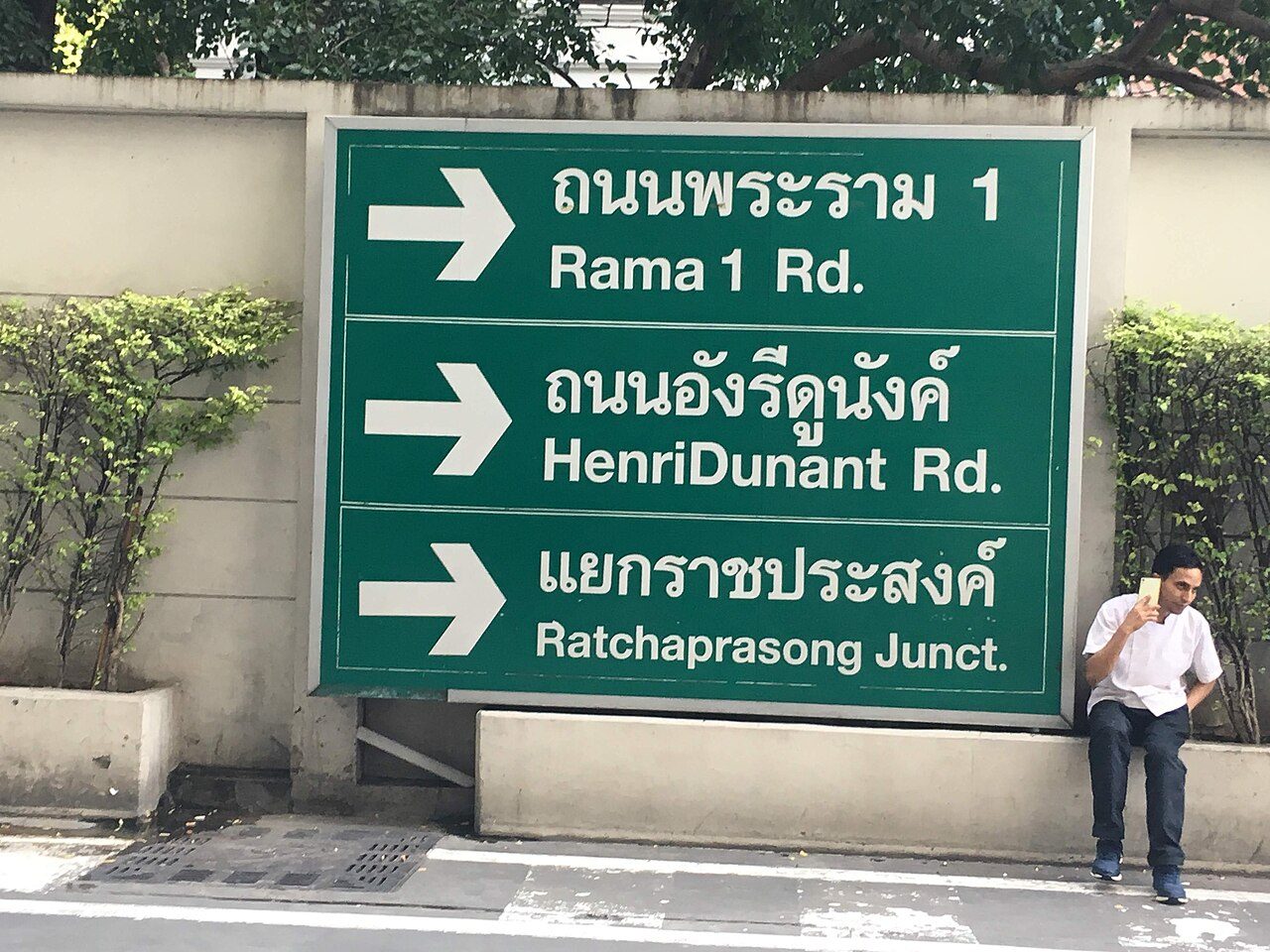
One promise up front: you do not need to understand the whole answer. Thai directions are gestural and repetitive, and catching two words out of ten is usually enough. The goal here is recognition, not fluency — you can speak Thai usefully long before you can speak it well.
The eight words every Thai direction is built from
Learn these and you will understand the shape of almost any reply, even when the rest of it goes past you:
| Thai | Pronunciation | Literal meaning |
|---|---|---|
| ตรงไป | dtrong bpai | “straight go” — carry on ahead |
| เลี้ยวซ้าย | liao saai | “turn left” |
| เลี้ยวขวา | liao khwaa | “turn right” |
| ข้างหน้า | khaang naa | “side front” — up ahead |
| ตรงข้าม | dtrong khaam | “straight across” — opposite |
| หัวมุม | hua mum | “head corner” — on the corner |
| สี่แยก | sii yaek | “four split” — a crossroads |
| สะพาน | sa-phaan | bridge — a very common landmark |
Notice how transparent the compounds are. สี่แยก is literally “four” plus “split”, and once you have it, สามแยก (saam yaek) for a T-junction needs no explanation. Thai rewards this kind of pattern-spotting constantly, which is why learning to read Thai script pays off faster than learners expect.
The one pair that catches everybody
ใกล้ and ไกล look almost identical and mean opposite things. ใกล้ (glâi, falling tone) is near. ไกล (glai, mid tone) is far. The tone is the only thing separating them in speech, and the spelling differs by a single vowel symbol. If you mishear this one you will walk for forty minutes, so it is worth over-learning. A safe workaround when you are unsure: ask ไกลไหม (glai mai khrap) — “is it far?” — and read the face and the hand as much as the word.
Four questions that always work
These four sentences are enough to speak Thai for the thirty seconds a direction takes. Thai question words go at the end of the sentence, which makes them easy to assemble. Male speakers finish with ครับ (khrap); female speakers with ค่ะ (kha). This is not optional politeness decoration — leaving it off sounds blunt in a way that correct vocabulary will not repair, and with a stranger you are asking for a favour, so it matters more here than almost anywhere.
- ขอโทษครับ (khor-thot khrap) — “excuse me”. Always open with this. Walking up and launching straight into a question reads as abrupt.
- [place] อยู่ที่ไหนครับ (yuu thii-nai khrap) — “[place] is located where?” The workhorse. Say the place name, then this.
- ไป...ยังไงครับ (bpai [place] yang-ngai khrap) — “go to [place] how?” Use this when you want a route rather than a location.
- เดินไปได้ไหมครับ (dern bpai dai mai khrap) — “can I walk there?” In Bangkok heat this is the most practical question on the list.
Who to ask
Ask someone who is standing still and not working a queue: security guards, motorbike-taxi drivers at the mouth of a lane, shop staff between customers. Thai social language runs on relative age, so พี่ (phee) — literally “older sibling” — is the warm, safe way to get the attention of anyone who looks older than you. พี่ครับ works much like “excuse me”. Foreigners are rarely faulted for using พี่ even with someone younger.
Read Thai script on the signs around you
Bangkok answers a lot of direction questions for free, because street signage carries Thai on top and a transliteration underneath. That layout is a permanent answer key: sound out the Thai, then check yourself a second later. These six are on almost every corner, and they are excellent first targets once you know your Thai consonants and vowels.
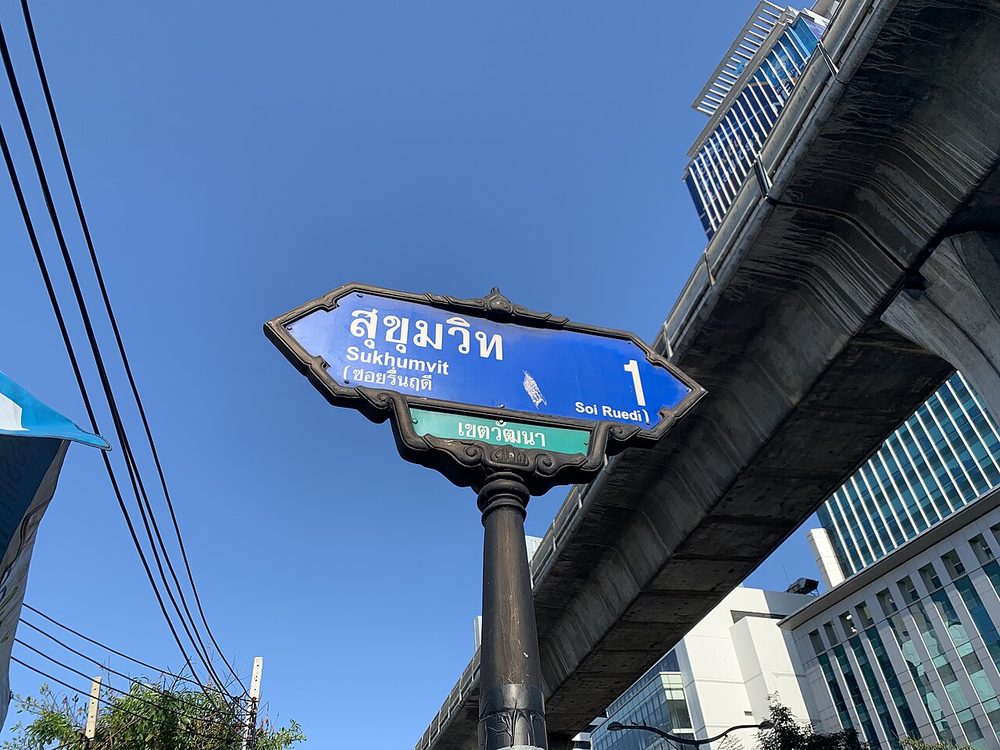
- ถนน (tha-non) — road. Opens the name of nearly every major street.
- ซอย (soi) — a side lane off a main road, usually numbered. Odd and even numbers run along opposite sides.
- ปากซอย (bpaak soi) — “mouth of the soi”, the junction where the lane meets the main road. Half of all Bangkok meeting points.
- สถานี (sa-thaa-nii) — station. You will read this above every BTS and MRT entrance.
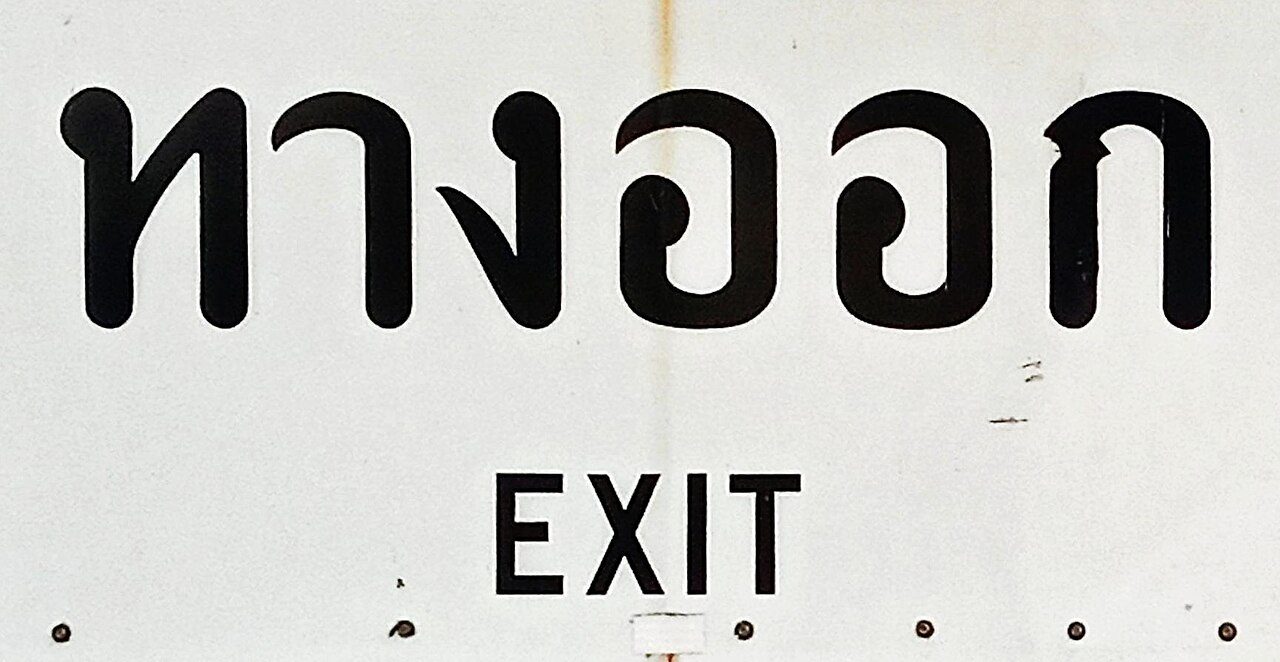
- ทางออก (thaang-ok) — exit, literally “way out”. ทางเข้า (thaang-khao) is the entrance.
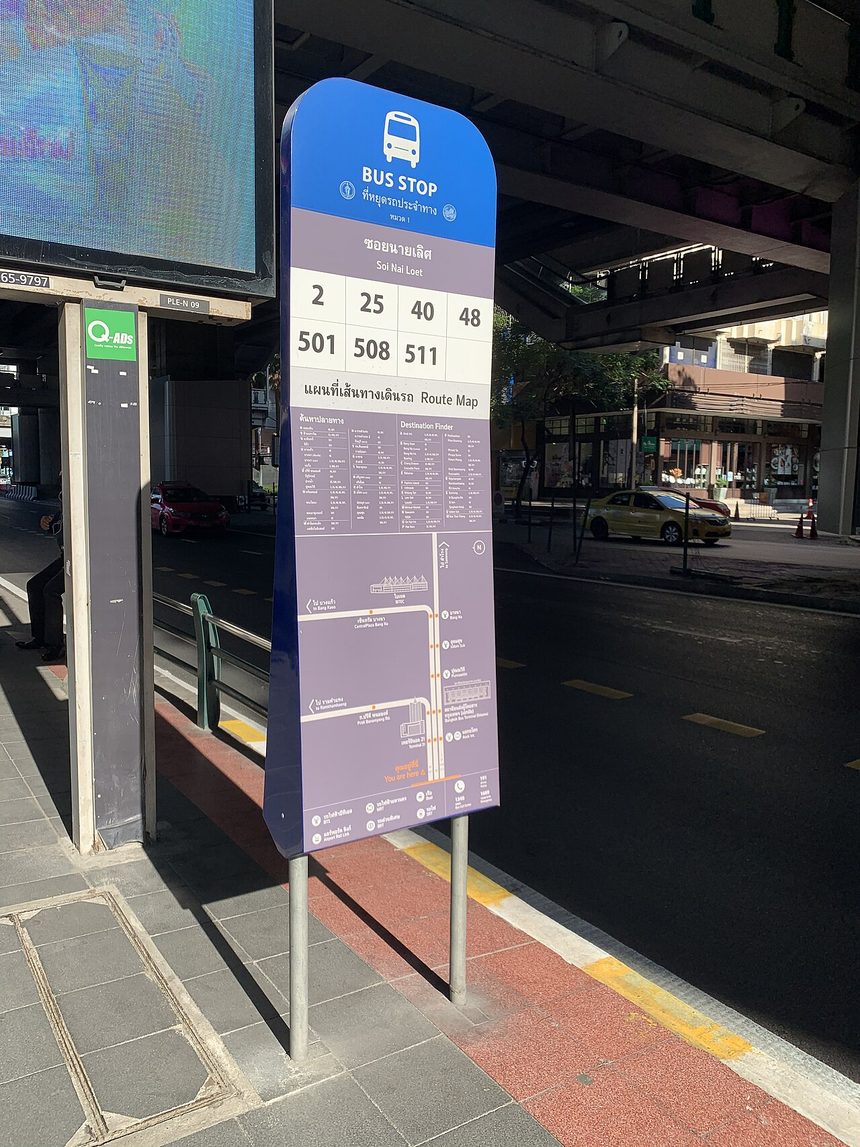
- ป้าย (bpaai) — sign, and also a bus stop.
If the Thai letters are still a wall, that is the thing to fix first — it makes everything above concrete. Our Thai alphabet reference lays out all 44 consonants and every vowel, and the flashcard trainer drills them until the shapes stop looking like decoration.
Understanding the answer
This is the part nobody warns you about: you speak Thai well enough to ask a clean question, and receive thirty words back. Do not panic and do not pretend. Three habits carry you through.
First, listen for the eight words above and ignore everything else. If you catch ตรงไป and เลี้ยวขวา you have the route. Second, watch the hands — Thai directions are heavily gestural, and the pointing is usually more precise than the vocabulary. Third, when you lose the thread, say ช้า ๆ หน่อยครับ (chaa chaa noi khrap), “slowly, please”, or อีกครั้งครับ (iik khrang khrap), “again, please”. Both are polite, both are normal, and asking someone to repeat themselves is not the failure it feels like.
One cultural note worth carrying. A Thai speaker may give you a confident answer rather than admit they do not know, because leaving a stranger empty-handed feels unhelpful. This is not deception; it is a different weighting of politeness. The practical response is simply to ask twice, in two places, whenever the destination matters.
A study tip that actually sticks
Do not drill this list at a desk. Walk one road you already know and narrate it to yourself in Thai as you go: ตรงไป to the corner, เลี้ยวซ้าย at the สี่แยก, the pharmacy is ตรงข้าม the bank. You will run out of words within a minute, and the words you reach for and cannot find are exactly the ones to look up that evening. Ten minutes of this beats an hour of flashcards, because the vocabulary gets attached to a real street instead of a list. It is also the cheapest Thai pronunciation practice in Thailand: nobody is listening, so nothing is at stake.
Directions are a small piece of Thailand expat language, but they are the piece that changes how a city feels. Everywhere in Thailand runs on the same eight words, so what you learn in one Bangkok soi transfers to Chiang Mai and Hat Yai unchanged. The first time someone answers you in Thai and you simply understand and walk the right way, the language stops being a subject you are studying and becomes something you use — which is the whole point of learning to speak Thai in the first place. Next, try the same words from the back of a cab with our Thai taxi phrases guide, or learn how Thai addresses are actually constructed in soi, thanon and house numbers.