Learn Thai Vocabulary in Thailand: Flower Market Words
Learn Thai vocabulary at a Thai flower market: garland, jasmine and marigold words in Thai script with transliteration, price tags, phrases and photos.
The best place to learn Thai vocabulary in Thailand costs ten baht and smells of jasmine. A Thai flower market is slower than a food market, nobody is shouting, and almost every stall has a handwritten price tag taped to a bucket — short, repeated, and written in the same plain Thai letters again and again. Buy one garland and you have used a number, a classifier, a politeness particle and a price in a single sentence. That is a complete beginner Thai lesson in under a minute, and you get to keep the flowers.
This guide works through five real photographs taken at Pak Khlong Talat, Bangkok’s wholesale flower market, and at a Bangkok temple. Every word appears in Thai script, in Thai transliteration and with the literal meaning, because Thai flower words are built from ordinary pieces you already half know. Once you can see the joins, a frightening row of Thai letters turns into two short words — and the same words reappear on taxi mirrors, spirit houses and temple trays for as long as you stay in the country.
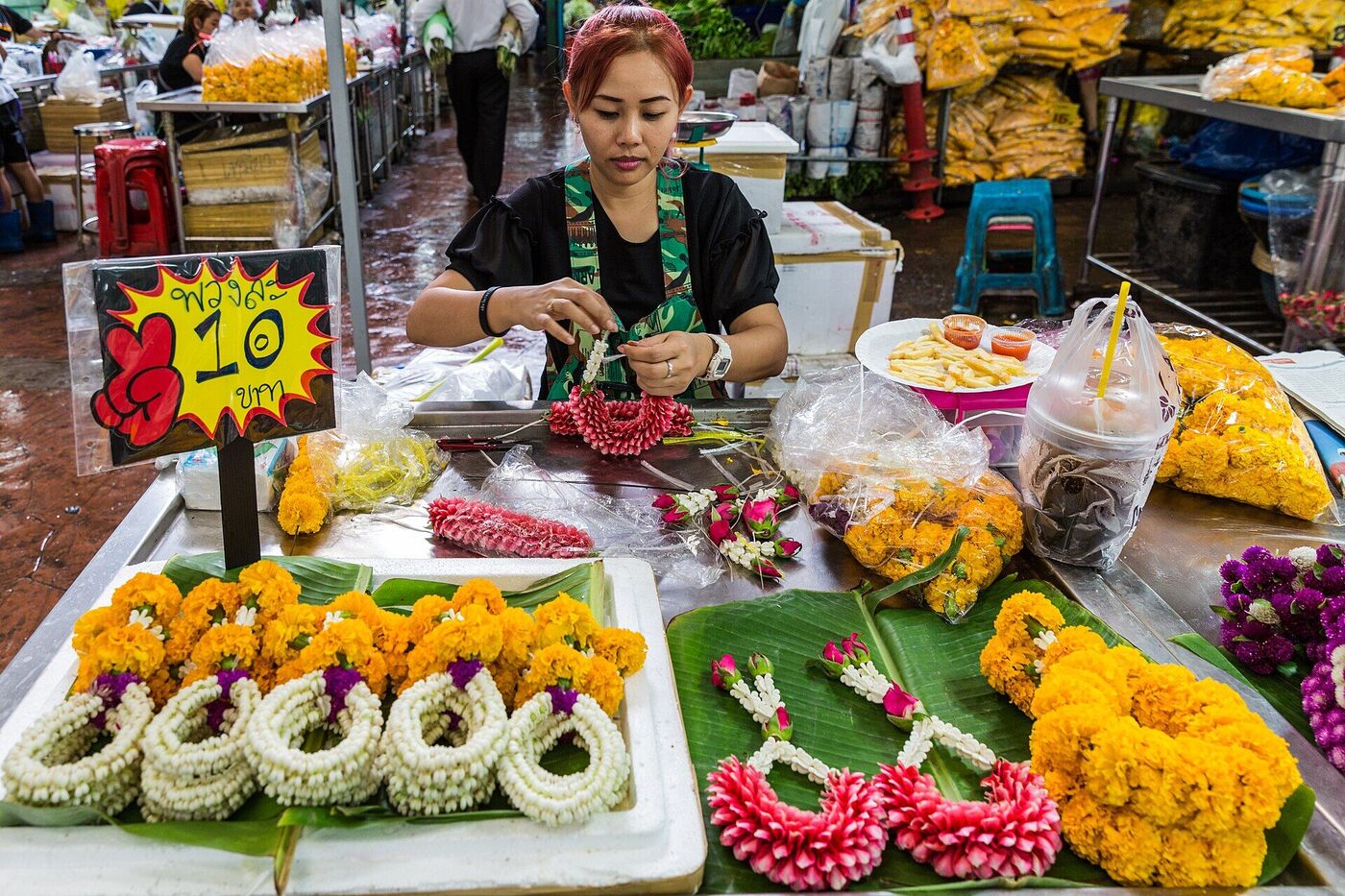
Learn Thai vocabulary for the market itself
Six words place you inside the market and let you ask for it by name in a taxi. Thai builds compounds relentlessly, so most of these are two familiar words stuck together.
- ดอกไม้ (dàwk-mái) — flower, literally “flower of the plant”: ดอก blossom plus ไม้ wood or plant.
- ตลาดดอกไม้ (tà-làat dàwk-mái) — flower market. ตลาด is any market, and it opens dozens of place names.
- ปากคลองตลาด (bpàak khlawng tà-làat) — Pak Khlong Talat, literally “mouth-of-the-canal market”: ปาก mouth, คลอง canal.
- ร้านดอกไม้ (ráan dàwk-mái) — flower shop. ร้าน is the word for any shop or stall.
- ขายส่ง (khǎai sòng) wholesale and ขายปลีก (khǎai plìik) retail — both printed on signs here, because the market is mostly the former.
- สด (sòt) fresh and หอม (hǎwm) fragrant — two adjectives vendors use constantly, and หอม is also a compliment.
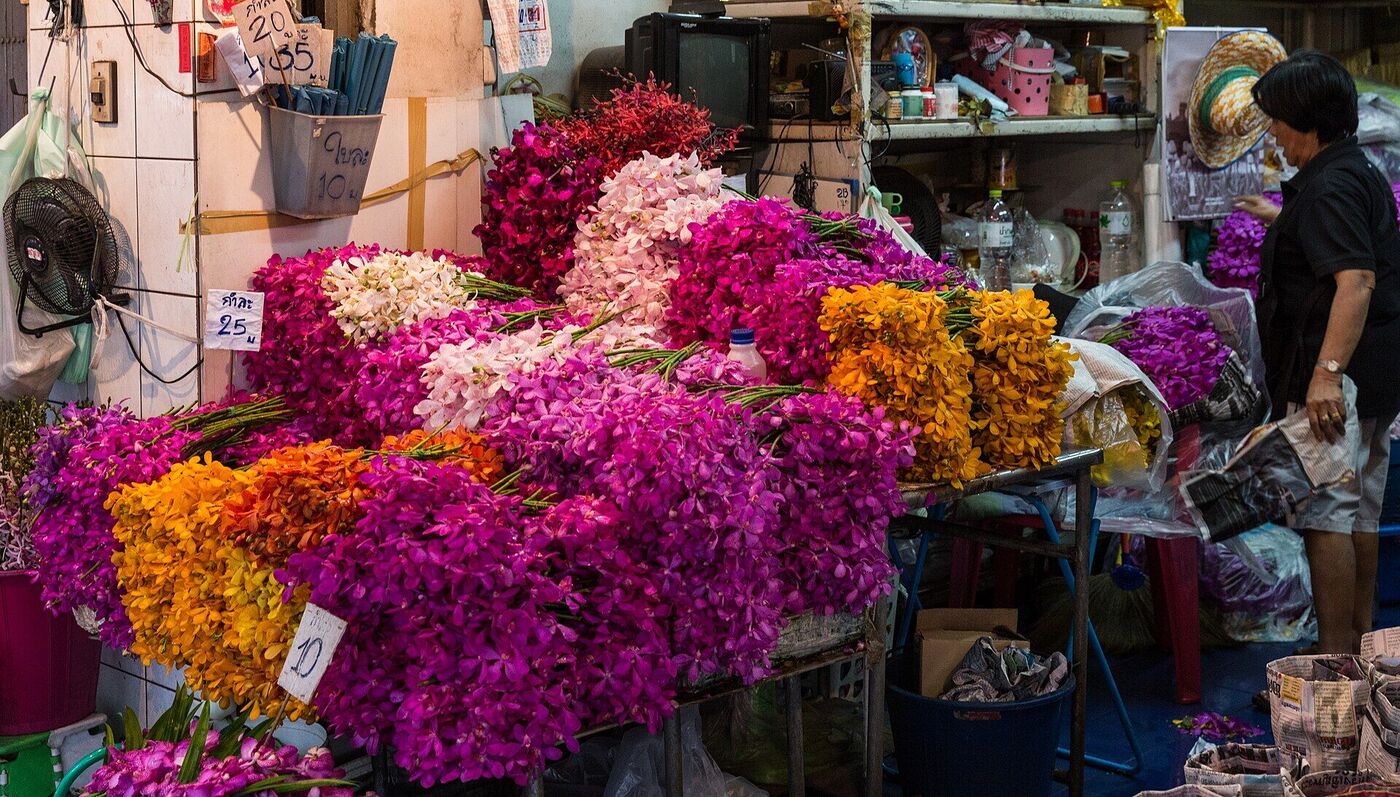
Read Thai letters on a handwritten price tag
Every price tag in the country follows one pattern, and it is worth memorising as a single shape: [classifier] ละ [number] บาท — “per X, Y baht”. The hard part for beginners is not the number. It is the classifier in front, because Thai insists on a different counting word for different shapes of thing.
- ดอก (dàwk) — the classifier for single flowers. ดอกละ 5 บาท = 5 baht each.
- พวง (phuang) — for garlands and anything threaded in a loop or cluster.
- กำ (gam) — a bunch you can hold in one fist; the word also means “to grip”.
- ช่อ (châw) — a bouquet or spray, the one you want for a wrapped gift.
- ถุง (thǔng) — a bag, so ถุงละ 20 is 20 baht a bag of loose blooms.
Classifiers are also the quickest way to learn Thai vocabulary in bulk, because each one drags a whole family of nouns along behind it. Get these five and you can read nine out of ten tags in the market without help. Our Thai classifiers guide explains why the little word is compulsory rather than decorative, and the explainer on reading Thai numerals covers the digits ๐–๙ that older vendors still chalk onto boards.
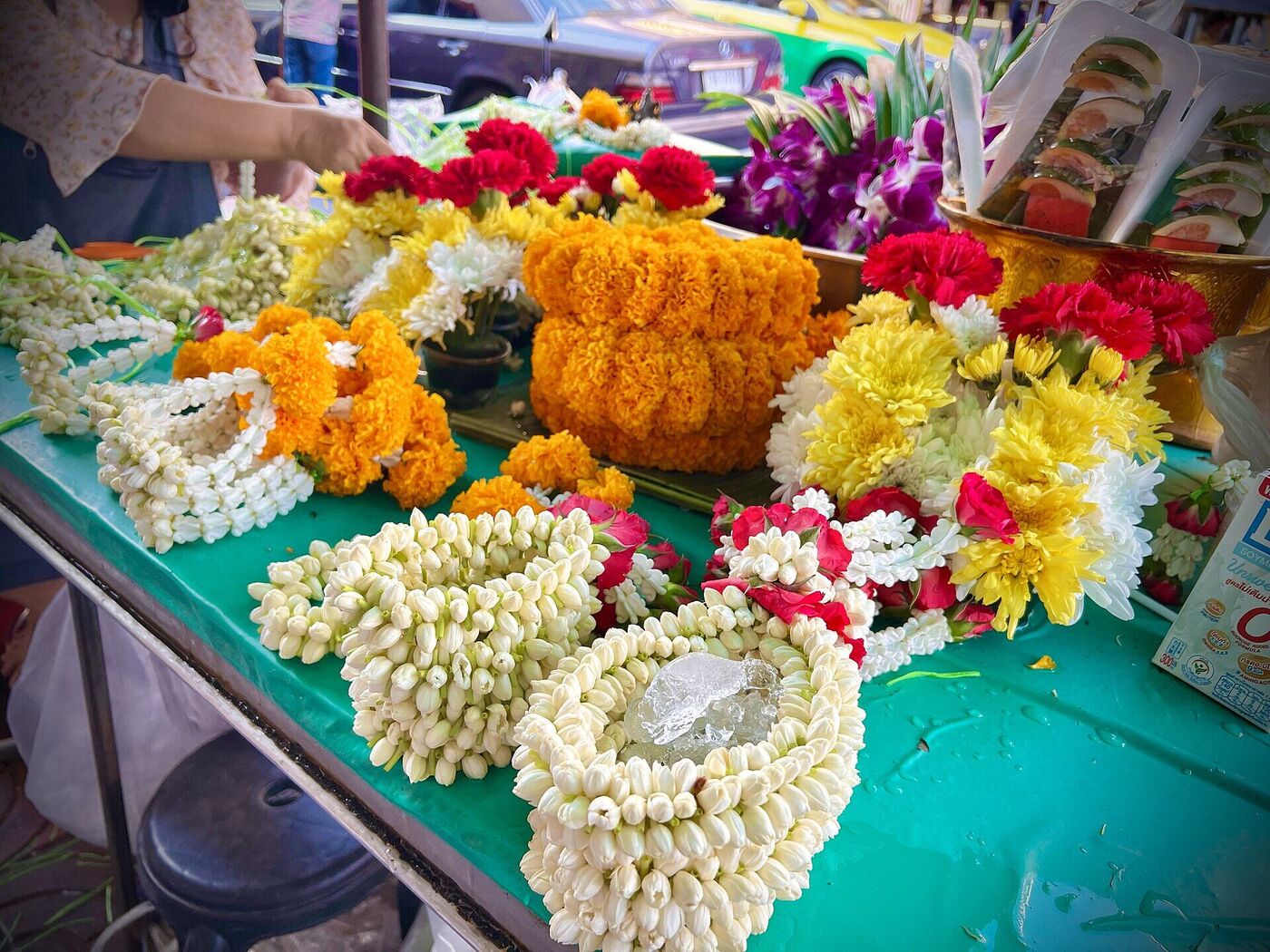
Thai pronunciation practice: the flower names worth knowing
You do not need a botanist’s list. Six names cover nearly everything sold for daily use in Thailand, and they are a good way to learn Thai vocabulary you can use in a sentence the same afternoon. Several of them double as ordinary words, which makes them stick.
- มะลิ (má-lí) — jasmine. The flower of Mother’s Day, วันแม่, and the one children give their mothers.
- ดาวเรือง (daao-rʉang) — marigold, literally “glowing star”: ดาว star, เรือง to glow.
- กุหลาบ (gù-làap) — rose; กล้วยไม้ (glûai-mái) — orchid, literally “banana plant”.
- บัว (bua) — lotus, sold as tight buds for temple use and folded back by hand before you offer it.
- รัก (rák) — crown flower, spelled and said exactly like the word for love, which is why it turns up in garlands for weddings.
- บานไม่รู้โรย (baan-mâi-rúu-rooi) — globe amaranth, literally “blooms and does not know how to wither”. Five syllables, and the best vocabulary bargain on this page.
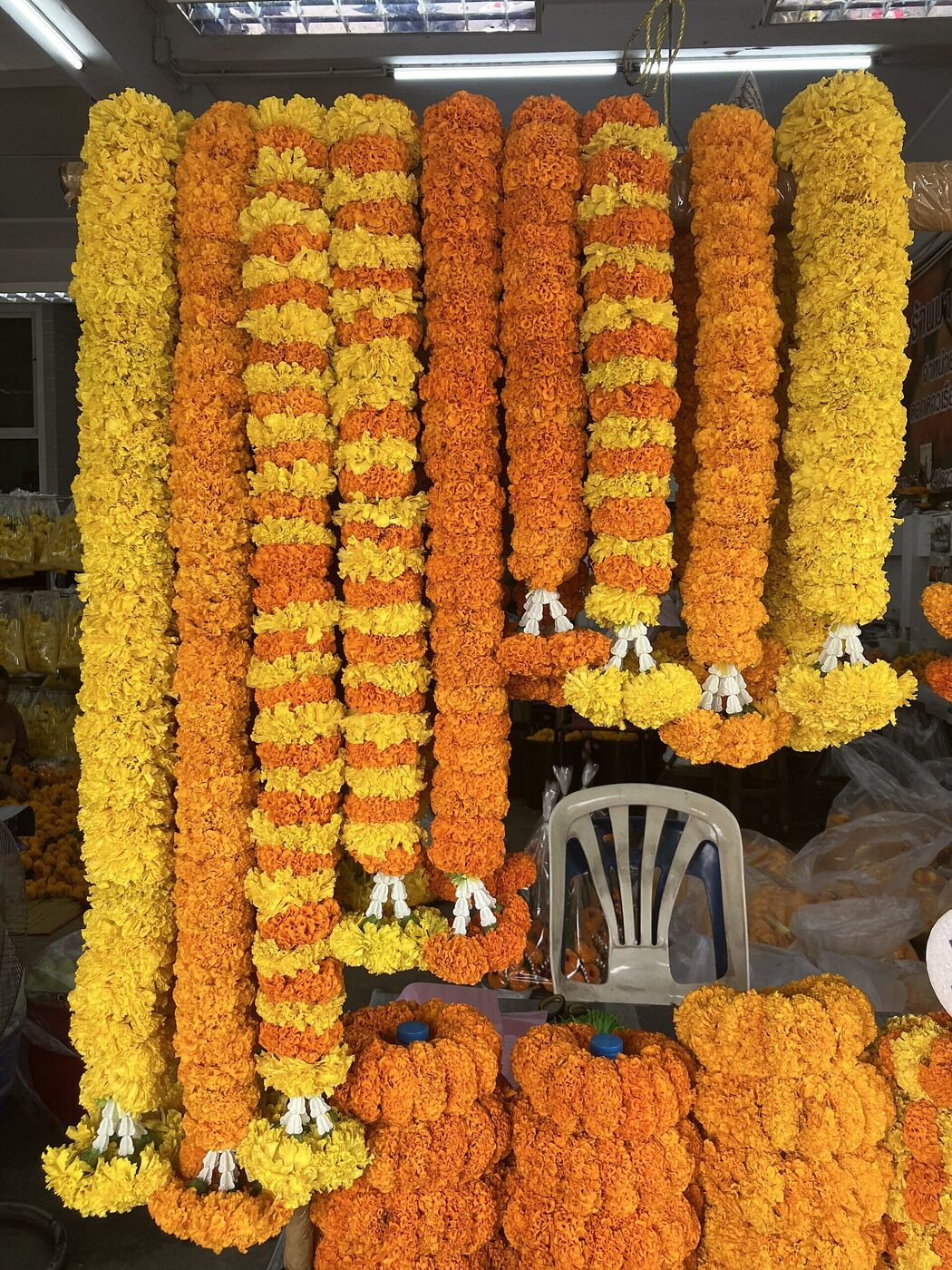
พวงมาลัย: the garland word with two meanings
If you learn Thai vocabulary from signs alone you will eventually trip over this one. พวงมาลัย (phuang-maa-lai) is a flower garland — and it is also the steering wheel of a car, because the first wheels looked like a ring of flowers. Context sorts it out, but the overlap is a useful reminder that Thai reuses shapes rather than inventing new words.
- มาลัย (maa-lai) — garland, the everyday short form.
- มาลัยข้อมือ (maa-lai khâw-mʉʉ) — wrist garland, ข้อมือ being the wrist joint.
- มาลัยคล้องคอ (maa-lai khláwng khaw) — neck garland, from คล้อง to loop over and คอ neck.
- พวงหรีด (phuang rìit) — funeral wreath. Worth recognising so you never order one by accident.
You will see the small ones hanging from a taxi’s rear-view mirror and draped on the spirit house outside every shop and condo in Thailand. Both are offerings, not decoration, which is the single most useful thing a newcomer can understand about them.
Speak Thai at the stall: four sentences and a particle
Flower vendors are patient and the transaction is tiny, so this is a low-risk place to open your mouth. Men finish a sentence with ครับ (khráp), women with ค่ะ (khâ); leaving the particle off is the fastest way to sound abrupt without meaning to.
- ขอมาลัยสองพวงครับ (khǎw maa-lai sǎwng phuang khráp) — “Two garlands, please.” Note the order: thing, number, classifier.
- อันนี้เท่าไหร่คะ (an-níi thâo-rài khá) — “How much is this one?”
- ลดได้ไหมครับ (lót dâi mǎi khráp) — “Can you come down?” Fair at a wholesale market if you are buying several, cheeky for a single ten-baht garland.
- ไม่เอาถุงค่ะ (mâi ao thǔng khâ) — “No bag, thanks.”
Keep each sentence short and let the vendor fill the gaps. If the particles still feel slippery, our explainer on khrap and kha is a five-minute read, and the fresh market guide covers the weights and bargaining words that go with them.
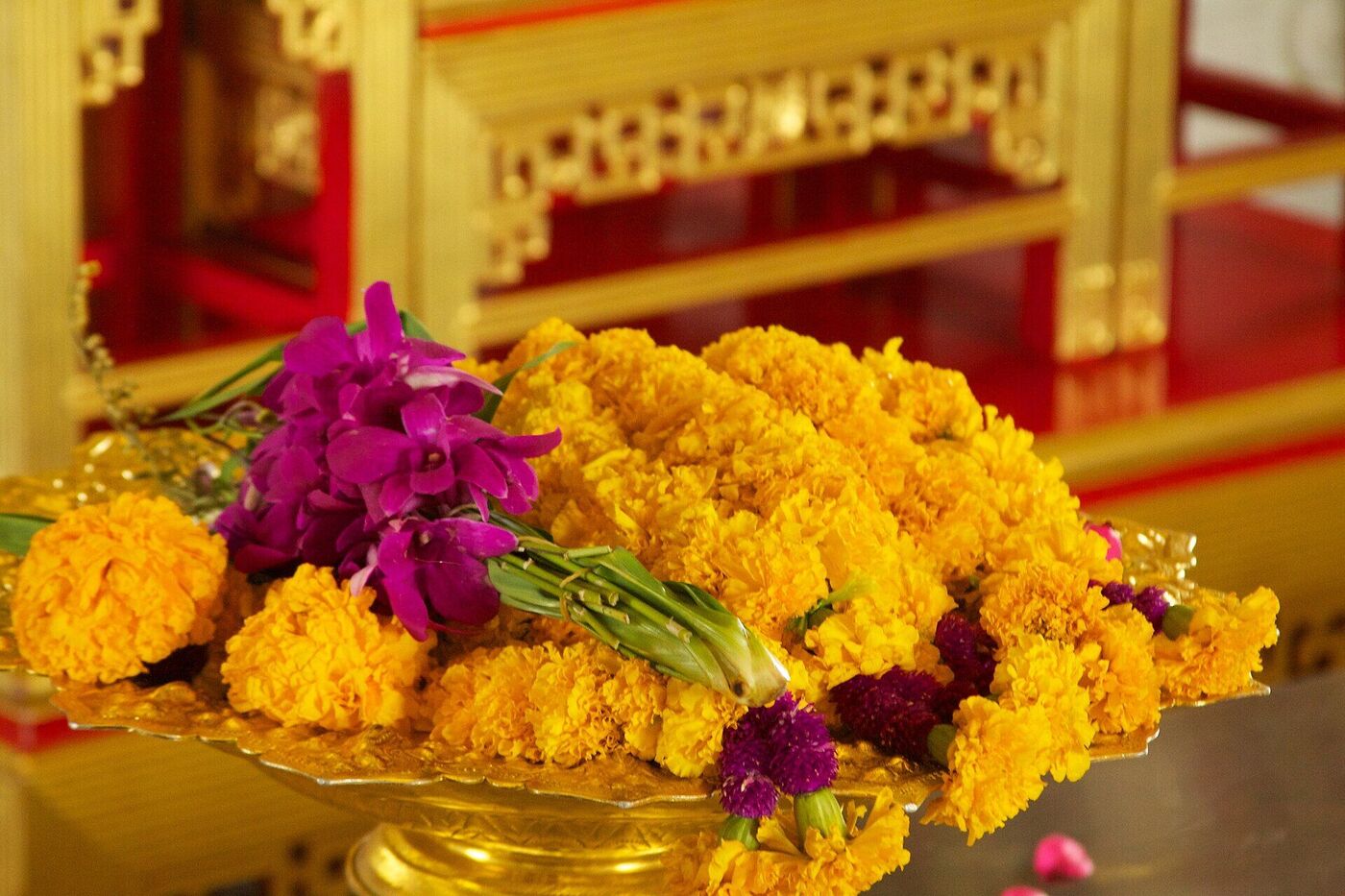
Thai transliteration at the temple: บูชา, ไหว้ and the set of three
Flowers are rarely bought for a vase in Thailand. They are bought to be given, and the vocabulary that surrounds that act is worth a few minutes even if you never set foot in a temple, because it explains what you are watching.
- ธูปเทียนดอกไม้ (thûup thian dàwk-mái) — incense, candle, flower: the standard set of three, sold together for about twenty baht at any temple gate.
- บูชา (buu-chaa) — to make an offering, to venerate.
- ไหว้ (wâai) — the palms-together gesture, and the verb for doing it.
- ถวาย (thà-wǎai) — to offer, used for monks, images and royalty rather than people.
A study tip: one stall, one tag, one notebook line
Here is a drill that costs almost nothing. Each time you pass a flower stall, photograph exactly one price tag and copy it out by hand that evening — the whole tag, numbers and all. You will meet the same handful of Thai consonants and vowels over and over, because the vocabulary of price tags is tiny: ละ, บาท, ดอก, พวง, กำ. Handwriting them is what makes the shapes stick, and because you know what the tag says, every line is self-marking. Three tags a week is a hundred and fifty reps a year, which is more than most people manage with an app — the usual Thailand expat language problem is repetition, not talent.
When you want the letters behind the words, our free Thai alphabet chart is the quickest way to learn the Thai alphabet, with all 44 consonants and the vowel shapes on one page, and the ThaiLetters flashcard trainer will drill them ten minutes at a time. Start with ด, ก, ม and ล: those four Thai letters alone open ดอก, ไม้, มาลัย and ละ — enough to learn Thai vocabulary from a ten-baht garland and walk away with both.