Read Thai Script: Thailand Beach & National Park Signs
Read Thai script on Thailand's beach, waterfall and national park signs: hat, ko, namtok and ham in Thai letters, with transliteration and real photos.
The cheapest Thai lesson in the country is bolted to a post beside a beach road. Learn to read Thai script on five words — ป้าย, หาด, เกาะ, น้ำตก and ห้าม — and Thailand’s coast, waterfalls and national parks stop being a blur of unfamiliar Thai letters. They start telling you where you are, how far you still have to walk, and which rule will cost you a thousand baht if you ignore it. Nature signs are the kindest place for a beginner to practise, because most of them print the English underneath: the sign marks your own homework.
This beginner Thai lesson works through five real photographs taken in Trat, Satun, Chiang Rai and the northeast. Every word is given in Thai script, in Thai transliteration and with a literal translation, because Thai place words are compounds built from small, ordinary pieces. Take a compound apart and a frightening row of Thai letters turns into two words you already know. The return is unusually good here: Thailand’s park and highway signs follow one house style nationwide, so the same thirty words carry you from Chiang Rai to the Malaysian border.
Read Thai script on the words that map Thailand
Thai geography runs on a short list of nouns, and nearly all of them are one or two syllables. Learn these twelve and you can place almost any signpost in the country, long before you can read a newspaper.
- ป้าย (bpâai) — sign. Also a bus stop, a label and a number plate.
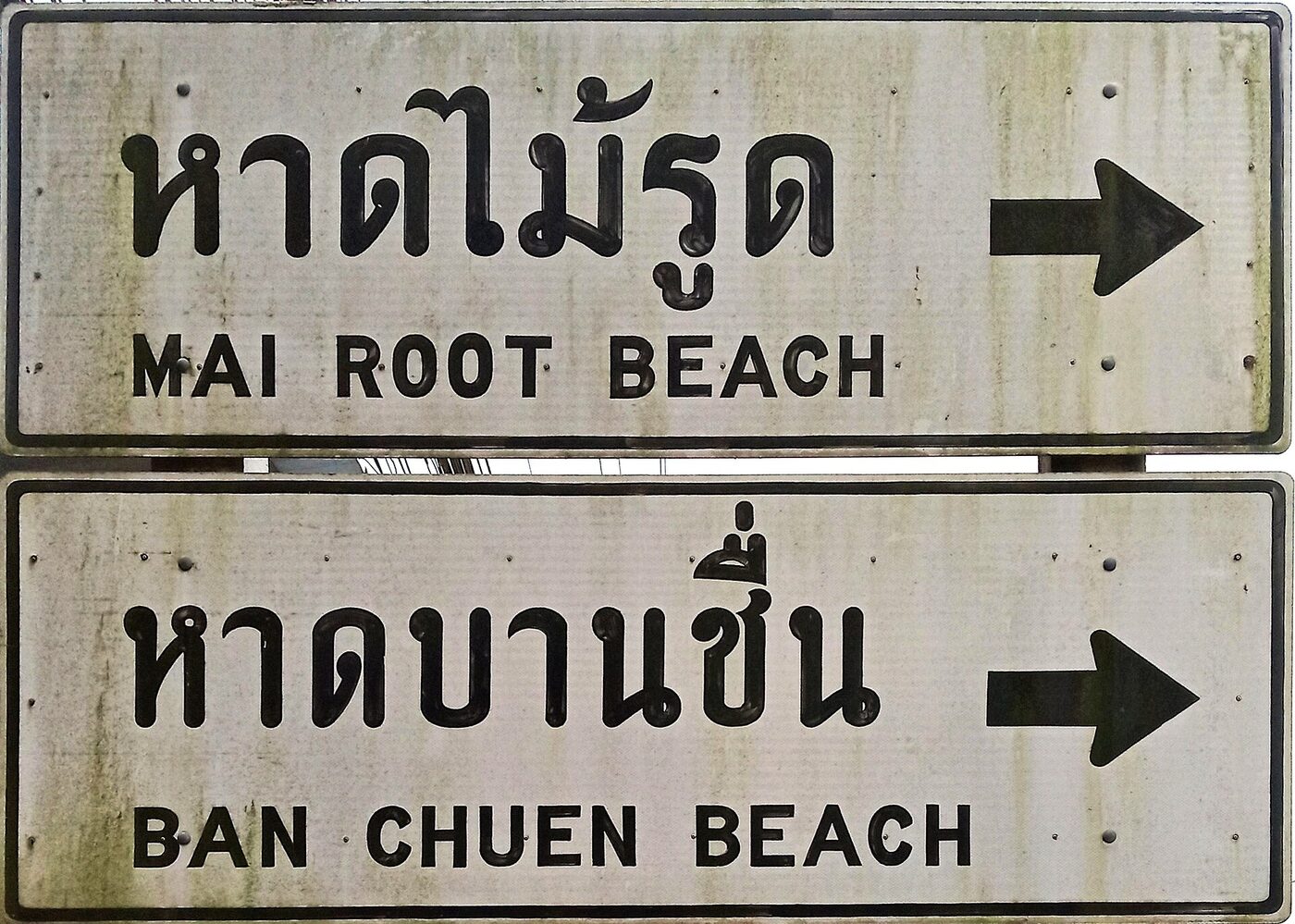
- หาด (hàat) — beach; the fuller word ชายหาด (chaai-hàat) is literally “edge of the beach”.
- เกาะ (gàw) — island, romanised as Ko, Koh or Kho depending on who painted the sign.
- หมู่เกาะ (mùu gàw) — archipelago, literally “group of islands”.
- อ่าว (àao) — bay, as in Ao Nang; แหลม (lǎem) — cape.
- ทะเล (thá-lee) — sea; แม่น้ำ (mâe-náam) — river, literally “mother water”.
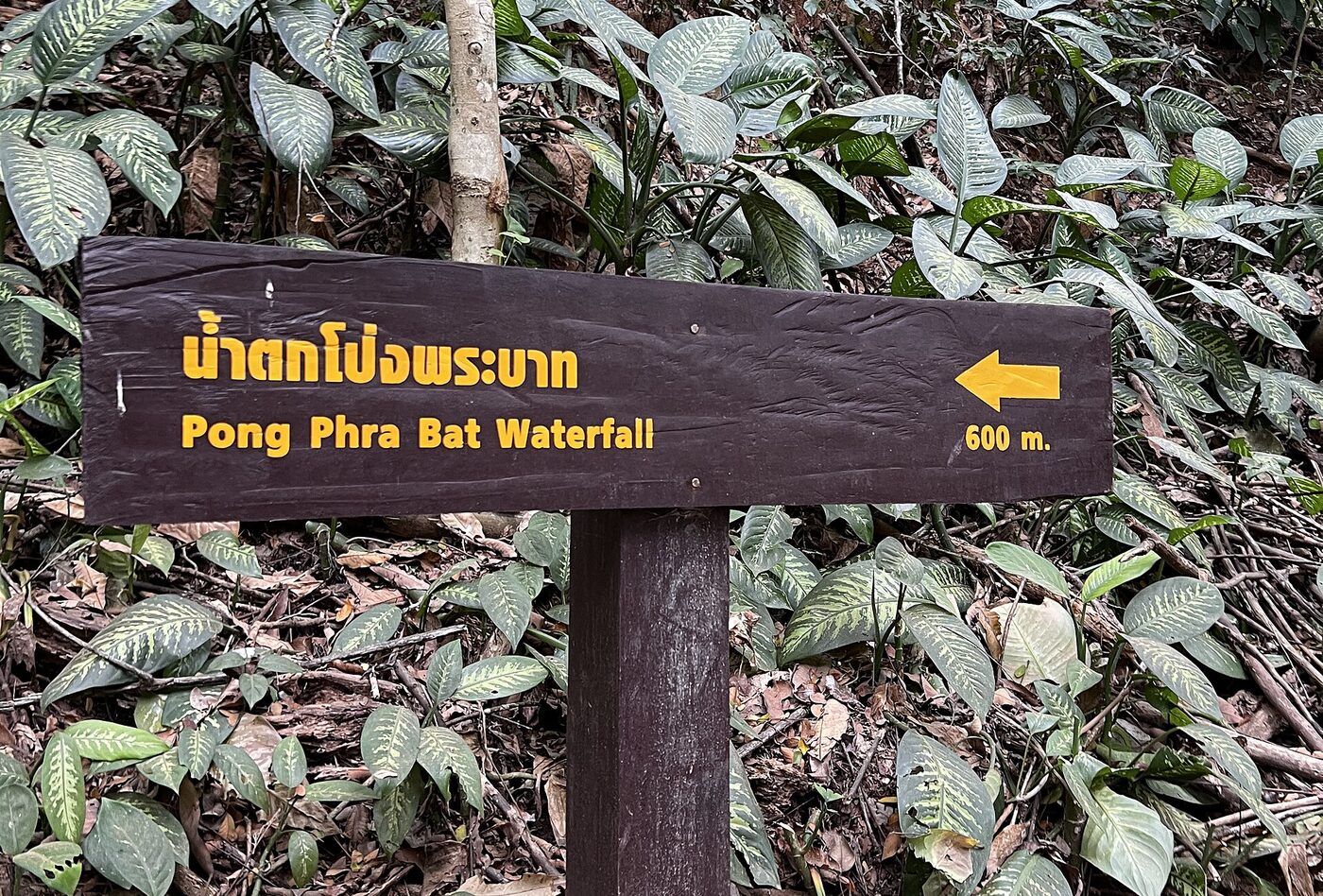
- น้ำตก (náam-dtòk) — waterfall, literally “water falls”.
- ถ้ำ (thâm) — cave; เขา (khǎo) — hill or mountain.
- ดอย (dooi) — mountain in the north, which is why peaks there are Doi this and Doi that.
- ป่า (bpàa) — forest; อุทยาน (ùt-thá-yaan) — park.
- จุดชมวิว (jùt chom wiw) — viewpoint, literally “point, admire, view”.
- ทางเข้า (thaang khâo) — entrance; ทางออก (thaang àwk) — exit.
หาด and เกาะ: Thai beach signs and the romanisation trap
Thai beach and island names are the friendliest reading practice in the country because the romanised line underneath is a built-in answer key. There is a trap, though, and it is worth meeting early. เกาะ appears in English as Ko, Koh, Kho and occasionally Goh, and หาด turns up as Hat, Haad or Had. None of them is wrong; Thai transliteration is a system for approximating Thai pronunciation with Roman letters, and different agencies approximate differently. The Thai spelling never changes, which is exactly why learning to read Thai script is more reliable than memorising the English. Our guide to Thai place names on road signs works through more of these pairs if you want the long version.
อุทยานแห่งชาติ: one long word, four easy pieces
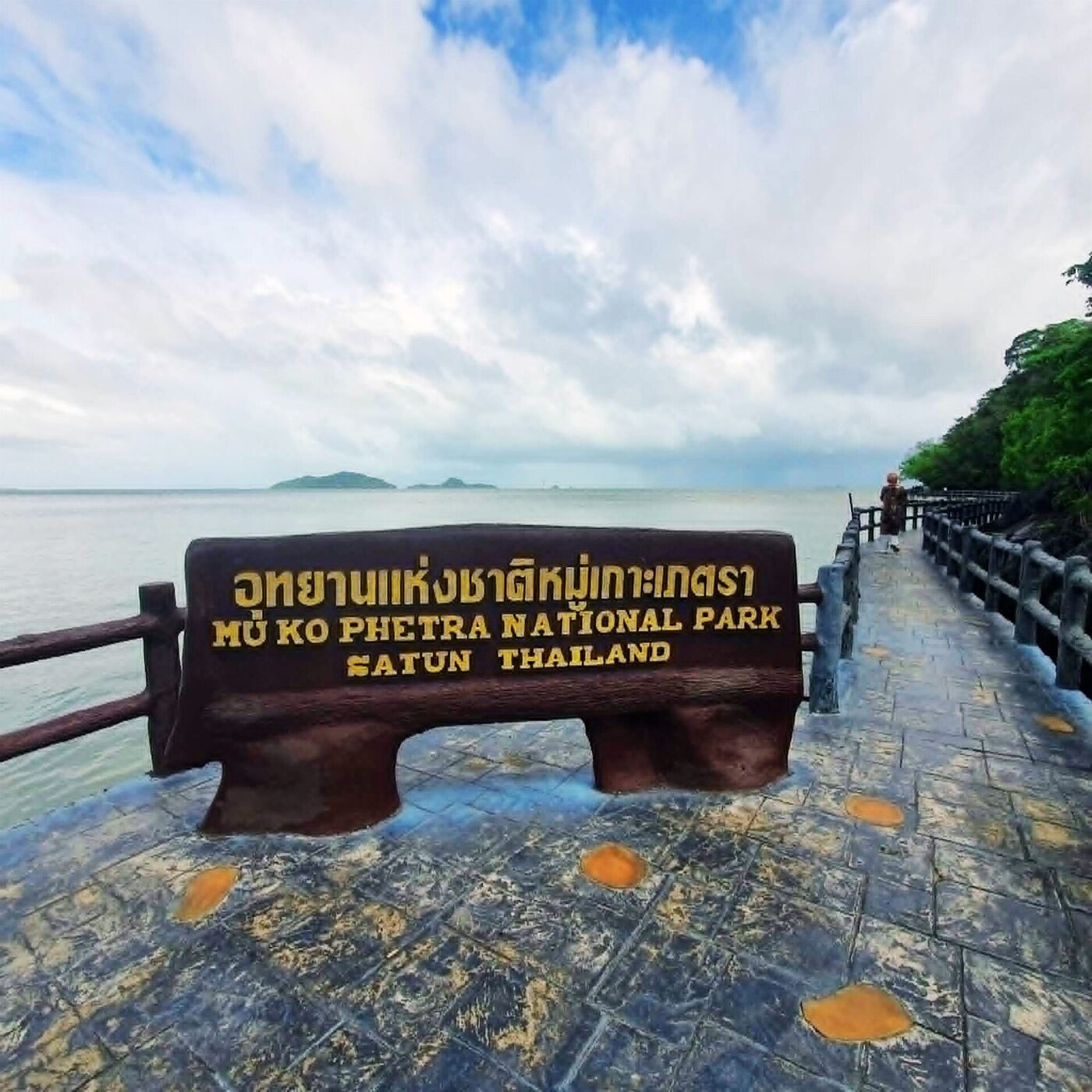
อุทยานแห่งชาติ (ùt-thá-yaan hàeng châat) looks like a wall of Thai consonants and vowels, and it is the single most useful long word in outdoor Thailand. Break it: อุทยาน is a park or garden, แห่ง is the formal “of”, and ชาติ is nation. Park, of, nation. The same แห่งชาติ tail appears on museums, libraries and stadiums, so one word of homework pays out in a dozen places. The department that runs these parks also uses a fixed vocabulary on its boards.
- วนอุทยาน (wá-ná ùt-thá-yaan) — forest park, a smaller protected site.
- ที่ทำการอุทยาน (thîi tham-gaan ùt-thá-yaan) — the park headquarters.
- ค่าเข้า (khâa khâo) — entrance fee. ค่า is the “cost of” prefix on hundreds of signs.
- ลานกางเต็นท์ (laan gaang dten) — campsite, literally “tent-pitching yard”.
- เส้นทางศึกษาธรรมชาติ (sên-thaang sùek-sǎa tham-má-châat) — nature study trail.
- ห้องน้ำ (hâwng-náam) — toilet, literally “water room”. Worth knowing by shape alone.
น้ำตก: waterfall signs, arrows and distances
Waterfall signs are short, repetitive and almost always bilingual, which makes them the ideal place to read Thai script on the move. น้ำตก is two pieces you will meet constantly: น้ำ (water) and ตก (to fall). The same น้ำ starts the words for ice, juice, perfume and flooding. Distances are written in Arabic digits far more often than in Thai numerals, but the unit is usually Thai: ม. for เมตร and กม. for กิโลเมตร.
- ชั้น (chán) — tier or level. A big waterfall is advertised as having seven ชั้น.
- เมตร (mét) — metre, abbreviated ม.; กิโลเมตร (gì-loo-mét) — kilometre, กม.
- ทางเดิน (thaang-dern) — footpath; บันได (ban-dai) — steps.
- จุดชมน้ำตก (jùt chom náam-dtòk) — waterfall viewing point.
- แก่ง (gàeng) — rapids. Do not confuse it with แกง (gaeng), curry — the tone mark is the only difference.
ห้าม and ระวัง: Thai warning signs worth obeying
Two words run every rule in Thailand. ห้าม (hâam) means “it is forbidden to”, and it is followed straight by a verb: ห้ามจอด no parking, ห้ามสูบบุหรี่ no smoking, ห้ามเล่นน้ำ no swimming. ระวัง (rá-wang) means “beware” and is followed by the thing to beware of. Learning to read Thai script on these two is the highest-value safety homework in Thailand expat language, and our fuller guide to Thai warning signs collects the rest.
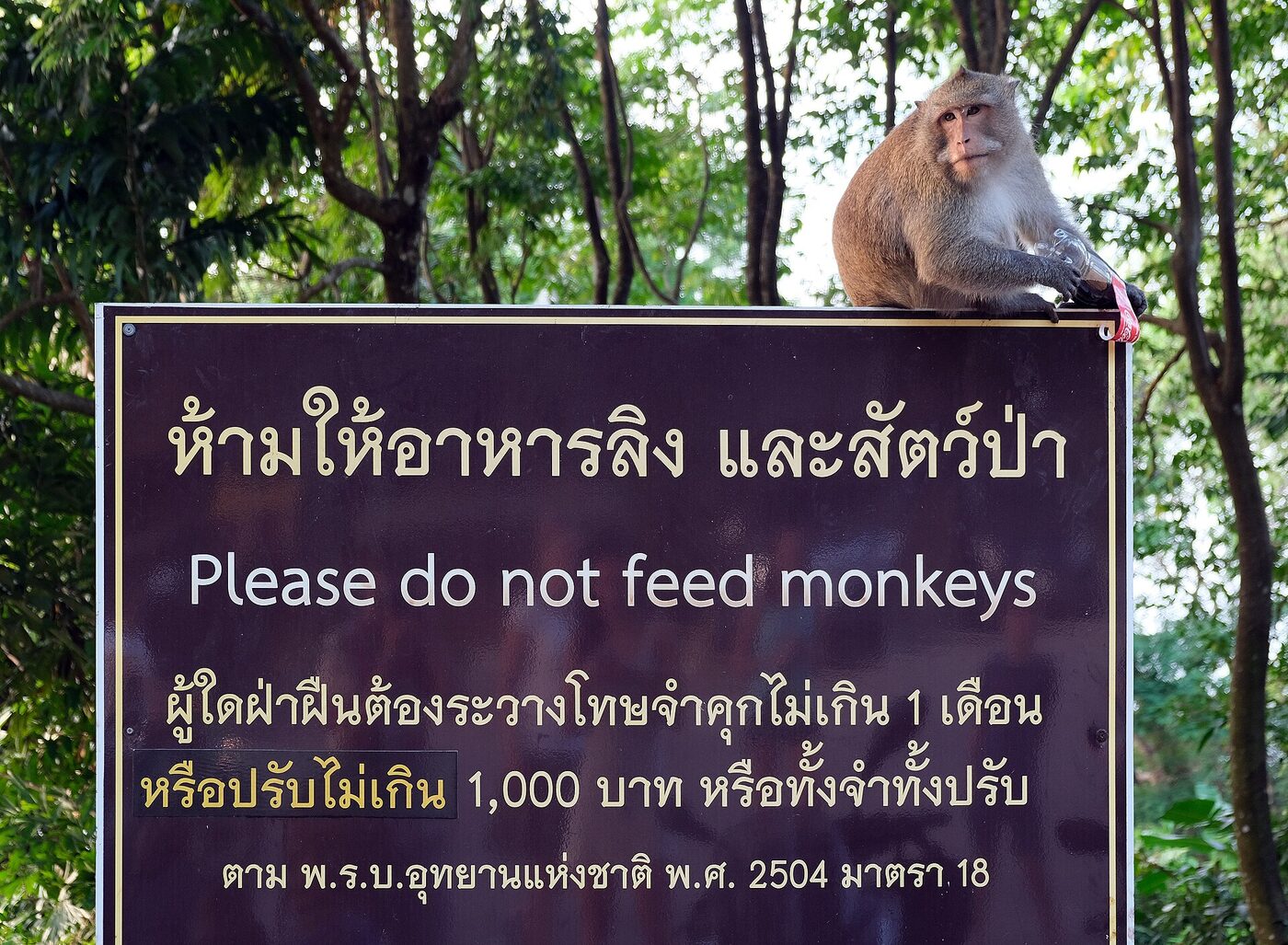
That little พ.ศ. is worth a second look, because it appears on every official sign, receipt and expiry date in the country. It stands for พุทธศักราช (phút-thá-sàk-gà-ràat), the Buddhist Era, and the arithmetic never changes: Thai year minus 543. If dates and numbers are your weak point, the Thai numbers guide covers the digits and the Buddhist calendar together.
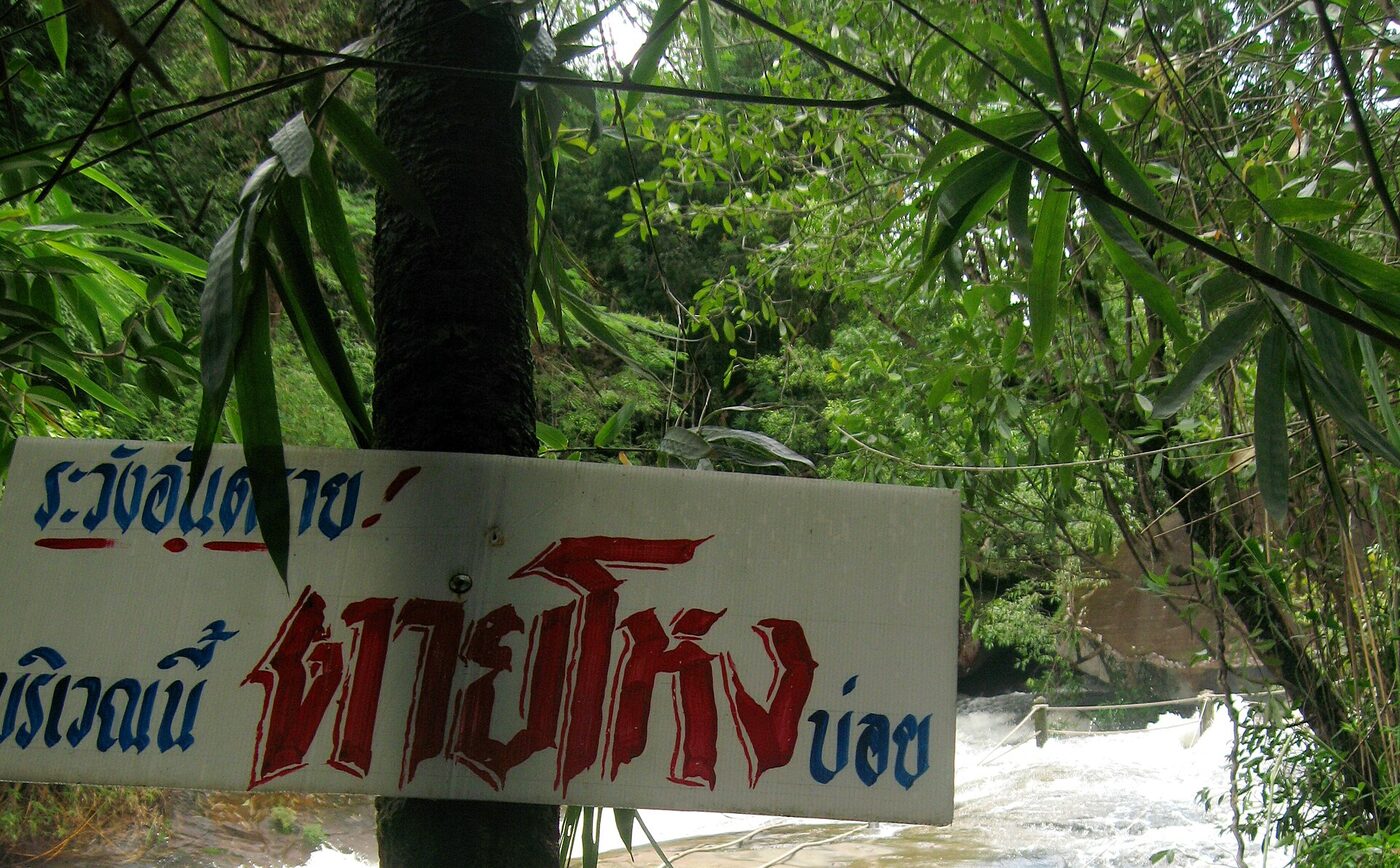
- อันตราย (an-dtà-raai) — danger. Often doubled with ระวัง for emphasis.
- ห้ามเล่นน้ำ (hâam lên náam) — no swimming, literally “forbidden to play water”.
- น้ำไหลแรง (náam lǎi raeng) — strong current.
- ระวังลื่น (rá-wang lûen) — slippery; ระวังงู (rá-wang nguu) — beware of snakes.
- ปรับไม่เกิน (bpràp mâi gern) — “fine not exceeding”, the phrase before every number on a penalty sign.
Speak Thai at the park gate: five phrases
Park staff are used to visitors with ten words of Thai, and they are generous with them. Finish each sentence with the politeness particle — men say ครับ (khráp), women say ค่ะ (khâ), switching to คะ (khá) at the end of a question — and an ordinary request turns into a polite one for the price of one syllable.
- ค่าเข้าเท่าไหร่ครับ (khâa khâo thâo-rài khráp) — “How much is the entrance fee?”
- น้ำตกอยู่ทางไหนคะ (náam-dtòk yùu thaang nǎi khá) — “Which way is the waterfall?”
- เดินไกลไหมครับ (dern glai mǎi khráp) — “Is it a long walk?”
- ว่ายน้ำได้ไหมคะ (wâai-náam dâi mǎi khá) — “Is swimming allowed?” Ask before you assume.
- ป้ายนี้เขียนว่าอะไรครับ (bpâai níi khǐan wâa à-rai khráp) — “What does this sign say?” The sentence that teaches you the next fifty words.
A study tip: read the Thai, then check the English
Here is the drill that makes bilingual signs work for you instead of against you. Cover the romanised line with your thumb. Read the Thai out loud, slowly, consonant by consonant. Only then lift your thumb and check. Getting it wrong is the useful part: the gap between what you said and what is printed underneath shows you exactly which Thai consonants and vowels you have not nailed down yet, and you will remember that correction far longer than a flashcard. Three signs a day on a beach road is roughly fifteen corrections a week.
When you want the letters behind the words, our free Thai alphabet chart is the fastest way to learn the Thai alphabet, with all 44 consonants and the vowel shapes on a single page, and the ThaiLetters flashcard trainer will drill them ten minutes at a time. Start with ห, น, ก and ท: those four Thai letters alone open หาด, น้ำตก, เกาะ and ทางเข้า, and that is already enough to read Thai script well enough to find the waterfall.