Learn Thai Vocabulary in Thailand: Spirit House Words
Learn Thai vocabulary at Thailand's spirit houses: san phra phum words in Thai script with transliteration, offering terms, polite phrases and real photos.
Almost every building in Thailand has a miniature house standing beside it on a pillar, and almost every visitor walks past one a hundred times before asking what it is. It is one of the best places in the country to learn Thai vocabulary, because the shrine, the things placed on it and the verb for what people do in front of it make up a tight little set of about twenty words — and those words then turn up everywhere else, from courthouses to steering wheels. This is a beginner Thai lesson hiding in plain sight on the pavement.
The shrine is a ศาลพระภูมิ (sǎan phrá phuum), romanised as san phra phum and translated loosely as “spirit house”. Everything below comes with Thai script, Thai transliteration and the literal meaning. Four real photographs do the teaching: a weathered shrine over a Bangkok canal, a pair of shrines outside a city hotel, a morning’s offerings in Chiang Rai, and a blue shrine standing in a building site on Koh Samui.
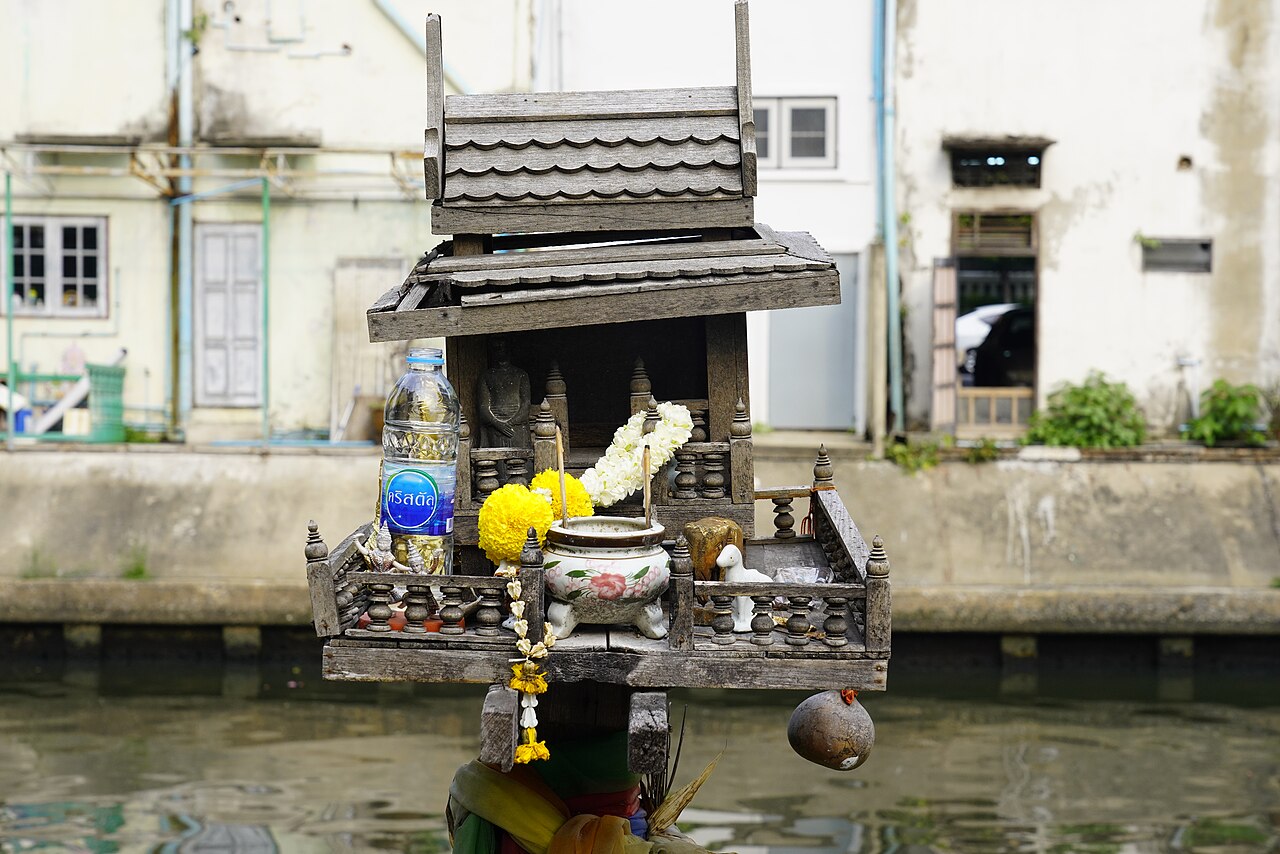
Learn Thai vocabulary: the words for the shrine itself
Start with the noun. ศาล (sǎan) means a shrine — and also a court of law, which is why ศาลจังหวัด on a road sign is the provincial courthouse and not a religious site. One word, two very different buildings, and the kind of overlap that makes Thai letters worth learning properly rather than guessing from romanised spellings.
- ศาล (sǎan) — shrine; also a court. Rising tone, long vowel.
- พระภูมิ (phrá phuum) — the guardian spirit of the ground. พระ marks anything sacred or royal; ภูมิ is “land, earth”, borrowed from Sanskrit and also sitting inside ภูมิภาค (phuu-mí-phâak), region.
- เจ้าที่ (jâo thîi) — “lord of the place”, the spirit of that particular plot. เจ้า is an owner or master, ที่ is place.
- ที่ดิน (thîi din) — land, literally “place-earth”. On every property sign in the country.
- เสา (sǎo) — post, pillar. The single post under the shrine, and the one under your balcony.
- หิ้ง (hîŋg) — shelf or ledge, the surface the offerings stand on.
A bonus for anyone starting to learn the Thai alphabet: ศาล opens with ศ, one of three Thai letters pronounced “s” — ส, ศ and ษ. They sound identical today and are kept apart only by spelling history, so a word like this is a painless way to meet a letter you would otherwise skip. Thai consonants and vowels reward exactly that: one real sign, one new letter, remembered for good.
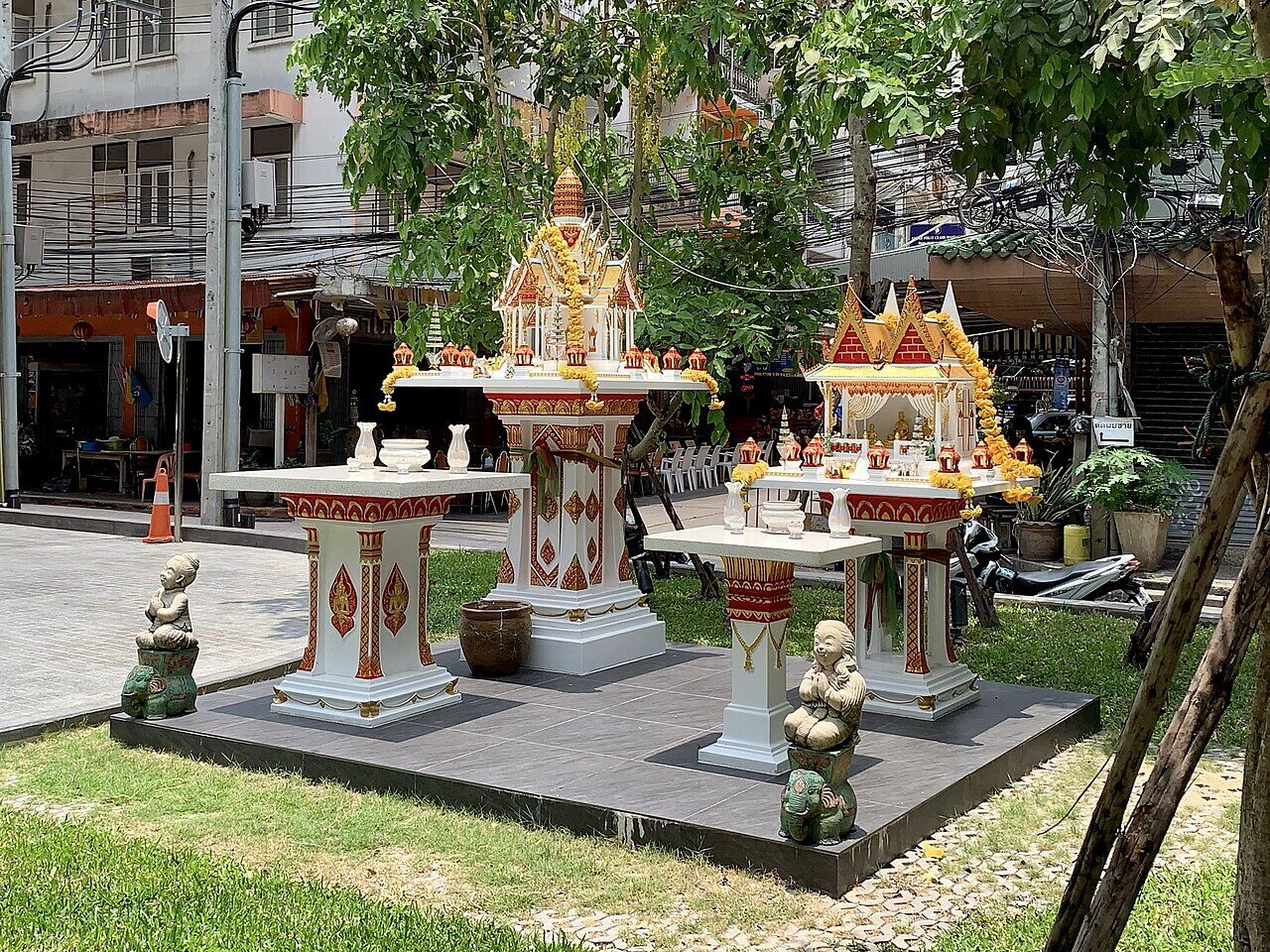
One shrine or two? ศาลพระภูมิ and ศาลเจ้าที่
Once you can tell the two apart you will never unsee it. The ศาลพระภูมิ stands on one post and looks like a small temple, because it houses a celestial guardian. The ศาลเจ้าที่ stands on several legs and looks like a little wooden house, for the homelier spirits of the plot — often called ศาลตายาย (sǎan dtaa-yaai), the “grandfather-grandmother shrine”. That name is a free chance to learn Thai vocabulary twice over: ตา is a maternal grandfather, ยาย a maternal grandmother.
Plenty of buildings have both, and the arrangement quietly teaches something no textbook does: different ranks get different accommodation. The same instinct runs through Thai pronouns and polite particles.
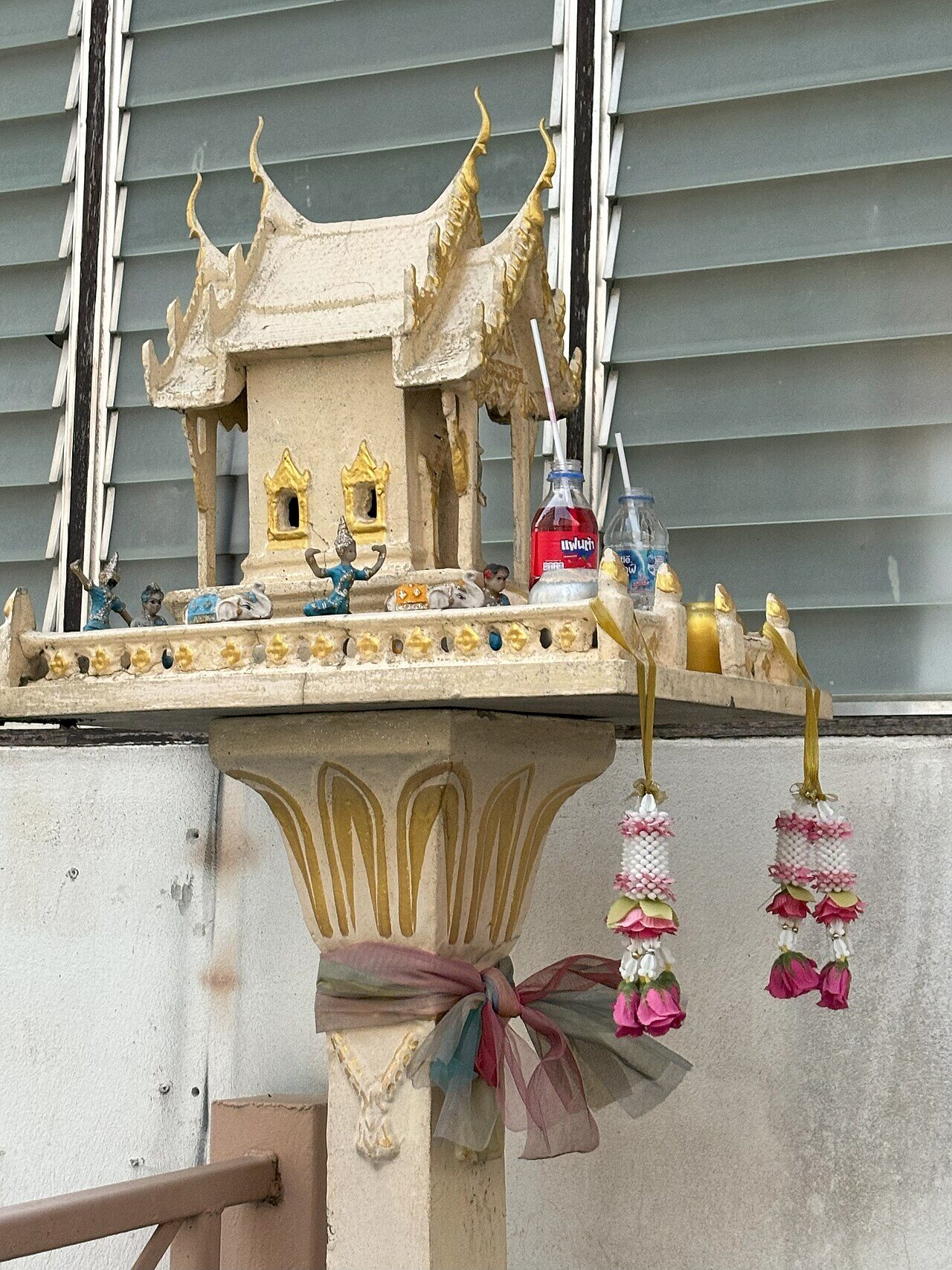
Read Thai script on the offering ledge
These six words are the ones you will actually hear at a market stall when someone buys them, so they pull double duty. Few places let you learn Thai vocabulary this efficiently: shrine words and shopping words in the same breath.
- ธูป (thûup) — incense stick. จุดธูป (jùt thûup) is to light one; จุด is the all-purpose “light, ignite”.
- เทียน (thian) — candle. Also the เทียน in Candle Festival.
- พวงมาลัย (phuang maa-lai) — a flower garland. Learn this one twice over: it is also the word for a car’s steering wheel.
- ดอกไม้ (dàawk-máai) — flowers, literally “wood-flower”. The marigold is ดาวเรือง (daao-rueang), “glowing star”.
- น้ำแดง (náam daeng) — “red water”, the red sala-flavoured drink. It explains the Fanta: colour matters more than brand.
- ผ้าแพร (phâa phrae) — the silk cloth tied round the post. ผ้า is cloth; you already know it from ผ้าห่ม, a blanket.
A quick note on Thai pronunciation, because two of these get mangled. ธูป ends in an unreleased “p” — the lips close and stop, no puff of air — and falls in tone rather than rising. And น้ำ is a short, high “nam”, not the long “naam” most learners produce. The vowel sign above the line is doing that work, which is the best argument there is for reading Thai script instead of leaning on transliteration forever.
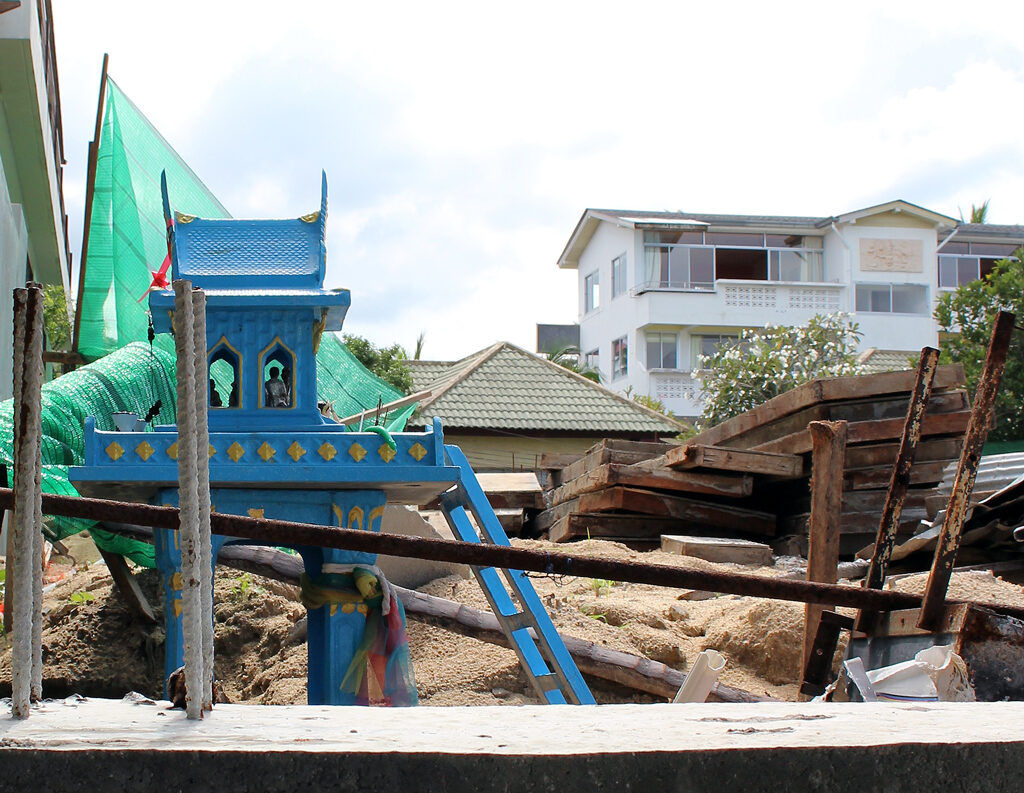
Thailand expat language: why the shrine goes up first
Rent a house or open a shop and this moves from sightseeing to paperwork. Builders set the shrine before or during construction, and the moment has a name: ลงเสาเอก (long sǎo èek), “lowering the first pillar”, when the main post of a new building goes into the ground on a date chosen for it. ก่อสร้าง (gàaw-sâang) is construction and เจ้าของ (jâo khǎawng) is the owner — in practice, whoever keeps the water topped up.
Three rules of etiquette are worth more than any phrase. Never move or re-site a shrine yourself. Never put anything on the ledge you would not offer a respected elder. And when you pass close in front of one, a slight bow of the head costs nothing and is noticed.
Speak Thai: four phrases for the shrine
Men finish a sentence with ครับ (khráp), women with ค่ะ (khâ), switching to คะ (khá) for a question. Around anything sacred the particle is not optional politeness; it is the baseline.
- ไหว้ (wâi) — the verb for the palms-together gesture. ไหว้เจ้าที่ is “to pay respects to the land spirit”.
- นี่คือศาลพระภูมิใช่ไหมครับ (nîi khue sǎan phrá phuum châi mǎi khráp) — “Is this a spirit house?” The frame ใช่ไหม turns any statement into a yes-no question.
- ขอถ่ายรูปได้ไหมคะ (khǎaw thàai rûup dâi mǎi khá) — “May I take a photo?” Worth asking at a shrine inside someone’s shop or garden.
- ขอให้โชคดีครับ (khǎaw hâi chôok dii khráp) — “May there be good luck.” ขอให้ opens every wish in Thai, from a shrine to a birthday card.
A study tip: one object, one line, one week
Pick the shrine nearest your flat and give it seven days. Each day take one object on the ledge, find its Thai name, and write three lines in a notebook: Thai script, your own transliteration, meaning. Seven days covers the whole ledge, and because you are looking at a real object rather than a list, the words attach to something you walk past anyway. It is the slowest-looking and fastest-working way to learn Thai vocabulary there is, and it transfers straight to a menu, a bus board or a shop front.
When you want the letters behind the words, our free Thai alphabet chart lays out all 44 Thai consonants and vowels on one page — start with ศ, ธ and ผ, the three that carry most of the words above. The guide to Thai polite particles covers ครับ and ค่ะ in detail, and the ThaiLetters flashcard trainer will drill the shapes ten minutes at a time until ศาลพระภูมิ reads as three words instead of a row of curves.