Thai Taxi Phrases: Directions for a Bangkok Ride
Speak Thai in a taxi with confidence: ten ride sentences, the direction words and the road-sign vocabulary that get you across Bangkok without a phone.
Nothing exposes the gap between studying a language and using one quite like the back seat of a Bangkok taxi. You know some words; the driver is already pulling into traffic and wants to know where he is going. The good news is that you do not need fluency here. You need about thirty words. If you can speak Thai for the ninety seconds it takes to name a destination, ask for the meter and say where to stop, you will get where you are going more cheaply, more accurately and with a far friendlier ride than the person holding up a phone screen. This guide gives you those words in Thai script, in plain English transliteration, and with the tone and politeness notes that make the difference between being understood and being smiled at politely.
Three words to read before you even open the door
Thai taxis advertise themselves in Thai, and the first small win of any beginner Thai lesson is recognising the words on the vehicle itself:
- แท็กซี่ (thaek-sii) — taxi. A straight loan word, spelled with the rarely seen ็ mark that shortens the vowel. Once you can pick this out on a roof light, you can pick it out anywhere.
- มิเตอร์ (mi-ter) — meter. Also a loan word, and the single most useful noun in this entire guide.
- ว่าง (waang, falling tone) — literally “empty” or “free”. This is the word glowing red in the windscreen of every available cab in Thailand. If it is lit, the taxi is empty and yours.
That last one is a good demonstration of why learning to read Thai script pays off faster than people expect. ว่าง is four symbols. Learn them once and you stop guessing at which cabs are free from thirty metres away.
Ten sentences that let you speak Thai for a whole ride
A taxi conversation is almost entirely predictable, which is exactly what makes it such good practice: the same ten sentences work every time, so you can speak Thai from memory rather than improvising. Male speakers end sentences with ครับ (khrap); female speakers with ค่ะ (kha). This is not optional decoration — dropping it sounds abrupt to Thai ears in a way that no amount of correct vocabulary will repair. The examples below use ครับ; swap it for ค่ะ if you are female.
| Thai | Pronunciation | What it does |
|---|---|---|
| ไปสยามครับ | bpai sa-yaam khrap | “To Siam, please.” Destination first — ไป (bpai) simply means “go”. |
| เปิดมิเตอร์หน่อยครับ | bpert mi-ter noi khrap | “Turn on the meter, please.” Said pleasantly, this settles the fare question before it becomes a negotiation. |
| ตรงไป | dtrong bpai | “Straight on.” Literally “straight go”. |
| เลี้ยวซ้าย | liao saai | “Turn left.” |
| เลี้ยวขวา | liao khwaa | “Turn right.” |
| กลับรถ | glap rot | “Make a U-turn.” Literally “return the car”. Bangkok runs on U-turns; you will use this daily. |
| เข้าซอย | khao soi | “Go into the soi.” ซอย is the side street; ปากซอย (bpaak soi) is its mouth on the main road. |
| จอดตรงนี้ครับ | jort dtrong-nee khrap | “Stop right here.” The sentence that ends every journey. |
| ขึ้นทางด่วนไหมครับ | khuen thaang-duan mai khrap | “Shall we take the expressway?” Tolls are paid by you, in cash, at the booth. |
| เท่าไหร่ครับ | thao-rai khrap | “How much?” Useful everywhere, not just here. |
How to address the driver
Thai social language runs on relative age, and taxis are no exception. พี่ (phee, falling tone) means “older sibling” and is the safe, warm way to address a driver who looks older than you — พี่ครับ to get his attention works like “excuse me”. A younger driver is น้อง (nong), though foreigners are rarely wrong to use พี่ for everyone. Finish the ride with ขอบคุณครับ (khorp khun khrap) and you have had a complete, polite, entirely Thai interaction.
Read Thai script on the signs going past the window
The reason a taxi is such good study time is that the vocabulary is bolted to poles outside. Every road sign in Thailand carries Thai above and a transliteration below, which means you can practise reading Thai script and check yourself a second later. These six words cover most of what you will see:
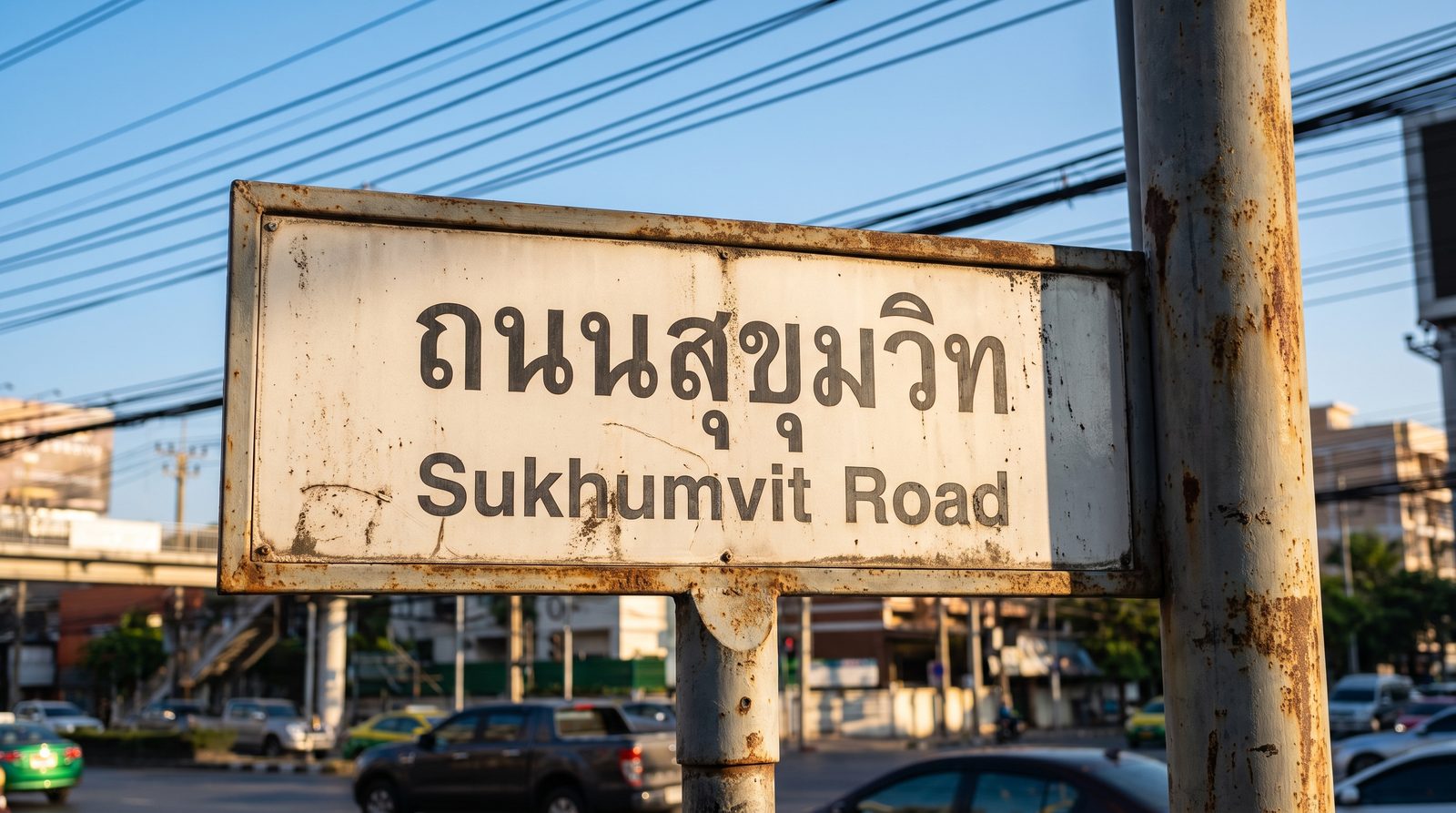
- ถนน (tha-non) — road. Written first, before the name.
- ซอย (soi, mid tone) — the numbered side street. Addresses are built as road, then soi, then house number.
- สี่แยก (see yaek) — crossroads; literally “four splits”. A T-junction is สามแยก (saam yaek), “three splits”.
- สะพาน (sa-phaan) — bridge, including the flyovers Bangkok is stitched together with.
- ทางด่วน (thaang duan) — expressway; literally “urgent way”.
- วงเวียน (wong wian) — roundabout.
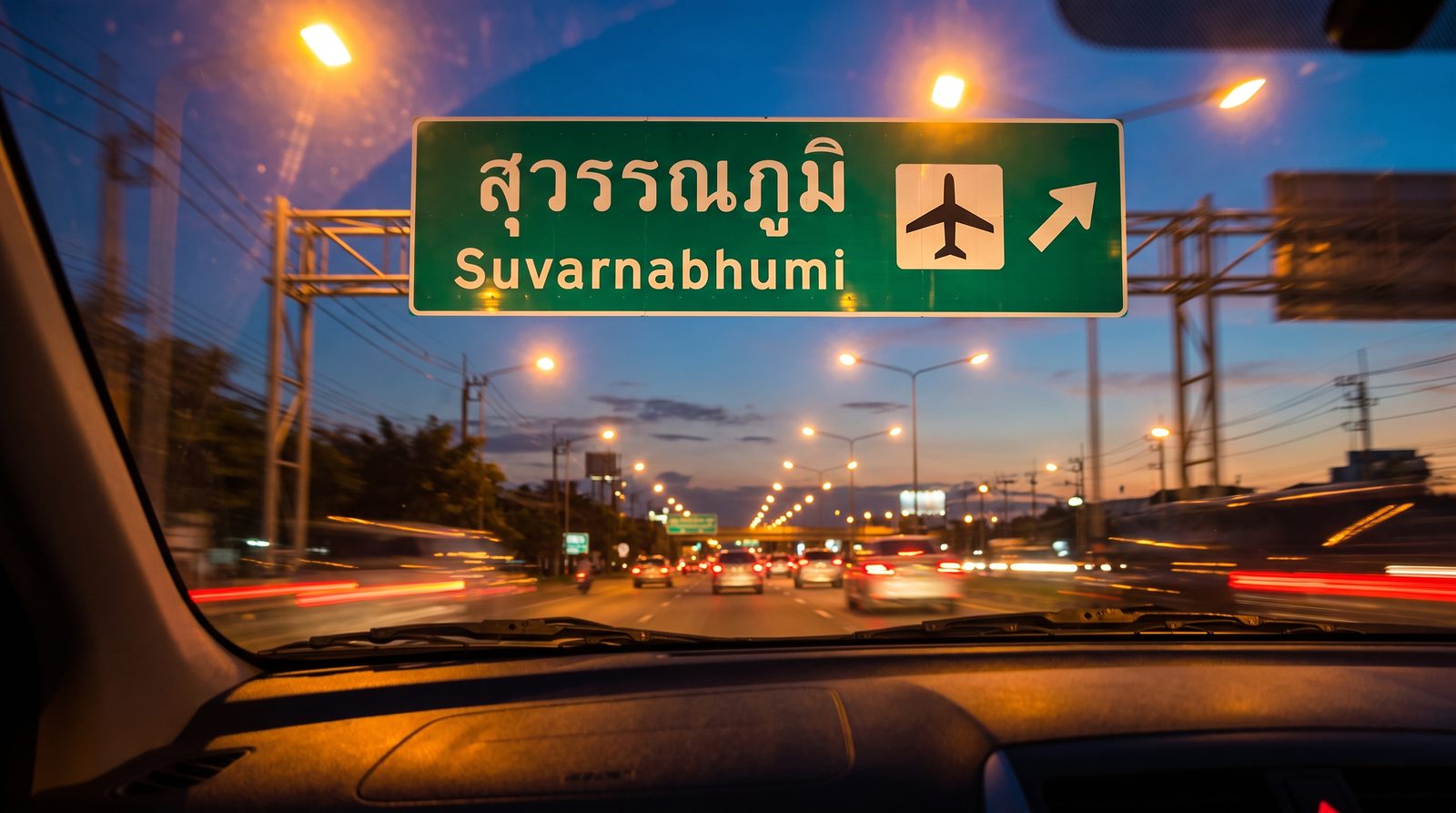
The transliteration underneath is not phonetic English and never has been — it follows an official romanisation system that throws away the tones. We unpack why สุวรรณภูมิ becomes “Suvarnabhumi” in our guide to Thai romanisation on road signs, which is worth reading before you trust a single English spelling in this country.
Landmark words: the fastest way to speak Thai directions
Bangkok house numbers are not sequential and most drivers navigate by landmark, not street number. Learn the building types and you can locate almost anything:
- สนามบิน (sa-naam bin) — airport; literally “flying field”.
- สถานีรถไฟฟ้า (sa-thaa-nee rot-fai-faa) — skytrain station; รถไฟฟ้า is literally “electric train”.
- โรงพยาบาล (rohng pha-yaa-baan) — hospital. โรง (rohng) prefixes most large buildings: โรงแรม (rohng raem) hotel, โรงเรียน (rohng rian) school.
- ห้าง (haang) — shopping mall.
- วัด (wat) — temple, and the most reliable landmark in any Thai neighbourhood.
- ท่าเรือ (thaa ruea) — pier, for the river boats.
Thai transliteration on station signs
If the traffic wins and you switch to the train, three more words finish the job: ทางเข้า (thaang khao) entrance, ทางออก (thaang ork) exit, and เติมเงิน (dterm ngern) top up. Station exits are numbered, so ทางออก 3 on a sign is simply Exit 3 — and if the numerals look unfamiliar, our guide to reading Thai numerals covers those shapes.
Thai pronunciation traps in the back of a cab
Thai is tonal, and a taxi is a noisy, fast-moving place to get a tone wrong. Good Thai pronunciation is what separates people who speak Thai from people who say Thai words. Three worth drilling before you need them:
- Left and right sit on different tones. ซ้าย (saai) is high, ขวา (khwaa) is rising. Say them flat and you will get a shrug. Pair them with a hand gesture until the tones are automatic.
- ไม่ (mai, falling) is “no”; ไหม (mai, rising) turns a sentence into a question. The vowels are identical — only the tone separates a refusal from a question, which is the single clearest argument for learning Thai consonants and vowels as a system rather than memorising sounds.
- ซอย is closer to “soy” than “soi”, and the number that follows it is read as a plain number: ซอยสิบเอ็ด is Soi 17, not “soi one seven”.
The study tip that makes this stick
Treat the ride as the lesson. On your next three taxi journeys, pick one job and do only that: read every ถนน sign aloud before you look at the English on trip one, name your turns in Thai on trip two, and ask the fare in Thai on trip three. Splitting it up is what stops the whole thing collapsing into panic at the door, and it builds the habit of using what you know rather than saving it for later. This is also the cheapest immersion available to anyone living the Thailand expat language experience — you were going to sit in that traffic anyway.
The reading half of the job is the half that compounds. Once you can decode signage, every road, station and shopfront in the country turns into free vocabulary practice. If you are not there yet, start with our Thai alphabet chart to learn Thai letters in context, then drill them with the free ThaiLetters flashcard trainer — fifteen minutes a day for a fortnight is genuinely enough to read a street sign. Do that, add the thirty words above, and you can speak Thai well enough to get yourself home.