Learn Thai Vocabulary at a Muay Thai Fight in Thailand
Learn Thai vocabulary at a Muay Thai fight in Thailand: ring, round, gym and body words in Thai script with transliteration, pronunciation and real photos.
The fastest way to learn Thai vocabulary in Thailand is to learn it somewhere you actually want to be, and for a lot of us that place is a boxing stadium on a Friday night. Muay Thai hands you a small, fixed set of words and then repeats them at you for three hours: the arena, the camp, the round, the knee, the elbow. Thirty words is enough to turn an evening of noise into something you can follow.
This beginner Thai lesson is built around four real photographs — the front of Rajadamnern Stadium in Bangkok, a televised card under the lights, a fighter settling his headband before the ritual dance, and a provincial stadium in Krabi. Everything below is given in Thai script, in Thai transliteration and with the literal English underneath, because almost every word here is assembled from ordinary pieces you will meet again on menus, maps and shop fronts.
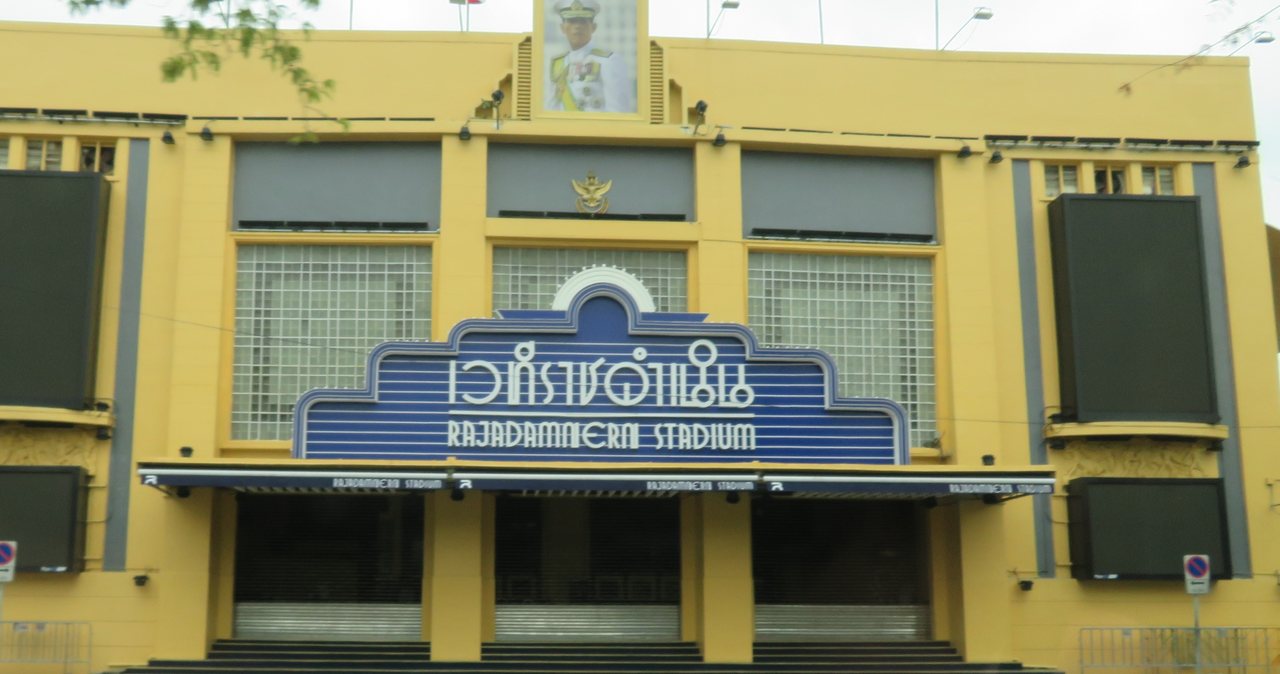
Read Thai script on the stadium sign: เวที and สนามมวย
Two words get you into the building. Neither one means “stadium” on its own, which is exactly why they are worth taking apart — this is where learning to read Thai script starts paying you back in whole families of words rather than single ones.
- เวที (weh-thii) — a stage or a platform. A boxing ring, a concert stage and a debate platform are all เวที.
- สนามมวย (sà-nǎam muay) — boxing stadium. Literally “field of boxing”: สนาม (sà-nǎam) is a field or ground, and it also gives you สนามบิน (sà-nǎam bin), “flying field” — the airport.
- มวยไทย (muay thai) — Thai boxing. มวย alone is boxing of any kind.
- ค่ายมวย (khâai muay) — a boxing camp or gym. ค่าย is a camp, military or otherwise.
- นักมวย (nák muay) — a boxer.
That last one is the generous one. นัก (nák) is a prefix meaning roughly “a person who does this seriously”, and once you can see those two Thai letters at the front of a word you can guess half a page of a newspaper: นักเรียน (nák rian, student), นักร้อง (nák ráwng, singer), นักท่องเที่ยว (nák thâwng thîao, tourist). One tiny piece of the Thai alphabet, a shelf of free vocabulary.
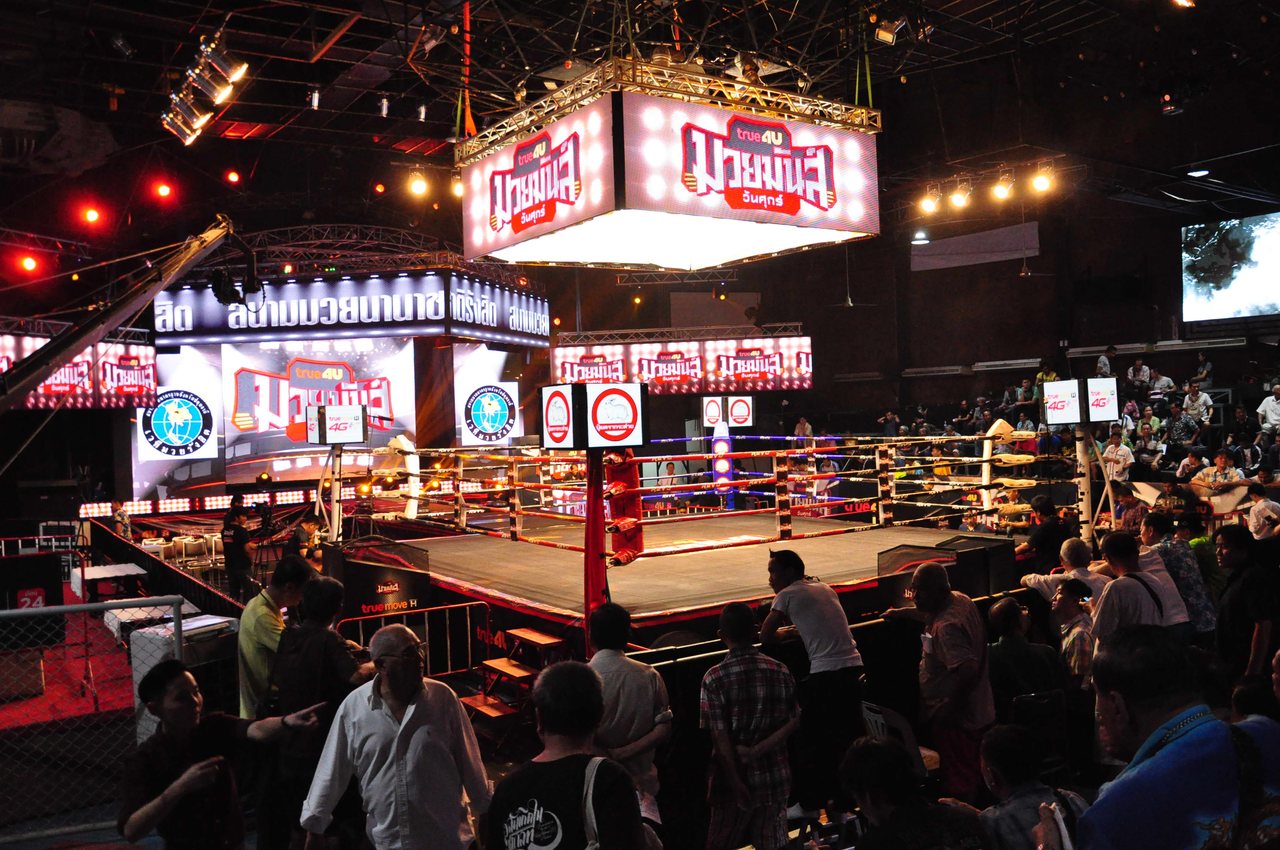
Thai vocabulary on the fight card: rounds, minutes and the referee
Everything that happens in the next two hours is announced with about eight words, which makes the ring the easiest place in the building to learn Thai vocabulary by ear. Read them once here and you will recognise them over the loudspeaker, which is useful, because Thai ring announcing is fast and heavily compressed.
| Thai | Thai transliteration | Meaning |
|---|---|---|
| ยก | yók | a round (literally “to lift”) |
| นาที | naa-thii | minute |
| กรรมการ | gam-má-gaan | referee, official |
| มุมแดง / มุมน้ำเงิน | mum daeng / mum nám-ngern | red corner / blue corner |
| น็อก | nók | knockout (an English loanword) |
| แชมป์ | chaem | champion (also borrowed) |
| เข็มขัด | khěm khàt | belt |
A standard professional fight is five ยก of three นาที, so the numbers one to five will be said out loud more than twenty times in an evening — a free drill. If the digits on the board are the round Thai numerals rather than 1–5, our guide to reading Thai numerals on prices and dates covers all ten in about five minutes.
Beginner Thai lesson: the body, part by part
English calls Muay Thai “the art of eight limbs”; Thai promoters write แปดอาวุธ (bpàet aa-wút), “eight weapons”. The eight are simply body parts, and this is the most portable Thai vocabulary on the page — you will use these words at the pharmacy, at the massage shop and the first time you stub a toe on a kerb in Bangkok.
- หมัด (màt) — fist.
- ศอก (sòrk) — elbow.
- เข่า (khào) — knee.
- เท้า (tháo) — foot.
- แข้ง (khâeng) — shin, the part that actually lands.
Then the verbs, which are short and blunt: ต่อย (dtòi, to punch), เตะ (dtè, to kick), ถีบ (thìip, to push-kick — the move foreigners spell “teep”) and สู้ (sûu, to fight). Thai pronunciation rewards you for being careful with the vowel length here: เตะ is clipped short, ถีบ is drawn out, and those two Thai vowels are doing the same job as a long and short vowel in English — they just get written as separate signs rather than guessed from spelling.

Speak Thai politely in the gym: ครู, ไหว้ครู and khrap/kha
Walk into a ค่ายมวย and the language problem is not vocabulary, it is rank. Thai social life runs on relative seniority, and a gym is a small, strict version of it. Get this part right and people will forgive almost any mistake you make with Thai consonants and vowels.
- ครู (khruu) — teacher. Say it to your trainer, with or without his name after it. Older fighters are พี่ (phîi), “older sibling”, which is warm rather than formal.
- สวัสดีครับ ครู (sà-wàt-dii khráp khruu) — “Hello, kru.” Men end with ครับ (khráp), women with ค่ะ (khâ).
- ขอบคุณครับ (khàwp khun khráp) — thank you. Say it at the end of every session, to the trainer who held pads for you.
- ไหว้ครู (wâi khruu) — literally “to wai the teacher”, the slow dance before the first bell. It is respect paid to a lineage, not a warm-up.
- ประเจียด (bprà-jìat) — the armband worn with the มงคล.
Two unwritten rules carry more weight than any sentence you can produce: feet are low and heads are high, so you do not step over someone’s gloves, bag or body on the floor, and you do not pat a Thai adult on the head. And the polite particle is not decoration — dropping ครับ or ค่ะ turns a question into an instruction. We unpack both in the guide to speaking Thai politely with khrap and kha.
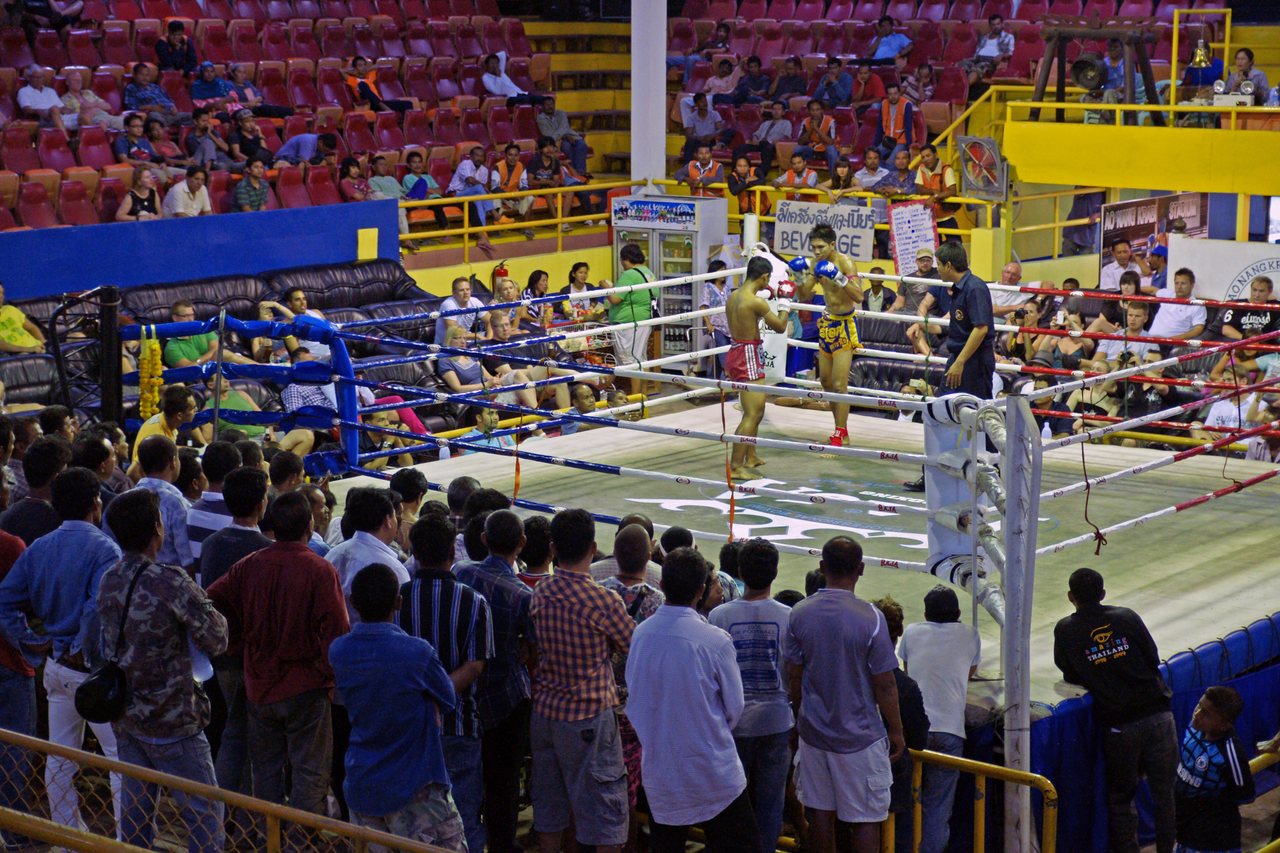
Thailand expat language at the ticket window
Six short lines cover getting in, sitting down and getting a drink. None of them needs grammar you have not already met, and all of them work at a bus station too — which is the quiet argument for using a fight night to learn Thai vocabulary in the first place.
- ตั๋ว (dtǔa) — ticket. ตั๋วหนึ่งใบครับ (dtǔa nèung bai khráp) — “one ticket, please.”
- ราคาเท่าไหร่ครับ (raa-khaa thâo-rài khráp) — “How much is it?”
- เริ่มกี่โมงครับ (rôoem gìi moong khráp) — “What time does it start?”
- เครื่องดื่ม (khrêuang-dèum) — drinks, written on half the stalls in Thailand.
- เก่ง (gèng) — skilful, good at something. The compliment you will hear shouted at a fighter and, eventually, at your Thai.
- สู้ๆ (sûu sûu) — “keep fighting”, the all-purpose Thai cheer, used for exams and hangovers as well as fights.
A study tip: learn the words you will hear again tonight
Pick five words from this page — say เวที, ยก, เข่า, ครู and เก่ง — and do not revise anything else until you have heard all five used by a Thai person. That is the whole method. Vocabulary that arrives attached to a bell, a crowd and a sore shin does not need to be memorised twice, which is why a stadium beats a word list for anyone trying to learn Thai vocabulary from scratch.
When you want the letters behind the words rather than the words themselves, our free Thai alphabet chart lays out all 44 consonants and the vowel signs on one page, and the ThaiLetters flashcard trainer will drill them in ten minutes at a time. Start with ม, ว and ย — you have already read them tonight, about four hundred times, on every banner in the building.