Learn Thai Vocabulary: Noodle Soup & Kuaitiao Thailand
Learn Thai vocabulary for ordering noodle soup in Thailand: kuaitiao noodle types, wet or dry, toppings and seasoning words in Thai script, with real photos.
A bowl of noodles costs about fifty baht in Thailand and takes ninety seconds to arrive, which means a noodle stall is the cheapest classroom in the country. It is also the most demanding one, because ordering is not a single word — it is four quick decisions made standing up, in Thai, while somebody behind you waits. This guide is built around those four decisions, and it is the fastest way to learn Thai vocabulary you will actually use before the end of the week.
Everything below comes with Thai script, a Thai transliteration you can say out loud, and the literal meaning wherever the literal meaning is what makes a word stick. Every photograph is a real bowl, a real stall and a real sign in Thailand — no illustrations, no mock-ups.
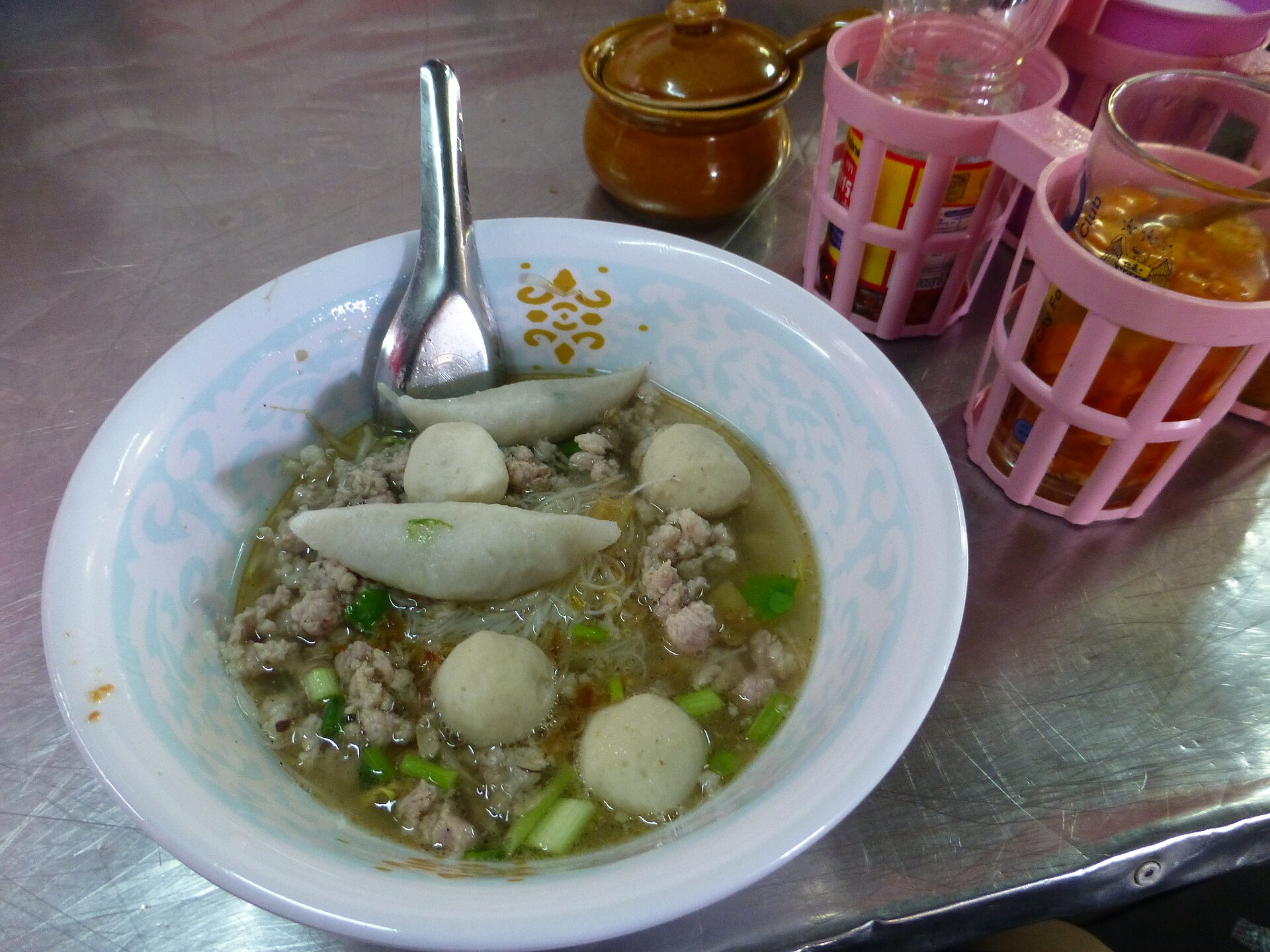
ก๋วยเตี๋ยว: one word, a whole category
ก๋วยเตี๋ยว (gǔay-dtǐao) is borrowed from Teochew Chinese and covers both the rice noodle itself and the dish built on it. In speech the first syllable usually vanishes and people simply say เตี๋ยว (dtǐao) — worth knowing, because the shortened form is what you will actually hear shouted across a shop. It is also a small beginner Thai lesson in spelling: both syllables carry ไม้จัตวา, the fourth tone mark, which is rare enough that the word is easy to spot on a sign once you know the shape.
Ordering runs in a fixed order, and the order never changes: noodle, then wet or dry, then topping, then anything you want left out. Learn the slots and you can fill them with new words forever.
Decision one: choose your noodle (เส้น)
เส้น (sên) means a strand or a line — the same word used for a line on a map. Every noodle name is เส้น plus a description, so this is a chance to learn Thai vocabulary six words at a time, from one root you already know.
- เส้นเล็ก (sên lék) — thin flat rice noodles, literally “small strand”. The default, and the safest first order
- เส้นใหญ่ (sên yài) — wide flat rice noodles, “big strand”
- เส้นหมี่ (sên mìi) — very thin rice vermicelli, the noodles in the photo above
- บะหมี่ (bà-mìi) — yellow wheat-and-egg noodles, springy rather than soft
- วุ้นเส้น (wún sên) — glass noodles, literally “jelly threads”
- เกี๊ยว (gíao) — wontons, usually ordered alongside บะหมี่
The pair เล็ก (lék, small) and ใหญ่ (yài, big) is worth hammering now, because it reappears everywhere — clothing sizes, bottle sizes, hotel rooms. One noodle order teaches you two adjectives you will use daily in Thailand.
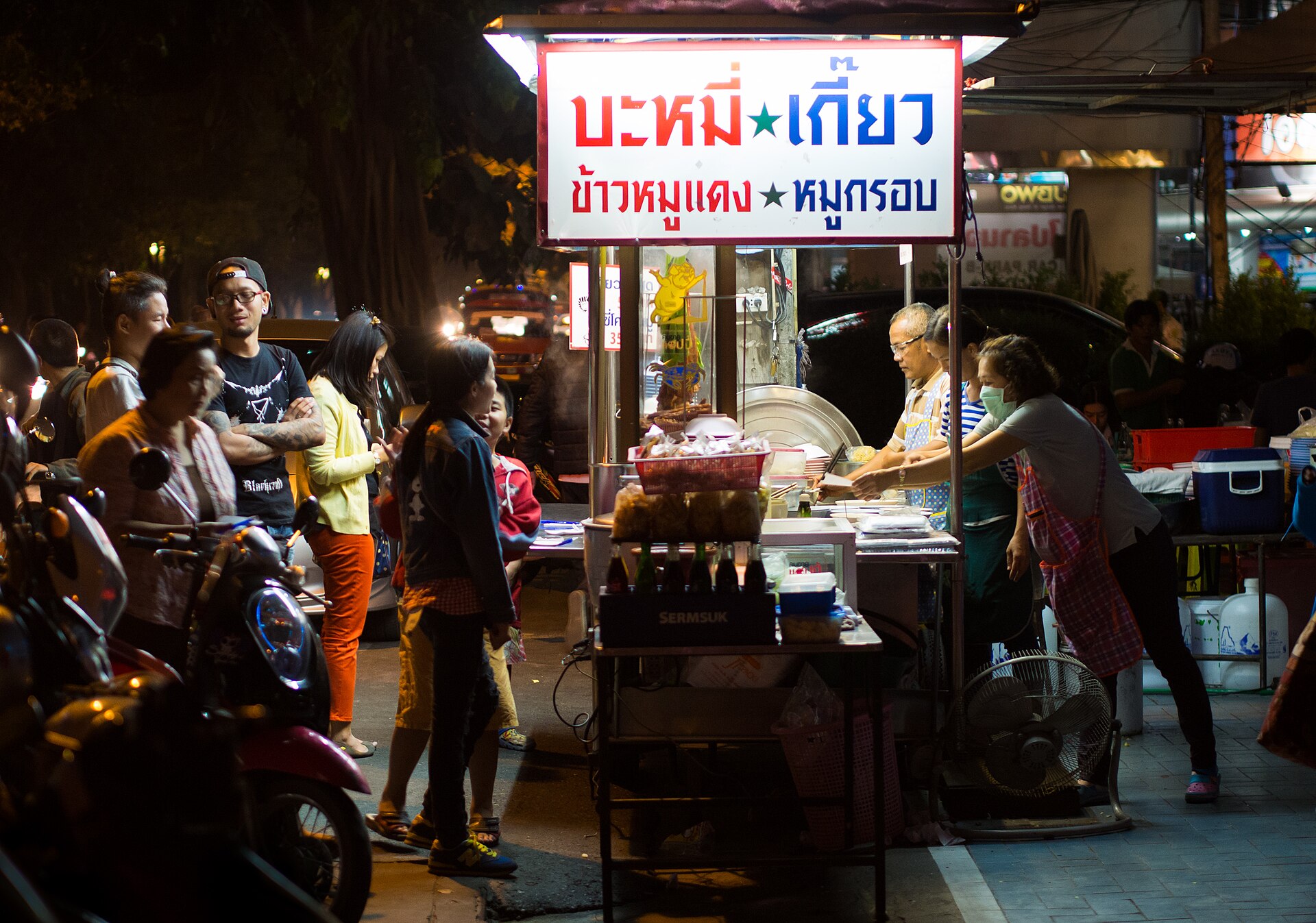
Decision two: น้ำ or แห้ง — wet or dry
This is the single most useful distinction at any noodle stall, and foreigners almost never know it exists. น้ำ (nám) is water, and a bowl ordered น้ำ arrives swimming in broth. แห้ง (hâeng) means dry: the same noodles and the same toppings, tossed in seasoning instead, with the broth served separately in a small bowl on the side. Nothing is missing — it has simply been unbundled.
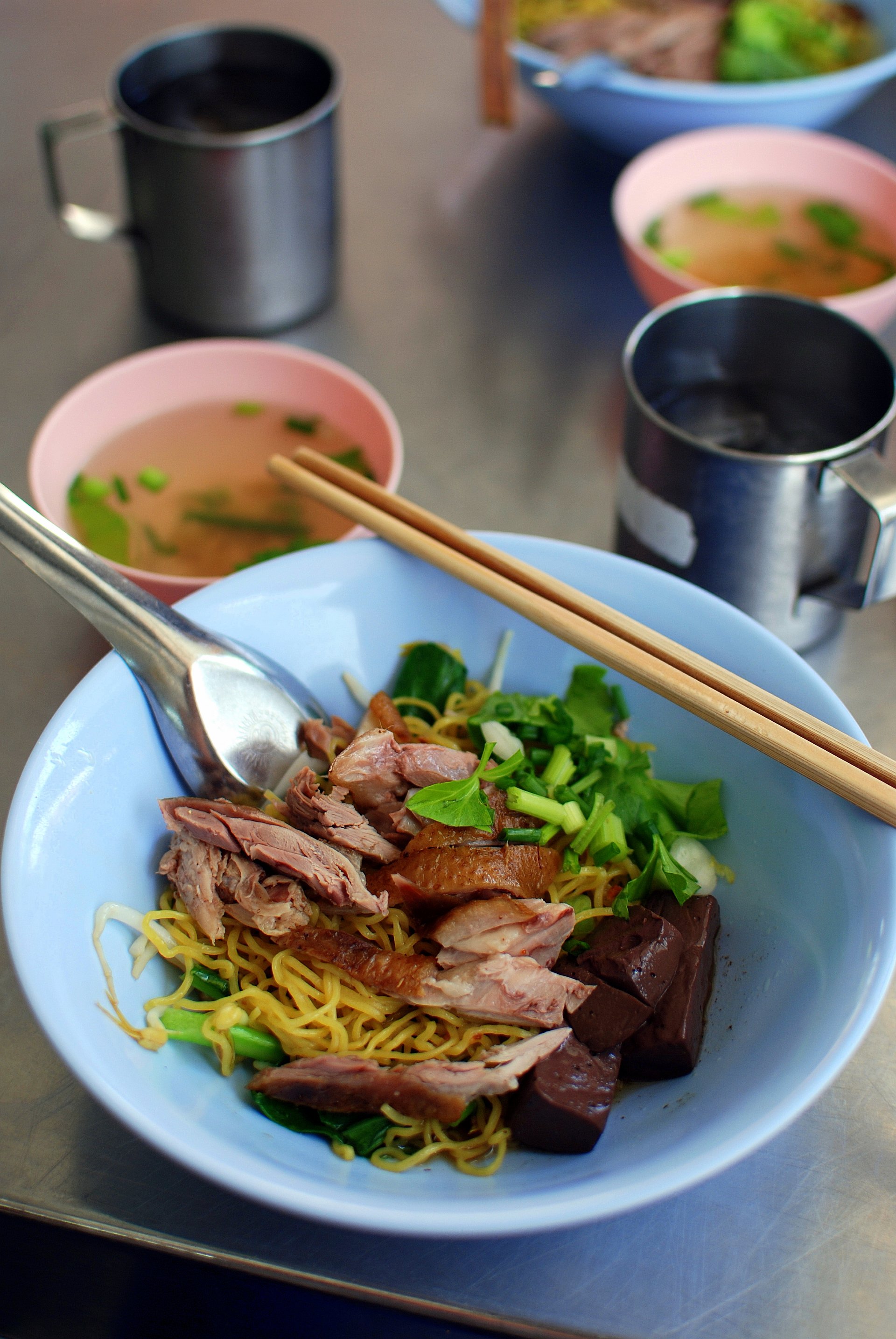
Two more words finish the slot. ธรรมดา (tham-má-daa) is a normal portion; พิเศษ (phí-sèet) is the large one, literally “special”, and usually costs ten baht more. If you are hungry, พิเศษ is the word.
Decision three: what goes on top
Toppings are the easiest place in Thailand to learn Thai vocabulary by the handful — a noodle stall quietly teaches you half a market’s worth of nouns. Read the handwritten board if there is one, point if there is not — but say the word as you point, because that is how it moves from the page into your mouth.
- หมูสับ (mǔu sàp) minced pork · หมูแดง (mǔu daeng) red roast pork, “red pork”
- ลูกชิ้น (lûuk chín) fish or pork balls, literally “child pieces”
- เป็ด (bpèt) duck · เนื้อ (núea) beef · ไก่ (gài) chicken
- ตับ (dtàp) liver · เลือด (lûeat) set blood
- ถั่วงอก (thùa ngâwk) bean sprouts, “sprouting bean” · ผักบุ้ง (phàk bûng) morning glory
- ต้นหอม (dtôn hǎwm) spring onion · ผักชี (phàk chii) coriander · กระเทียมเจียว (grà-thiam jiao) fried garlic
And the single most valuable construction in the whole guide: ไม่ใส่ (mâi sài), “don’t put in”. ไม่ใส่ผักชี (mâi sài phàk chii) spares you coriander; ไม่ใส่ถั่วงอก drops the sprouts. Say it while the cook is still assembling the bowl, not after.
เครื่องปรุง: the four pots on the table
Thai noodle soup arrives deliberately bland, because seasoning it is the eater’s job. The rack in the middle of the table is เครื่องปรุง (khrûeang bprung) — เครื่อง “apparatus, set of things” plus ปรุง “to season”. Four pots, four tastes, always the same four.
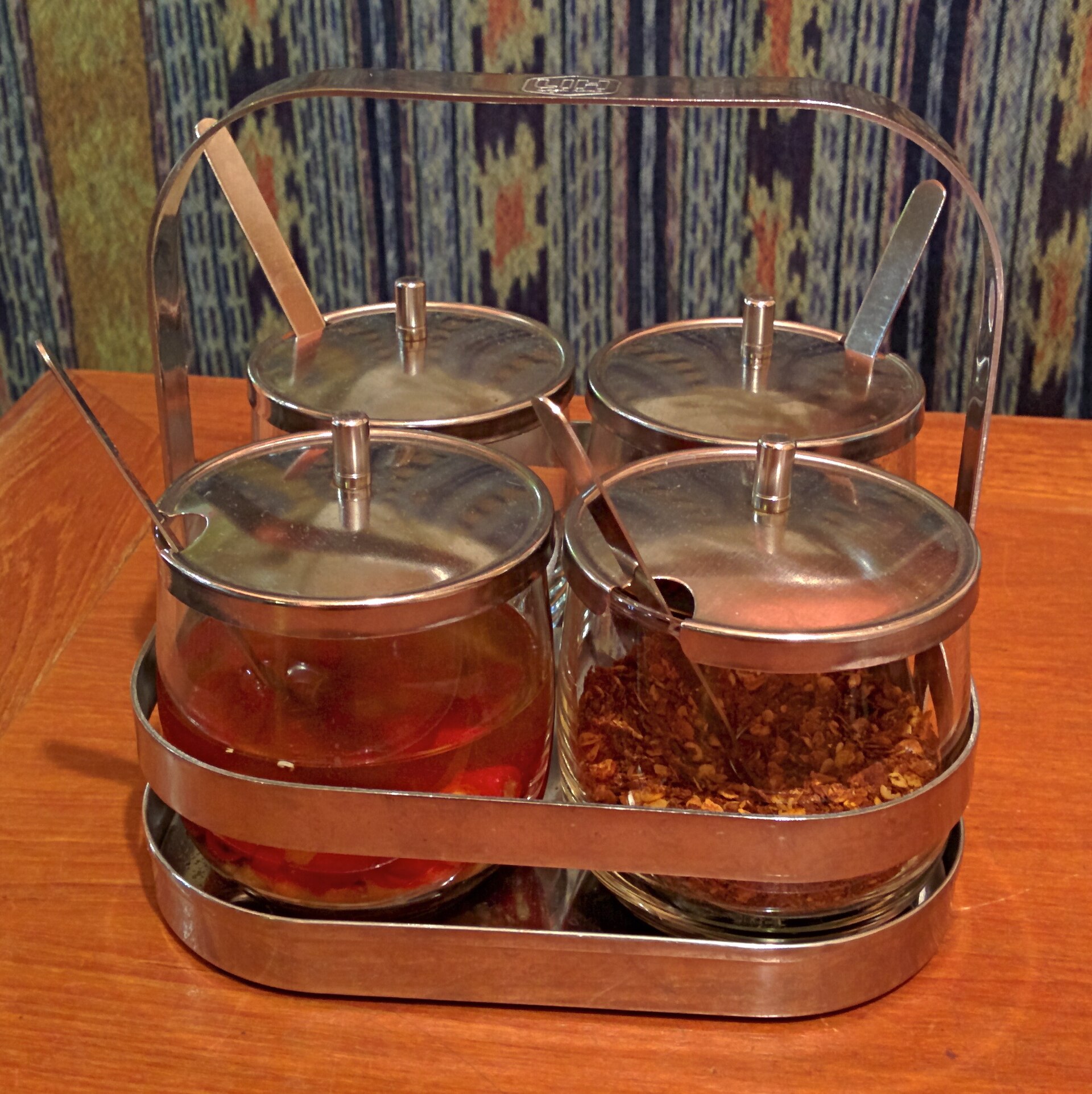
Those names are a free Thai pronunciation drill, because three of them begin with น้ำ (nám) — water. น้ำตาล is “sugar-palm water”, น้ำปลา is “fish water”, น้ำส้ม is “orange water”, which is vinegar and not orange juice. Thai builds hundreds of compounds like this from a short list of roots, so each one you learn makes the next one cheaper. If the letters themselves are still slow going, our free Thai alphabet chart is the place to fix that first.
Famous bowls worth knowing by name
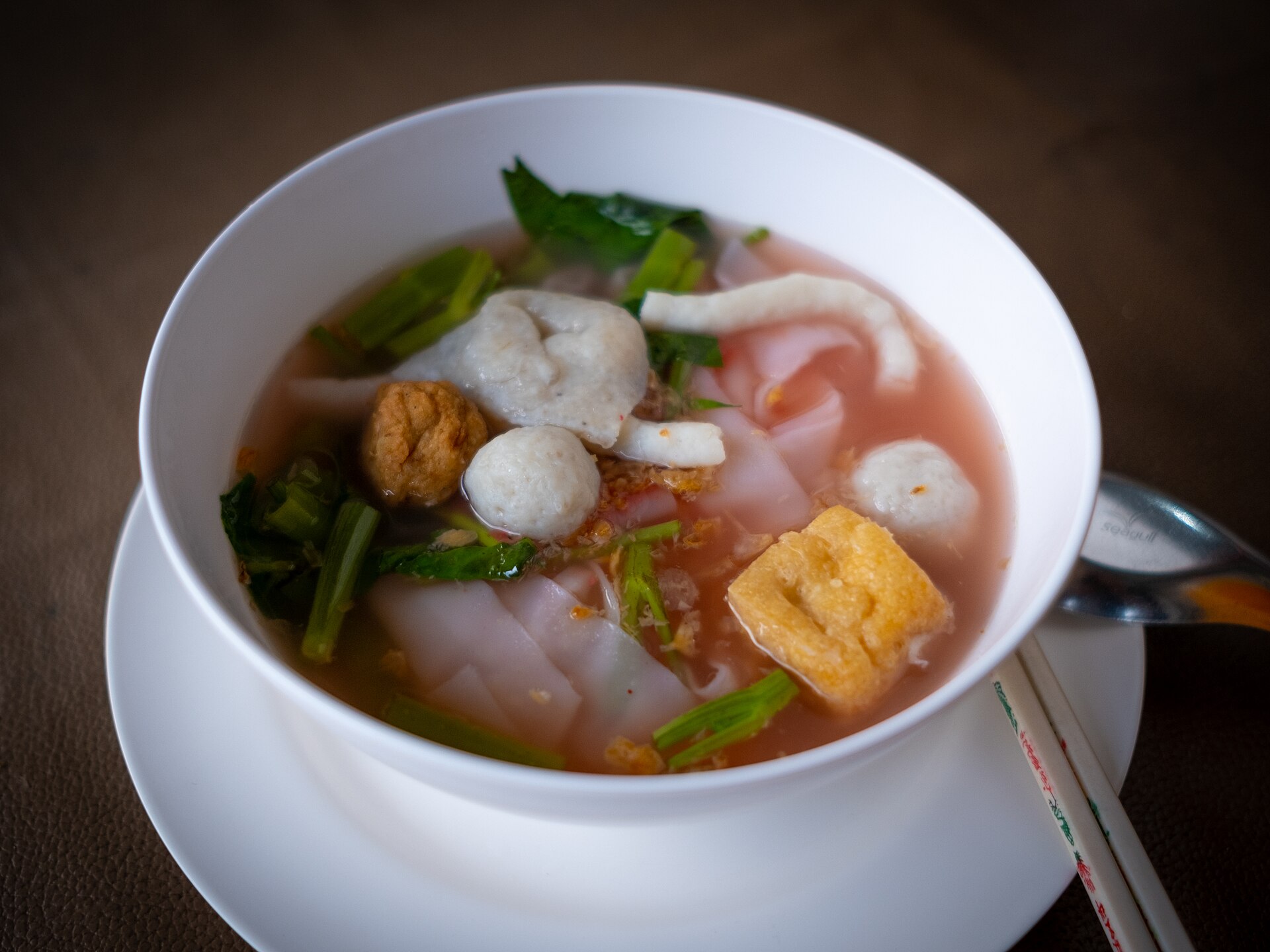
Four names, four completely different bowls — and sorting near-neighbours like this is how you learn Thai vocabulary that survives contact with a real menu.
- ก๋วยเตี๋ยวต้มยำ (gǔay-dtǐao dtôm yam) — the sour-hot one, with lime, chilli and crushed peanuts
- ก๋วยเตี๋ยวน้ำตก (gǔay-dtǐao nám dtòk) — “waterfall noodles”, a dark broth thickened with blood
- ก๋วยเตี๋ยวเรือ (gǔay-dtǐao ruea) — boat noodles, served in tiny bowls; stacks of empties are the scoreboard
- ก๋วยจั๊บ (gǔay jáp) — rolled noodles in peppery broth, a different animal entirely
Saying it out loud: ครับ, ค่ะ and one sentence
Stack the slots in order and you get a real order. เอาก๋วยเตี๋ยวน้ำ เส้นเล็ก หมูสับ ครับ — ao gǔay-dtǐao nám, sên lék, mǔu sàp, khráp — “I’ll take noodle soup, thin noodles, minced pork, please.” You do not need much to speak Thai at a noodle stall — a verb, a noun and a particle will do. Men end with ครับ (khráp), women with ค่ะ (khâ), and that particle is what turns a list of nouns into a polite request. Swap one word at a time and you have ordered a hundred different bowls. Our guide to khrap and kha covers the rest of the politeness system in twenty minutes.
- เอา...ครับ / ค่ะ (ao … khráp / khâ) — “I’ll take…”, the normal way to order
- ไม่เผ็ด (mâi phèt) — not spicy; เผ็ดน้อย (phèt nói) — a little spicy
- ใส่ถุง (sài thǔng) — “in a bag”, i.e. takeaway
- อีกชามหนึ่ง (ìik chaam nùeng) — “one more bowl”; ชาม is the classifier for bowls, and our guide to Thai classifiers has the others
- เช็คบิล (chék bin) or คิดเงิน (khít ngern) — the bill, please
- อร่อยมาก (à-ràwy mâak) — “very tasty”, which gets you a smile every time
One pronunciation warning. เส้น (sên, noodle) and เซ็น (sen, to sign) differ only by tone, and ไม้ (mái, wood), ไม่ (mâi, not) and ไหม (mǎi, the question particle) are near-identical to an untrained ear. Thai readers separate them instantly from the tone mark and the class of the first consonant, which is the real argument for learning the Thai consonants and vowels properly rather than leaning on romanisation forever. Our guide to Thai tone marks explains how the two interact.
A study tip: one stall, one slot
Do not try to memorise this page. Take one slot per visit instead. On Monday, change only the noodle — order เส้นใหญ่ and see what lands. On Tuesday, change only wet or dry. By Friday you have varied every slot independently, and the grammar of the order is in your hands rather than on a screen. This is how people who learn Thai vocabulary quickly actually do it: small substitutions into a sentence frame that already works, with the result delivered to the table ninety seconds later.
Then push it one step further and read before you point. Sound the sign out, commit to a guess, then check against the bowl. Learning to read Thai script is hundreds of small guesses corrected fast — and the Thai letters on a noodle sign are large, repetitive and always attached to something you can taste. Drill the shapes in the ThaiLetters flashcard trainer, then go and test them on a cart. For more words from the same street, our guide to Thai street food vocabulary is the natural next stop. That loop — guess, check, eat — is the whole of Thailand expat language learning, and it costs fifty baht a lesson.