Read Thai Script: Bangkok Bus Signs in Thailand
Read Thai script on Bangkok bus signs in Thailand: decode stop boards, route numbers and windscreen destinations in Thai, with pronunciation and photos.
A Bangkok city bus will carry you eight kilometres for about fifteen baht, which makes it the best transport bargain in Thailand — and almost the only one that offers you nothing in English. The skytrain is bilingual from end to end. The bus gives you a number, a strip of blue Thai letters across the windscreen, and a conductor who wants to know where you are going before the lights change. Learning to read Thai script on bus signs is therefore the highest-value piece of reading in the city: five or six short words, repeated on every pole and every windscreen, standing between you and a network of several hundred routes.
This Thai language guide works through those signs in the order you actually meet them — the pole at the kerb, the numbers printed on it, the destination banner across the glass, and the words you will hear once you are aboard. Every entry gives the Thai script, a Thai transliteration you can say out loud, and the literal meaning, because in bus Thai the literal meaning is nearly always the memory hook. All four photographs are real signs photographed on real Bangkok streets, so what you practise here is exactly what you will meet tomorrow.
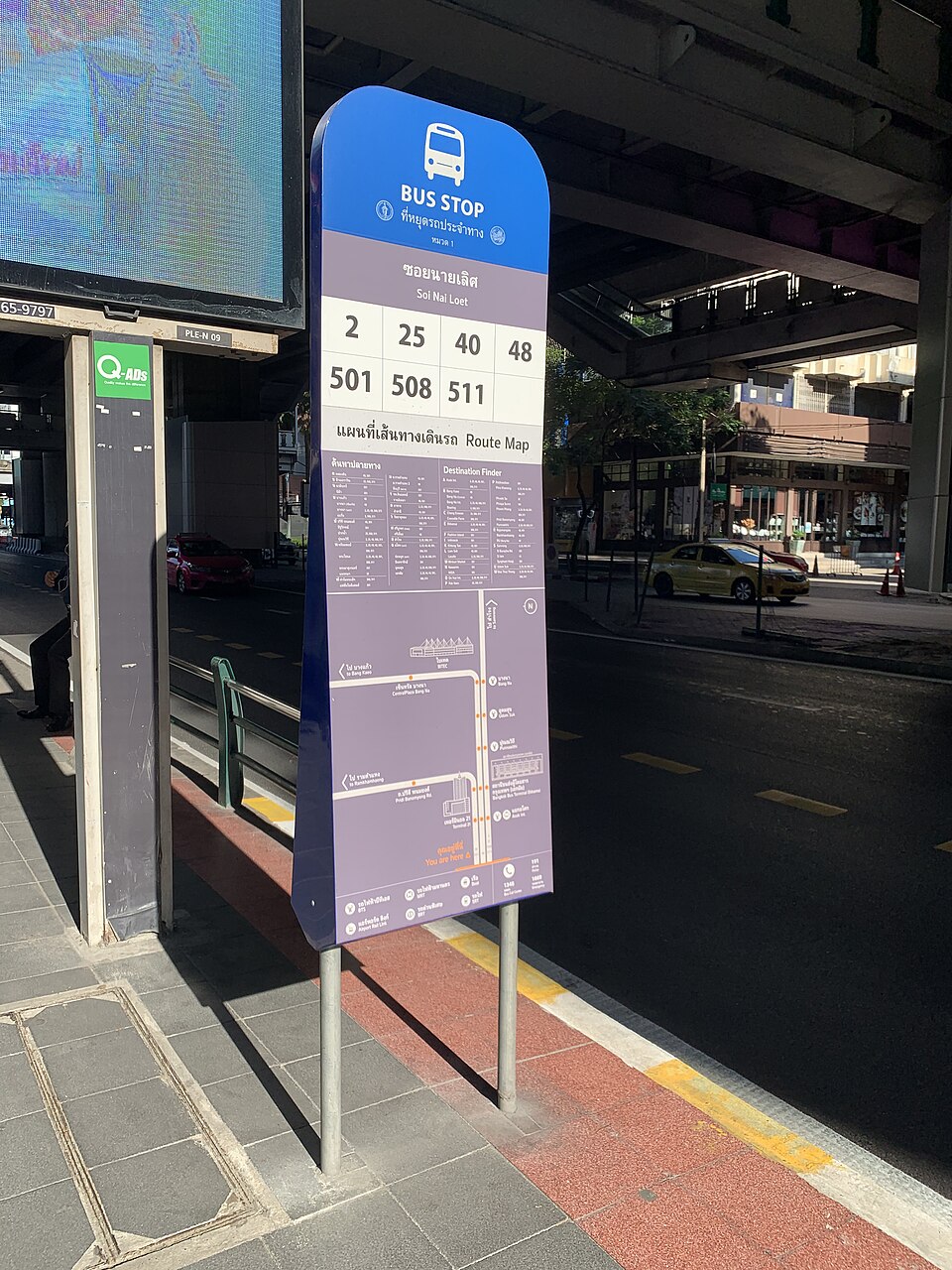
ที่หยุดรถประจำทาง: the header on every stop
Thai has a formal word for a bus and a street word for a bus, and the sign uses one while everybody around you uses the other. Learn both on day one:
- รถประจำทาง (rót bprà-jam thaang) — bus, lit. “vehicle regular to a route”. This is the word printed on signs and spoken in announcements
- รถเมล์ (rót mee) — bus, the everyday word; เมล์ is borrowed from English “mail”, from the old mail coaches
- ที่หยุดรถประจำทาง (thîi yùt rót bprà-jam thaang) — bus stop, lit. “place where the route vehicle halts”
- ป้ายรถเมล์ (bpâai rót mee) — the same thing in speech, lit. “bus sign”. Ask for this, never for the long version
- ป้าย (bpâai) — sign, board, plate. One of the most reusable nouns in Thai: it appears on licence plates, shop fronts and every stop in the country
- หมวด (mùat) — category. The small หมวด ๑ under the header grades the stop in the operator’s own scheme; you can safely ignore it, but it is a free word
The operator’s initials are worth recognising too. ขสมก. (khǎw sǎw mǎw gaw) is short for องค์การขนส่งมวลชนกรุงเทพ, the Bangkok Mass Transit Authority, and it is stamped on the side of most buses in the city. Thai abbreviates by keeping the first letter of each word and adding a full stop, which is why so many official Thai letters turn up in clusters like this.
Route numbers and the Thai numerals beside them
The white grid in the middle of the pole is the part you will use every single time. Each cell holds one route number, and the Thai word for a route is the one to memorise. Learn to read Thai script on this one panel and you can plan a journey standing at the kerb:
- สาย (sǎai) — route, line. สาย ๒๕ is “route 25”; the same word covers phone lines and rivers
- สายนี้ (sǎai níi) — this route · ไป (bpai) — to go to. Together they make the only question you really need
- วงกลม (wong glom) — circular, lit. “round circle”. A route marked this way loops back rather than reversing
- สุดสาย (sùt sǎai) — the end of the line, where everybody is put off
- แผนที่เส้นทางเดินรถ (phǎen-thîi sên-thaang dəən rót) — route map, lit. “map of the line the vehicle walks”
- ค้นหาปลายทาง (khón-hǎa bplaai-thaang) — destination finder, the dense two-column table of place names and route numbers
- คุณอยู่ที่นี่ (khun yùu thîi nîi) — you are here, printed in orange on the little map
Route numbers on the pole are in Arabic digits, but timetables, fare notices and older plates still use Thai ones — ๐ ๑ ๒ ๓ ๔ ๕ ๖ ๗ ๘ ๙. Half an hour with our guide to reading Thai numerals, prices and dates removes that obstacle permanently, and it is the fastest win available to a beginner.
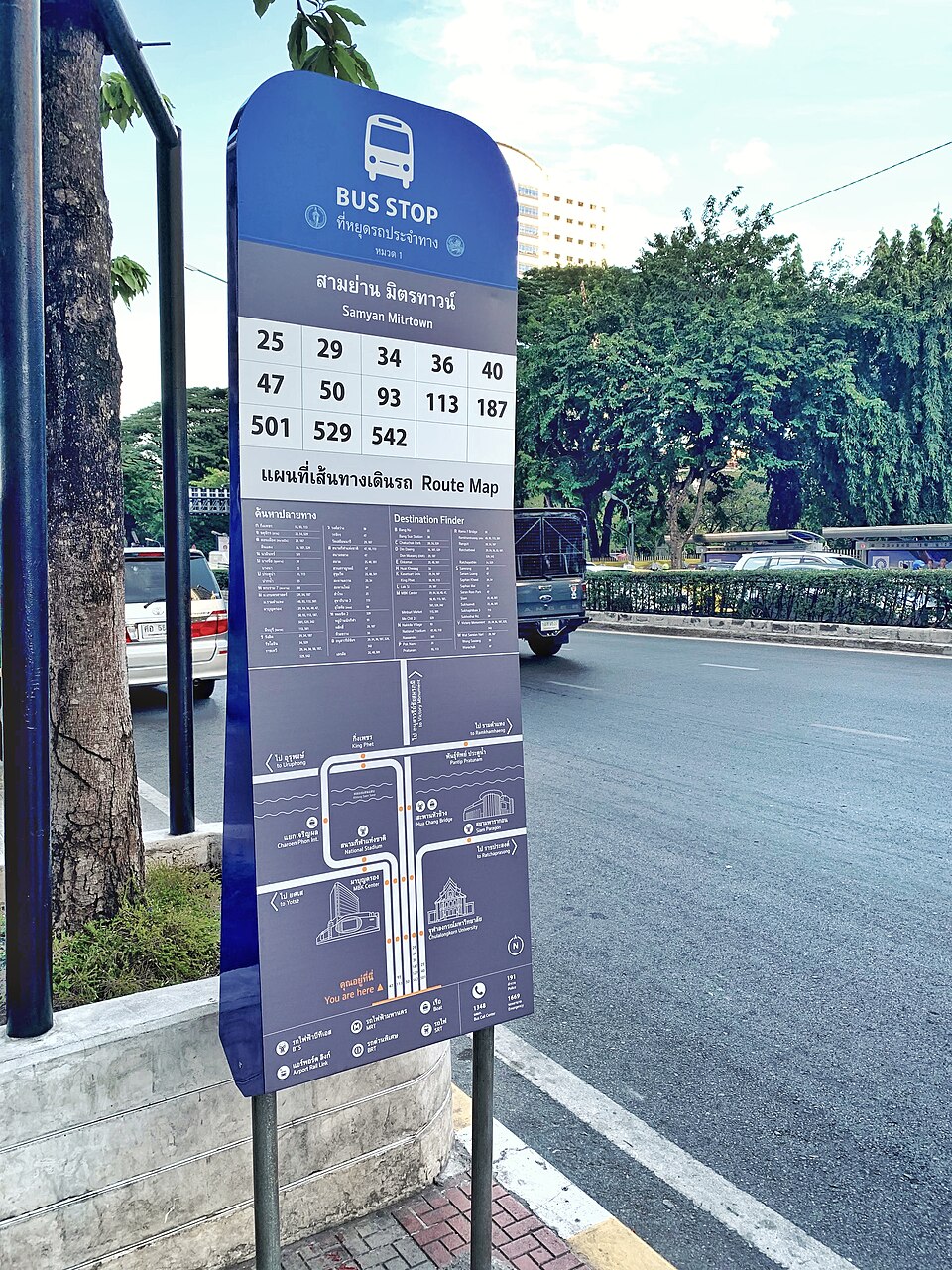
ต้นทาง and ปลายทาง: the pair that runs the system
Thai describes a journey as a length of road with two ends, and once you see the pattern you can read half the transport vocabulary in the country without being taught it:
- ทาง (thaang) — way, path, route. The root of everything below
- ต้นทาง (dtôn thaang) — the origin, lit. “trunk of the way”, the same ต้น as in a tree
- ปลายทาง (bplaai thaang) — the destination, lit. “tip of the way”
- ระหว่างทาง (rá-wàang thaang) — along the way, in between
- ทางด่วน (thaang dùan) — expressway, lit. “urgent way”. A bus marked ขึ้นทางด่วน (khûen thaang dùan) climbs onto the toll road and skips the next dozen stops
- ด่วน (dùan) — express, urgent. On a windscreen it is a warning as much as a promise
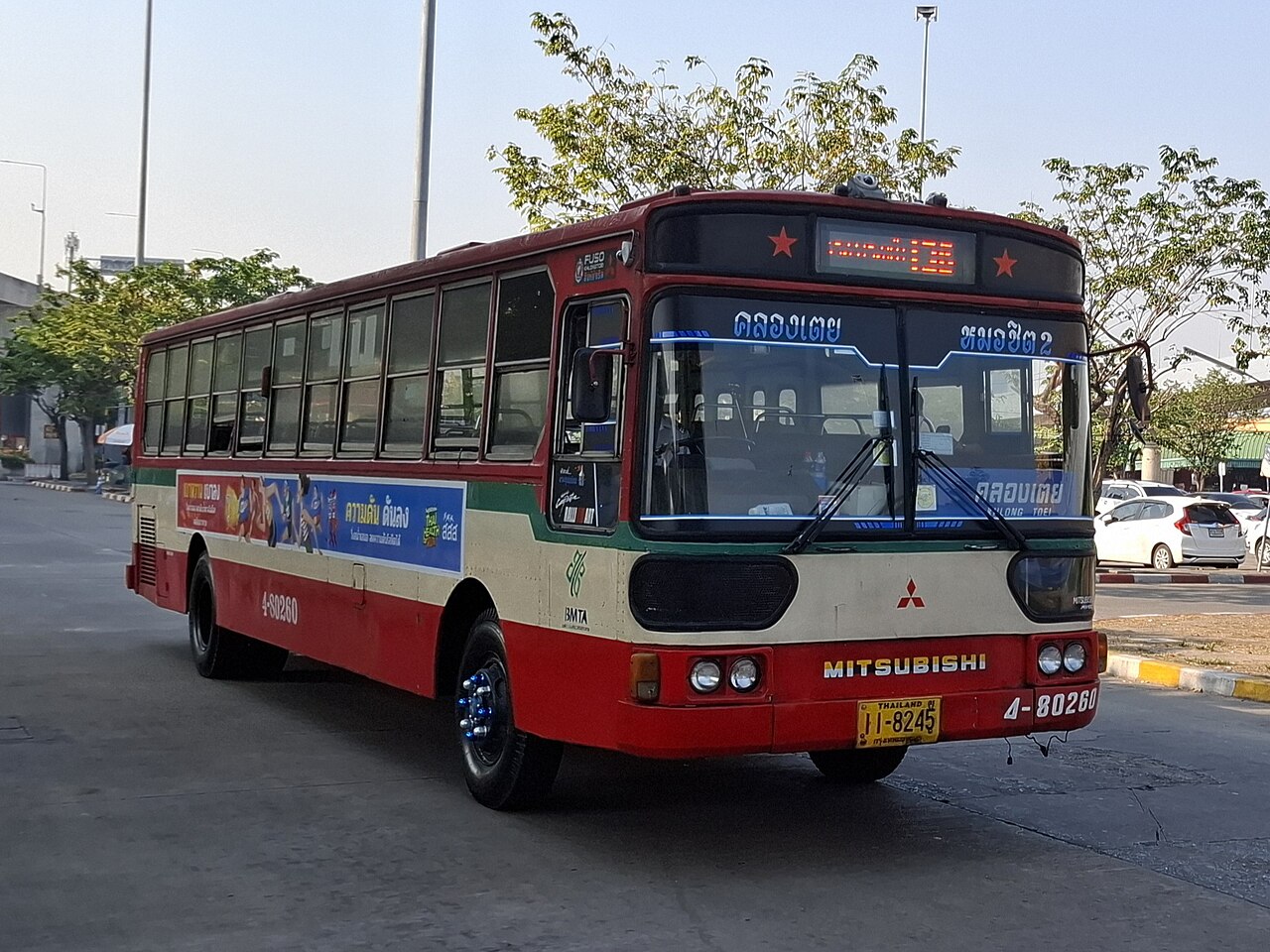
Read Thai script on the windscreen before the bus reaches you
You get roughly four seconds. The good news is that bus-front Thai is printed large, widely spaced and in plain block letters — far kinder to a learner than a menu — and the place names repeat endlessly across the city. Work on the ten or fifteen destinations that matter on your own routes and you have effectively learnt the network — this is the cheapest way to learn Thai vocabulary that you will use several times a week. Our guide to reading Thai place names covers the building blocks: บาง, คลอง, บ้าน and the handful of other syllables that start a quarter of the destinations in Thailand.
Two more words belong on the windscreen list, because both of them mean “do not bother running”:
- อู่ (ùu) — depot, garage · เข้าอู่ (khâo ùu) — going back to the depot, so the bus is not in service
- เที่ยวสุดท้าย (thîao sùt tháai) — the last trip of the day · งดวิ่ง (ngót wîng) — service suspended
- รถเต็ม (rót dtem) — full · ไม่จอด (mâi jàwt) — not stopping
ปรับอากาศ or ธรรมดา: reading the fare off the paintwork
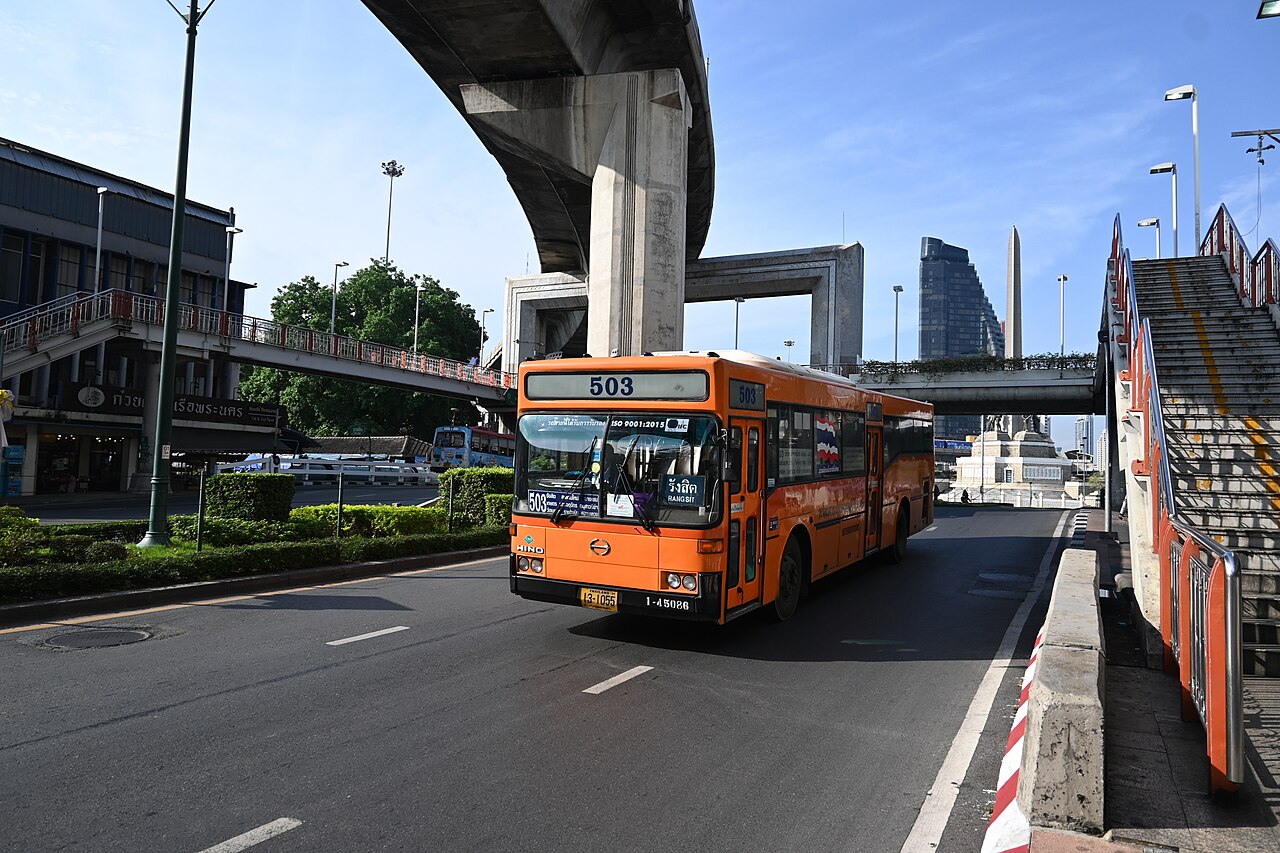
Colour tells you the price before any word does, and the Thai confirms it. These six words are the ones to read Thai script for while the bus is still a block away. An orange, blue or yellow bus is air-conditioned and charges by distance; a cream-and-red one is the fan-cooled flat-fare bus, and it is the cheapest ride in the capital.
- ปรับอากาศ (bpràp aa-gàat) — air-conditioned, lit. “adjusts the air” · รถแอร์ (rót ae) — the spoken version
- ธรรมดา (tham-má-daa) — ordinary, plain · รถร้อน (rót ráwn) — “hot bus”, what everyone honestly calls it
- พัดลม (phát lom) — fan · รถฟรี (rót frii) — free bus, on the few subsidised routes
On board: the conductor, the fare and getting off
On a red bus a conductor works the aisle with a steel fare tube that rattles; on an air-conditioned one you may pay by card. This is also where your Thai pronunciation gets its first honest test, because these words are spoken fast and over an engine. Either way, these are the words that get used:
- กระเป๋ารถเมล์ (grà-bpǎo rót mee) — the conductor, lit. “bus bag”, named after the money bag. Shortened to กระเป๋า when you call for attention
- คนขับ (khon khàp) — the driver, lit. “person who drives”
- ค่าโดยสาร (khâa dooi sǎan) — the fare. That ค่า (khâa) prefix means “charge for” and builds dozens of Thai bills
- ตั๋ว (dtǔa) — ticket. Keep it: inspectors do board
- ขึ้น (khûen) — to get on, lit. “to ascend” · ลง (long) — to get off, “to descend”
- ป้ายหน้า (bpâai nâa) — the next stop, lit. “the sign ahead” · จอด (jàwt) — to stop, to park
Five sentences that let you speak Thai on the bus
Thai politeness is carried almost entirely by one syllable at the end of the sentence: ครับ (khráp) if you are a man, ค่ะ (khâ) if you are a woman. Drop it while asking a stranger for help and you sound abrupt rather than rude, but on a crowded bus the difference is noticeable. Our explainer on khrap and kha is worth ten minutes before you try these:
- รถสายนี้ไปสยามไหมครับ/คะ (rót sǎai níi bpai sà-yǎam mǎi khráp/khá) — does this route go to Siam?
- ไปอนุสาวรีย์ชัยฯ ขึ้นสายอะไรครับ/คะ (bpai à-nú-sǎa-wá-rii chai khûen sǎai à-rai khráp/khá) — which route do I take to Victory Monument?
- ค่าโดยสารเท่าไหร่ครับ/คะ (khâa dooi sǎan thâo rài khráp/khá) — how much is the fare?
- ขอลงป้ายหน้าครับ/ค่ะ (khǎw long bpâai nâa khráp/khâ) — I’d like to get off at the next stop
- ถึงแล้วบอกด้วยนะครับ/คะ (thǔeng láeo bàwk dûay ná khráp/khá) — please tell me when we arrive
The last one is the real traveller’s sentence. Say it to the conductor as you pay, name your stop, and you have outsourced the hardest part of the journey to somebody who does it four hundred times a day.
A study tip: one pole, five minutes
Do not try to memorise this page. Walk to the ป้ายรถเมล์ nearest your home and give it five minutes with our free Thai alphabet chart open on your phone. Sound out the header, then the stop name, then one line of the destination finder — out loud, slowly, even badly. Nobody learns to read Thai script silently. Stop signs are the ideal beginner Thai lesson precisely because they are patient: the pole will not move, nobody is waiting for your answer, and the romanisation printed underneath grades your work instantly. That feedback loop is how the Thai consonants and vowels stop being a chart and start being words.
Then put the ten words you actually met into the flashcard trainer for a week and ride one unfamiliar route from end to end. Reading a destination banner correctly at thirty kilometres an hour is a genuinely good feeling, and it is the moment most learners stop treating the script as decoration. Few skills improve Thailand expat language confidence faster than getting on the right bus, in the right direction, because you could read Thai script on the front of it.