Reading Thai Place Names: Ban, Nong, Chiang and More
Read Thai script on any road sign: the two dozen building blocks behind Thai place names, given in Thai letters, pronunciation and literal English.
Once you can read Thai script well enough to sound out a road sign, something surprising happens: the place names stop being random noise. Thai town, province and district names are built from a small stock of repeating words — city, town, golden, new, river mouth, canal, village — and roughly two dozen of them cover a huge share of the map. This guide gives you those building blocks in Thai letters, in plain Thai transliteration and in literal English, so that the next green sign over a motorway reads as a sentence rather than a shape.
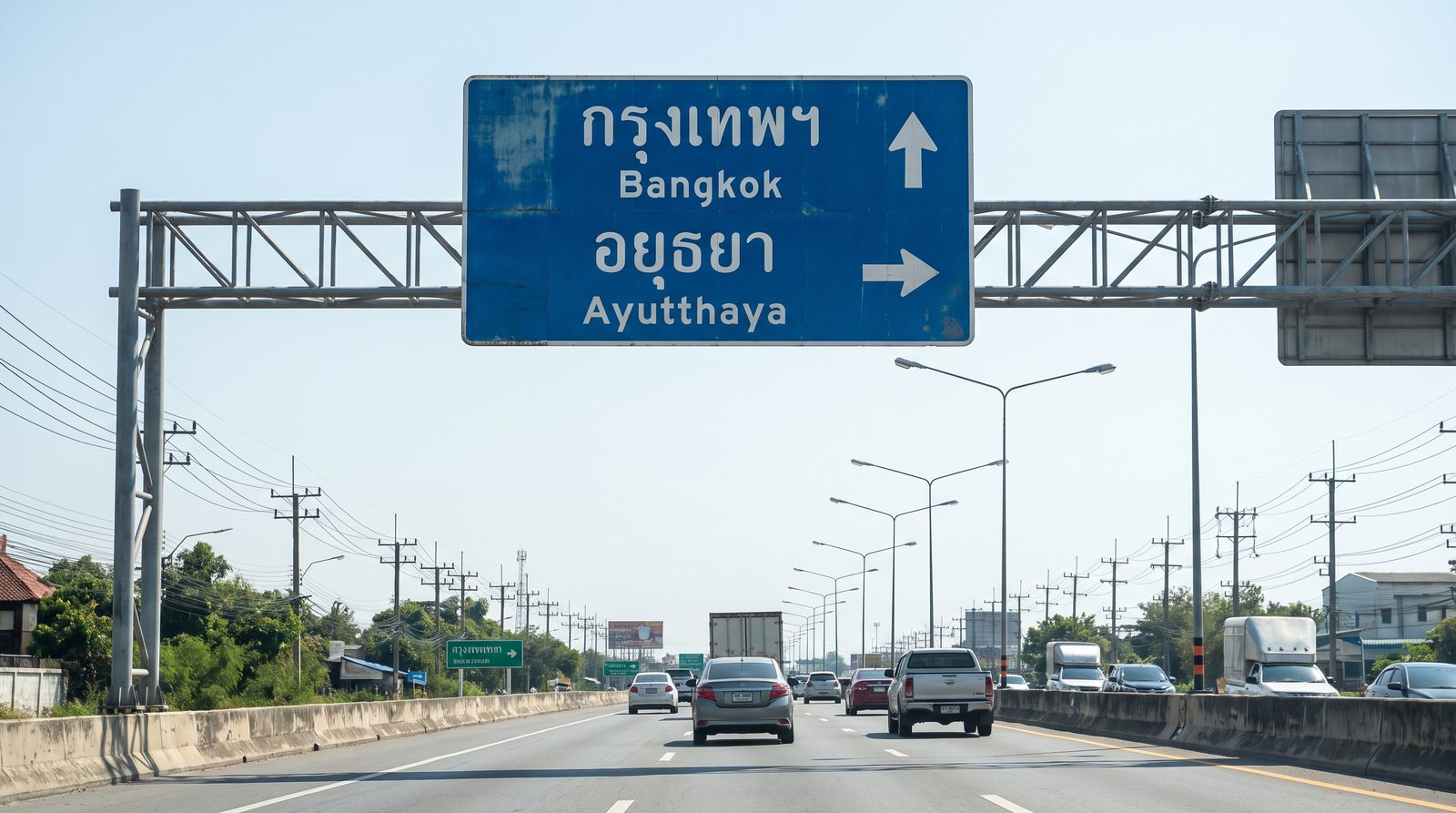
Why place names are the fastest way to read Thai script
Most beginner Thai lessons start with greetings you will use twice a day. Place names, by contrast, are in front of you constantly — on motorway gantries, station boards, ticket screens, bus windscreens and delivery apps. They are also unusually forgiving practice material, because almost every large sign in Thailand prints the Thai and a romanised version side by side. You get an instant answer key. That makes signs the cheapest possible way to build Thai pronunciation and reading speed at the same time.
There is a second reason. Thai place names are compounds, and the pieces repeat. Learn บาง once and you have partially decoded Bang Na, Bang Rak, Bang Sue, Bang Kapi and several hundred others. This is the point at which the effort you put into learning Thai alphabet shapes starts paying compound interest.
The city and town words
These are the heavyweights. They usually sit at the end of a name, and they tell you what kind of place you are looking at:
- กรุง (krung) — “capital city”. Reserved in practice for กรุงเทพๆ (krung-thep), Bangkok.
- เมือง (mueang) — “town”. Every province has a อำเภอเมือง, the central district that shares the province’s name.
- นคร (nakhon) — “city”, from Sanskrit. Nakhon Pathom, Nakhon Sawan, Nakhon Ratchasima.
- บุรี (buri) — “walled city”. Chonburi, Kanchanaburi, Lopburi, Saraburi.
- ธานี (thani) — “town”, a close cousin of buri. Udon Thani, Surat Thani, Pathum Thani.
- บาง (bang) — a village on water. Bang Na, Bang Rak, Bang Sue.
A quick worked example. กาญจนบุรี is kan-cha-na-buri: กาญจน means “gold” and บุรี means “city” — the golden city. ชลบุรี is chon-buri, “water city”. Neither is a mystery once the second half is familiar.
Words that describe the land
The second family describes geography, and these usually come first in the name. They are short, high-frequency and full of useful everyday vocabulary:
| Thai | Pronunciation | Literal meaning | Seen in |
|---|---|---|---|
| เชียง | chiang | walled town (northern) | Chiang Mai, Chiang Rai |
| ใหม่ | mai | new | Chiang Mai – “new town” |
| หนอง | nong | marsh, pond | Nong Khai, Nong Bua |
| ห้วย | huai | stream | Huai Khwang |
| ดอน | don | raised ground | Don Mueang airport |
| เกาะ | ko | island | Ko Samui, Ko Chang |
| ท่า | tha | pier, landing | Tha Phra, Tha Chang |
| ปาก | pak | mouth (of a river) | Pak Nam, Pak Chong |
| แม่ | mae | mother; also river | Mae Sai, Mae Hong Son |
| เขา | khao | mountain | Khao Yai – “big mountain” |
A note on Thai transliteration
You will meet the same Thai word romanised three ways: Ko, Koh and Kaw for เกาะ; Chonburi and Chon Buri; Ayutthaya and Ayudhya. Thai transliteration is a convention, not a spelling, and different agencies apply it differently — which is exactly why the Thai script version is the reliable one. If two signs disagree in English but the Thai letters match, they are the same place. That single habit prevents a lot of expensive taxi confusion, and it is the clearest everyday payoff for learning to read Thai script at all.
Royal and Sanskrit vocabulary on the map
A third layer comes from Sanskrit and Pali, which is why some place names look far longer than they sound. These pieces carry prestige, and they cluster around royal sites, airports and temples:
- ราช (rat) — royal. Ratchaburi, Ratchathewi, Ratchadamnoen.
- ศรี (si) — glory, auspicious. Si Racha, Sisaket, Ayutthaya’s full name.
- ทอง (thong) — gold. Thonburi, Ang Thong.
- ทวาร (thawan) — heaven. Nakhon Sawan, “heavenly city”.
- มหา (maha) — great. Mahachai, Maha Sarakham.
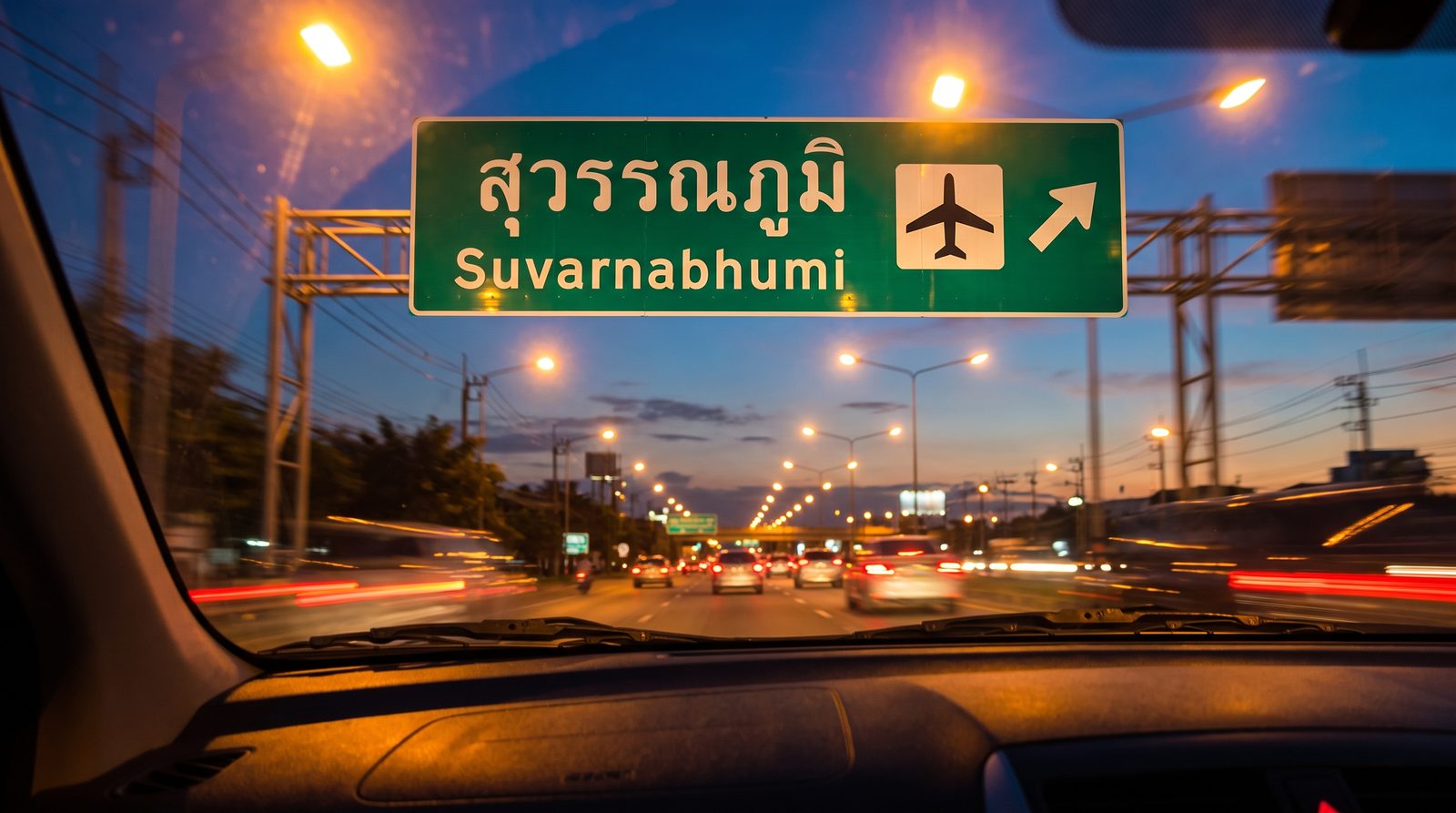
These borrowed words are where Thai consonants and vowels behave least like the beginner rules. Sanskrit loans keep letters that Thai no longer pronounces, and they use the rarer consonants — ณ, ญ, ธ, ศ — that seem pointless when you first meet the alphabet. Place names are where those letters earn their keep. If you have wondered why the script carries so many duplicate sounds, our explainer on why Thai has 44 consonants covers the history.
Saying them politely, and saying them right
Two practical notes for anyone learning to speak Thai from signage. First, Thai compounds are said as an even run of short syllables, not with a heavy English stress: kan-cha-na-bu-ri, five light beats, rather than KAN-chana-buri. Second, when you ask directions, wrap the name in the polite frame and add your particle — ไปเชียงใหม่ยังไงครับ (pai chiang-mai yang-ngai khrap), “how do I get to Chiang Mai?”. Men end with ครับ (khrap), women with ค่ะ (kha). Dropping the particle is not rude exactly, but it lands flat, and in Thailand the particle is most of the politeness.
One warning worth having: do not improvise nicknames for places from their literal meanings. Calling Suvarnabhumi “the golden land” to a Thai listener will get you a puzzled look. The etymology is a memory aid for you, not a way of speaking.
Study tip: read one sign a day, out loud
Pick a single sign each day — from a window, a photo, a map app — and try to read Thai script on it three ways: find the pieces you recognise, guess the pronunciation before you look at the romanisation, then check yourself against the English underneath. Because Thai signage supplies both versions, you are effectively carrying a graded reader everywhere you go, which is a rare luxury in the Thailand expat language experience.
If the letters themselves are still the bottleneck, drill them first: our Thai alphabet chart lists every consonant and vowel with sound values, and the free ThaiLetters flashcard trainer gets the shapes into memory in a couple of weeks. Then come back to the map. Two dozen building blocks and a little patience are genuinely enough to read Thai script across most of Thailand’s road network.