Learn Thai Vocabulary in Thailand: Rain & Weather Words
Learn Thai vocabulary for rain, storms, floods and Thailand's three seasons: weather words in Thai script with transliteration, real photos and phrases.
In October, Thailand gives you a free lesson every afternoon at about four o’clock. If you want to learn Thai vocabulary that you can use the same day you meet it, start with the weather: it changes constantly, everybody talks about it, and the words are short. A Thai colleague will ask you three times a week whether it is going to rain. The shopkeeper will warn you the floor is slippery. The taxi driver will blame the traffic on the sky. None of that requires grammar — it requires about twenty-five words, and this guide is those words.
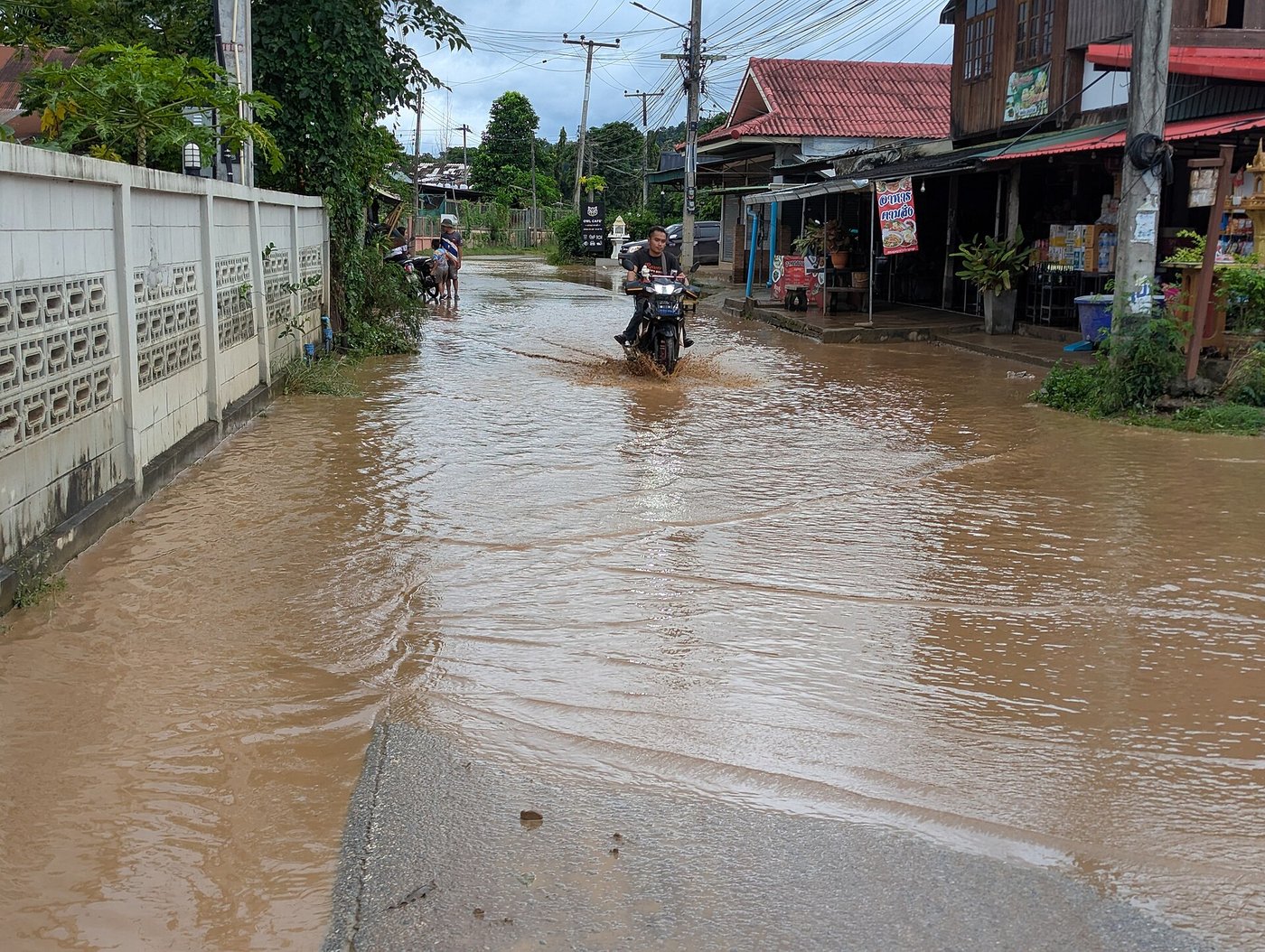
Everything below appears in Thai script, in Thai transliteration and with the literal meaning, because Thai weather words are nearly all compounds of pieces a beginner already owns. ฝนตก is just “rain falls”. น้ำท่วม is “water overflows”. ฟ้าร้อง is “the sky cries”. Five real photographs — a storm rolling over Bangkok, a flooded street in Mae Hong Son, a rain-blurred windscreen, a monsoon afternoon in Khao Yai and the sign outside Thailand’s own weather office — show you where each word lives in the wild.
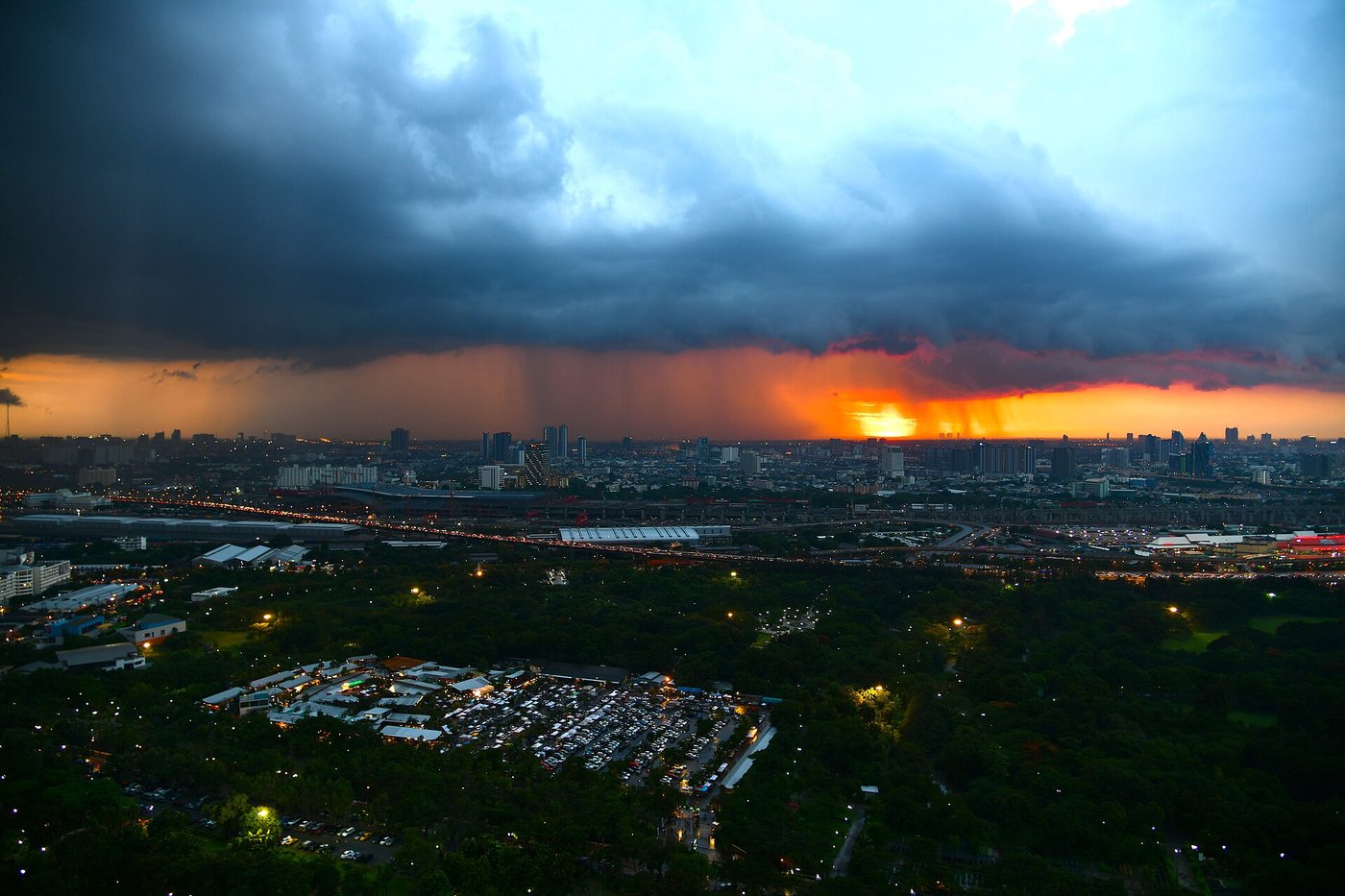
ฝนตก: learn Thai vocabulary for rain
Thai does not say “it is raining”, because there is no “it”. The rain does the work itself: ฝน (rain) plus ตก (to fall). Learn that pair and you have a complete sentence of two syllables — probably the shortest useful sentence in the language, and a good first win in any beginner Thai lesson.
- ฝน (fǒn) — rain, the noun. Rising tone: your voice goes down and then up, like a question.
- ฝนตก (fǒn tòk) — it’s raining, literally “rain falls”. ตก also does duty for snow, dew and falling over.
- ฝนตกหนัก (fǒn tòk nàk) — heavy rain; หนัก is the ordinary word for “heavy”.
- ฝนปรอยๆ (fǒn bpràwi bpràwi) — drizzle. The repeated word softens it, the way Thai often does.
- ร่ม (rôm) — umbrella. The same word means “shade”, so a shady table is ร่ม too.
- เสื้อกันฝน (sêüa gan fǒn) — raincoat, literally “shirt that guards against rain”: the five-baht plastic one every motorbike rider keeps under the seat.
- เปียก (pìak) — wet, and ลื่น (lûün) — slippery, the warning you will hear in every 7-Eleven doorway.

Thai pronunciation for hot, cold and everything between
Weather adjectives are where Thai pronunciation pays off quickly, because the words are one syllable and the tone is the whole word. Say them flat and you will still be understood; say them with the tone and people answer you in Thai instead of English. They are also the cheapest way to learn Thai vocabulary in bulk, because the same adjectives describe food, drinks and moods as well as the sky.
- ร้อน (ráwn) — hot, and ร้อนมาก (ráwn mâak) — very hot. You will say this daily.
- หนาว (nǎao) — cold, used both for the weather and for the person feeling it: หนาวจัง (nǎao jang) — “so cold!”
- เย็น (yen) — cool, the compliment version of cold. It is also the word for “evening”.
- ชื้น (chûün) — humid, and อบอ้าว (òp âao) — stuffy, airless. Bangkok in April is both.
- แดด (dàet) — sunshine as a thing you stand in; แดดออก (dàet àwk) is “the sun is out”, literally “sunshine exits”.
- ลม (lom) — wind, and ลมแรง (lom raeng) — strong wind. แรง is force, so it reappears everywhere from spicy food to loud music.
- อากาศ (aa-gàat) — air, and by extension the weather. อากาศดี (aa-gàat dii) — “nice weather” — is small talk you can use on day one.
The three Thai seasons: หน้าร้อน, หน้าฝน, หน้าหนาว
Thailand runs on three seasons, not four, and there are two ways to say each one. The formal word is ฤดู (rú-duu), which you will see on signs and in forecasts. In speech almost everyone uses หน้า (nâa) instead — the same word as “face” and “in front of”. Hearing both is a small but real step up in listening, and taking the two forms together is the economical way to learn Thai vocabulary: one meaning, two registers, no extra effort.
- หน้าฝน / ฤดูฝน (nâa fǒn / rú-duu fǒn) — the rainy season, roughly May to October.
- หน้าหนาว / ฤดูหนาว (nâa nǎao / rú-duu nǎao) — the cool season, November to February, and the reason Thais wear coats at 22°C.
- หน้าร้อน / ฤดูร้อน (nâa ráwn / rú-duu ráwn) — the hot season, March to May, which ends with Songkran.
- มรสุม (maw-rá-sǔm) — monsoon, and พายุ (phaa-yú) — storm or typhoon, the word the news uses when a system is named.
- ฟ้าร้อง (fáa ráwng) — thunder, literally “the sky cries out”, and ฟ้าผ่า (fáa phàa) — lightning striking, “the sky splits”.

Read Thai script on the weather office’s own sign
One sign in Bangkok is worth a whole reading exercise, because it carries the longest weather word in Thai with the roman letters printed underneath it as an answer key. Cover the English line, read the Thai, then check yourself — that is the entire method, and it works on every bilingual sign in the country.
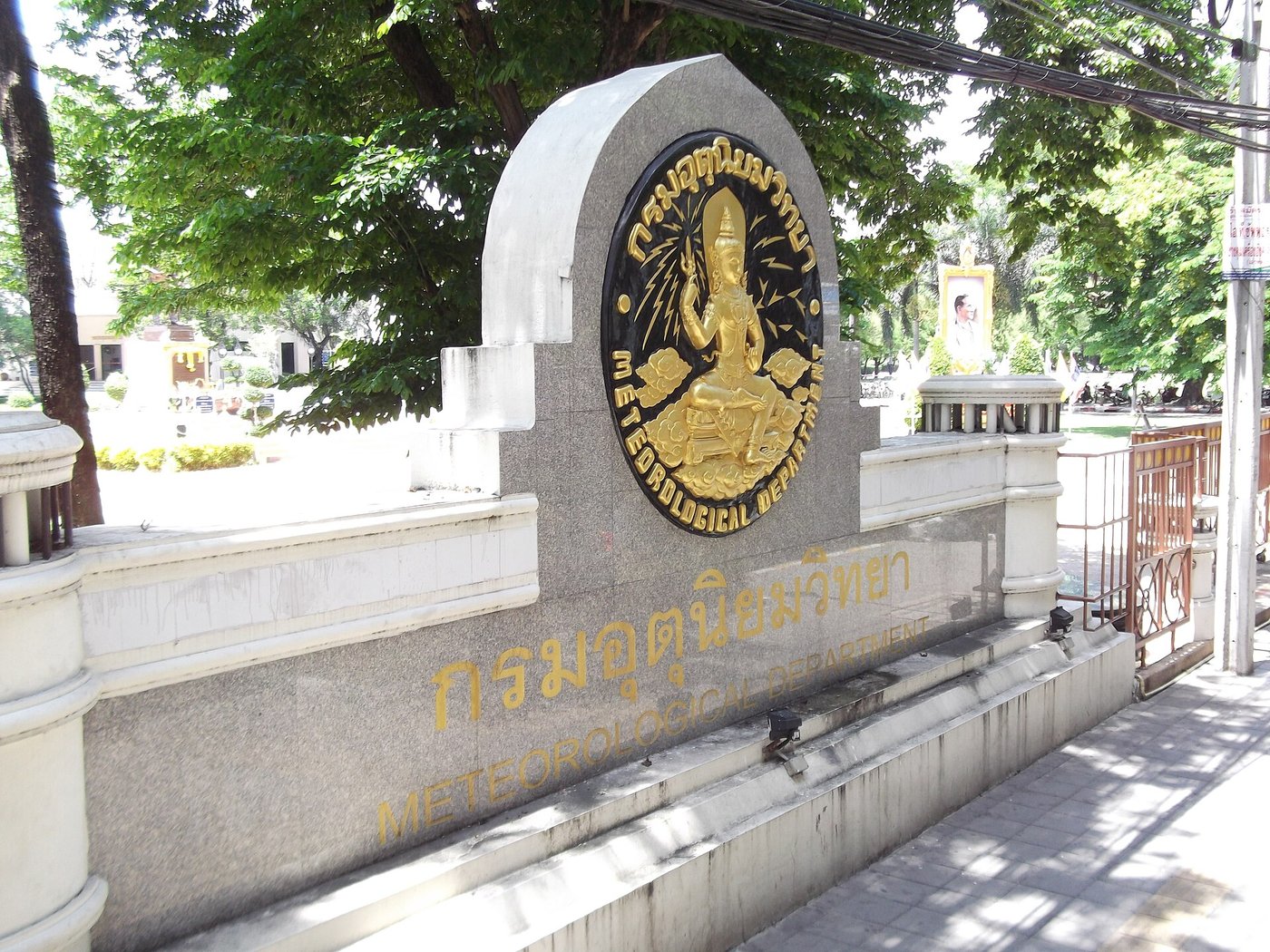
- พยากรณ์อากาศ (phá-yaa-gawn aa-gàat) — weather forecast. This is the phrase to search on YouTube if you want slow, clear Thai read aloud every single day.
- กรมอุตุฯ (grom ù-tù) — how everybody actually says it. The ฯ on the end is ไปยาลน้อย, the Thai “etc.” mark that chops a long official name short.
- อุณหภูมิ (un-hà-phuum) — temperature, and องศา (ong-sǎa) — degrees.
- ประกาศเตือน (brà-gàat tûüan) — a warning announcement, the heading on every storm bulletin.
- ระวัง (rá-wang) — beware. One word, and it opens most of the warning signs in Thailand.
If the roman line on signs like this looks arbitrary to you, it is: the same Thai vowel turns up as u, oo or ou depending on who painted it. That inconsistency is the best argument there is for learning the Thai consonants and vowels properly — our guide to why Thai signs spell words differently explains the system behind the mess.
น้ำท่วม: flood words and Thailand expat language
Between September and November these words stop being vocabulary and start being logistics. They are also beautifully transparent: almost every one is built from น้ำ (náam), water — the same น้ำ you have already ordered in a restaurant. That is how to learn Thai vocabulary here — in families, rather than one unrelated word at a time.
- น้ำท่วม (náam thûüam) — flood, literally “water overflows”.
- น้ำขัง (náam khǎng) — standing water that will not drain, the kind that closes a soi for two days.
- น้ำป่า (náam bàa) — a flash flood, “wild water”, and ดินถล่ม (din thà-lòm) — landslide.
- ระดับน้ำ (rá-dàp náam) — water level, the number on every television map in October.
- กระสอบทราย (grà-sàwp saai) — sandbag, stacked across shop doorways all over the country.
- ระบายน้ำ (rá-baai náam) — to drain water away; the sign on the pumps.
Speak Thai about the weather: five sentences
Weather talk is the safest place in Thailand to open your mouth, because the answer is always short and you can see it for yourself if you miss a word. Men finish a sentence with ครับ (khráp), women with ค่ะ (khâ) — leaving the particle off is the fastest way to sound blunt without intending to.
- วันนี้ร้อนมากครับ (wan-níí ráwn mâak khráp) — “It’s very hot today.” The universal opener.
- ฝนจะตกไหมคะ (fǒn jà tòk mǎi khá) — “Is it going to rain?” จะ marks the future and ไหม makes it a question.
- มีร่มไหมครับ (mii rôm mǎi khráp) — “Do you have an umbrella?” Answer: มี (there is) or ไม่มี (there isn’t).
- รอฝนหยุดก่อนค่ะ (raw fǒn yùt gàwn khâ) — “Let’s wait for the rain to stop.” Say this and nobody will rush you.
- ระวังลื่นนะครับ (rá-wang lûün ná khráp) — “Careful, it’s slippery.” You will hear it before you ever say it.
Keep each sentence short and let the other person fill the gaps. If the particles still feel slippery themselves, our explainer on khrap and kha is a five-minute read, and the guide to Thai calendar words covers the months and festivals that mark where you are in the three seasons.
A study tip: one sky, one sentence, every day
Here is a drill that costs nothing and fits the climate. Once a day, look out of the window and describe what you see in one Thai sentence — out loud, not in your head. วันนี้แดดออก. ฝนตกหนัก. อากาศดี. It takes four seconds, the vocabulary is tiny, and because the weather changes you are forced to pick a different sentence most days rather than reciting one. Write the sentence by hand afterwards and you are practising the same Thai letters — ฝ, น, ต, ก, ร — over and over in words you have just used. The usual Thailand expat language problem is repetition, not talent, and the sky hands you the repetitions for free.
When you want the alphabet behind the words, our free Thai alphabet chart is the quickest way to learn the Thai alphabet, with all 44 Thai consonants and vowels on one page, and the ThaiLetters flashcard trainer will drill the shapes ten minutes at a time. Start with ฝ and น: those two letters give you ฝน, and with ต and ก you can already read the most useful two-word sentence in the country. That is enough to learn Thai vocabulary from nothing more expensive than the view from your balcony.