Learn Thai Vocabulary: Tuk-Tuk Rides in Thailand
Learn Thai vocabulary for a tuk-tuk ride in Thailand: agree the fare in Thai, read the yellow licence plate in Thai script and name every regional model.
Nowhere in Thailand will you be forced to speak Thai faster than on the back bench of a tuk-tuk. There is no meter to hide behind and no app to tap: you say where you are going, the driver says a number, you say something back, and only then does the engine start. That is why this is such a good place to learn Thai vocabulary — the words have to work, immediately, or you do not move.
This Thai language guide takes one tuk-tuk ride apart from the kerb up: what the name means, the words for the vehicle and its parts, how to read Thai script on the yellow licence plate, the handful of sentences that settle a fare, and the regional models that have their own names. Every entry gives the Thai script, a Thai transliteration you can say out loud, and the literal sense wherever it explains something.
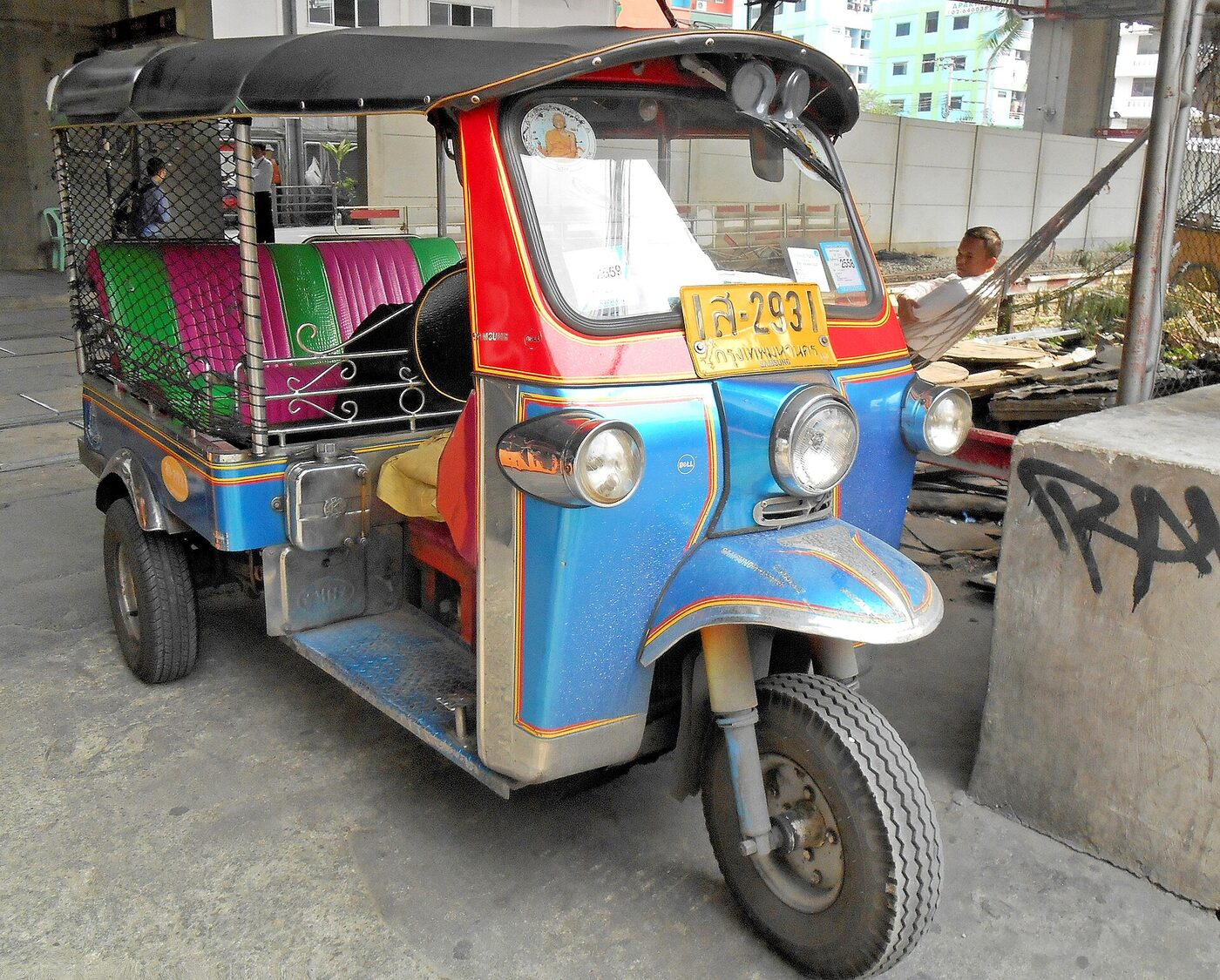
What ตุ๊กตุ๊ก and สามล้อ actually mean
ตุ๊กตุ๊ก (túk túk) is not a description of anything. It is the sound of a small two-stroke engine idling, repeated twice, and Thai does this often: a doubled syllable that imitates a noise becomes the name of the thing making it. The official term, the one on paperwork and in traffic law, is รถสามล้อเครื่อง (rót sǎam lɔ́ɔ khrûɛalang), which unpacks neatly as “vehicle · three · wheels · engine”.
In speech most people shorten that to สามล้อ (sǎam lɔ́ɔ), “three wheels”. Be aware that the same word still covers the pedal trishaw, สามล้อถีบ (sǎam lɔ́ɔ thìip, “three wheels · to pedal”), which still works in provincial towns. If you want the motorised one, say ตุ๊กตุ๊ก and no one will be confused.
The spelling is worth a minute if you are still working on the Thai consonants and vowels. ตุ๊ก is ต (tɔɔ tào) plus the short vowel ุ underneath, plus the consonant ก closing the syllable — and that little curl on top is ไม้ตรี (mái trii), the third tone mark, which you will meet far less often than the first two. On a mid-class consonant like ต it produces a high tone, so both syllables are pitched up and clipped short. Our guide to Thai tone marks shows where ไม้ตรี sits among the four.
Learn Thai vocabulary for the vehicle and the rank
Nine words cover almost everything you can point at. This is the kind of Thailand expat language that sticks, because the object is in front of you while you say it:
- รถ (rót) — vehicle. It opens the name of nearly everything with wheels: รถเมลь coach, รถไฟ train, รถตุ๊กตุ๊ก tuk-tuk.
- คนขับ (khon khàp) — the driver: “person · to drive”.
- ผู้โดยสาร (phûu dooi sǎan) — the passenger, which is you.
- ค่าโดยสาร (khâa dooi sǎan) — the fare: “cost · of travelling”. ค่า prefixes every charge in Thailand, from ค่าน้ำ (water bill) to ค่าเช่า (rent).
- เบาะ (bɔ̀) — the padded bench in the back.
- หลังคา (lǎng khaa) — the roof, the thing you will be grateful for in a downpour.
- คิว (khiu) — the rank where drivers wait. Borrowed straight from English “queue”, and used for the motorbike ranks too.
- ป้ายทะเบียน (pâai thá-biian) — the licence plate.
- จังหวัด (jang-wàt) — province, the word printed along the bottom of that plate.
Read Thai script on the yellow licence plate
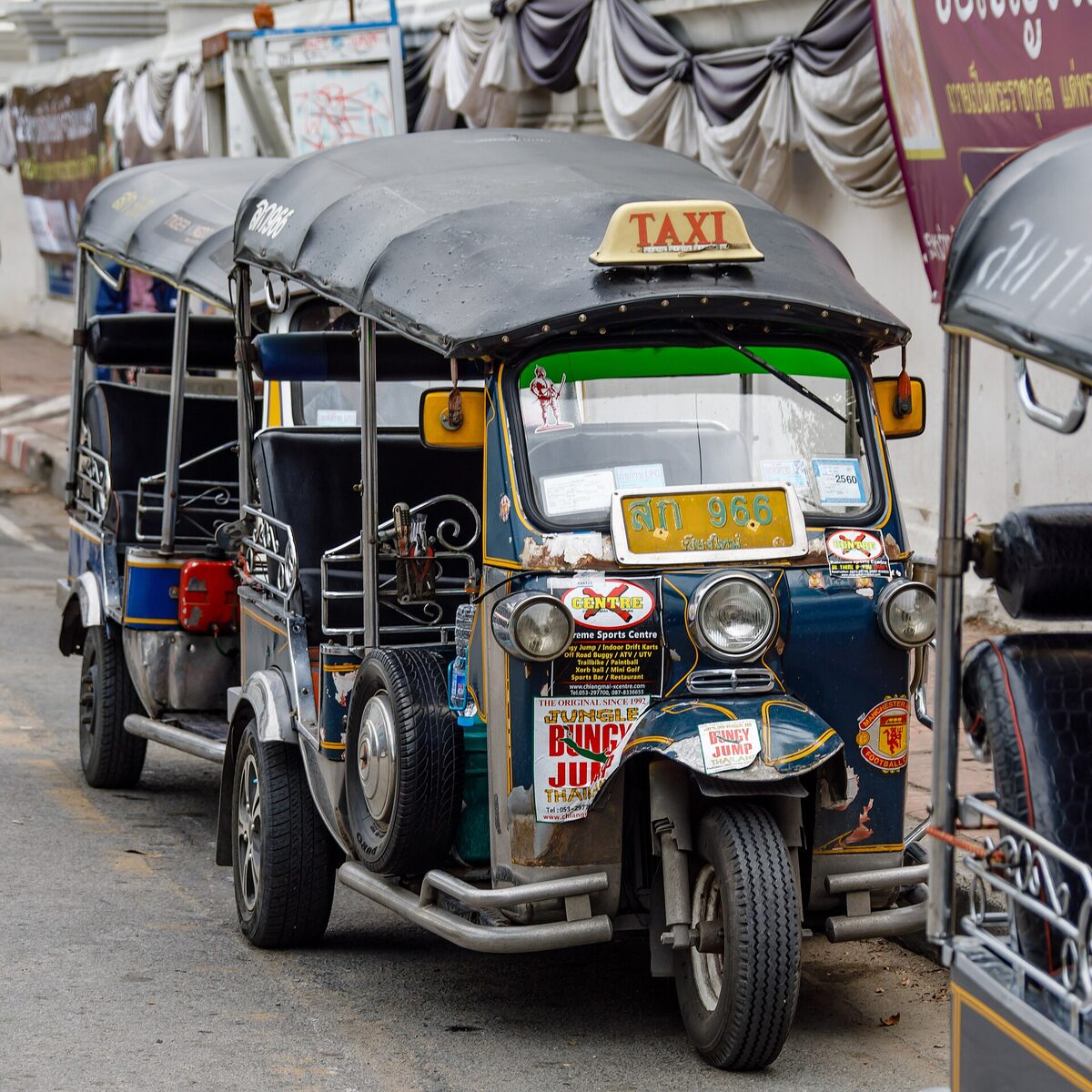
Thai plates are a free, repeating reading exercise, and tuk-tuks carry the easiest version of all. Private cars get a white plate; anything licensed to carry paying passengers gets a yellow one. So the colour alone tells you whether the vehicle beside you is allowed to pick you up, before you have read a single letter. Plates are also the cheapest place to learn Thai vocabulary that repeats: the same short list of letters and province names rolls past you all day.
Two Thai letters, then numerals, then a province
The top line is a pair of Thai consonants followed by a number. Look at the three plates photographed for this guide — one in Nonthaburi, one in Chiang Mai, one in Ayutthaya — and they all open with the same pair: สก. That is ส (sǒo sǔea, the tiger) and ก (gɔɔ gài, the chicken), the very first letter in the alphabet and usually the first one a learner recognises in the wild. Our Thai alphabet chart has both, with their traditional picture-words.
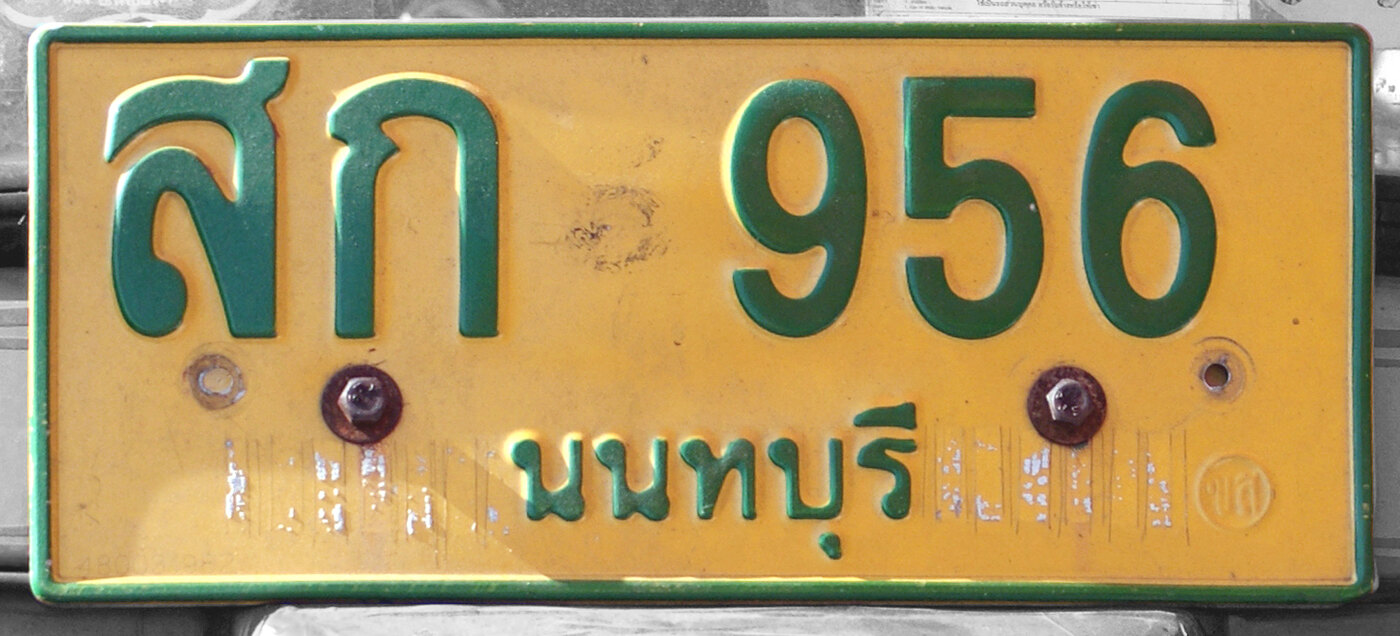
The digits are the ordinary Arabic numerals you already know. Thai numerals — ๑ ๒ ๓ and the rest — turn up on official vehicles, temple signs and price boards instead, and they are worth half an hour of your life; the Thai numbers page sets out all ten with a converter.
Speak Thai before you get in: the fare conversation
A tuk-tuk fare is agreed on the kerb, never during the ride and never afterwards. If you learn Thai vocabulary for one situation only, make it this one. Learn the exchange as a block and you can speak Thai at any rank in the country. Men end sentences with ครับ (khráp), women with ค่ะ (khâ):
- ไปสยามไหมครับ (pai sa-yǎam mǎi khráp) — “Going to Siam?” The opener. ไหม is the yes-or-no question word; in speech it is often written มั้ย and pitched high.
- เท่าไหร่ครับ (thâo rài khráp) — “How much?” Say it before you touch the vehicle.
- แพงไปครับ (phaeng pai khráp) — “Too expensive.” Said lightly, with a smile; it is an opening move, not an accusation.
- ลดหน่อยได้ไหมครับ (lót nɔ̀i dâi mǎi khráp) — “Could you come down a bit?”
- ร้อยเดียวได้ไหมครับ (rɔ́ɔi diao dâi mǎi khráp) — “Would a hundred flat do?” เดียว means “single, just the one” and is how Thai counters a price.
- เหมาเท่าไหร่ครับ (mǎo thâo rài khráp) — “How much to take the whole vehicle?” เหมา (mǎo) is one of the most useful verbs in Thai commerce: to take the lot at a flat price.
- ไม่แวะร้านนะครับ (mâi wé ráan ná khráp) — “No shop stops, please.” แวะ is “to drop by”, and this sentence quietly declines the commission detour to a tailor or a gem shop.
- จอดตรงนี้ครับ (jɔ̀ɔt trong níí khráp) — “Stop here.”
How to address the driver
Thai rarely uses “you” with strangers; it uses a family word instead. พี่ (phîî, older sibling) is the safe, friendly default for a driver who looks roughly your age or older. For a visibly older man, ลุง (lung, uncle) is warmer and will usually get you a better price than haggling does. Our guide to speaking politely with ครับ and ค่ะ goes through the rest of the system.
Thai pronunciation for the numbers you will hear
The driver's answer is a number, spoken fast, and this is where a beginner Thai lesson usually falls over. Three things will save you. First, 20 is ยี่สิบ (yîî sìp), never sǎong sìp — Thai has a special word for two-tens and no other decade behaves that way. Second, hundreds are simply ร้อย (rɔ́ɔi): สองร้อย is 200. Third, 150 is said ร้อยห้าสิบ (rɔ́ɔi hâa sìp), and in quick market speech the สิบ gets swallowed. If you are unsure, hold up fingers and say the number back — confirming out loud is normal here, not rude.
Regional models, and the Thai names for them
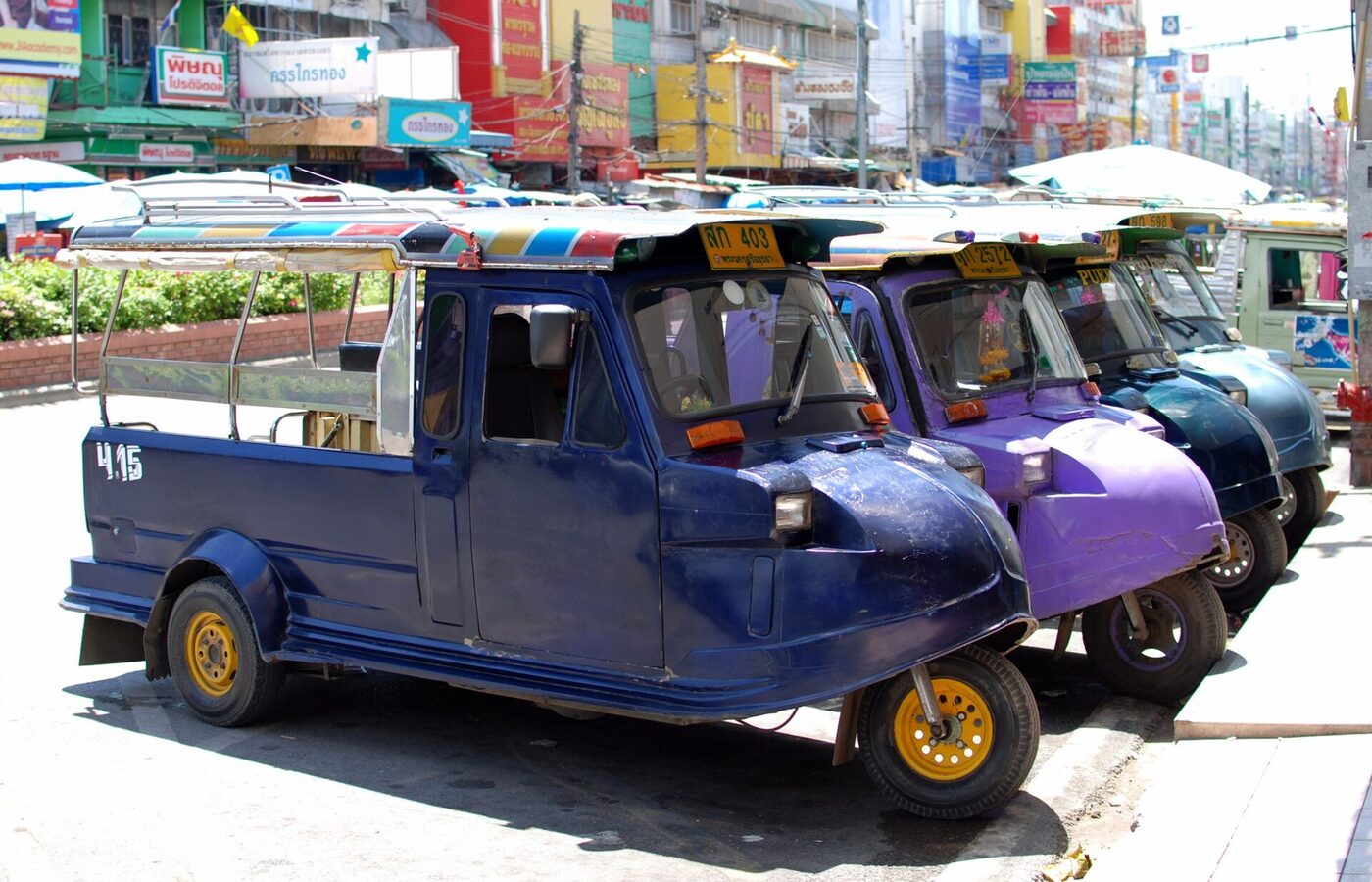
“Tuk-tuk” is a national word covering some quite different machines, and knowing the local name is a painless way to learn Thai vocabulary that people around you actually use:
- หัวกบ (hǔa kòp) — “frog head”, the snub-nosed long-bodied model of Ayutthaya and Trang, named for the bulging headlamps.
- สกายแล็บ (sa-kaai-láep) — “Skylab”, the motorbike-and-sidecar taxi of the north-east. The story goes that it was named after the American space station that fell to earth in 1979, which tells you something about how it rides.
- ตุ๊กตุ๊กไฟฟ้า (túk túk fai fáa) — the electric ones now appearing in Bangkok. ไฟฟ้า is literally “fire · sky”.
- รถสองแถว (rót sǎong thǎeo) — “two rows”, the shared pickup truck. Not a tuk-tuk, but often parked beside one; our bus and songthaew guide covers how those are read.
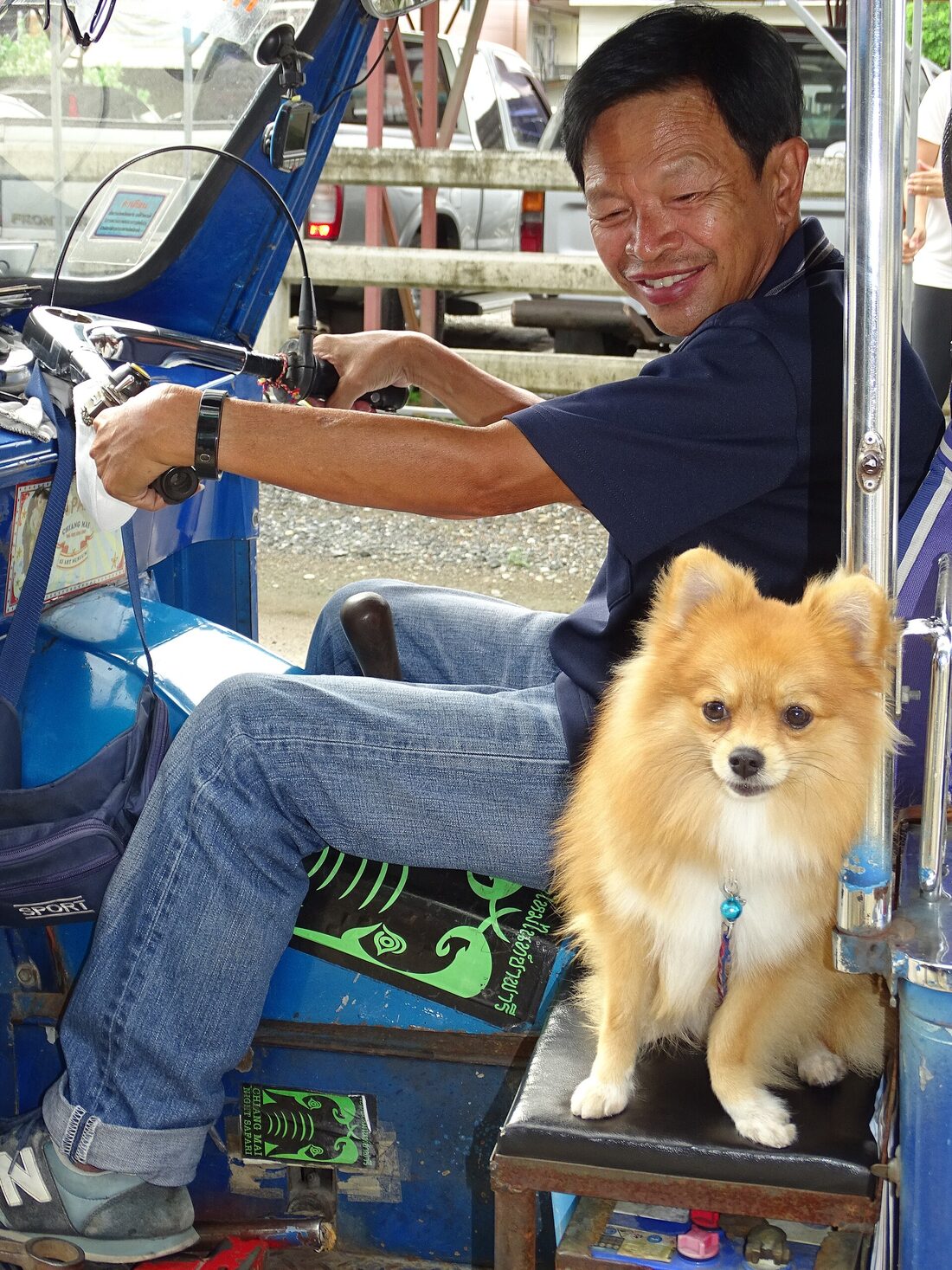
A study tip: one ride, one page
Here is the method that turns one tuk-tuk ride into a way to learn Thai vocabulary that sticks. Before you take one, write the five fare sentences above on a single page by hand, in Thai script — not typed, handwritten, because copying the letters is how the shapes stop blurring into one another. Use the page at the kerb. Afterwards, add the one word the driver said that you did not catch, and only that one. A page a week is forty new words by the end of a visit, every one of them attached to a memory of actually using it.
Then widen it. The plate-reading trick works on every vehicle in the street: colour first, letters second, province last. The fare sentences transfer almost unchanged to a motorbike taxi, where only the destination changes. And when the letters themselves are still the bottleneck, the ThaiLetters flashcard trainer will drill the Thai letters until สก on a yellow plate reads as fast as an English word does.