Learn Thai Vocabulary: Som Tam and Isan Food in Thailand
Learn Thai vocabulary for som tam and Isan food in Thailand: order papaya salad in Thai script, set your chilli level and read a real street cart menu board.
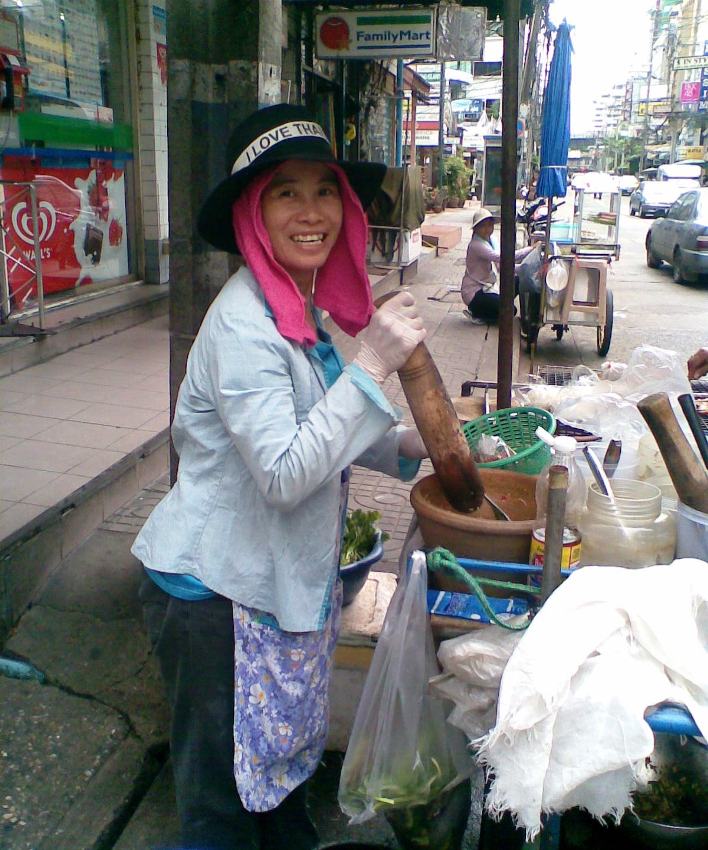
The best place to learn Thai vocabulary in Thailand is not a classroom. It is a metal cart on a side street with a clay mortar on top of it, a yellow menu board tied to the handle, and a woman asking you a question you do not yet understand. The dish is ส้มตำ (sôm tam), green papaya salad, and ordering one properly involves a verb, a list of ingredients, a politeness particle and a decision about chillies. Get those right and you have had a better beginner Thai lesson than an hour of grammar drills.
This Thai language guide takes the som tam cart apart word by word: the equipment, the menu board, the ordering phrases, the chilli negotiation, and the rest of the Isan table that comes with it. Every entry gives the Thai script, a Thai transliteration you can say out loud, and the literal sense where it explains something. There is also a reading trick halfway down that lets you decode an entire som tam menu once you know one syllable.
What the name actually means
ส้มตำ breaks into two ordinary words. ส้ม (sôm) means sour — the same syllable that gives Thai its word for orange — and ตำ (tam) means to pound in a mortar. So the dish is literally “sour pounded”, a description of a method and a taste rather than an ingredient. That is worth knowing, because the papaya is optional. Pound sour green mango in the same mortar and you get ตำมะม่วง; pound cucumber and you get ตำแตง. The verb stays, the ingredient changes.
In Isan and Lao the dish has a different name, ตำหมากหุ่ง (tam màak hùng), because หมากหุ่ง is the north-eastern word for papaya where central Thai says มะละกอ (má-lá-kɔɔ). Both are used in Bangkok. If you hear a vendor use the Isan form, you have learned something useful about her, not just about the salad.
Learn Thai vocabulary from the cart itself
Stand at a stall for two minutes and most of this vocabulary is physically in front of you, which is exactly the kind of Thailand expat language that sticks:
- ร้านส้มตำ (ráan sôm tam) — a som tam shop. ร้าน opens the name of almost every business in the country.
- รถเข็น (rót khǒn) — a push cart: “vehicle · to push”.
- ครก (khrók) — the mortar · สาก (sàak) — the pestle.
- มะละกอ (má-lá-kɔɔ) — papaya · ถั่วฝักยาว (thùa fàk yaao) — long beans, literally “bean · pod · long”.
- มะเขือเทศ (má-khǔa thêet) — tomato, literally “foreign aubergine”.
- กุ้งแห้ง (kûng hɜɜng) — dried shrimp · ถั่วลิสง (thùa lí-sǒng) — peanuts.
- น้ำปลา (nám plaa) — fish sauce · มะนาว (má-naao) — lime · น้ำตาลปี๊บ (nám-taan píip) — palm sugar sold in a tin.
- พริก (phrík) — chilli. The single most important noun at this cart.
Read Thai script on a som tam menu board
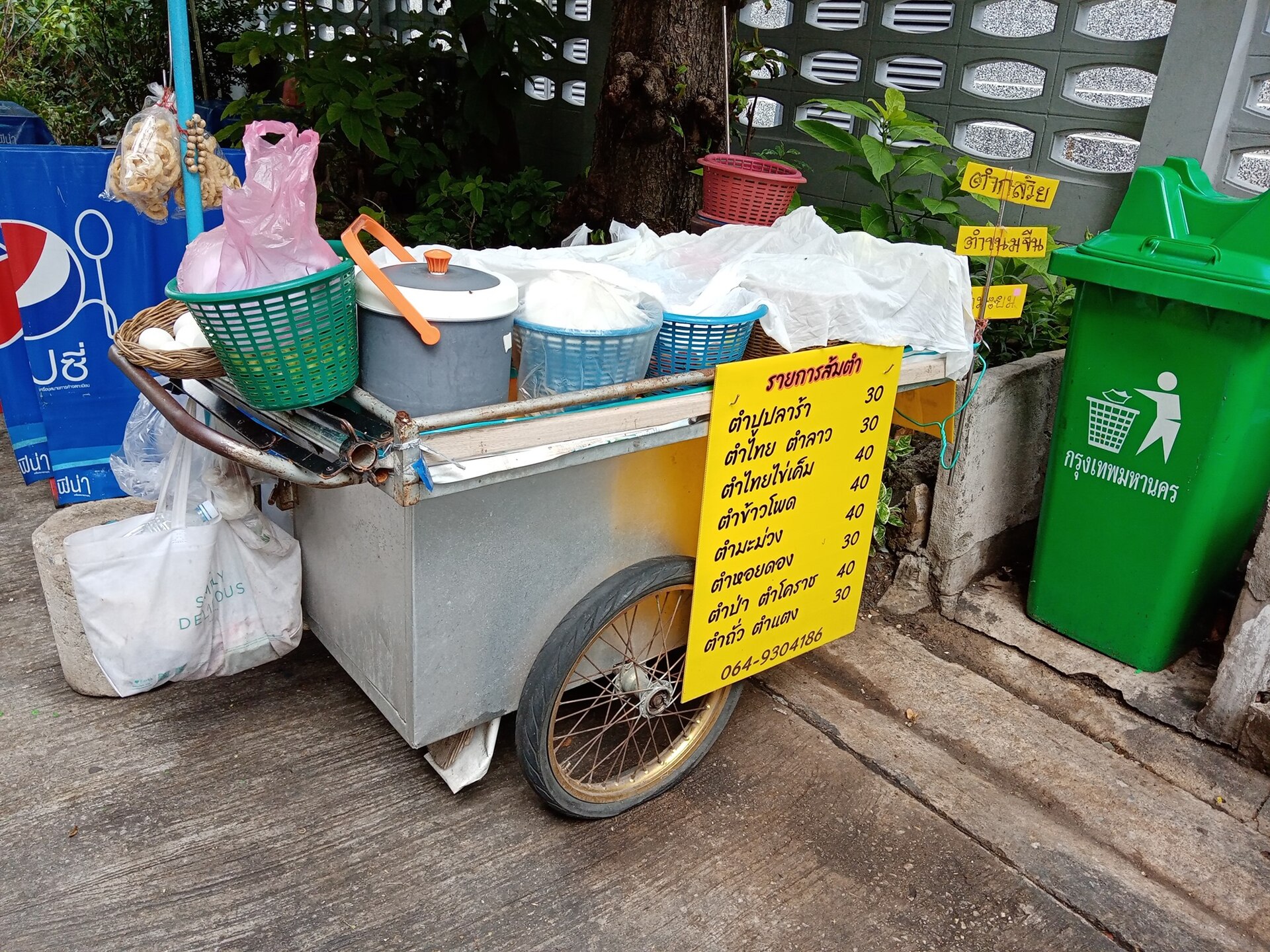
Menu boards drop the ส้ม and keep the verb, so every dish is ตำ plus whatever goes in the mortar. That single pattern makes a som tam board one of the easiest places in the country to read Thai script for real, because you only have to decode the second half of each line:
- ตำไทย (tam thai) — the central Thai version: sweeter, with peanuts and dried shrimp, no fermented fish. The safe first order.
- ตำลาว (tam laao) — the Lao/Isan version: saltier and sharper, built on fermented fish rather than sugar.
- ตำปูปลาร้า (tam puu plaa ráa) — with rice-field crab and fermented fish. The one locals order and foreigners are warned about.
- ตำไทยไข่เค็ม (tam thai khài khem) — with salted duck egg. เค็ม means salty.
- ตำข้าวโพด (tam khâao phôot) — sweetcorn · ตำมะม่วง (tam má-mûang) — green mango.
- ตำแตง (tam tɜɜng) — cucumber · ตำถั่ว (tam thùa) — long beans.
- ตำป่า (tam pàa) — “jungle tam”, everything in the cart at once, usually the fiercest on the board.
- ตำโคราช (tam khoo-râat) — the Korat style, halfway between Thai and Lao. Named after the city, like a great many Thai dishes.
One vowel unlocks the whole board
If you are still working through the Thai consonants and vowels, look closely at ตำ. It is one consonant, ต (tɔɔ tao, the turtle letter), plus the vowel sign ◌ำ, called สระอำ (sà-rà am), which is written after the consonant and sounds “-am”. Two marks, one syllable, and it opens every line on that yellow board. Beginners usually try to learn Thai alphabet charts front to back and lose heart around letter twenty; learning the handful of Thai letters that appear on the signs you stand in front of every day works far better. Our Thai alphabet chart shows where ต sits among the mid-class consonants, and the free flashcard trainer will drill it until you recognise it at a glance.
Speak Thai at the cart: the four phrases that matter
Ordering is a short, fixed exchange. Learn it as a block and you can speak Thai at any cart in Thailand:
- เอาส้มตำไทยหนึ่งที่ครับ/ค่ะ (ao sôm tam thai nèung thîi khráp / khâ) — “one som tam thai, please”. ที่ (thîi) is the counter for a portion.
- เผ็ดน้อยๆ (phèt nóɔy nóɔy) — “only a little spicy” · ไม่เผ็ด (mâi phèt) — “not spicy”.
- ไม่ใส่... (mâi sài) — “don’t put in…”. ไม่ใส่ปลาร้า and ไม่ใส่ผงชูรส (no MSG) are the two you will use most.
- ใส่กลับบ้าน (sài klàp bâan) — “to take home”, i.e. takeaway, usually answered with a plastic bag and a rubber band.
The question she asks back is almost always about chillies: กี่เม็ด (kìi mét) — “how many?”, counting chillies by the seed-word เม็ด. The honest answer for most newcomers is หนึ่งเม็ด (nèung mét), one chilli. Thai scales up fast from there, and a local ordering ห้าเม็ด is not being brave, just ordinary. This is also a free Thai pronunciation exercise: เผ็ด (phèt, spicy) and เป็ด (pèt, duck) differ only by an aspirated puff of air, and mixing them up at a food stall is a rite of passage.
Politeness: who you are talking to
End every sentence with ครับ (khráp) if you are a man and ค่ะ (khâ) if you are a woman — at a cart it does more work than perfect tones. For address, พี่ (phîi, older sibling) suits a vendor roughly your own age or a little older, and ป้า (pâa, aunt) suits an older woman. Both are warm, not formal. Our guide to speaking politely with khrap and kha sets out when each particle changes shape.
ปลาร้า, the word that decides how your salad tastes
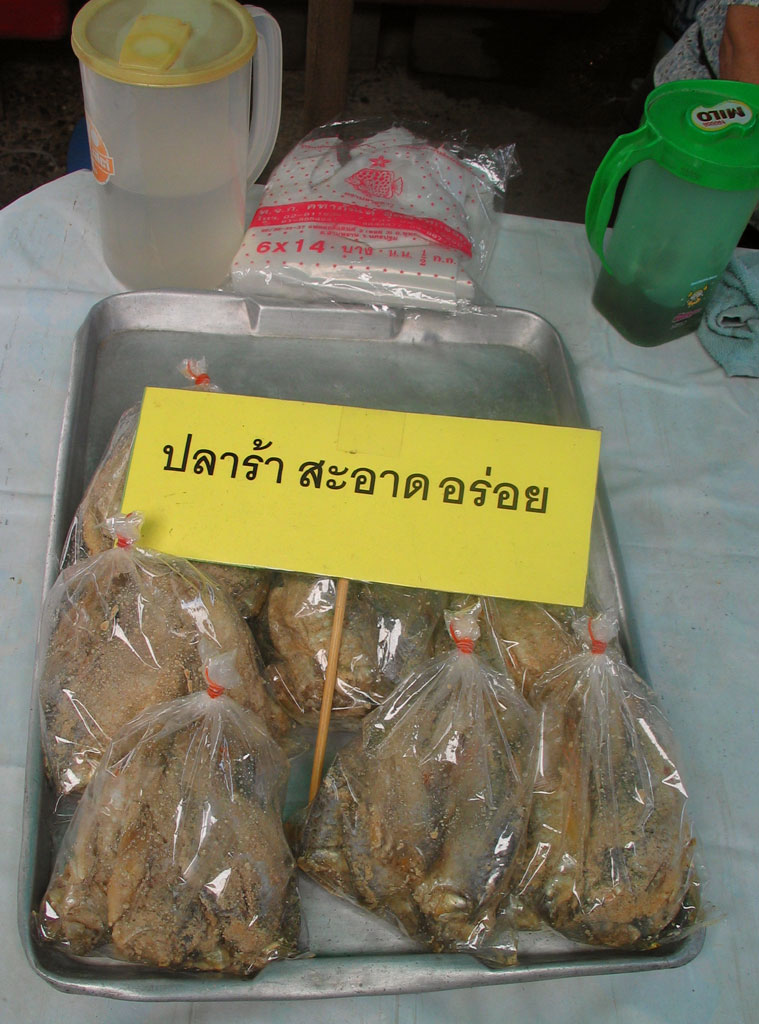
ปลาร้า (plaa ráa) is fermented fish, and it is the single ingredient that separates one som tam from another. ปลา is simply “fish”; the ร้า marks it as the fermented kind, salted and left in a jar for months. It is pungent, deeply savoury, and the backbone of Isan cooking. ตำไทย leaves it out, ตำลาว and ตำปูปลาร้า are built on it.
Two related words will keep appearing. ปู (puu) is crab, and in this context specifically ปูนา, the small salted rice-field crab pounded in whole — shell included. น้ำปลาร้า (nám plaa ráa) is the strained liquid version. If you want to try the real thing without committing, ask for ใส่ปลาร้านิดหน่อย (sài plaa ráa nít nòy), “just a little fermented fish”. Vendors are used to the request and nobody minds.
The rest of the Isan table
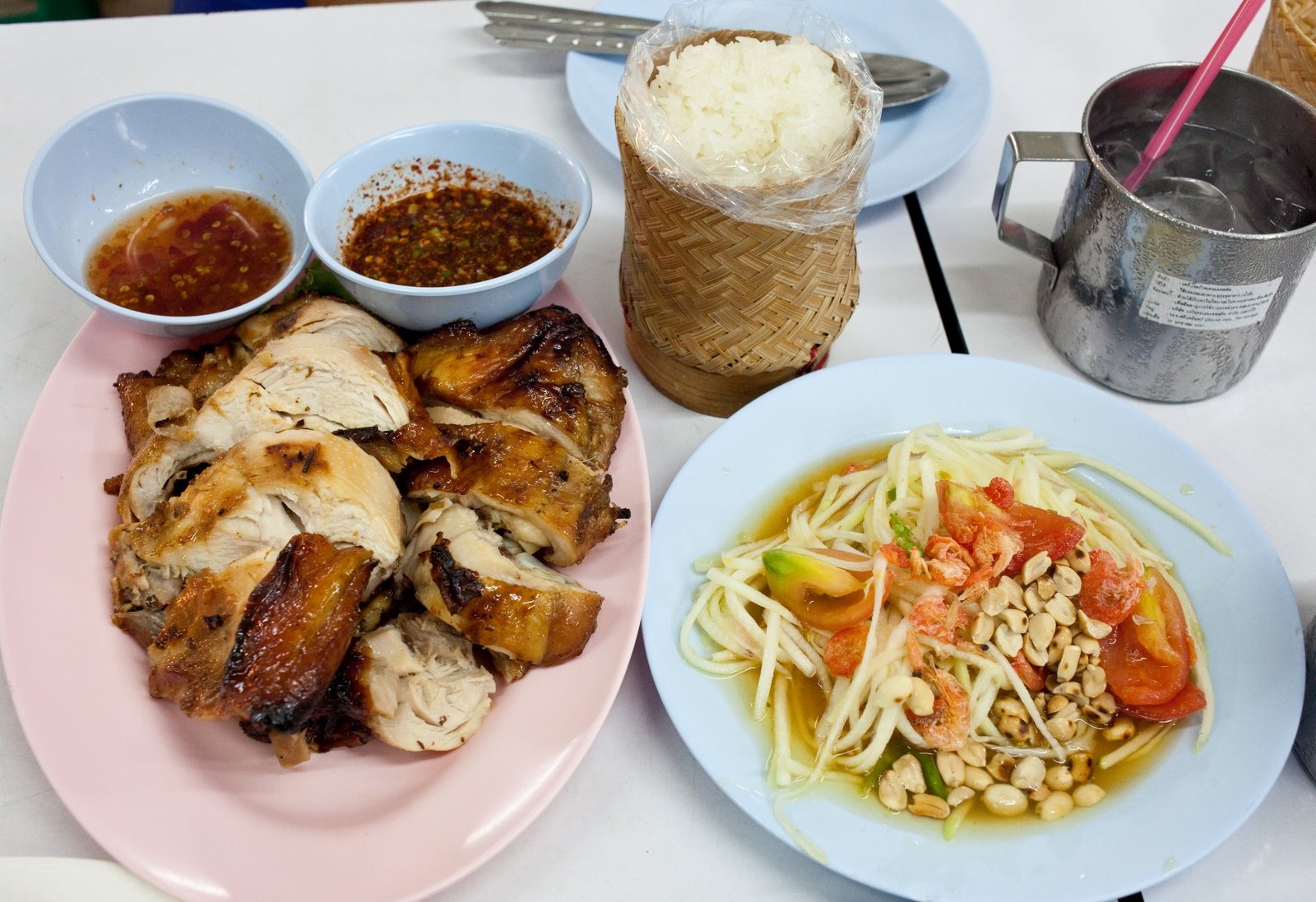
Som tam almost never arrives alone. These are the dishes it travels with, and together they make a vocabulary set you can order from for years:
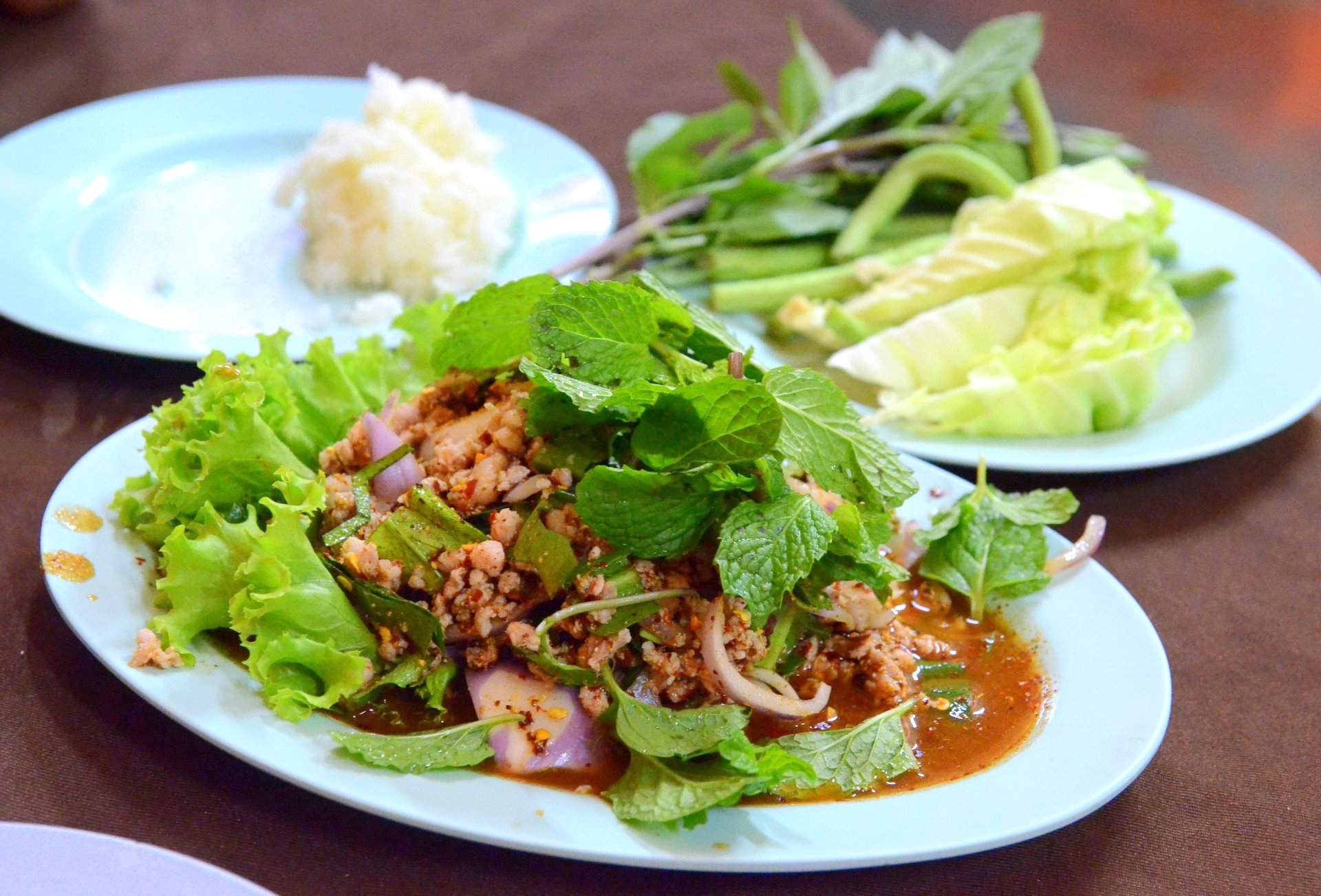
- ข้าวเหนียว (khâao nǐao) — sticky rice, literally “rice · sticky”, eaten with the fingers from a lidded basket.
- ไก่ย่าง (kài yâang) — grilled chicken. ย่าง is “to grill over charcoal”, and it turns up all over Thai menus.
- ลาบ (lâap) — minced meat salad with toasted rice powder, herbs and lime. ลาบหมู is the pork one.
- น้ำตก (nám tòk) — grilled sliced pork or beef dressed like larb. The name means “waterfall”.
- ต้มแซ่บ (tôm sêêp) — a hot-and-sour Isan soup, usually pork ribs.
- คอหมูย่าง (khɔɔ mǔu yâang) — grilled pork neck, sliced and served with a chilli dip.
- แจ่ว (jèèo) — the dry-chilli dipping sauce that comes with the grilled things.
- แซ่บ (sêêp) — Isan for “delicious”, with a built-in suggestion of heat. Say it instead of อร่อย at an Isan table and watch the reaction.
A study tip: one menu board, one evening
Here is the method, and it beats any word list. Photograph one som tam board on your way home. That night, copy it out by hand, line by line, and split every line into ตำ plus the rest. You will have eight ingredients, written the way Thais actually write them, attached to a street you walked down. Tomorrow, order one of them out loud. The reason this works is that you are not trying to learn Thai vocabulary in the abstract — you are learning eight words you are about to eat.
Then widen it. The same trick works on a noodle stall, where the pattern is a noodle type plus a topping; our guide to Thai street food vocabulary covers that board the same way. Keep drilling the letters that keep reappearing with the ThaiLetters flashcard trainer, and when a sign gives you a syllable you cannot place, check it against the alphabet chart. Start with ตำ, เผ็ด and ข้าวเหนียว. Three words, one plate, and you have begun to learn Thai vocabulary the way it is actually used in Thailand.