Learn Thai Vocabulary in Thailand: Thai Wedding Words
Learn Thai vocabulary for a Thai wedding in Thailand: sin sot, khan maak and rod nam sang in Thai script, with pronunciation, meaning and real photos.
Stay in Thailand long enough and an invitation will arrive: a gold-edged card, a date, and a village you have never heard of. A Thai wedding is one of the best places there is to learn Thai vocabulary, because the whole day is built out of words you can actually see — trays of gold, a chain stretched across the lane, a conch shell, an envelope on a table. Learn fifteen of them and you stop being the guest who is politely lost and become someone who knows what is happening and why.
Everything below is given in Thai script, a Thai transliteration you can say out loud, and a literal translation wherever the literal meaning is the thing that explains the custom. The photographs are real ceremonies in Thailand, so the words you meet here are the words you will meet on the day.
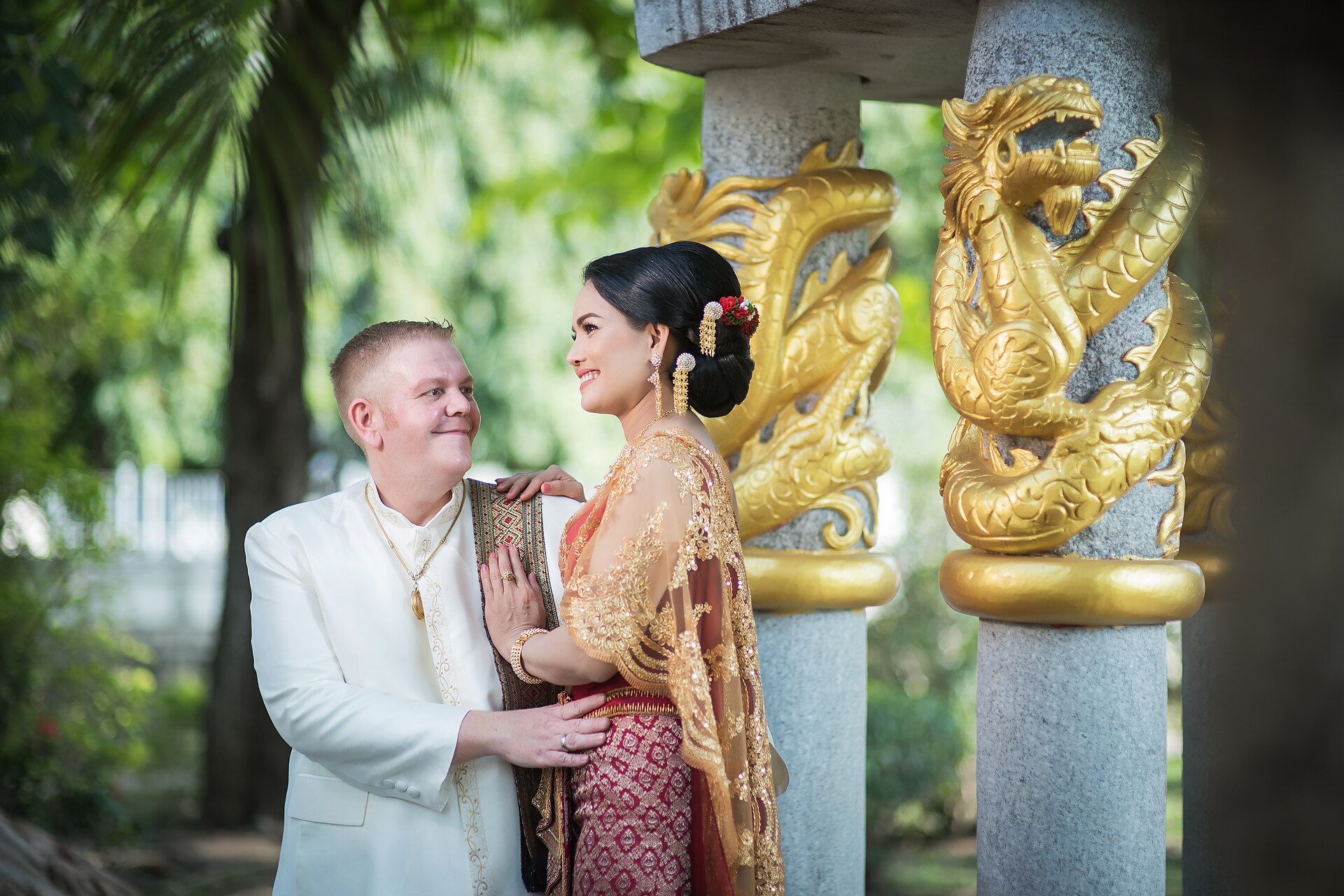
แต่งงาน: the first Thai words for marriage, bride and groom
Start with the words printed on the card. This is the tidiest way to learn Thai vocabulary for the whole day, because Thai builds most of them out of pieces you will reuse everywhere else, which makes it a surprisingly efficient beginner Thai lesson — งาน alone will later give you “party”, “festival”, “job” and “funeral”.
- แต่งงาน (dtàeng ngaan) — to marry, from แต่ง “to dress, to arrange” and งาน “work, event, celebration”
- งานแต่งงาน (ngaan dtàeng ngaan) — the wedding itself, the event
- เจ้าบ่าว (jâo bàao) — groom; เจ้าสาว (jâo sǎao) — bride. เจ้า is the honorific “lord, owner” that also sits inside เจ้าของ (jâo khǎawng), “owner”.
- คู่บ่าวสาว (khûu bàao sǎao) — the couple, literally “pair groom bride”
- หมั้น (mân) — to become engaged; งานหมั้น (ngaan mân) — the engagement ceremony
- สามี (sǎa-mii) — husband; ภรรยา (phan-rá-yaa) — wife
- แฟน (faen) — boyfriend, girlfriend, partner. It is borrowed from English “fan”, but in Thai it never means an admirer.
- จดทะเบียนสมรส (jòt thá-biian sǒm-rót) — to register a marriage
That last one matters more than visitors expect. The ceremony is the celebration; the marriage becomes legal only when the couple sign at the ที่ว่าการอำเภอ (thîi wâa gaan am-phooe), the district office, or at a เขต (khèet) office in Bangkok. Plenty of Thai couples hold the ceremony one year and register another — useful Thailand expat language to understand before you nod along to either word.
Learn Thai vocabulary for สินสอด and ทองหมั้น: the money words
The one piece of Thai wedding vocabulary foreigners always hear first is สินสอด (sǐn sàawt), usually translated “dowry”, though that is backwards: it travels from the groom’s family to the bride’s parents, not the other way. Think of it as a public thank-you for raising her, and a public statement that the groom can provide.
- สินสอด (sǐn sàawt) — bride price, presented in cash on the day
- ทองหมั้น (thaawng mân) — “engagement gold”: necklace, bracelet, ring, often 96.5% Thai gold
- แหวนหมั้น (wǎen mân) — engagement ring; แหวนแต่งงาน (wǎen dtàeng ngaan) — wedding ring
- พาน (phaan) — the footed offering tray everything is displayed on
- เถ้าแก่ (thâo gàe) — the respected elder who negotiates on the groom’s behalf
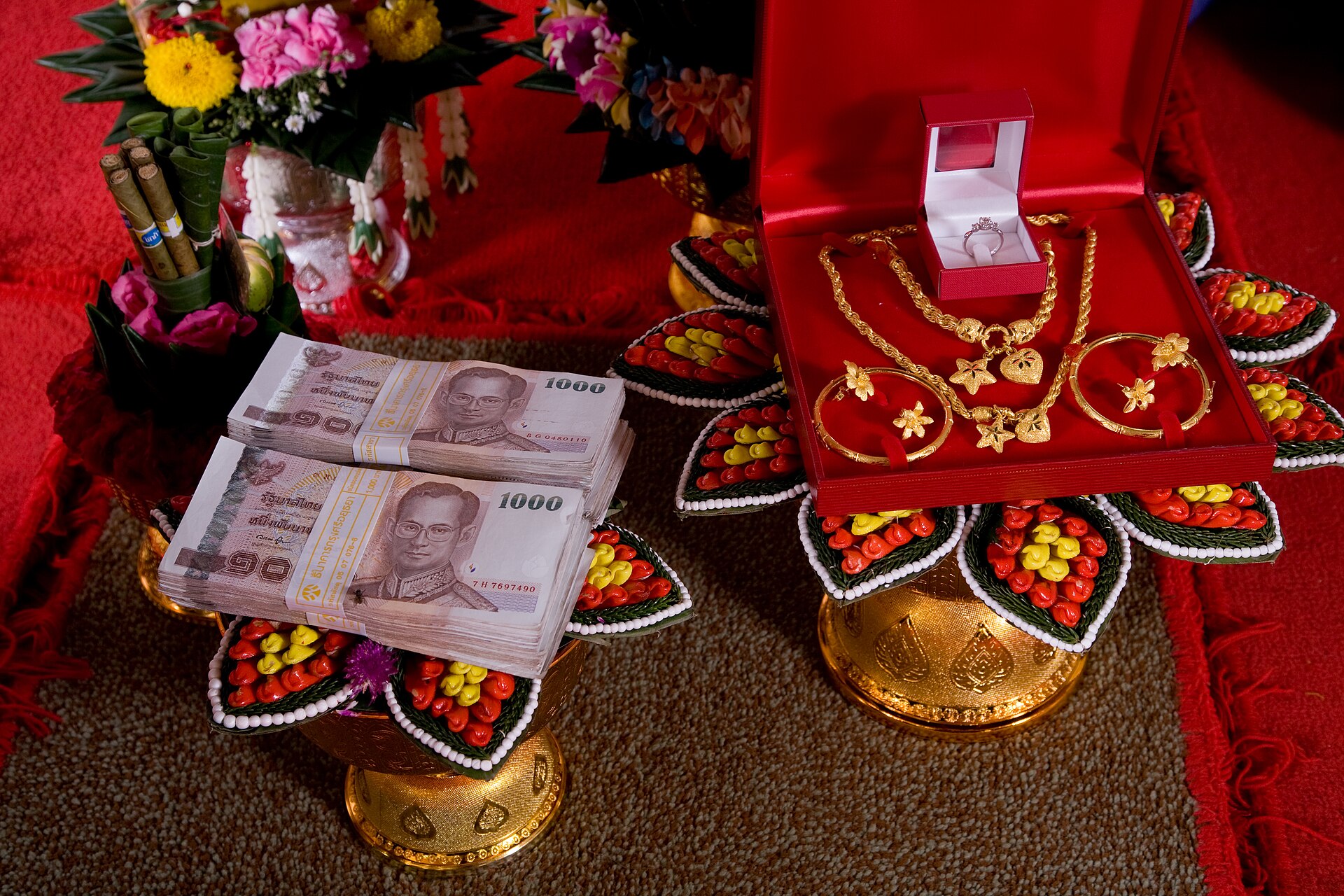
Numbers come up constantly in these conversations, and they are quoted in บาท (bàat) at speed. If figures in Thai still slow you down, half an hour with our guide to Thai money words and prices and the Thai numbers page will pay for itself the first time someone says a price out loud.
ขันหมาก: the procession, the silver gate and the gold gate
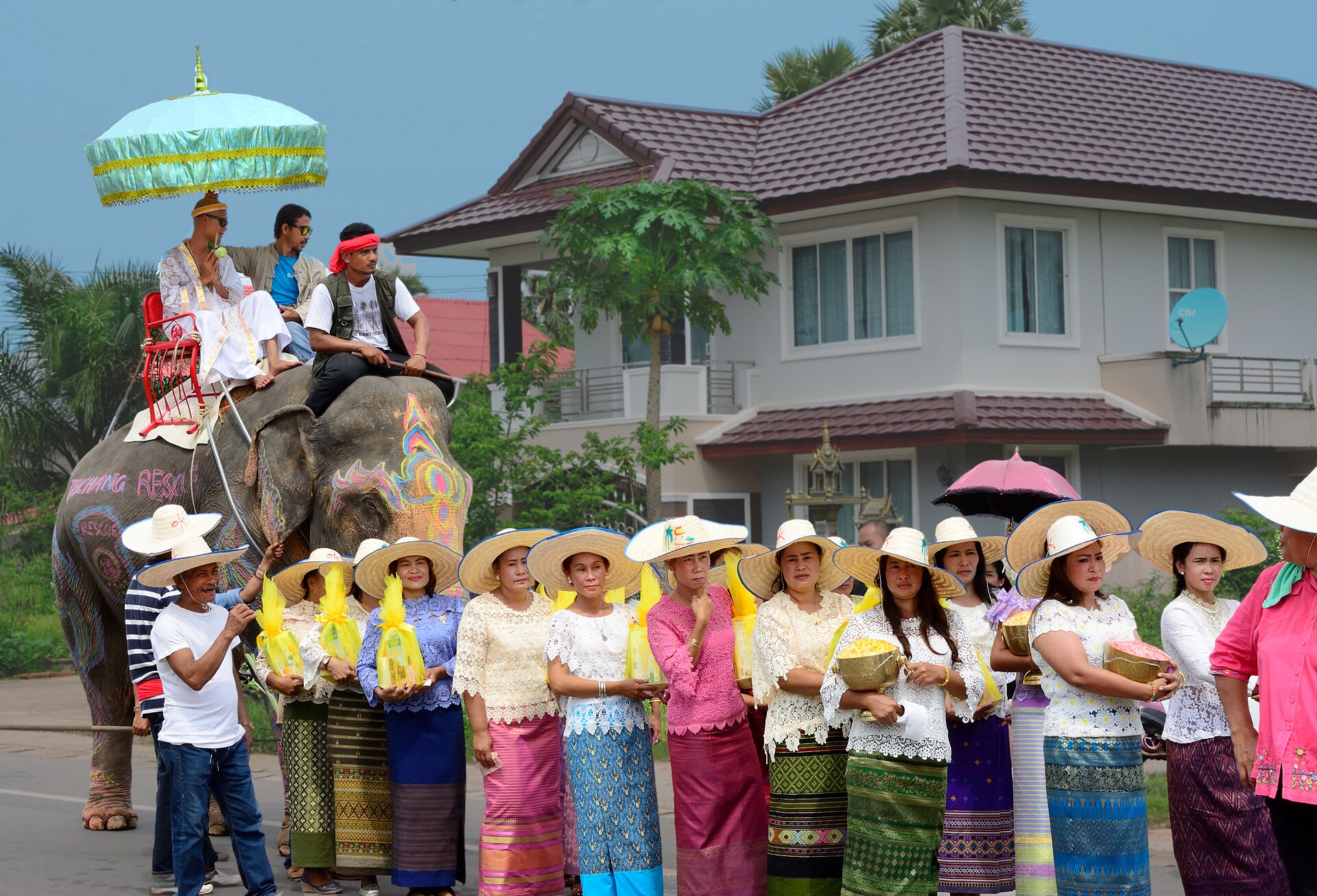
This is the section where you learn Thai vocabulary nobody teaches in a classroom. On the morning itself the groom does not simply arrive. He is walked to the bride’s house at the front of a noisy parade carrying trays of food, gold and betel nut — and then he has to buy his way in.
- ขันหมาก (khǎn màak) — the engagement trays, literally “bowl of betel nut”, from the areca nut once offered to seal an agreement
- แห่ขันหมาก (hàe khǎn màak) — the procession that carries them; แห่ is the same verb used for a temple parade
- ขบวน (khà-buan) — a procession, a convoy
- ประตูเงินประตูทอง (bprà-dtuu ngern bprà-dtuu thaawng) — “silver gate, gold gate”: belts, chains or ribbons held across the path by the bride’s relatives
- ค่าผ่านประตู (khâa phàan bprà-dtuu) — the gate fee, a joking envelope handed over at each one. ค่า means “fee, cost” and fronts half the prices in Thailand.
Read Thai script on the invitation card
The card in your hand is a tidy place to read Thai script, because you already know what it has to say. Formal Thai invitations use a tiny set of phrases, and one of them is a gift to learners: ณ (na), a single letter standing alone as the preposition “at”, used only in formal writing. Spot it and the next words are the venue.
- บัตรเชิญ (bàt chooen) — invitation card; ขอเรียนเชิญ (khǎaw riian chooen) — “we respectfully invite you”
- งานมงคลสมรส (ngaan mong-khon sǒm-rót) — the formal name for a wedding, “auspicious marriage ceremony”
- วันเสาร์ที่ (wan sǎo thîi) — “Saturday the…”; เวลา (wee-laa) — time
- ฤกษ์ (rôek) — the auspicious moment, chosen by a monk or an astrologer, which is why ceremonies start at odd times like 9:09
If those Thai letters still arrive as a solid wall, work through our free Thai alphabet chart first and drill the Thai consonants and vowels in the ThaiLetters flashcard trainer. Invitation cards are forgiving practice: the English is usually printed underneath.
รดน้ำสังข์: the blessing that makes it a Thai wedding
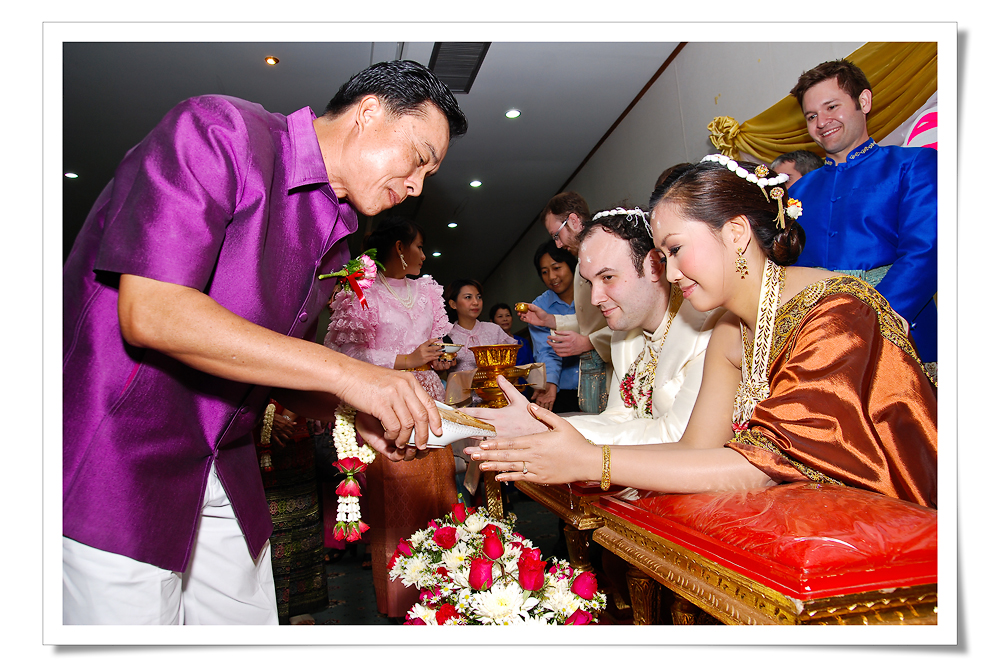
If you only remember one ceremony word, make it this one. รดน้ำสังข์ (rót nám sǎng) is literally “pour water conch”: guests queue up, pour scented water from a conch shell over the couple’s hands, and say a blessing. It is the part everyone photographs, and the part you will be invited into.
- สังข์ (sǎng) — conch shell; น้ำมนต์ (nám mon) — blessed water
- มงคลแฝด (mong-khon fàet) — “twin mongkhon”, the pair of white headbands joined by a single thread so the couple share one circle
- สายสิญจน์ (sǎai sǐn) — the sacred white cotton thread, also strung around houses and temples
- ผู้ใหญ่ (phûu yài) — “the big people”, the elders, who pour first
- อวยพร (uai phaawn) — to give a blessing; พิธีสงฆ์ (phí-thii sǒng) — the monks’ ceremony held earlier in the morning
Speak Thai at the reception: congratulations and envelopes
By evening the Thai you need is short and repeatable — the best kind of Thai to learn Thai vocabulary from, because you end up saying it rather than studying it. These are the lines to practise out loud before you go, because you will say each of them a dozen times — and saying them is the fastest way to speak Thai that anyone has ever found.
- ยินดีด้วย (yin dii dûai) — “congratulations”, literally “glad with you”
- ขอแสดงความยินดีด้วยครับ (khǎaw sà-daeng khwaam yin dii dûai khráp) — the formal version for the parents
- ขอให้มีความสุข (khǎaw hâi mii khwaam sùk) — “may you be happy”, the standard blessing
- ใส่ซอง (sài saawng) — “to put in an envelope”: the cash gift, which replaces a wrapped present
- งานเลี้ยง (ngaan líiang) — the reception; ของชำร่วย (khǎawng cham-rûai) — the little favour guests take home
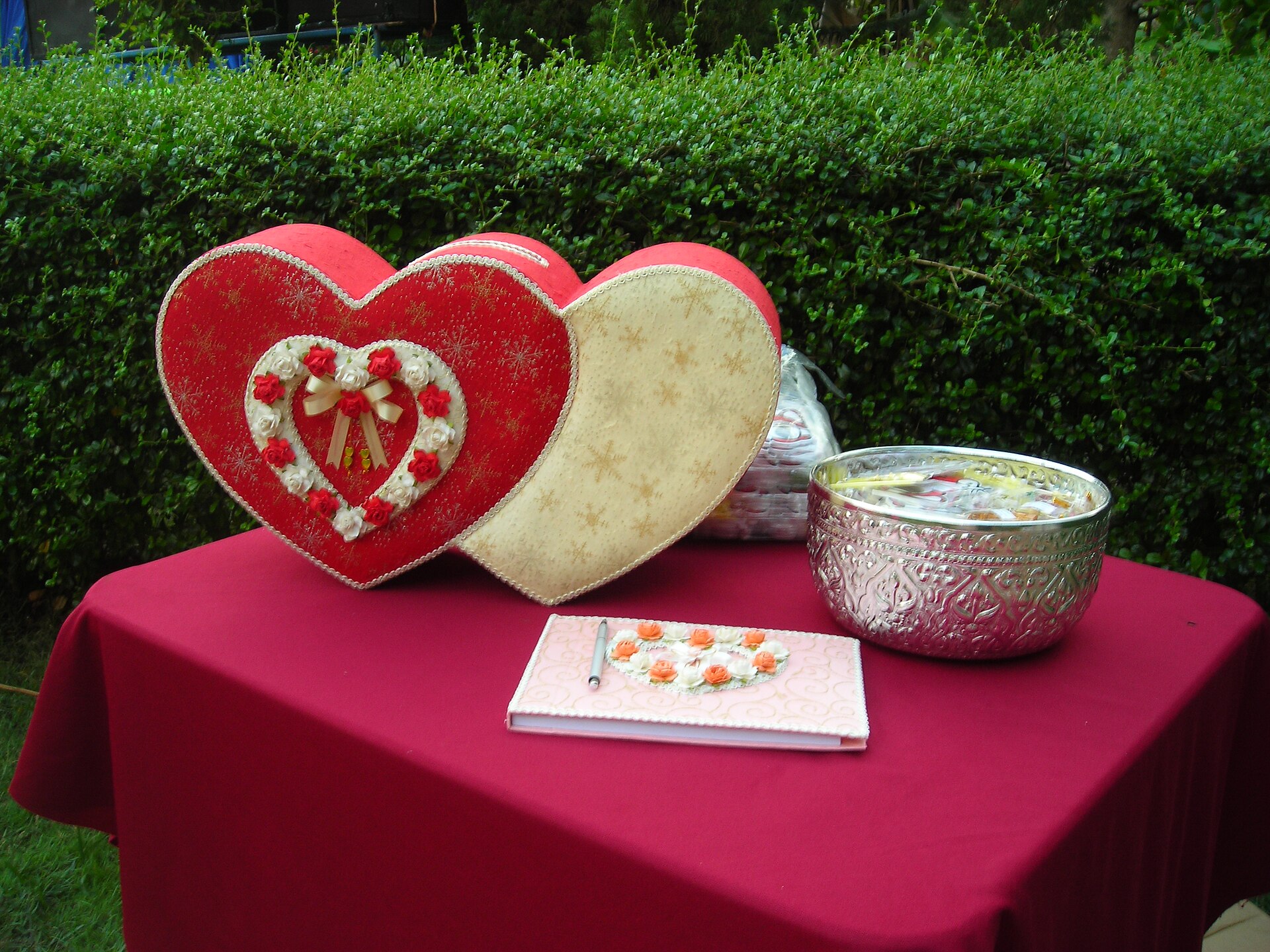
- สมุดอวยพร (sà-mùt uai phaawn) — the blessing book you sign on the way in
Khrap, kha, and who you call พี่
A wedding is a room full of relatives ranked by age, so the politeness machinery is running at full power. Finish every sentence with ครับ (khráp) if you are a man, ค่ะ (khâ) if you are a woman — and remember that a woman’s particle shifts to คะ (khá) when she asks a question. Dropping it is not rude exactly, but at a ceremony it lands like wearing shorts.
Address anyone noticeably older than you as พี่ (phîi) and anyone younger as น้อง (náawng), and use คุณ (khun) plus a first name when you are unsure. The couple’s parents are safest as คุณพ่อ (khun phâaw) and คุณแม่ (khun mâae) — “honoured father” and “honoured mother” — even though they are not yours. Our guides to khrap and kha and to Thai family words go through the whole hierarchy, aunts and uncles included, which is exactly the table you will be seated at.
A study tip: learn the day in order
Do not memorise this as a list. Memorise it as a sequence, because that is how the day will hand it to you: บัตรเชิญ → พิธีสงฆ์ → แห่ขันหมาก → ประตูเงินประตูทอง → สินสอด → รดน้ำสังข์ → งานเลี้ยง. Seven words, each one triggered by something you are watching, which is why they stick when a flashcard deck of thirty would not.
Then do what every successful learner in Thailand does and let the real world test you. Read the invitation before anyone translates it, listen for ยินดีด้วย in the queue, and count the trays. People learn Thai vocabulary fastest when the words arrive attached to a day they will remember anyway — and if the Thai pronunciation of รดน้ำสังข์ comes out wobbly the first time, say it anyway. At a Thai wedding, trying is the entire point.