Learn Thai Vocabulary: Night Markets in Thailand
Learn Thai vocabulary for a Thai night market: read the shop signs in Thai script, use the five sentences that settle a price, and know your market names.
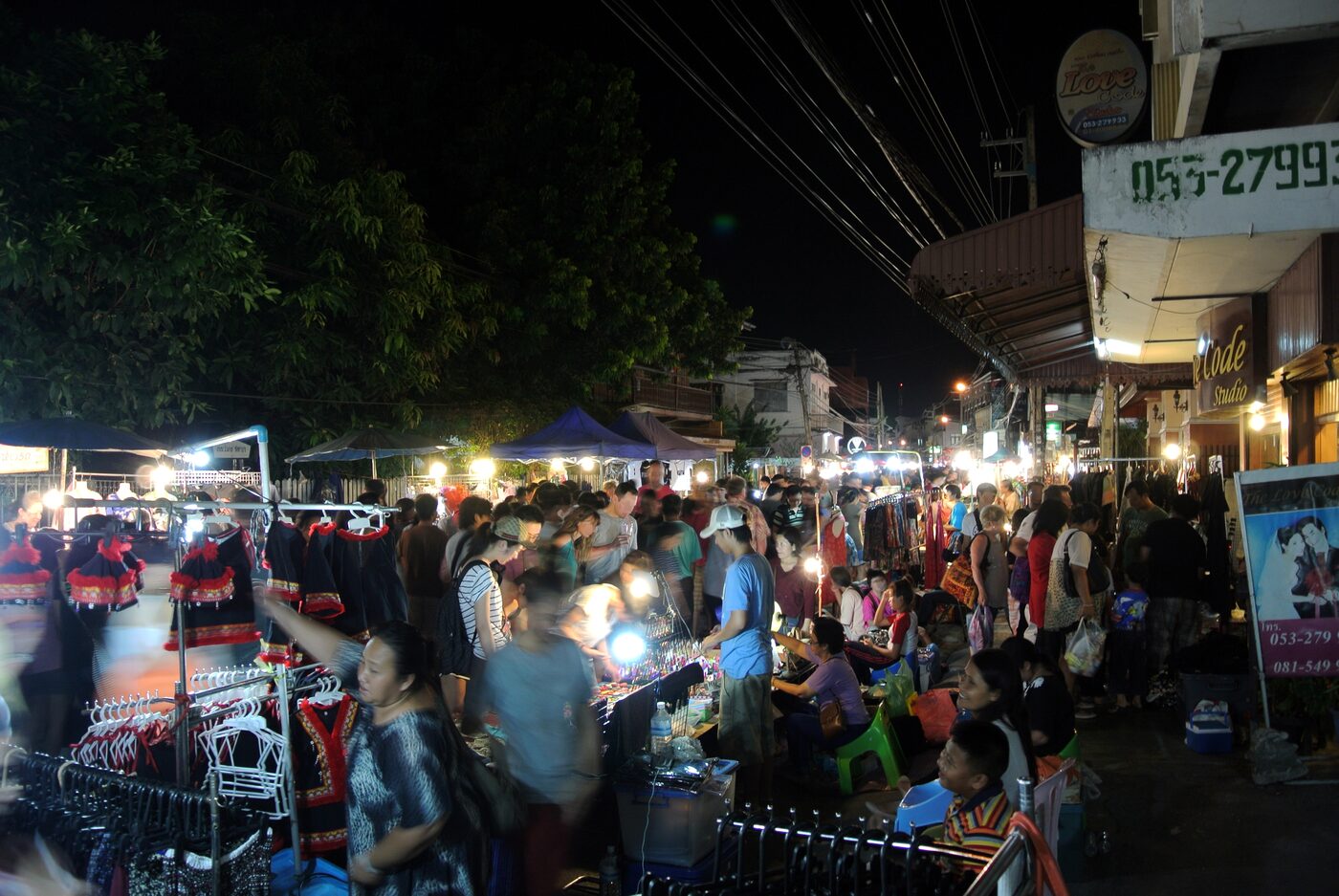
The cheapest language lesson in Thailand starts at about six in the evening, when a road closes to traffic and two hundred stalls unfold along it. A night market is the best possible place to learn Thai vocabulary, because nothing there is theoretical: everything has a price, almost every price can be discussed, and every stall has a sign over it written in Thai script.
This Thai language guide walks one market from the top of the street to the last stall. You will get the real meaning of the Thai names for these markets, the words for the stalls and the people in them, the shop-sign pattern that lets you read Thai script at a glance, and the short sentences that settle a price without anyone losing face. Every entry gives the Thai script, a Thai transliteration you can say out loud, and the literal sense wherever it explains something.
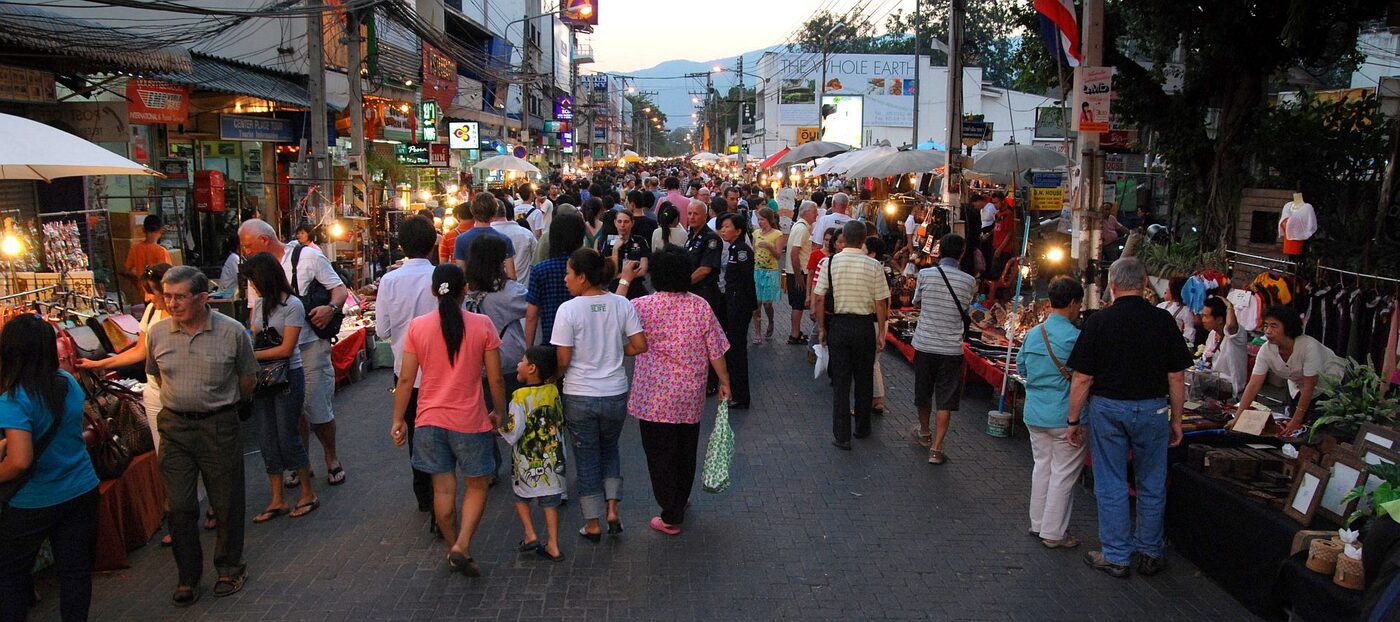
What ตลาดนัด and ถนนคนเดิน actually mean
ตลาด (talàat) is the ordinary word for a market, and you will meet it everywhere. Add นัด (nát), which means “to make an appointment”, and you get ตลาดนัด (talàat nát) — an “appointment market”, one that appears on agreed days and then vanishes again. That single word tells you something practical: if it is a ตลาดนัด, turning up on the wrong day means an empty car park.
ถนนคนเดิน (thanǒn khon dəən) is the walking street: ถนน road, คน person, เดิน to walk. A ตลาดโต้รุ่ง (talàat tôo rûng) is the all-night version, the name meaning roughly “a market that holds out until dawn”. And in the north you will see กาด (kàat) on signs instead of ตลาด — it is the Lanna word for market, which is why Chiang Mai has a กาดหมั้ว (kàat mûa), a “jumbled market” of local food.
The plain descriptive term, ตลาดกลางคืน (talàat klaang khʉʉn, “market · middle · night”), is understood everywhere, so it is a safe thing to say to a taxi driver when you cannot remember the market’s own name.
Learn Thai vocabulary for the stalls and the people
Nine words cover almost everything you will need to point at or ask about. They are worth learning as a block, because they recur in every market in the country.
- แผงลอย (phǎng lɔɔi) — a street stall, literally a “floating rack”, the kind that is wheeled away at midnight.
- ร้าน (ráan) — a shop, or any fixed stall. The most useful noun on this page.
- แม่ค้า (mâe kháa) — a female vendor, literally “mother · trade”.
- พ่อค้า (phâɔ kháa) — a male vendor, “father · trade”.
- ลูกค้า (lûuk kháa) — a customer, “child · trade”. The family logic of these three is typical of Thai.
- ของฝาก (khǒɔng fàak) — a gift you bring home for other people, “thing · to entrust”. Thais buy these by the bagful.
- ของที่ระลึก (khǒɔng thîi rálʉ́k) — a souvenir, “thing · of · remembrance”, the one you keep yourself.
- งานฝีมือ (ngaan fǐi mʉʉ) — handicraft, “work · skill · hand”.
- มือสอง (mʉʉ sǒɔng) — second-hand, “hand · two”. Written on half the clothes racks at a weekend market.
One point of etiquette that matters more than any of the words above: address the vendor as พี่ (phîi, “older sibling”) if they look anywhere near your age or older, and ป้า (pâa, aunt) or ลุง (lung, uncle) for someone clearly a generation above you. Thai conversation runs on these relative-age words, and using one correctly is the single clearest signal that you are a foreigner making an effort rather than a tourist shouting numbers.
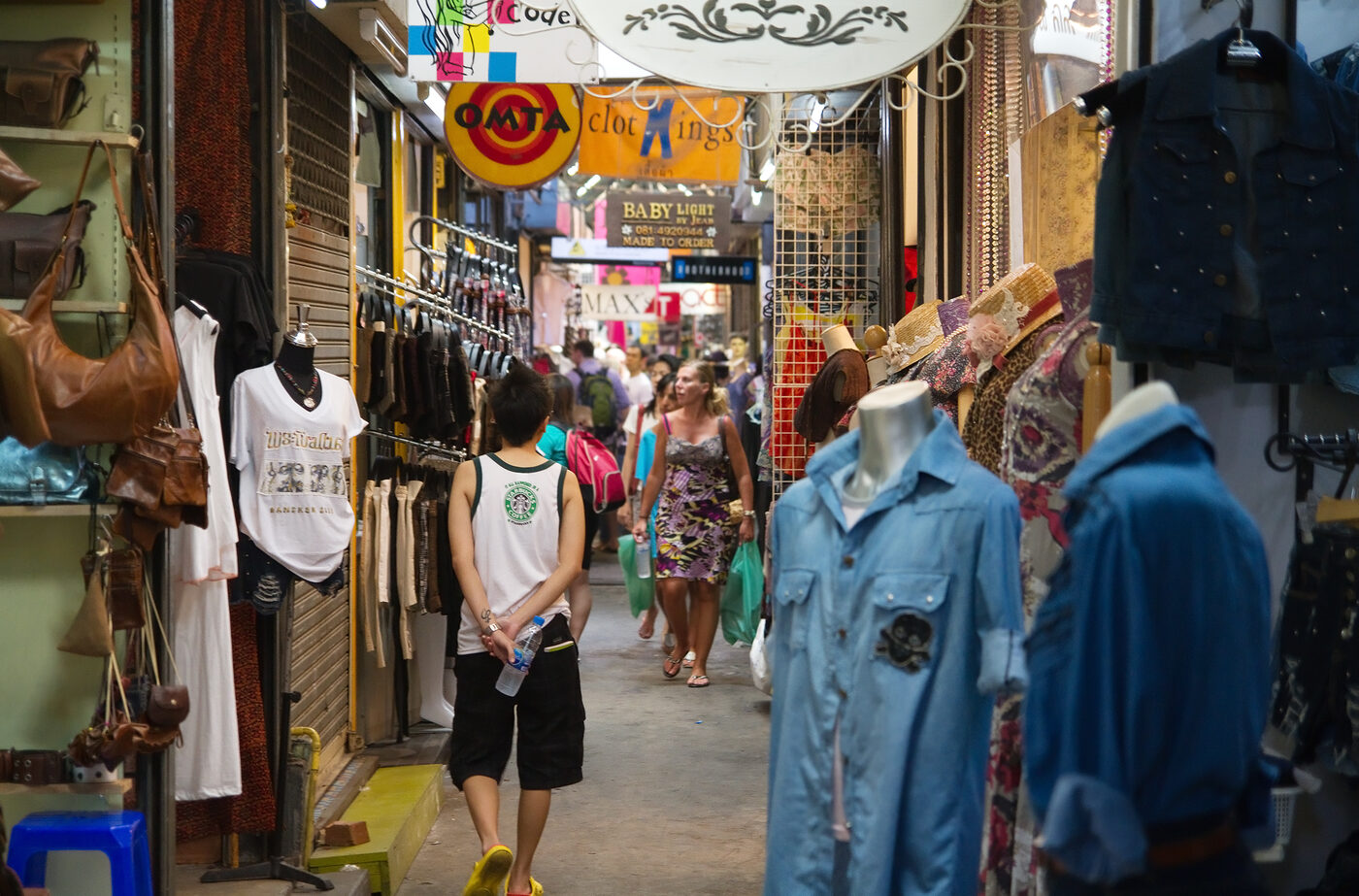
Read Thai script on the signs: the ร้าน formula
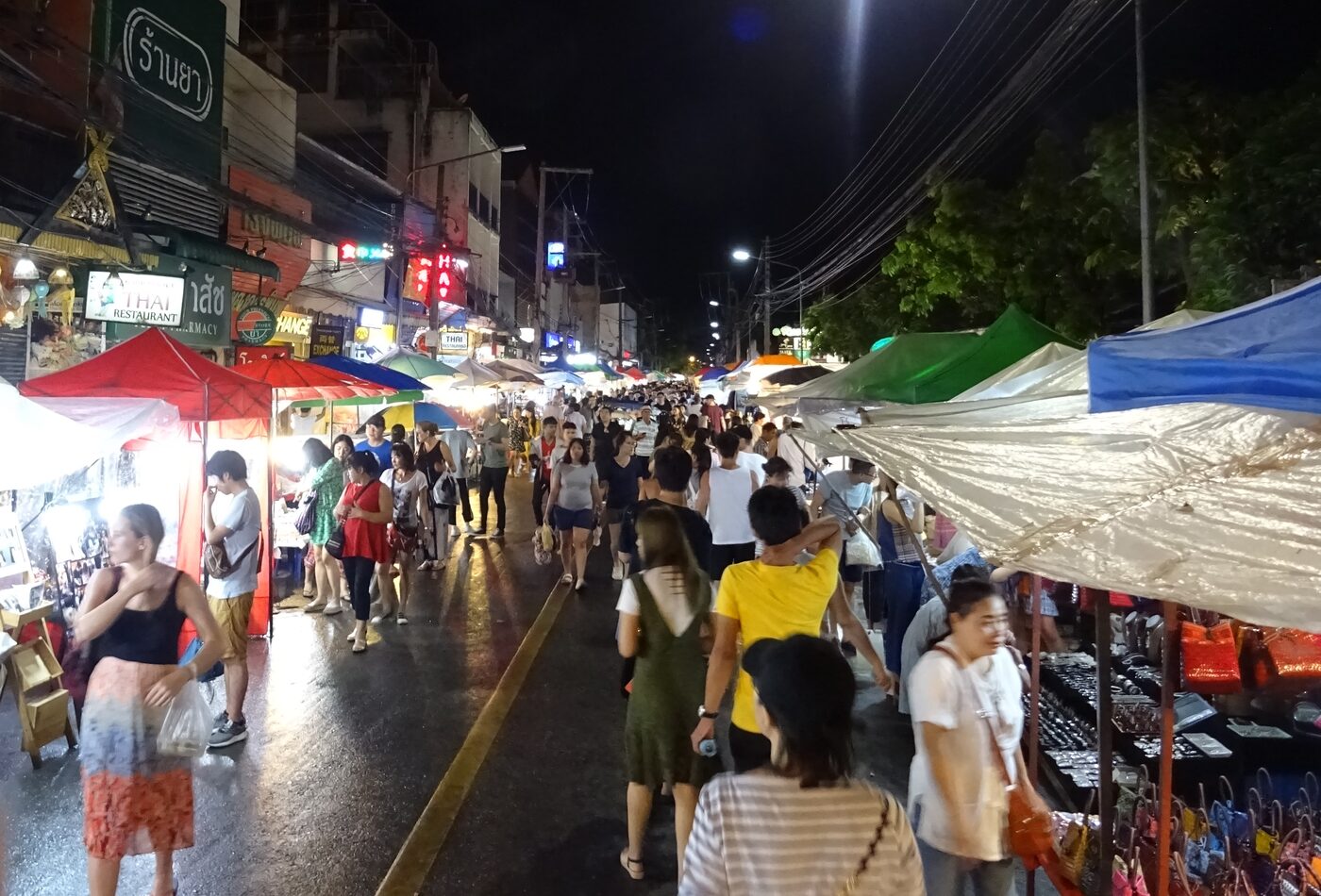
If you learn to recognise one word in Thai script this week, make it ร้าน (ráan). Thai builds shop names the way English builds compound nouns, by putting ร้าน in front of whatever is sold inside. Once the shape of those four letters is familiar, half the signs above a market street decode themselves.
- ร้านยา (ráan yaa) — pharmacy, “shop · medicine”.
- ร้านอาหาร (ráan aahǎan) — restaurant, “shop · food”.
- ร้านกาแฟ (ráan kaafɛɛ) — café. The second word is borrowed, and sounds it.
- ร้านทอง (ráan thɔɔng) — gold shop, always painted red and impossible to miss.
- ร้านเสื้อผ้า (ráan sʉ̂a phâa) — clothes shop, “shop · shirt · cloth”.
The spelling repays a minute if you are still working through the Thai consonants and vowels. ร้าน is ร (rɔɔ rʉa), the long vowel า, and น (nɔɔ nǔu) closing the syllable — and the little mark above is ไม้โท (mái thoo), the second tone mark, which on a low-class consonant like ร produces a high tone. Our guide to Thai tone marks shows how that rule works across all four marks, and the Thai alphabet chart has the full set of Thai letters in order.
Thai price signs, numbers and the right classifier
Market price cards are short, and they nearly all use one grammar word: ละ (lá), which means “per”. It sits between the thing counted and the price, so ตัวละ ๒๕๐ is “250 per item”. Learn that one pattern and you can read almost any card in the street, which is the fastest way to learn Thai vocabulary for money and numbers at the same time.
- ราคา (raa khaa) — price; บาท (bàat) — baht, often written as the symbol ฿.
- ชิ้นละ (chín lá) — per piece; ตัวละ (tua lá) — per garment; คู่ละ (khûu lá) — per pair; โหลละ (lǒo lá) — per dozen.
- ลดราคา (lót raa khaa) — reduced price, a sale.
- เหมา (mǎo) — to take the whole lot for one flat price. Powerful word at a stall with a pile of identical things.
- แถม (thǎem) — to throw in something extra free. If the price will not move, ask whether the vendor can แถม instead.
Two warnings about the numbers themselves. First, the classifier is not optional: in Thai you say the noun, then the number, then the counting word, so “three shirts” is เสื้อสามตัว (sʉ̂a sǎam tua). Our explainer on Thai classifiers lists the ones you actually need. Second, most price cards use the same digits you already read, but Thai numerals ๐๑๒๓๔๕๖๗๘๙ still turn up on older handwritten signs and on government notices, so it is worth ten minutes with the Thai numbers page before you go.
Speak Thai while you bargain: five sentences
You do not need fluency to speak Thai at a stall. You need five sentences, in this order, said quietly and with a smile. Men end each one with ครับ (khráp) and women with ค่ะ (khâ); these politeness particles are not decoration, and leaving them off makes a reasonable request sound like an order.
- อันนี้เท่าไหร่ (an níi thâo rài) — “How much is this one?”
- ขอดูหน่อยได้ไหม (khǒɔ duu nɔ̀i dâi mǎi) — “May I have a look?” Picking things up unasked is poor form.
- ลดหน่อยได้ไหม (lót nɔ̀i dâi mǎi) — “Could you come down a little?” The standard opening, and never an insult.
- เอาสองอัน ลดได้ไหม (ao sǒɔng an, lót dâi mǎi) — “I’ll take two — any discount?” Volume moves a price far better than complaining does.
- ไม่เป็นไร ขอบคุณ (mâi pen rai, khɔ̀ɔp khun) — “Never mind, thank you.” The graceful exit, and the one most visitors never learn.
Know when not to use them. Bargaining belongs at a stall with no printed price, on souvenirs, clothes and handicrafts. It does not belong at a food cart, in a shop with price tags, at a 7-Eleven, or over a 50-baht bowl of noodles — pushing there reads as mean rather than clever. One round of haggling is normal, two is the limit, and if the answer is no, you pay the asking price or leave politely. แพงไป (phɛɛng pai, “too expensive”) is best said with a laugh, if at all. The deeper logic behind all of this is in our guide to speaking Thai politely with ครับ and ค่ะ, which is essential Thailand expat language whether you are shopping or not.
Opening days and hours: a beginner Thai lesson in four words
Because these markets are appointments rather than places, the days matter, and this corner of the Thai language guide is where you learn Thai vocabulary that pays off the same evening. Four words and you can read the board at the entrance:
- เปิด (pə̀ət) — open; ปิด (pìt) — closed. Two small words, painted on every door in the country.
- ทุกวัน (thúk wan) — every day.
- วันเสาร์ (wan sǎo) — Saturday; วันอาทิตย์ (wan aathít) — Sunday.
Those cover the big four: ตลาดนัดจตุจักร (talàat nát chatùchàk), the Bangkok weekend market, Saturday and Sunday; the Chiang Mai Sunday walking street on ถนนราชดำเนิน; the Saturday one on ถนนวัวลาย; and the provincial ตลาดโต้รุ่ง that runs late into the night. For the full set of hour and day formats you will meet on shutters and gates, see our guide to reading Thai opening-hours signs.
A study tip: one market, one page
Here is the method that turns an evening of browsing into Thai pronunciation you keep. Before you go, copy the five bargaining sentences onto one sheet of paper by hand, in Thai script — handwritten, not typed, because drawing the letters is what stops them blurring into one another. Use the sheet at the stall. Afterwards, add the one word the vendor said that you did not catch, and only that one. Do that weekly and you will finish a trip with forty words, every one of them attached to the memory of actually using it.
Then widen the net. The same ร้าน trick reads the signs on any street in the country, the ละ pattern reads every price card at the fresh market, and the politeness particles transfer unchanged to the street food cart you stop at on the way home. And when the script itself is still the bottleneck, the free ThaiLetters flashcard trainer will drill the Thai letters until a green sign reading ร้านยา registers as fast as an English word does. That is the point at which you stop studying Thai and simply start to learn Thai vocabulary from the street itself.