Speak Thai at a Temple in Thailand: Monk & Merit Words
You take your shoes off, you copy what everybody else is doing, and you get through it. But the moment somebody speaks to you — a monk, a caretaker, the woman selling flowers at the gate — the ordinary Thai you have been practising quietly stops being the right Thai.
If you want to speak Thai anywhere near a วัด, you need a second small vocabulary. To speak Thai here you need a separate register for talking to and about monks: different verbs, different pronouns, a different word for “give”. It sounds intimidating and it is not — there are about fifteen words in it, they are short, and knowing even five of them changes how you are received at every temple in the country. This beginner Thai lesson covers the merit-making words, the monk register, and the handful of phrases that make a temple visit go smoothly, all in Thai script with pronunciation and literal English.
Why temple words come early in a Thai language guide
Two reasons, and neither is religious. First, these words are everywhere in ordinary life: colleagues take a morning off to ทำบุญ, a new shop gets blessed before it opens, a funeral is described entirely in this vocabulary. Anyone learning to speak Thai in daily life will hear it long before they ever set foot in an ordination hall.
Second, temple Thai is the clearest possible demonstration of something that runs through the whole language. Thai encodes relative status in the words themselves, not in the tone of voice. Learn the monk register and the rest of the politeness system — the particles, the pronouns, the careful verbs — suddenly makes structural sense. If you have not met that system yet, our guide to khrap, kha and politeness in Thai is the place to start.
The four words on the gate
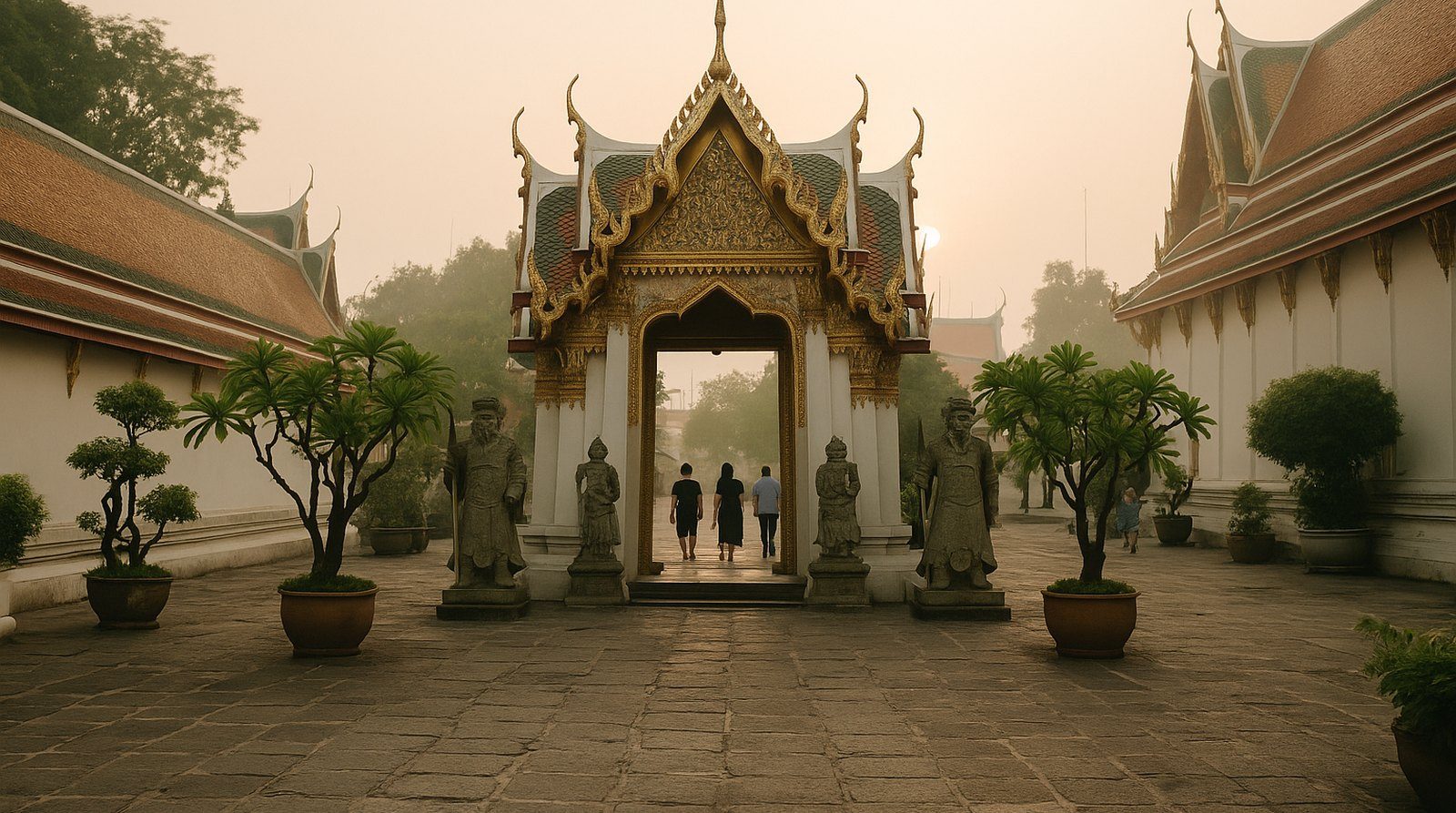
Start with what is written on the sign before you walk in. These four appear on almost every temple in Thailand, and they are short enough to be good early reading practice once you can sound out Thai consonants and vowels.
- วัด (wat, high tone) — the temple complex as a whole. Every temple name begins with it: วัดโพธิ์ (Wat Pho).
- โบสถ์ (bot, low tone) — the ordination hall, the most sacred building on the grounds. Often the one with the boundary stones around it.
- เจดีย์ (jedi) — the bell-shaped or pointed stupa. Literally a reliquary.
- พระ (phra, high tone) — a monk, and also the honorific prefix on anything sacred, including Buddha images (พระพุทธรูป).
You will also meet two instruction signs constantly: ถอดรองเท้า (thot rong thao) — “remove shoes”, and ห้ามเข้า (ham khao) — literally “forbid enter”. Our companion guide on reading Thai temple signs works through the rest of the signage.
Tham bun: the vocabulary of making merit
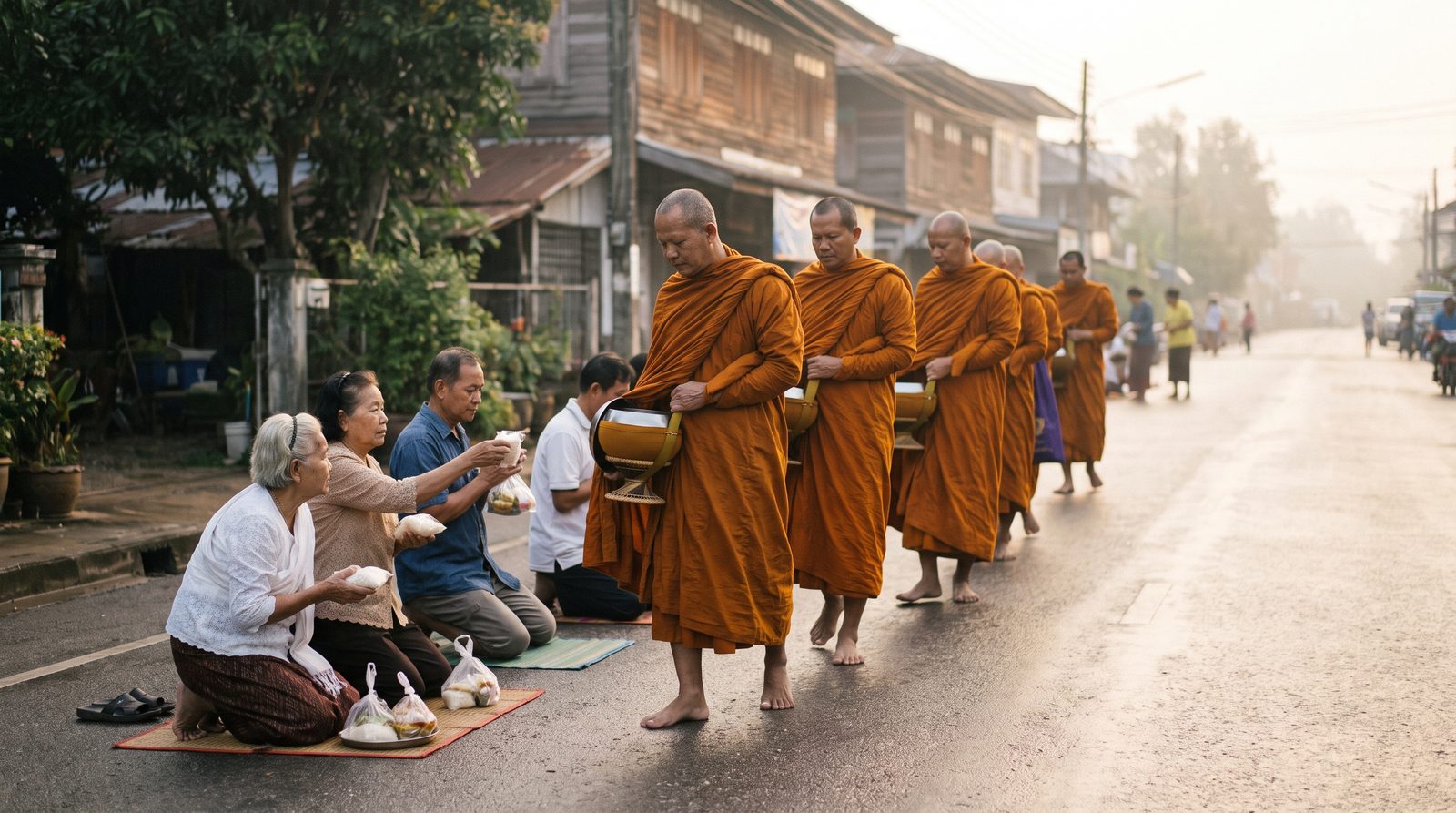
Everything a Thai person does at a temple sits under one heading: ทำบุญ (tham bun), literally “to make merit”. It is not a solemn phrase. People use it the way an English speaker might say “doing something good”, and it covers donating money, feeding monks, releasing fish, or paying for a new temple roof.
| Thai | Pronunciation | Literal / meaning |
|---|---|---|
| ทำบุญ | tham bun | make merit — the umbrella term |
| ใส่บาตร | sai baat | “put in the bowl” — give food on the alms round |
| บาตร | baat | the monk’s alms bowl itself |
| ถวาย | tha-wai | to offer — replaces ให้ (“give”) for monks |
| ประเคน | pra-khen | to hand something formally to a monk |
| บริจาค | bo-ri-jak | to donate (money, to the box: ตู้บริจาค) |
| ธูปเทียนดอกไม้ | thup thian dok mai | incense, candle, flowers — the standard offering set |
| ปิดทอง | pit thong | “close gold” — press gold leaf onto an image |
| สาธุ | saa-thu | roughly “amen” — said at the end of a blessing |
Two of those repay a closer look. ถวาย is not a polite version of “give” — it is a different verb entirely, used only when the recipient is a monk, a royal, or a Buddha image. And ประเคน describes a specific physical act: placing an item into a monk’s hands or onto a cloth he is holding. Women do not hand things to monks directly, which is why you will see a monk lay out a folded cloth first and a woman set the item on that instead. Nobody expects a visitor to get this right unprompted; doing it anyway is noticed.
The monk register: when Thai pronouns change
This is the part no phrasebook explains, and it is the most interesting thing in the whole topic. When a monk speaks to a layperson, both sides swap out their ordinary pronouns.
- อาตมา (aat-ta-ma) — “I”, used only by a monk. If you hear it, the speaker is ordained.
- โยม (yom) — “you”, used by a monk for a layperson. Being called โยม is normal and carries no edge to it.
- หลวงพ่อ (luang phor) — literally “royal father”, a warm, respectful way to address a senior monk. หลวงพี่ (luang phi) for a younger one.
- นิมนต์ (ni-mon) — “to invite”, used instead of เชิญ (choen) when the person being invited is a monk.
You do not need to produce most of these in order to speak Thai respectfully. You need to recognise them, and you need to avoid the one mistake that actually lands badly: using the casual second-person pronouns on a monk. Stick to หลวงพ่อ or simply avoid a pronoun altogether, which Thai allows far more comfortably than English does.
Khrap and kha do not go away
The ordinary polite particles still apply. Men end sentences with ครับ (khrap), women with ค่ะ (kha) on statements and คะ on questions. One near-collision worth knowing: กราบ (krap, low tone) is the deep bow with forehead to the floor — a different word, a different spelling, and a different tone from the particle ครับ. Thai transliteration flattens them into the same three letters, which is exactly the sort of thing that makes learning the script worth the effort. The particles guide has the full set.
Ten phrases for an actual visit
Short, usable, and safe in any temple in Thailand — enough to speak Thai rather than point. Male speakers end with ครับ, female speakers with ค่ะ.
- ขอโทษครับ/ค่ะ — khor thot khrap/kha — “excuse me / sorry”.
- ถ่ายรูปได้ไหมครับ — thai ruup dai mai khrap — “may I take a photo?”
- เข้าได้ไหมครับ — khao dai mai khrap — “may I go in?”
- ต้องถอดรองเท้าไหมครับ — tong thot rong thao mai khrap — “do I need to take my shoes off?”
- ทำบุญที่ไหนครับ — tham bun thi nai khrap — “where do I make a donation?”
- ขอธูปหน่อยครับ — khor thup noi khrap — “could I have some incense, please?”
- ไม่เป็นไรครับ — mai pen rai khrap — “no problem / never mind”.
- สวยมากครับ — suay mak khrap — “it’s very beautiful”.
- ขอบคุณครับ — khop khun khrap — “thank you”.
- สาธุ — saa-thu — said, palms together, after a blessing.
Two things to leave out
Skip the jokes. Humour about monks or Buddha images does not travel, and images of the Buddha used decoratively — on a tattoo, a T-shirt, a bar wall — are a genuine sore point rather than a quaint local rule. Second, skip the caged-bird release. Vendors sell ปล่อยนก (ploi nok, “release birds”) merit outside busy temples; the birds are trapped to be sold again. Dropping a note in the ตู้บริจาค is the cleaner version of the same gesture.
A study tip: learn the pair, not the word
Temple vocabulary is the easiest place in Thai to practise something that pays off everywhere else — learning words in register pairs. ให้ / ถวาย. เชิญ / นิมนต์. กิน / ฉัน (the verb “to eat”, ordinary and monastic). Each pair means the same thing and tells you something different about who is talking to whom, and once you hold four or five of them, the logic of Thai politeness stops being a list of rules to memorise.
Write each pair on one card, ordinary word on the left, elevated word on the right, and say both out loud. Then go and read the gate of the nearest temple: วัด plus a name is a very forgiving first sentence of real Thai. If the letters are still slow, a few minutes a day on the flashcard trainer and the Thai alphabet reference will close that gap faster than anything else. Temple Thai is a small vocabulary with an unusually large return — fifteen words, and the country reads differently.