Read Thai Script: Thailand Province & District Signs
Read Thai script on Thailand's province, district, tambon and village signs: changwat, amphoe and tambon in Thai letters with transliteration and real photos.
Thailand keeps a free reading lesson on the front of every government building. Learn to read Thai script on four words — จังหวัด, อำเภอ, ตำบล and หมู่บ้าน — and you can place yourself exactly on the map of Thailand, fill in the address boxes on a visa form, and understand the small print under a village name sign on a country road. These four words are the skeleton of every Thai address, every ID card and every parcel label in the country, and they never change.
This guide works through five real photographs taken in Bangkok, Ang Thong, Nakhon Ratchasima, Nakhon Nayok and Surin. Every term appears in Thai script, in Thai transliteration and with its literal meaning, because Thai administrative words are compounds built from small, ordinary pieces. Take the compound apart and a fourteen-letter wall of Thai letters turns into three words you already know. It is a beginner Thai lesson with an unusually good return: these signs are standardised nationwide, so the same handful of words repeats in all 77 provinces.
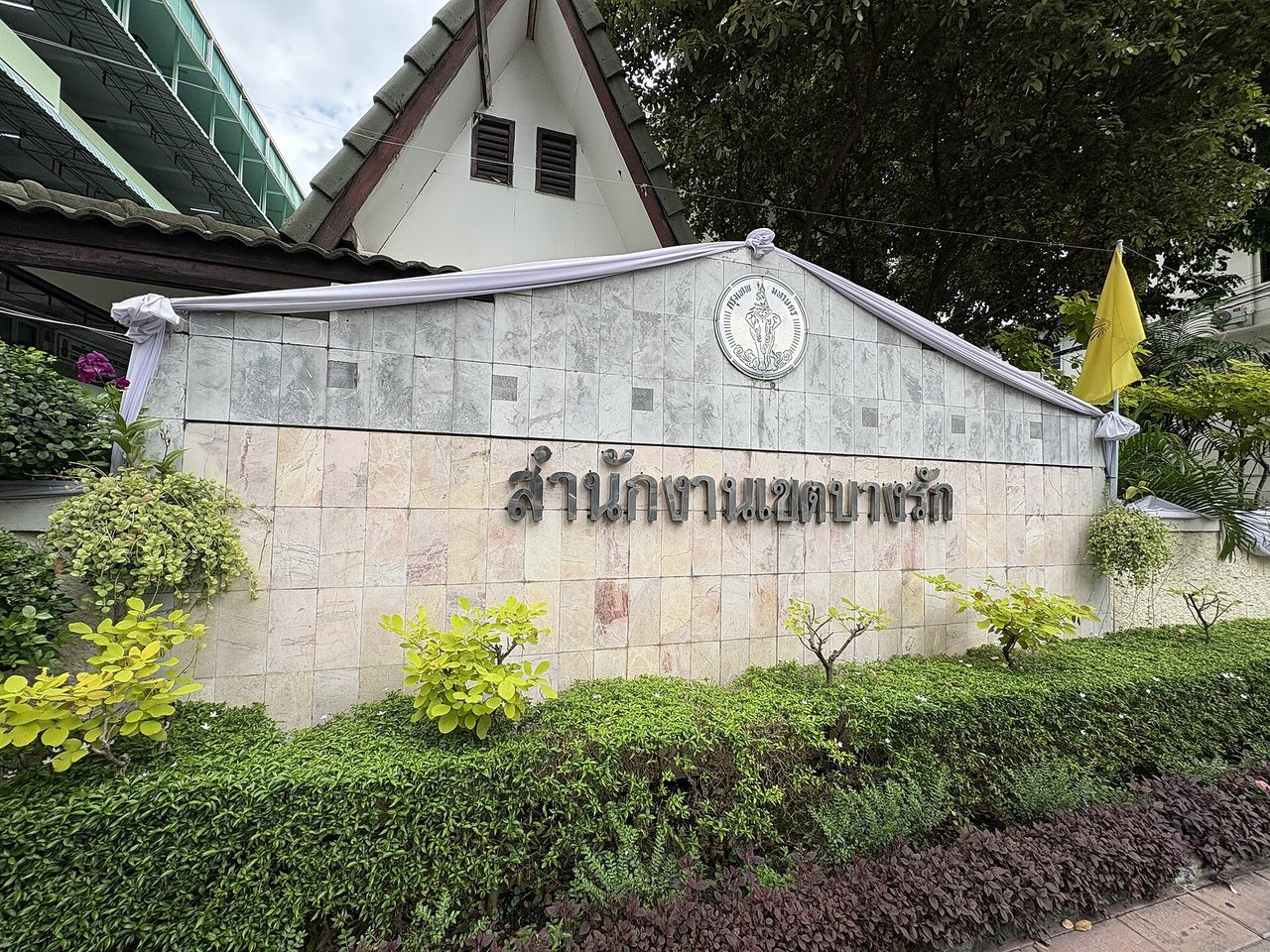
Read Thai script on the four words in every Thai address
Thailand is divided into provinces, provinces into districts, districts into subdistricts, and subdistricts into villages. Six words cover the whole system, and every one of them is short. Learn these before anything else: they turn up on road signs, hospital forms, rental contracts and the blue house book.
- จังหวัด (jang-wàt) — province. There are 76 of them plus Bangkok, which is governed separately. On a form this is the biggest box; on a sign it is usually the last word.
- อำเภอ (am-pher) — district, the level that issues most of your paperwork. Around 900 of them nationwide.
- ตำบล (dtam-bon) — subdistrict, often written “tambon” in English. Roughly 7,000 of these.
- หมู่บ้าน (mùu-bâan) — village, literally “group” plus “house”. In an address it is shortened to หมู่ plus a number.
- เขต (khèet) — Bangkok’s word for a district. If you see เขต rather than อำเภอ, you are in the capital.
- แขวง (khwǎeng) — Bangkok’s word for a subdistrict, used where the rest of Thailand uses ตำบล.
จังหวัด: Thai provinces and the provincial hall
Each province has a ศาลากลางจังหวัด, a provincial hall, and the name is a nice piece of plain Thai: ศาลา is a pavilion, กลาง is middle or central. A “central pavilion” is exactly what these buildings were. Reading the gold letters on one is a good test of whether you can read Thai script at distance, because the lettering is formal, evenly spaced and unhurried.
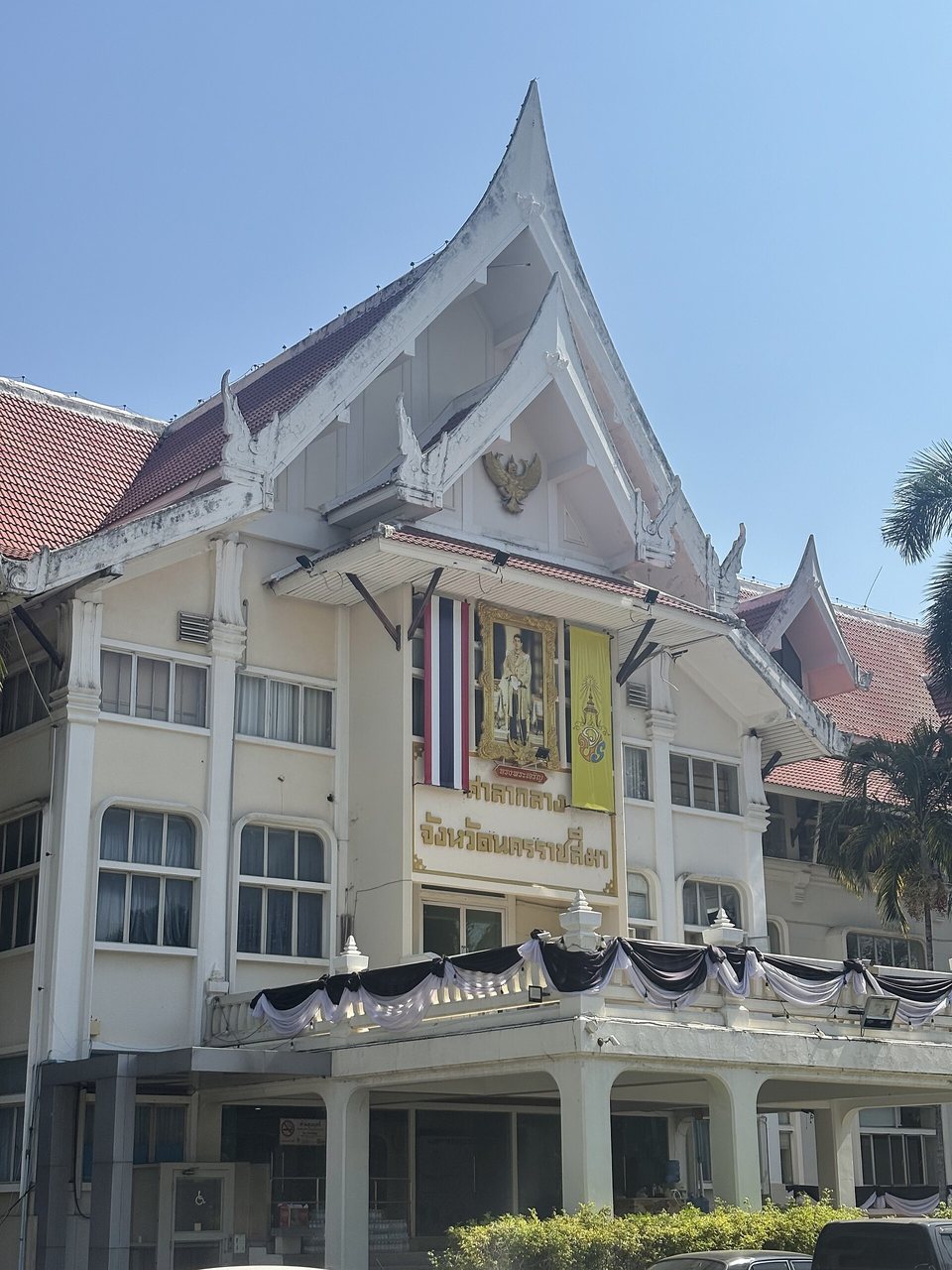
- ศาลากลาง (sǎa-laa-glaang) — provincial hall, literally “central pavilion”.
- อำเภอเมือง (am-pher mueang) — the “city district”, the capital district of every province. อำเภอเมืองเชียงใหม่ is simply central Chiang Mai.
- ผู้ว่าราชการจังหวัด (phûu-wâa râat-chá-gaan jang-wàt) — the provincial governor. In speech, just ผู้ว่าฯ.
- เทศบาล (thêet-sà-baan) — municipality. A town hall is a สำนักงานเทศบาล.
- ภาค (phâak) — region, as in ภาคเหนือ (north) and ภาคอีสาน (northeast).
อำเภอ: the district office where the paperwork happens
The district office is the building most long-stay foreigners end up visiting, so its sign is worth knowing by sight. ที่ว่าการอำเภอ looks fearsome and is actually three easy pieces: ที่ (place), ว่าการ (to administer), อำเภอ (district). Place-of-administering-the-district. Thai builds hundreds of official words this way, which is why ที่ is one of the highest-value Thai letters combinations a beginner can learn.
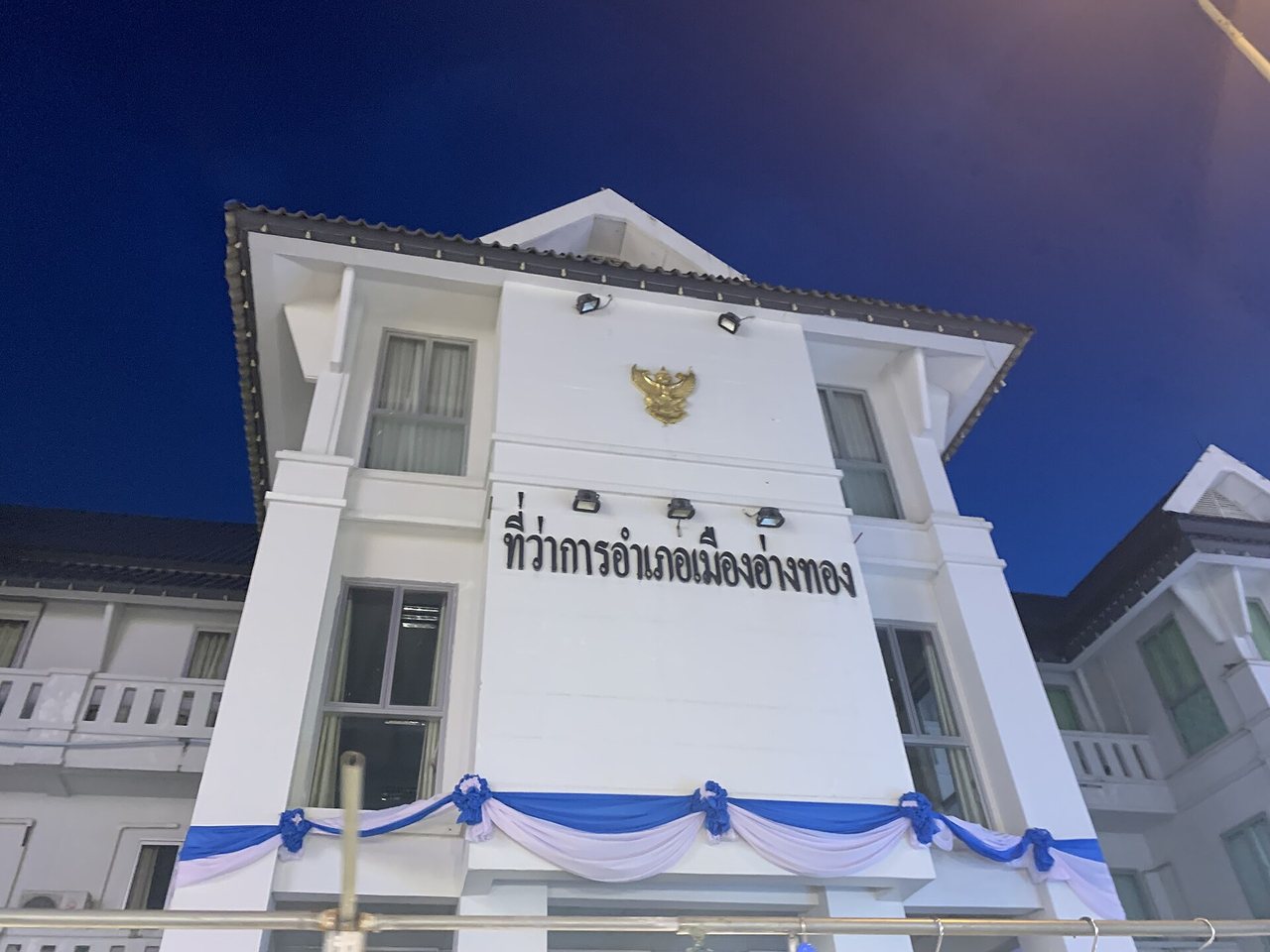
- ที่ว่าการอำเภอ (thîi-wâa-gaan am-pher) — district office.
- นายอำเภอ (naai am-pher) — the district chief, literally “mister district”.
- ฝ่ายทะเบียน (fàai thá-bian) — the registration section, the counter you queue at. ทะเบียน means register, and it is also the word on a car number plate.
- ทะเบียนบ้าน (thá-bian bâan) — the house registration book, the blue booklet that proves who lives where.
- บัตรประชาชน (bàt bprà-chaa-chon) — national ID card. ประชาชน is “the people”.
- สำนักงาน (sǎm-nák-ngaan) — office. Pair it with any word and you have the name of a government department.
ตำบล and หมู่บ้าน: Thai letters on the smallest signs
Below the district sit the subdistrict and the village, and this is where rural Thailand does its own administration. The office in the photograph below belongs to an องค์การบริหารส่วนตำบล — a subdistrict administrative organisation, universally shortened to อบต. and pronounced letter by letter, aw-baw-dtaw. Thai pronunciation of initialisms works exactly like this: you say the names of the Thai consonants and vowels involved, not the English letters.
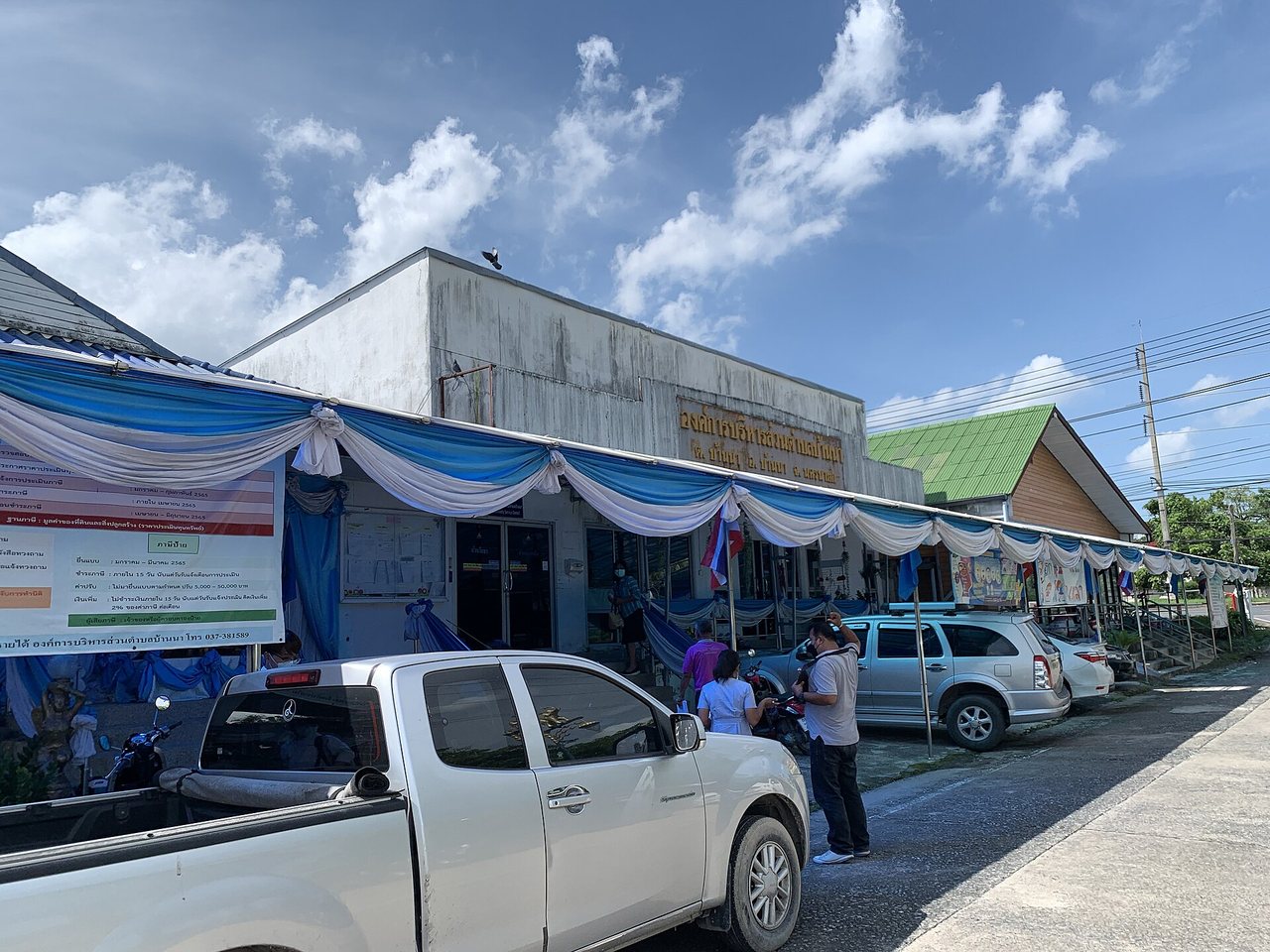
- องค์การบริหารส่วนตำบล (ong-gaan baw-rí-hǎan sùan dtam-bon) — subdistrict administrative organisation, the อบต.
- ที่ทำการ (thîi tham-gaan) — “the place where the work is done”, the normal word for a local office.
- หมู่ที่ (mùu thîi) — “village number”, always followed by a digit. On an address it is abbreviated to ม.
- บ้าน (bâan) — house, home, and the first word of thousands of village names. บ้านนา is “field village”.
- กำนัน (gam-nan) — the elected subdistrict headman; the village equivalent is the ผู้ใหญ่บ้าน (phûu-yài bâan), literally “village big person”.
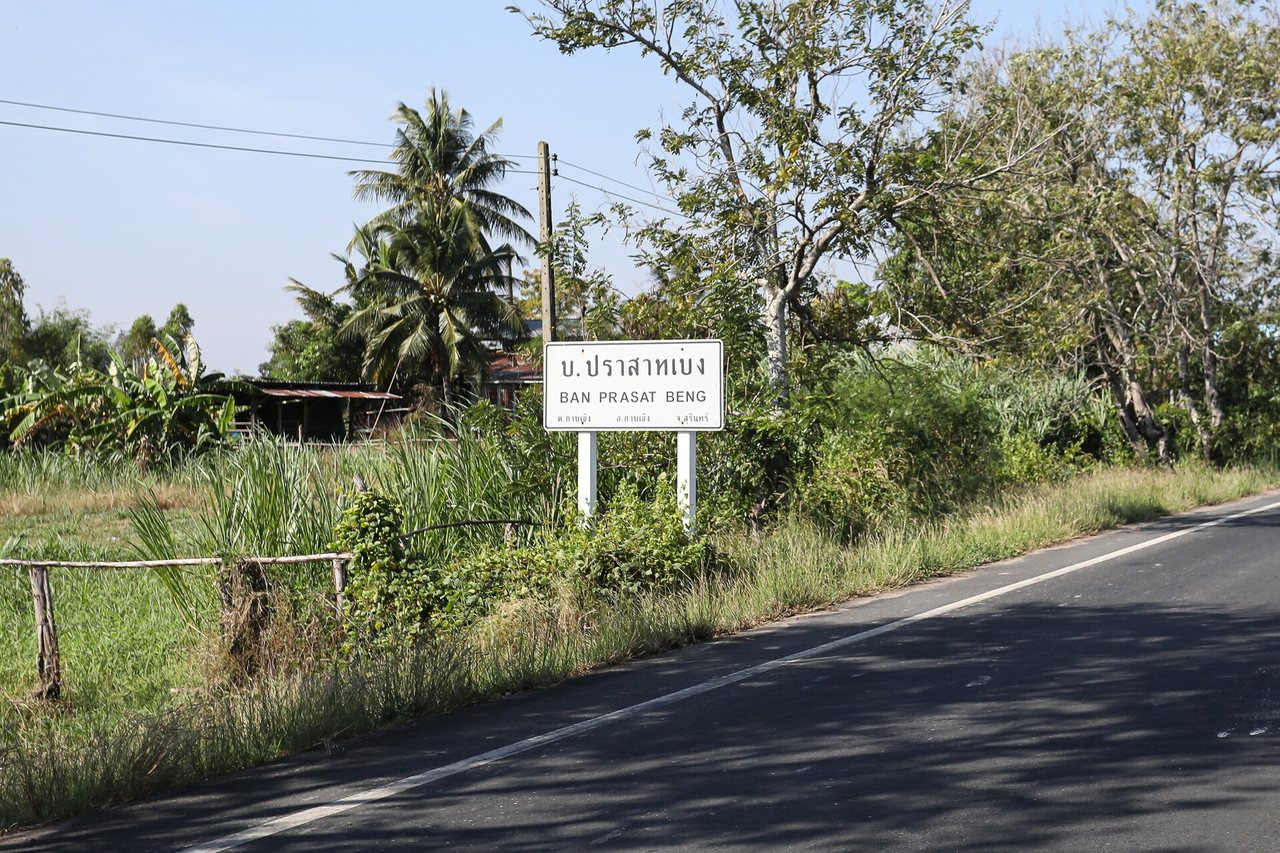
Thai abbreviations: จ. อ. ต. ม. and the ฯ mark
Thai addresses are written almost entirely in abbreviations, and once you know five of them you can read Thai script on an envelope without reading a single full word. An abbreviation in Thai is marked with a full stop, exactly as in English, and it is always the first letter of the word.
- จ. = จังหวัด, province.
- อ. = อำเภอ, district. In Bangkok you will see เขต written out in full instead.
- ต. = ตำบล, subdistrict — แขวง in Bangkok.
- ม. = หมู่, village group number; บ. = บ้าน, the village itself.
- ถ. = ถนน (thà-nǒn), road, and ซ. = ซอย (soi), lane.
- ฯ — not a letter at all but the abbreviation mark paiyannoi. It chops the end off a long name: กรุงเทพฯ is Bangkok’s full ceremonial name cut short after two syllables.
Read a Thai address from the inside out
Thai addresses run from the smallest unit to the largest, the reverse of the English habit of starting with a street. A rural address reads: house number, then ม. and the village number, then ต. subdistrict, then อ. district, then จ. province, then the five-digit รหัสไปรษณีย์ (rá-hàt bprai-sà-nii), the postcode. In Bangkok the same slots are filled by ซ. and ถ. for the lane and road, then แขวง and เขต. If you are working out a Bangkok street address in detail, our guide to Thai addresses, soi numbers and house numbers takes the city version apart line by line.
Speak Thai at the counter: five phrases worth memorising
Government Thai is formal Thai, and the politeness particle does a lot of work: men finish with ครับ (khráp), women with ค่ะ (khâ), switching to คะ (khá) at the end of a question. Nobody will mind if you drop it, but every Thai person in the queue will be using it, and it costs one syllable.
- ที่ว่าการอำเภออยู่ที่ไหนครับ (thîi-wâa-gaan am-pher yùu thîi nǎi khráp) — “Where is the district office?”
- ผมอยู่ตำบลอะไรครับ (phǒm yùu dtam-bon à-rai khráp) — “Which subdistrict am I in?” Genuinely useful when a form demands it and you have no idea.
- ขอทะเบียนบ้านหน่อยค่ะ (khǎaw thá-bian bâan nòi khâ) — “May I have the house registration, please.” ขอ … หน่อย is the all-purpose polite request.
- ฝ่ายทะเบียนอยู่ชั้นไหนคะ (fàai thá-bian yùu chán nǎi khá) — “Which floor is the registration section on?”
- ช่วยเขียนที่อยู่เป็นภาษาไทยให้หน่อยครับ (chûai khǐan thîi-yùu bpen phaa-sǎa thai hâi nòi khráp) — “Could you write the address in Thai for me?” The sentence that saves an afternoon.
A study tip: copy the sign, then copy the address
Here is a drill that costs nothing and works fast. Photograph one official sign a week — a district office, a village name board, a municipal notice — and that evening write it into a notebook three times: Thai script first, your own Thai transliteration second, the meaning third. Administrative Thai repeats relentlessly, so by the fourth or fifth sign you will be recognising ที่, การ, สำนัก and งาน on sight, and those four pieces alone unlock dozens of official words. Then write out your own address in Thai and keep it in your wallet; it is the single most practical piece of Thailand expat language homework there is.
When you want the letters behind the words, our free Thai alphabet chart lays out all 44 Thai consonants and vowels on one page, the Thai numbers guide covers the digits in a postcode and a house number, and the ThaiLetters flashcard trainer will drill the shapes ten minutes at a time. Start with จ, อ, ต and ม: get those four Thai letters and you can already read Thai script well enough to find yourself on any sign in Thailand.