Thai Vowels: Where They Sit Around the Consonant
Read Thai script properly: Thai vowels sit before, after, above and below the consonant. Every position, with Thai letters, pronunciation and examples.
You can memorise all forty-four consonants and still fail to read Thai script in the wild, because Thai does something no European alphabet does: the vowels do not queue up politely after the consonant. They sit in front of it, on top of it, underneath it, or in two or three pieces at once — and sometimes they are not written at all. This guide walks through every position a Thai vowel can take, with Thai script, plain Thai transliteration and the literal meaning, so that a word which looked like decoration ten minutes ago resolves into a syllable you can actually say.
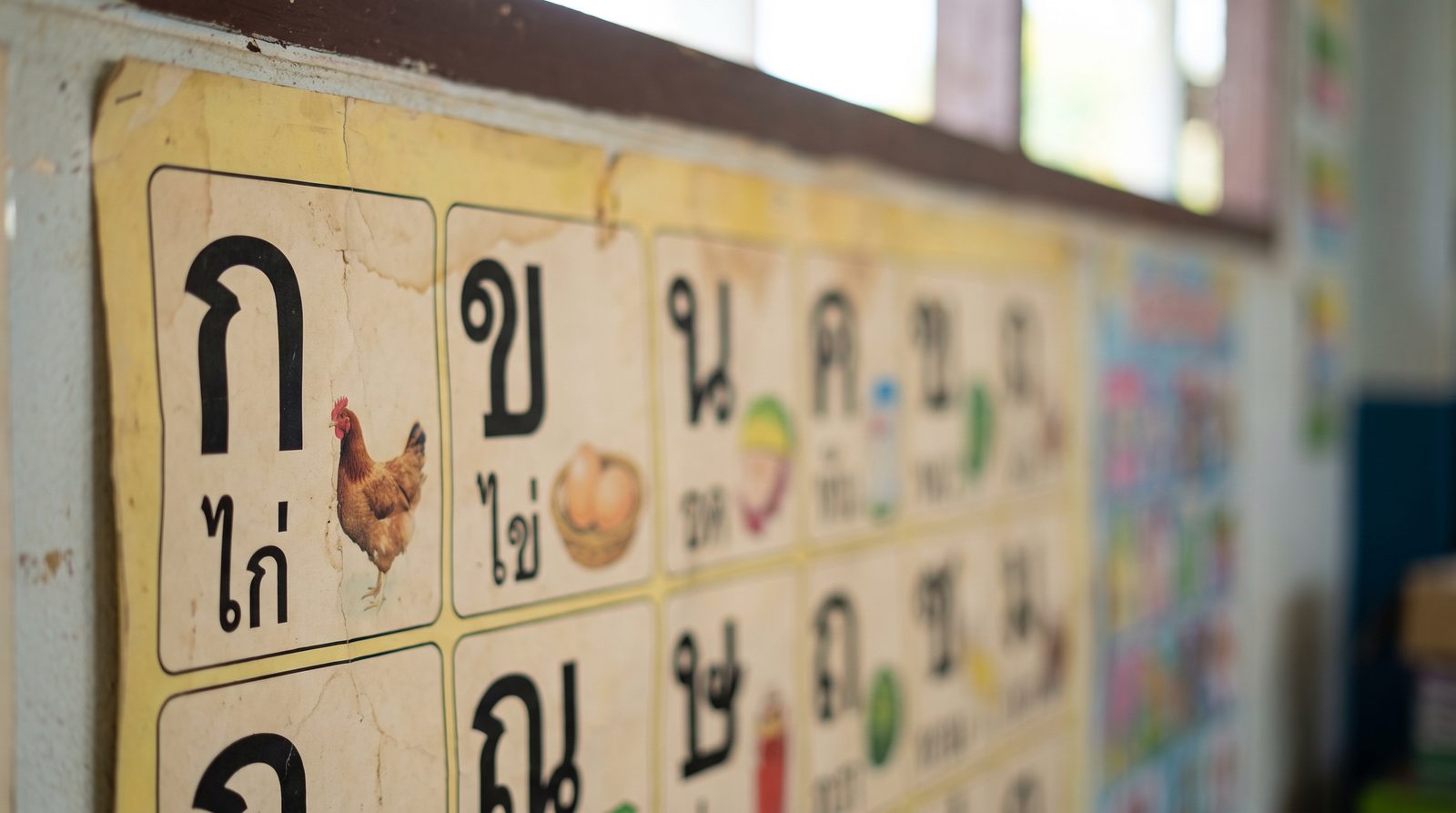
Thai vowels orbit the consonant, they do not follow it
In English, letters run left to right and you read them in the order you say them. Thai keeps the left-to-right sweep for consonants, but a vowel is attached to its consonant like a satellite. The Thai word for vowel, สระ (sa-ra), is written in the alphabet books as สระอะ, สระอา and so on — that อ in the middle is a placeholder meaning “a consonant goes here”. When you see เ◌า written in a chart, read the circle as the slot.
So the question is never “what does this row of Thai letters spell”. It is always: find the consonant, then look around it. Get that habit and a beginner Thai lesson stops being memorisation and starts being pattern recognition, because every attempt to read Thai script becomes the same two-step move.
Vowels written before the consonant
These five are the reason so many learners give up. They appear to the left of the consonant on the page, but they are pronounced after it:
- เ◌ (ay) — เธอ thuh, “you”.
- แ◌ (ae) — แม่ mae, “mother”.
- โ◌ (oh) — โต dtoh, “big”.
- ไ◌ (ai) — ไก่ gai, “chicken”.
- ใ◌ (ai) — ใจ jai, “heart”.
The last two sound identical. The difference is pure spelling history: ใ appears in only about twenty native Thai words — ใจ, ใหม่ (mai, new), ให้ (hai, to give), ใน (nai, in), ใหญ่ (yai, big) among them. Everything else uses ไ. Thai schoolchildren learn the twenty as a rhyme; foreigners are better off simply noticing that the curly one is rare and treating each sighting as a small vocabulary win.
Vowels after, above and below the line
The remaining single-piece vowels are easier, because their position is fixed and obvious once you know to look for it. Thai consonants and vowels share the same line of text, so the marks above and below are small — on a low-resolution phone photo of a menu they are the first thing to disappear.
| Vowel | Position | Example |
|---|---|---|
| ◌า (aa) | After | มา maa — “to come” |
| ◌ะ (a) | After, short | จะ ja — “will” |
| ◌ี (ee) | Above | ดี dee — “good” |
| ◌ิ (i) | Above, short | กิน gin — “to eat” |
| ◌ื (ue) | Above | มือ mue — “hand” |
| ◌ู (uu) | Below | ดู duu — “to look” |
| ◌ุ (u) | Below, short | คุณ khun — “you” |
Short and long are different words, not accents
English speakers hear vowel length as emphasis. In Thai it is meaning. The clearest pair for a beginner:
- เข้า (khao, short) — “to enter”.
- ข้าว (khaao, long) — “rice”.
Same consonant, same falling tone, same three-ish letters rearranged — and if you hold the vowel too long while asking the way into a building you have asked for rice. This is also why Thai transliteration into English letters is so unreliable: most systems write both of those as khao. The script is more honest than the romanisation, which is the strongest practical argument for learning to read Thai script at all.
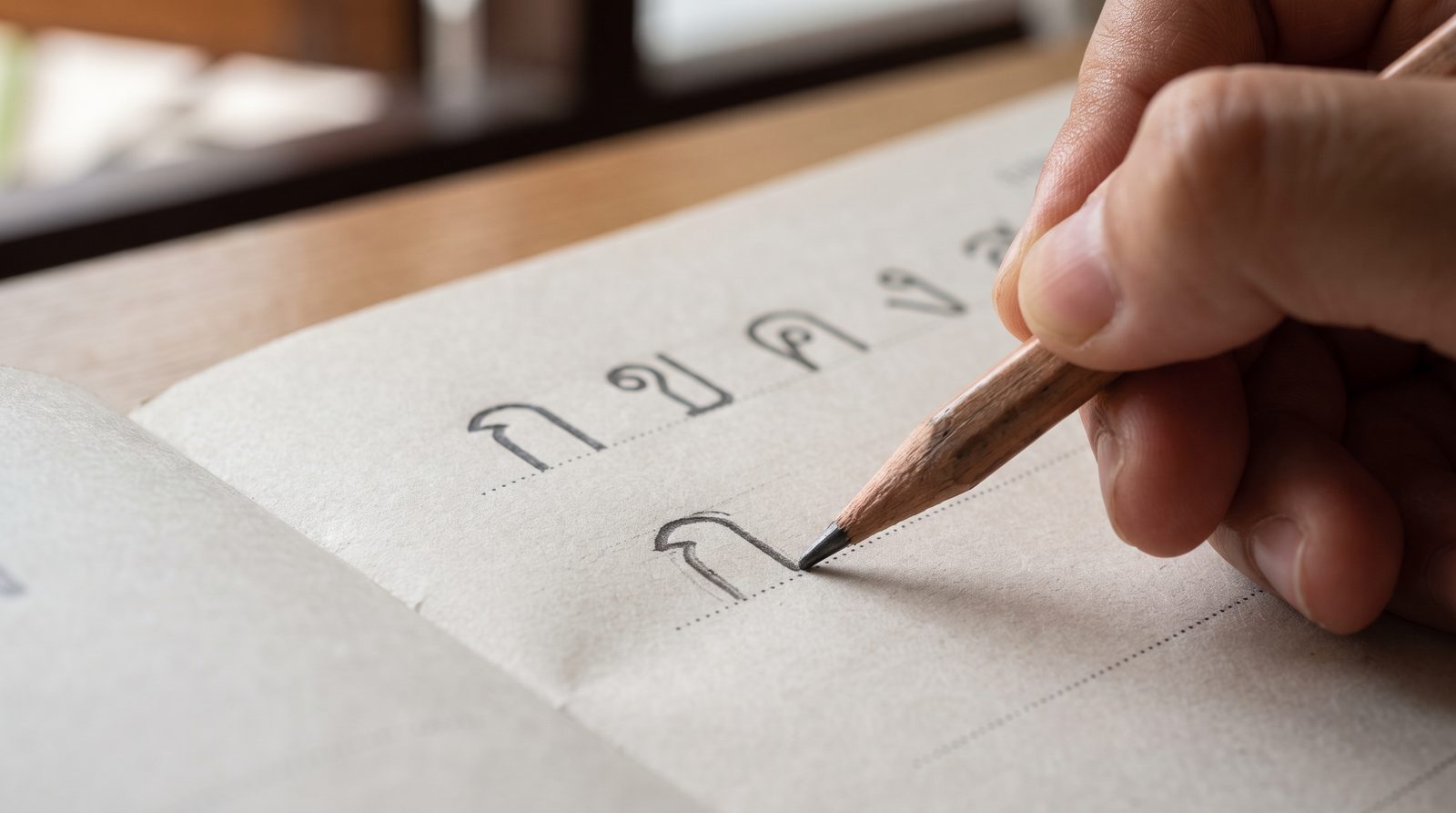
Vowels that wrap around the consonant
Some Thai vowels are two or three separate marks that surround the consonant on both sides. They are single sounds written in pieces, and once you expect them they are easy to spot:
- เ◌า (ao) — เรา rao, “we”. One mark left, one right.
- เ◌ีย (ia) — เรียน rian, “to study”. Left, above and right, plus a final consonant.
- เ◌ือ (uea) — เสื้อ suea, “shirt”.
- ◌ัว (ua) — ตัว dtua, “body”, and the classifier for animals.
- เ◌อ (uh) — เธอ thuh, “you”.
Take โรงเรียน (rohng-rian, school), a word painted on gates all over Thailand. It contains a leading โ in the first syllable and a three-part เ◌ีย in the second. Eight symbols, two syllables. Decode that one word and you have met most of this article in the wild.
The vowel that is not written at all
Here is the trick that makes Thai letters finally behave. When a short vowel is followed by a final consonant, it often changes shape or vanishes:
- ◌ะ becomes ◌ั — มัน (man, it), not มะน.
- เ◌ะ becomes เ◌็ — เด็ก (dek, child).
- โ◌ะ disappears entirely — นก (nok, bird), คน (khon, person), ลม (lom, wind).
That third rule explains the two-consonant words that look impossible to pronounce. There is no missing vowel: an unwritten short o is understood between them. And when three consonants sit together with nothing else, Thai usually inserts a quiet a after the first: ขนม is kha-nom (snack), ถนน is tha-non (road). Both of those turn up on street signs constantly.
What this does to your Thai pronunciation
Two habits fix most learner errors. First, never say a leading vowel first — scan for the consonant, then read outward. Second, decide short or long before you open your mouth, because Thai pronunciation treats length as part of the word rather than as expression. Tone sits on top of all this: the same vowel with a different tone mark is a different word again, which our guide to Thai tone marks unpacks properly. For anyone building a Thailand expat language habit, vowels are the cheaper win — they are finite, visible and rule-governed in a way tones are not.
Study tip: one syllable at a time, out loud
Do not try to read a whole sign. Cover everything except one consonant and its satellites, say that syllable aloud, then slide the cover along. Five minutes of that on a shopfront teaches more than an hour of silent staring, because you are practising the exact skill you need: locating the consonant and reading outward from it. Within a week or two, leading vowels stop feeling backwards and start feeling like a signal that a syllable is about to begin.
If the consonant shapes are still the bottleneck, fix that first — learn Thai alphabet forms with our Thai alphabet chart, drill them with the free ThaiLetters flashcard trainer, and read why Thai has forty-four consonants for the history behind the duplicates. Fifteen minutes a day is genuinely enough to read Thai script on a menu inside a month.