How to Read Thai Shop Signs: The Words That Repeat
Read Thai script on shopfronts: the repeating words behind Thai shop and street signs, with Thai letters, pronunciation and literal English for beginners.
The fastest way to read Thai script in real life is not a textbook — it is the shopfront you walk past every morning. Thai shop and street signs are built from a small stock of repeating words: shop, house, hall, market, road, room. Learn perhaps thirty of them and an entire street stops being decoration and starts being information. This beginner Thai lesson gives you those words in Thai letters, in plain Thai transliteration and in literal English, so you can start decoding signs today rather than after your fiftieth flashcard session.
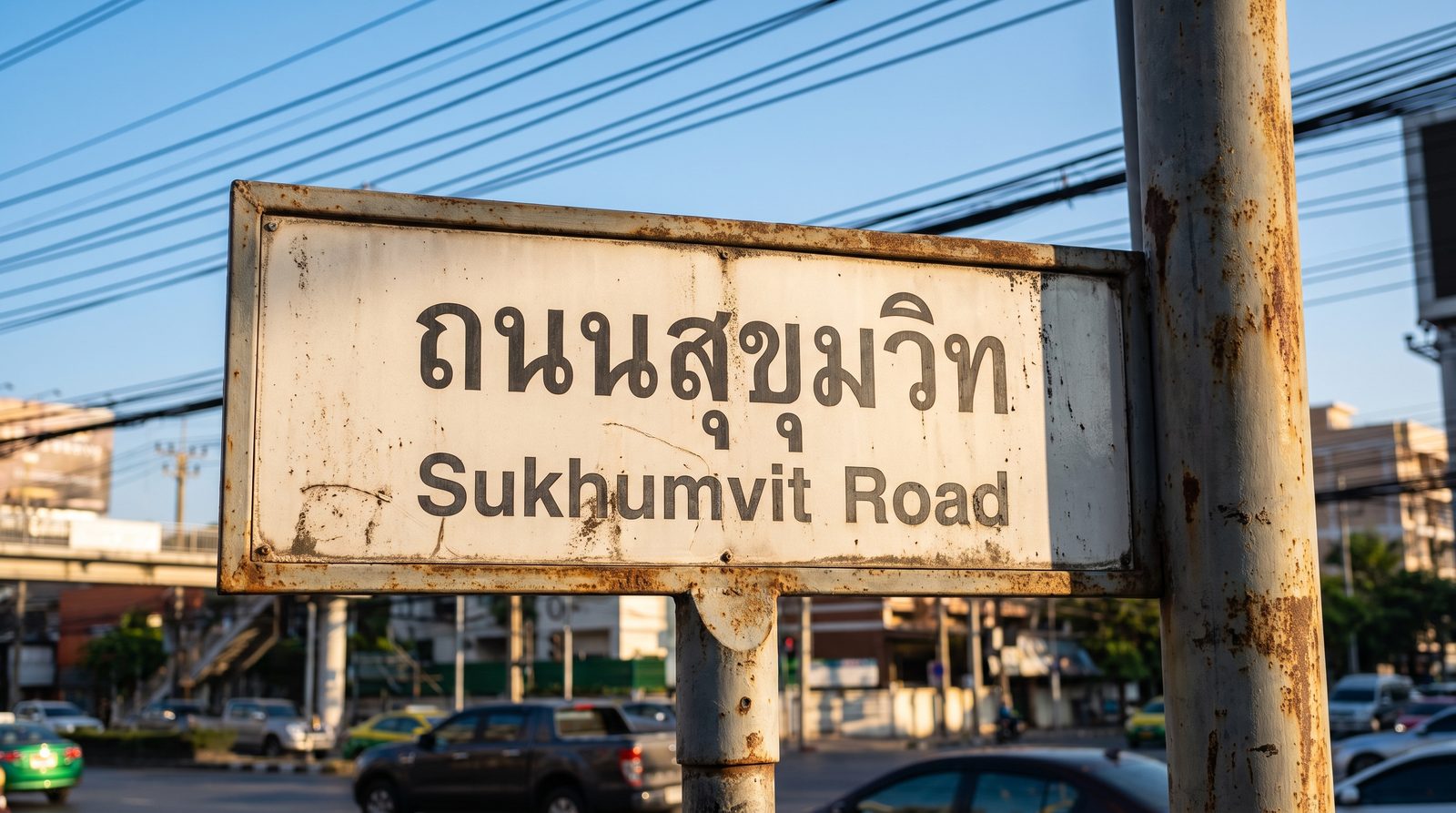
Why shop signs are the best beginner Thai lesson
Signs have three qualities that make them ideal practice material. They are short, so a single glance is a complete exercise. They repeat, so the same twenty or thirty words appear again and again within one block. And a great many of them print a romanised version underneath, which gives you an instant answer key for checking your Thai pronunciation without asking anyone.
They are also low-stakes. Nobody is waiting for you to answer. You can stand at a crossing and sound out four letters at your own speed, which is exactly the kind of repetition that turns knowledge of the Thai alphabet into actual reading. If you have not learned the letter shapes yet, work through our Thai alphabet chart first — this guide assumes you can name most Thai consonants and vowels, even slowly.
The one word that unlocks half the high street
If you learn a single word from this guide, make it ร้าน (ran) — “shop”. Thai builds business names by putting ร้าน first and describing what is sold second. The pattern is relentlessly logical:
- ร้านอาหาร (ran aahan) — literally “shop food”: a restaurant.
- ร้านกาแฟ (ran kafae) — “shop coffee”: a café.
- ร้านขายยา (ran khai ya) — “shop sell medicine”: a pharmacy. Worth memorising before you need it.
- ร้านสะดวกซื้อ (ran saduak sue) — “shop convenient buy”: a convenience store.
- ร้านซักรีด (ran sak rit) — “shop wash iron”: a laundry.
- ร้านตัดผม (ran tat phom) — “shop cut hair”: a barber.
- ร้านทอง (ran thong) — “shop gold”: a gold shop, usually unmistakable in red and gold.
Two spelling details are worth noticing while you are here, because they recur everywhere. The ้ hovering over ร้าน is a tone mark, not a vowel, and the ์ you will meet on other signs is a silencer that switches off the letter beneath it. Neither is decoration. If tone marks are still a mystery, our guide to Thai tone marks explains what each one does to the syllable.
Buildings, not shops: the words that start with rong and sathani
Larger institutions use a different opener. โรง (rong) means roughly “hall” or “large building”, and สถานี (sathani) means “station”. Both behave exactly like ร้าน: the describing word follows.
| Thai | Pronunciation | Literal meaning | What it is |
|---|---|---|---|
| โรงเรียน | rong rian | hall + study | school |
| โรงพยาบาล | rong phayaban | hall + nursing | hospital |
| โรงแรม | rong raem | hall + lodging | hotel |
| สถานีรถไฟ | sathani rot fai | station + fire vehicle | railway station |
| สถานีตำรวจ | sathani tamruat | station + police | police station |
| ธนาคาร | thanakhan | — | bank |
| ตลาด | talat | — | market |
| ห้องน้ำ | hong nam | room + water | toilet |
รถไฟ deserves a moment: it is literally “fire vehicle”, a nineteenth-century description of a steam train that Thai never bothered to update. Compounds like this are one of the quiet pleasures of learning to read Thai script — the language keeps its own history on public display.
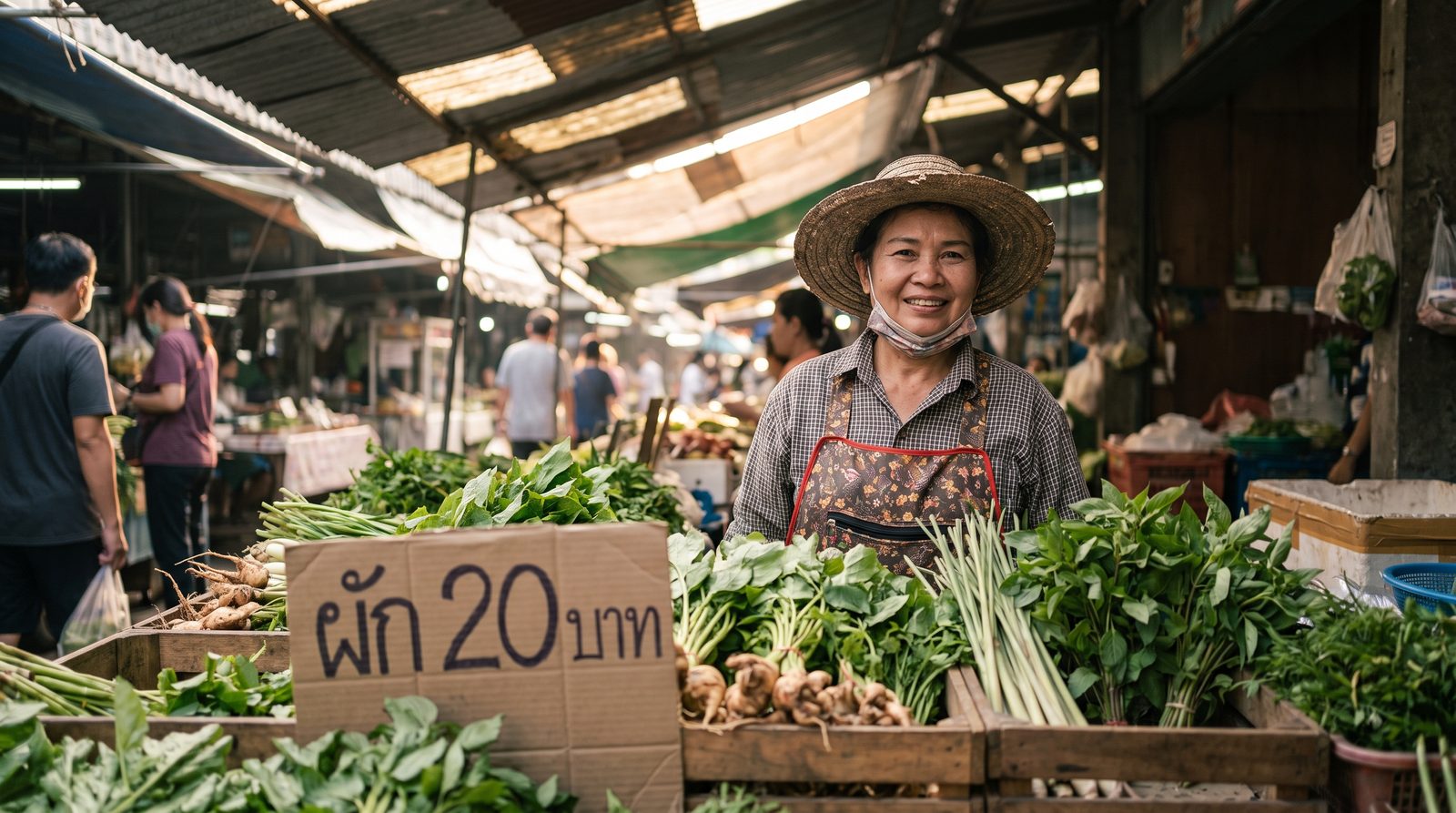
Words on the door: open, closed, and price
These are the short, high-frequency words that decide whether you walk in or walk on. They are also short enough to read at a glance, which makes them ideal for building speed:
- เปิด (poet) — open. ปิด (pit) — closed. One extra vowel apart; check twice.
- ราคา (rakha) — price. ลดราคา (lot rakha) — “reduce price”, a sale.
- บาท (baht) — baht, printed after almost every number you will see.
- มี (mi) — “there is”. ไม่มี (mai mi) — “there isn’t”, the two words that answer most questions in a shop.
- ห้าม (ham) — forbidden. ห้ามจอด is “no parking”.
- ทางเข้า (thang khao) — way in. ทางออก (thang ok) — way out.
- กรุณา (karuna) — “please”, the polite opener on official notices.
Thai transliteration: why the English underneath disagrees with itself
You will see ถนน romanised as thanon, tanon and thanon with a capital T, sometimes on the same street. Thai transliteration is a convention rather than a spelling, and different agencies and shopkeepers apply it differently. It also throws away tone entirely, which is why two words that look identical in English can be completely different in Thai. Treat the romanisation as a hint and the Thai letters as the truth — that single habit does more for your reading than any amount of memorising.
Saying it out loud: khrap and kha
Signs are silent, but the moment you use one of these words you are speaking Thai, and Thai politeness is carried by a particle at the end of the sentence: ครับ (khrap) if you are male, ค่ะ (kha) if you are female. “ห้องน้ำอยู่ที่ไหนครับ” — “where is the toilet, please” — is a normal, polite question. The same words without the particle sound abrupt, especially to someone older than you. Adding it costs nothing and changes how the whole exchange feels, so make it a habit from your first day.
A study tip that actually works
Pick one street and read it slowly, once a week. Photograph three signs you cannot decode, then work them out at home letter by letter rather than guessing from the English. Nearly all of them will turn out to contain a word from this guide plus one new item, and that new item is the only thing you actually have to learn. Ten minutes of that beats an hour of passive review, because you are retrieving under real conditions.
When a shape refuses to stick, drill it directly — our Thai letter trainer is built for exactly that, and five minutes of it before you go out primes the letters you are about to meet. Do this for a month and something quietly remarkable happens: you stop reading Thai script and simply start reading, which is the whole point. Thailand expat language progress is measured in ordinary moments like that one.