Read Thai Script: Sak Yant Tattoo Letters in Thailand
Read Thai script around sak yant tattoos in Thailand: why the letters are Khom not Thai, what the designs are called, and the words to use at the shop.
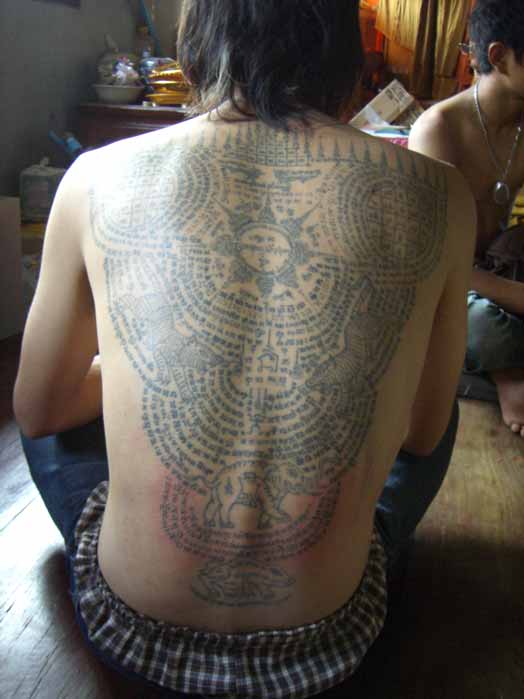
Here is a sentence no other guide will tell you: if you try to read Thai script on a sak yant tattoo, you will fail — and the reason why is one of the most useful things a learner in Thailand can know. Those tight rows of curling letters on a Thai man’s back are not Thai letters at all. They are a different alphabet entirely, written in a different language, and recognising that in two seconds flat marks you out as someone who has actually studied the country rather than photographed it.
This Thai language guide covers both halves of the subject: the sacred script on the skin, and the ordinary Thai letters on the shop sign outside, which you really can learn to read. Every term below gives the Thai script, a Thai transliteration you can say out loud, and the literal meaning where it explains something. By the end you will know what the tattoo is called, who makes it, what the five famous lines are, and how to ask about one politely without causing offence.
สักยันต์: two completely ordinary Thai words
The name of the practice is สักยันต์ (sàk yan), and both halves are words you will use elsewhere. สัก (sàk) is the everyday verb “to tattoo” — originally “to puncture”. ยันต์ (yan) comes from the Sanskrit yantra and means a geometric diagram charged with a sacred formula. So สักยันต์ is literally “to tattoo a yantra”, and a good beginner Thai lesson hides inside it: the word is written with four letters but spoken with three sounds, because the little mark over the final ต cancels it. More on that mark at the end.
Keep three related words together and you can talk about tattoos in general, not just sacred ones. รอยสัก (rɔɔi sàk) is a tattoo as an object, literally “a mark · tattooed”. ช่างสัก (châang sàk) is a tattoo artist — ช่าง is the prefix Thai puts in front of every skilled trade, from hairdresser to mechanic. And ร้านสักลาย (ráan sàk laai) is a tattoo shop, “shop · tattoo · pattern”, which is the sign you will actually see on the street.
Why you cannot read Thai script on the tattoo itself
The lettering inside a yant is อักษรขอม (àk-sǒɔn khǒɔm), Khom Thai script — a Khmer-derived alphabet that Thai monks used for centuries to write sacred texts. It looks rounder, more looped and more tightly packed than modern Thai, and it has no spaces you can lean on. Before printing arrived, this was the prestige script of the monastery; Thai letters were for letters and ledgers, Khom was for scripture, amulets, protective cloths and skin.
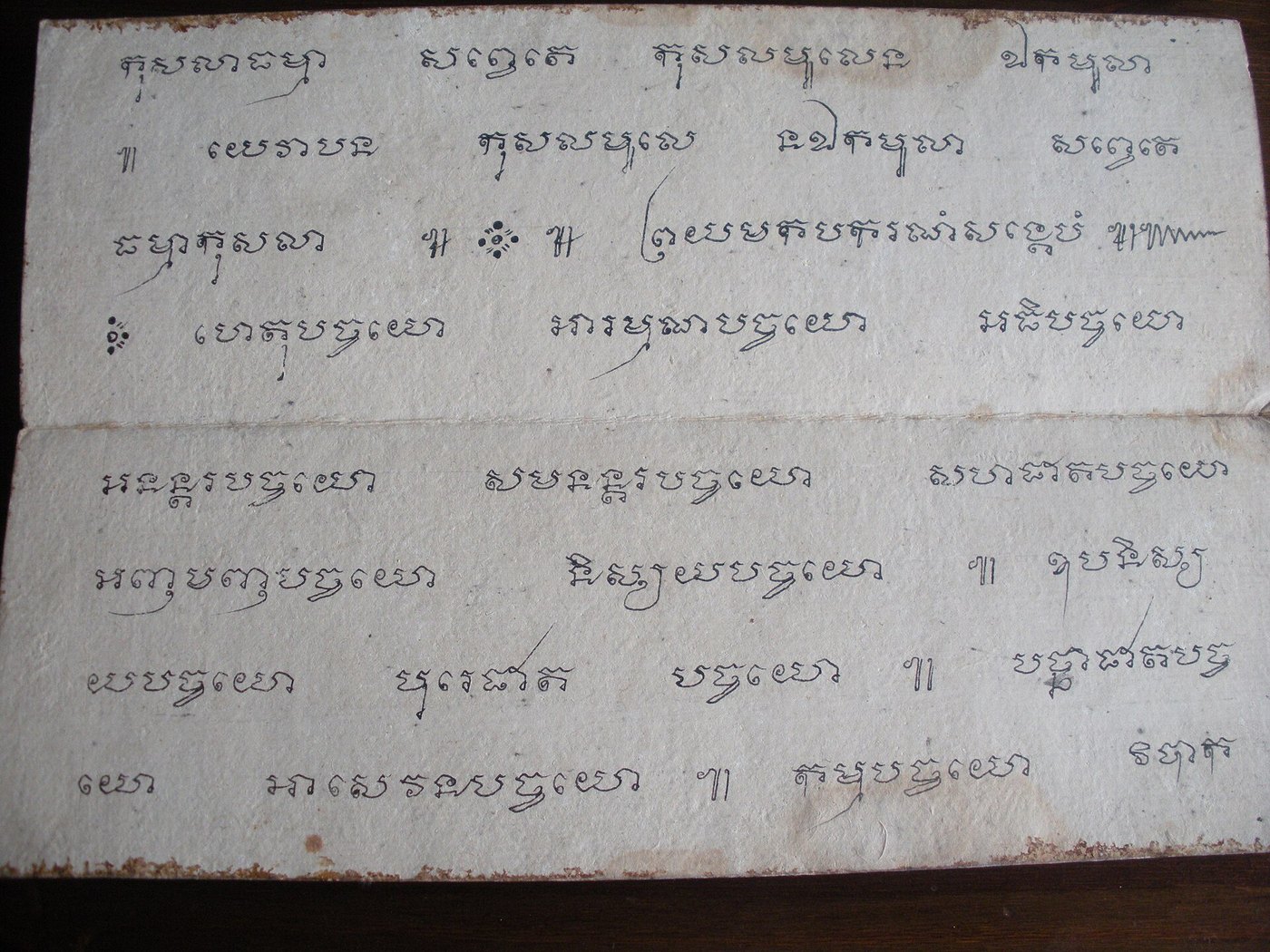
And the language is not Thai either. The words are คาถา (khaa-thǎa), Pali or Sanskrit incantations, each one a compressed prayer. This is why asking a Thai friend “what does my tattoo say?” usually gets a shrug: they can see it is sacred without being able to read it, exactly as most English speakers recognise Latin on a church wall without translating it. If you are learning to read Thai script, that contrast is worth fixing in your head early, because it tells you instantly which writing on a wall is addressed to you. Knowing the distinction is proper Thailand expat language knowledge, and it stops you repeating the tourist line that sak yant is “written in Thai”.
Learn Thai vocabulary for the designs themselves
Designs have names, and Thais use them the way we use the names of tattoo styles. These are the ones you will hear:
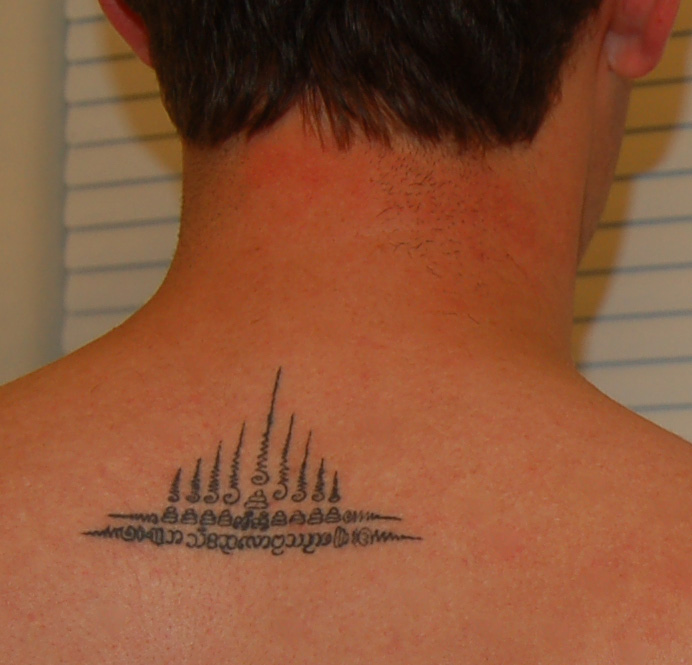
- ยันต์ห้าแถว (yan hâa thɜɜo) — the five-line yant, literally “yant · five · rows”. The most requested design in the country; each line carries its own คาถา.
- ยันต์เก้ายอด (yan kâao yôɔt) — the nine-spire yant. ยอด is a peak or summit, the same word used for a mountain top or a temple spire.
- หนุมาน (hà-nú-maan) — Hanuman, the monkey warrior, tattooed for strength and fearlessness.
- เสือเผ่น (sǔəa phèn) — the “leaping tiger”, for authority and command. เสือ is simply “tiger”.
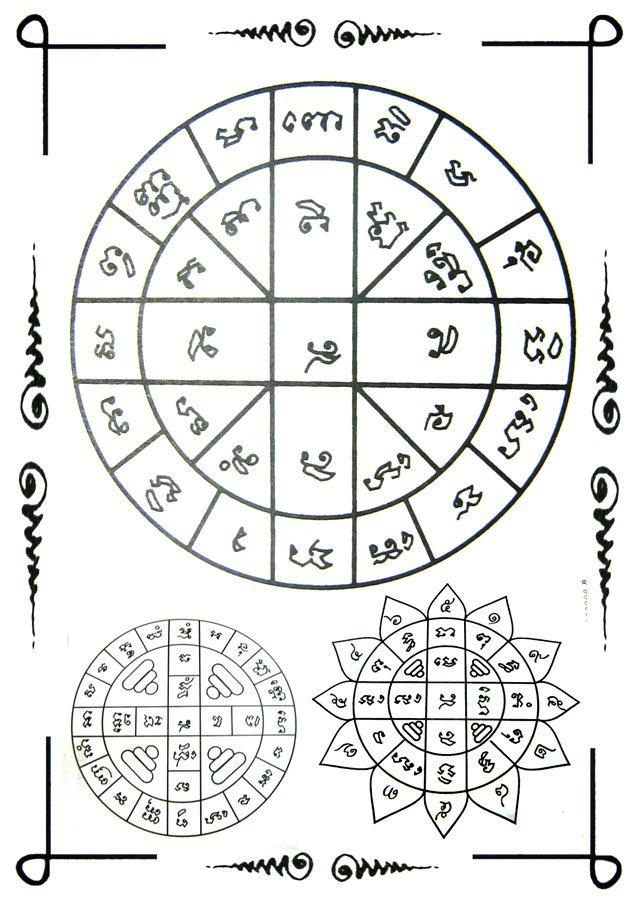
- แปดทิศ (pèèt thít) — “eight directions”, a circle of eight protective syllables, one for each point of the compass.
- ยันต์ครู (yan khruu) — the “teacher yant”, traditionally the first one a person receives.
นะ มะ พะ ทะ and the syllables you see everywhere
One string turns up in yant after yant: นะโมพุทธายะ (ná-moo-phút-thaa-yá), five syllables standing for the five Buddhas of this era. Thai people also meet it in its shortened form, นะ มะ พะ ทะ (ná má phá thá), and the first syllable alone, นะ (ná), is probably the single most tattooed symbol in Thailand. Here is the encouraging part for anyone working through the Thai consonants and vowels: นะ in modern Thai is just น (nɔɔ nǔu, the mouse letter) plus the short vowel ◌ะ. Two marks, one syllable. If you can read that, you have read the heart of the formula — our Thai alphabet chart shows exactly where น sits among the low-class consonants.
The master, the needle and the rules
The person who tattoos you matters more than the design, and the vocabulary reflects that:
- อาจารย์ (aa-jaan) — master or teacher, the usual title for a lay sak yant practitioner. You will hear it anglicised as “ajarn”.
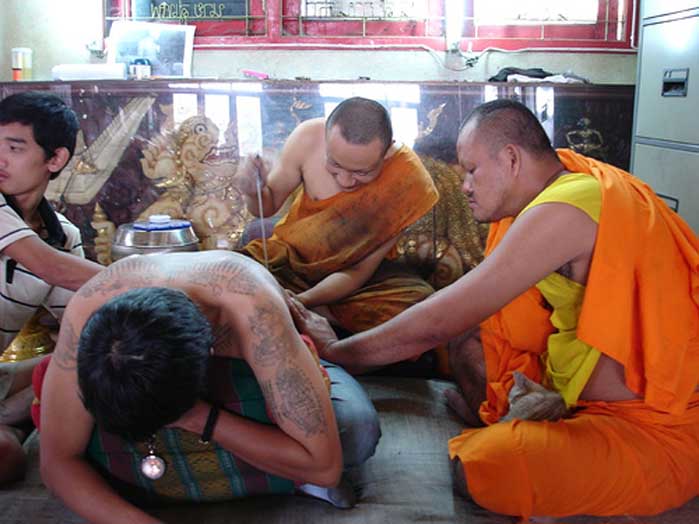
- พระ (phrá) — a monk. Some temples still tattoo; most do not.
- เหล็กจาร (lèk jaan) — the traditional metal rod, literally “iron · to inscribe”. The modern alternative is เข็มสัก (khǒm sàk), a tattoo needle.
- ลงคาถา (long khaa-thǎa) — “to lay down the incantation”, the blessing chanted over the finished work.
- ข้อห้าม (khôɔ hâam) — the prohibitions. Every master gives a list — conduct rules that are said to keep the tattoo’s power alive.
- ไหว้ครู (wâi khruu) — “paying respect to the teacher”, the annual ceremony. The best known is held at วัดบางพระ (wát baang phrá) in Nakhon Pathom, where thousands return each hot season.
Speak Thai politely before you raise a camera
Sacred tattoos are religion, not decoration, so the phrases below do real work. Men end with ครับ (khráp) and women with ค่ะ (khâ), and if you speak Thai at all here, speak it quietly:
- ขอถ่ายรูปได้ไหมครับ (khǒɔ thàai râup dâi mǎi khráp) — “may I take a photo?” Ask first, every time.
- ยันต์นี้แปลว่าอะไรคะ (yan níi plɜɜ wâa à-rai khá) — “what does this yant mean?”
- สวยมากครับ (sǒɔay mâak khráp) — “it’s beautiful”. Safer than asking what it cost, which is considered crude.
- ห้ามถ่ายรูป (hâam thàai râup) — “photography forbidden”. A sign, not a phrase: ห้าม opens almost every prohibition in the country.
Two points of etiquette that language alone will not teach you. A sacred image belongs on the upper body, so Thais consider Buddha figures tattooed low on the leg disrespectful, and the Ministry of Culture has said so publicly more than once. And never rest your foot near someone’s yant or point at it with a toe — the foot is the lowest part of the body in Thai thinking, the head the highest, which is also why the shoulders are prime tattoo ground. Our guide to temple etiquette and merit-making words covers the same logic inside a วัด.
Three signs you can read today in real Thai letters
Outside the studio, everything is written in ordinary Thai, which means this topic also hands you some of the easiest street reading in the country — a genuine chance to read Thai script in the wild. Look for รับสักยันต์ (ráp sàk yan), “sak yant accepted here” — รับ means “to receive” and starts hundreds of Thai shop signs. Then ร้านสักลาย, a tattoo shop, and อาจารย์สัก (aa-jaan sàk), a tattoo master.
Take the word สัก apart as a piece of Thai pronunciation practice. It is ส (sǒɔ sǔea, the tiger letter) plus the short vowel sign ◌ั plus ก (kɔɔ kài, the chicken letter): s-a-k, low tone, because a high-class consonant with a short dead syllable always lands low. Now look back at ยันต์. That tiny circle over the last letter is ทัณฑฆาต (than-thá-khâat), the killer mark, and it silences the letter underneath — which is why four letters come out as “yan”. Spot that mark and you will stop mispronouncing dozens of imported words. Drill the individual letters with the free ThaiLetters flashcard trainer whenever a sign leaves you stuck.
A study tip: one word, three scripts
Here is the exercise that makes all of this stick. Write สักยันต์ by hand three times — once in Thai letters, once in your own transliteration, once as the English “sak yant” you see on shopfronts. Three rows, one word, and the differences between a writing system, a sound and a spelling convention become obvious in a way no explanation achieves. Then add รอยสัก, ช่างสัก and อาจารย์ the same way. Four handwritten words is a small enough target to finish tonight, and copying is still the fastest way to learn to read Thai script rather than merely recognise it.
Do that and you have gained more than four words. You now know that sacred Thai tattoos are written in Khom, that the language inside them is Pali, that the ink is applied with an iron rod by a master who gives you rules to keep, and that the sign on the door is plain Thai you can decode letter by letter. That is the right order to learn Thai vocabulary in: the thing in front of you first, the grammar later. Keep going with our guide to reading temple signs, and the next time you read Thai script on a wall in Thailand, you will know immediately whether it is meant for you to read at all.