Learn Thai Vocabulary: Thai Silk Words in Thailand
Learn Thai vocabulary for silk in Thailand: cloth, loom, pattern and shop words in Thai script with pronunciation, literal translations and the mai trap.
A silk shop is one of the gentlest places in Thailand to learn Thai vocabulary. Nobody is queuing behind you, the staff are glad to let you handle things, and almost every label on the shelf is built on the same short word: ผ้า (phâa), cloth. Learn that one syllable and the handful of words that attach to it, and you can read a good share of the signage in a weaving village, a department-store fabric floor or a Sunday market stall.
This Thai language guide follows the words in the order the silk itself travels: from the cocoon to the loom, off the loom as patterned cloth, and over the counter to you. Every entry gives the Thai script, a Thai transliteration you can say out loud, and the literal meaning, because in Thai the literal meaning is almost always the better memory hook. On the way we will deal with ไหม, the word that trips up more beginners than anything else in this subject — for reasons that have nothing to do with silk.
Start with ผ้า, the most reusable noun in your wardrobe
Thai builds names for things by stacking plain words together, and ผ้า is one of the busiest building blocks in the language. Once you can read those two letters you get a long list of everyday nouns almost free — a good illustration of why it pays to learn Thai vocabulary in families rather than one word at a time:
- ผ้าไหม (phâa mǎi) — silk, literally “cloth · silk”. The full phrase for the national product is ผ้าไหมไทย.
- ผ้าฝ้าย (phâa fâai) — cotton. ฝ้าย is the cotton plant.
- ผ้าพันคอ (phâa phan khɔɔ) — a scarf: “cloth · wrap · neck”.
- ผ้าเช็ดตัว (phâa chét tua) — a towel: “cloth · wipe · body”. Change the last word and you get ผ้าเช็ดมือ, a hand towel.
- ผ้าห่ม (phâa hòm) — a blanket, from ห่ม, to cover yourself.
- ผ้าถุง (phâa thǔng) — a sarong, literally “bag cloth”, because it is sewn into a tube.
- ผ้าขาวม้า (phâa khǎao máa) — the checked all-purpose cloth men wear, use as a towel, a belt, a sling and a sunshade.
The shop that sells them is a ร้านผ้า (ráan phâa) or ร้านขายผ้า — “shop · sell · cloth”. ร้าน opens the name of nearly every business in the country, so it is worth pairing this guide with our walk through reading Thai shop signs.
The ไหม trap: five Thai words that all sound like “mai”
Here is where silk vocabulary turns into a Thai pronunciation lesson. Thai has a famous cluster of short words that romanise identically and are told apart only by tone and vowel — exactly the kind of thing Thai transliteration hides from you and Thai script makes obvious:
- ไหม (mǎi, rising) — silk.
- ไหม (mǎi, often said mái) — the question word tacked onto the end of a sentence, as in แพงไหม, “is it expensive?” Spelled the same as silk; context does the work.
- ใหม่ (mài, low) — new. Note the different vowel: ใ, not ไ.
- ไม่ (mâi, falling) — not. The one word you will say most often all week.
- ไม้ (máai, high and long) — wood.
Two things in the writing separate them. The first is the tone mark above the consonant — ่ and ้ — which our guide to Thai tone marks unpacks properly. The second is the vowel: ใ (sàrà ai máai múan) appears in only twenty words in the language, and ใหม่ is one of them; everything else uses ไ. Recognising that curl is the quickest way to know you are reading “new” and not “not”.
Put them together for a drill worth saying aloud in the shop: ผ้าไหมใหม่ (phâa mǎi mài) — “new silk cloth” — and ผ้าไหมแท้ไหมครับ (phâa mǎi tháe mǎi khráp), “is this real silk?”, where ไหม appears twice in one sentence doing two different jobs. Get that one out cleanly and you will be taken seriously.
From cocoon to thread: a beginner Thai lesson in six words
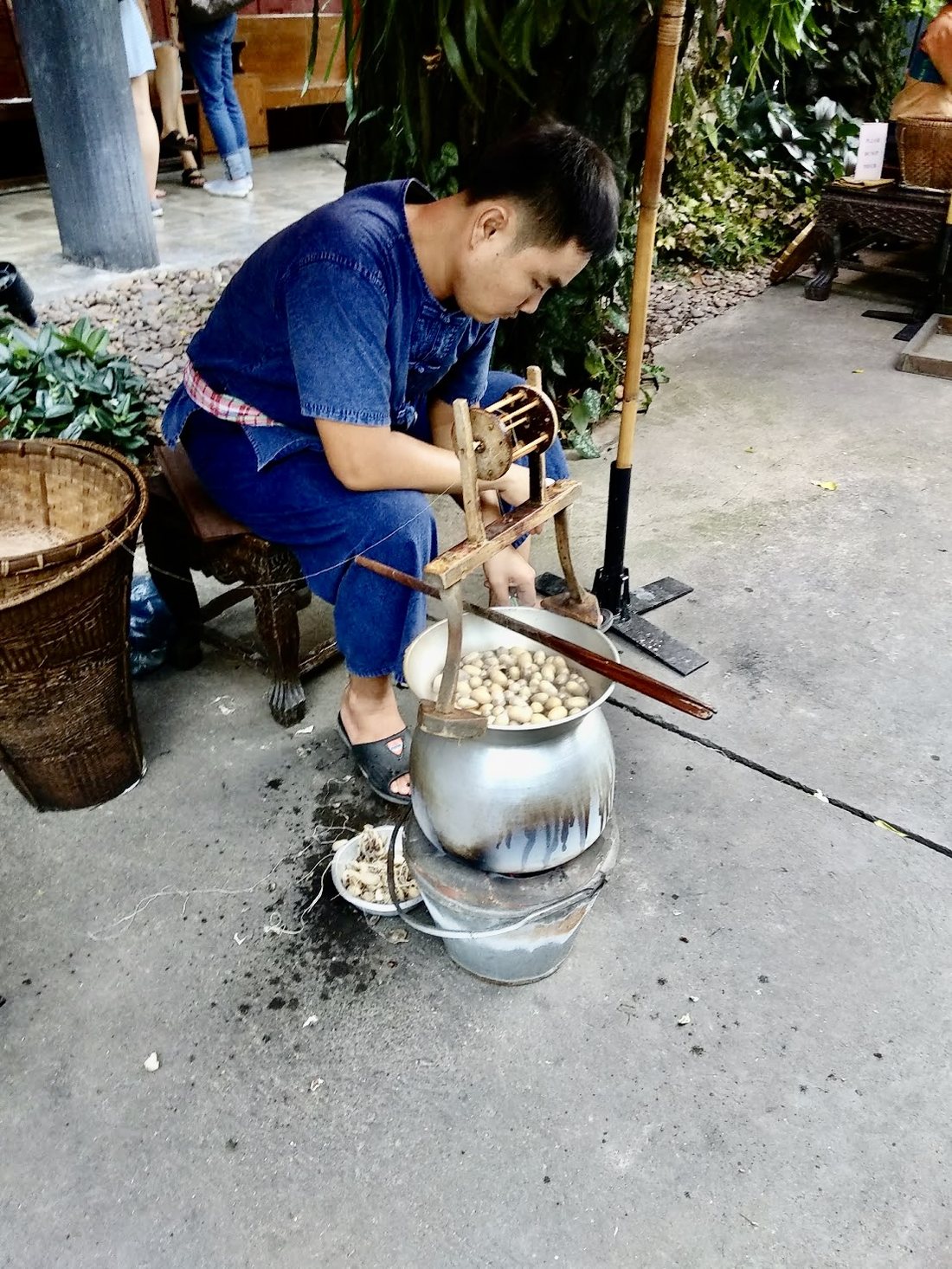
Weaving villages run demonstrations for visitors, and the commentary uses the same small set of words every time. Six of them carry the whole process, and most reappear in a kitchen or a garden — which makes this a tidy beginner Thai lesson and a chance to learn Thai vocabulary that is not specialist jargon:
- หม่อน (mɔ̀ɔn) — mulberry. ใบหม่อน is the leaf the worms eat, and ใบ means leaf everywhere else too.
- หนอนไหม (nɔ̌ɔn mǎi) — silkworm: “worm · silk”. หนอน is the ordinary word for a caterpillar or grub.
- รังไหม (rang mǎi) — cocoon, from รัง, a nest. Birds’ nests, wasps’ nests and dandruff all use it.
- ต้ม (tôm) — to boil. Yes, the ต้ม of tom yum; the cocoons are boiled to loosen the thread.
- เส้นไหม (sên mǎi) — silk thread. เส้น is a strand or line, and it is also what you count noodles in.
- ย้อม (yɔ́ɔm) — to dye. ย้อมสีธรรมชาติ is natural dyeing, and ย้อมผม is dyeing your hair.
At the loom: ทอ, ลาย and มัดหมี่
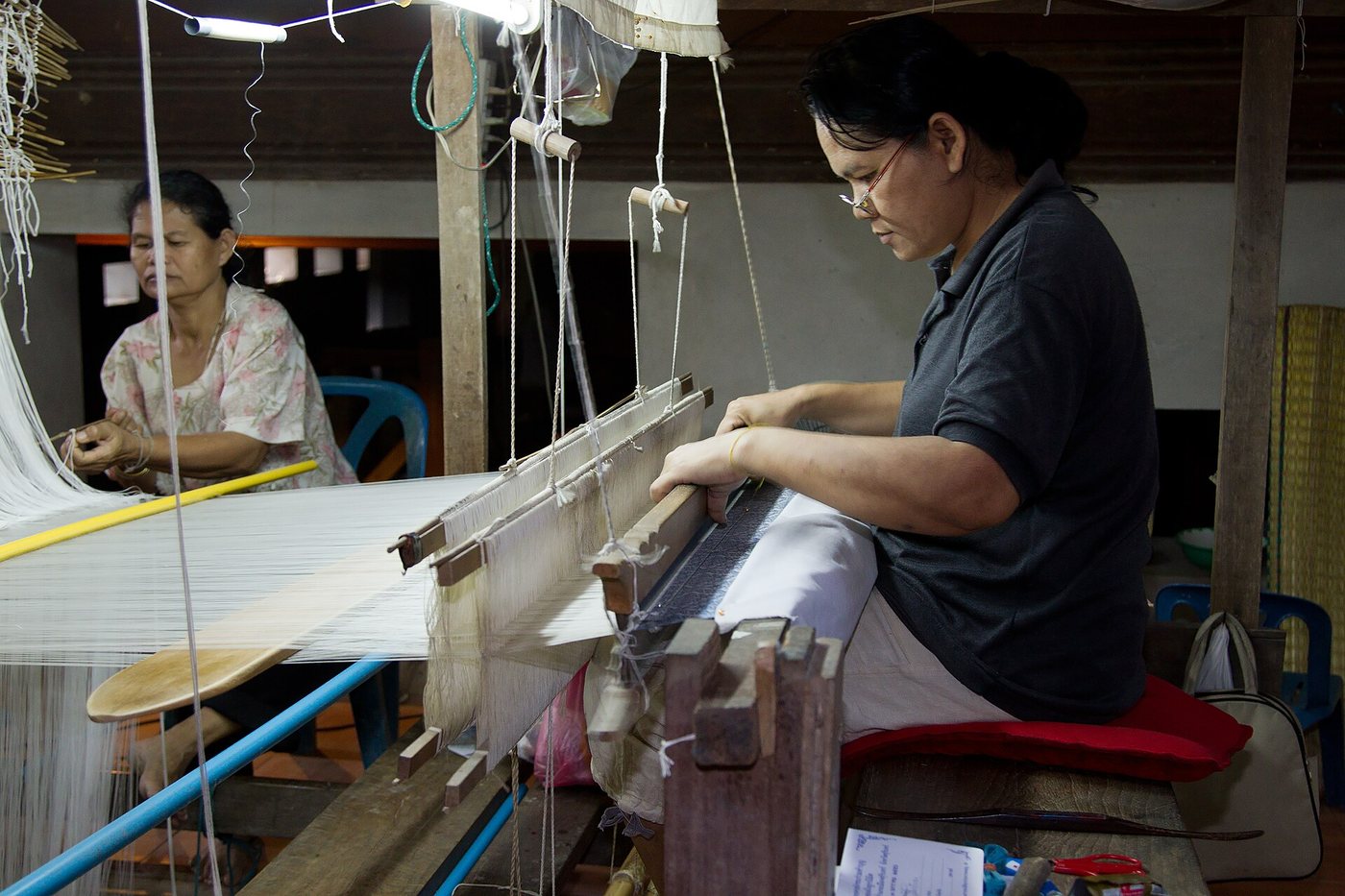
Four more words cover everything that happens on the loom itself. ทอ (thɔɔ) is to weave, so ทอมือ (thɔɔ mue) on a label means hand-woven, and ผ้าทอ is woven cloth as a category. The loom is a กี่ (kìi) — identical in sound and spelling to กี่, “how many”, which is a small joke the language plays on learners — or a หูก (hùuk), the older word still used across the north-east.
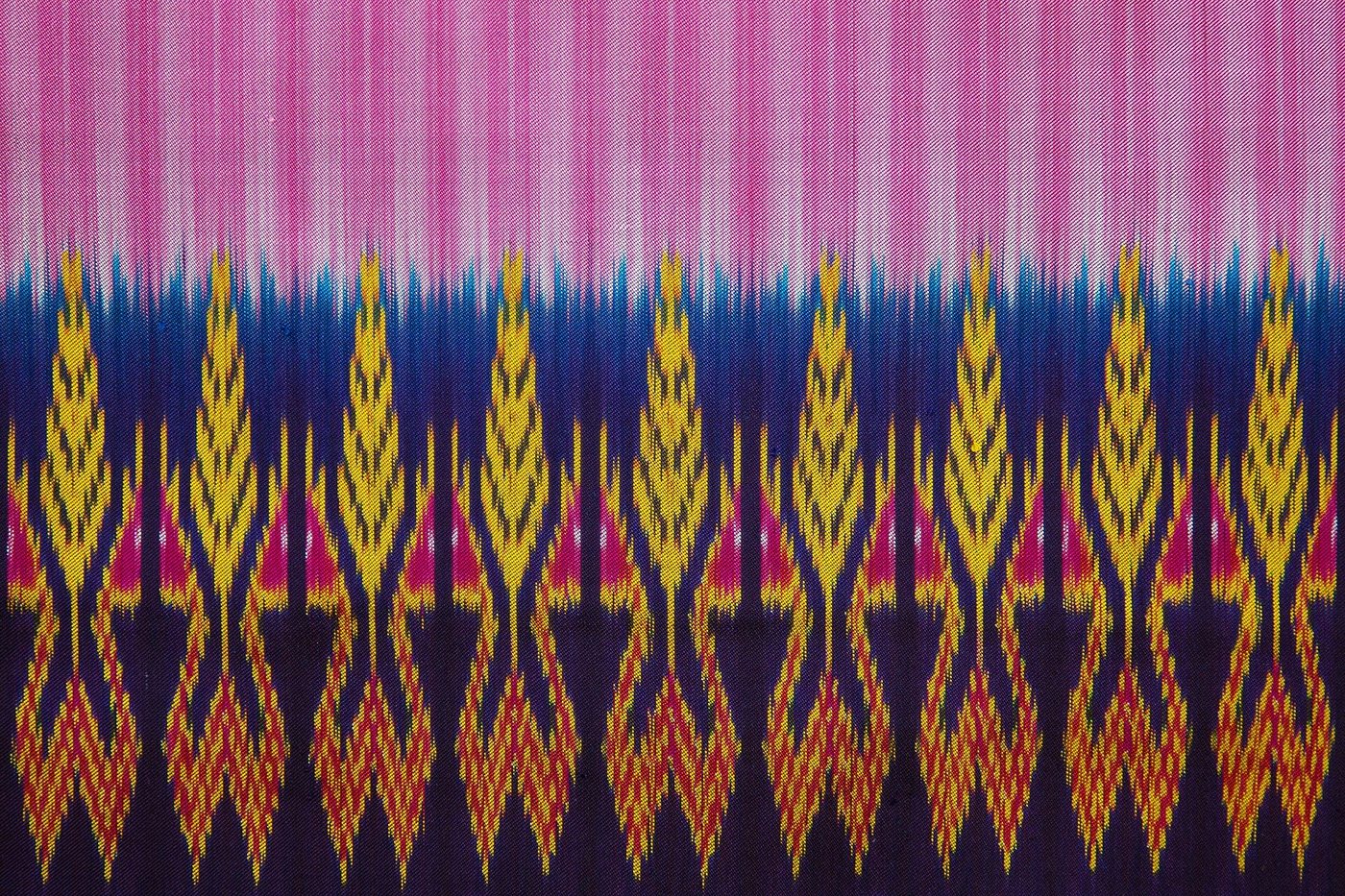
Then there is ลาย (laai), pattern or design: the word a vendor will use when you point at a cloth and want to ask what you are looking at. Two patterns are worth knowing by name:
- มัดหมี่ (mát mìi) — ikat. มัด means to tie or bind, and the threads are indeed tied in bundles and dyed before weaving, so the colour is already in the yarn when it reaches the loom.
- ยกดอก (yók dɔ̀ɔk) — brocade: “to lift · flower”, for the raised figured pattern. With metallic thread it becomes ยกทอง, gold brocade, the speciality of the Surin villages.
Buying it: the phrases that do the work
Silk shopping is a slow, polite transaction, and a few words of Thai change the temperature of it completely. These are the six phrases to learn Thai vocabulary from first. Finish each one with your politeness particle — ครับ (khráp) if you are a man, ค่ะ (khâ) if you are a woman:
- ขอดูได้ไหมครับ (khǒɔ duu dâai mǎi khráp) — “may I look at it?” ขอ is the all-purpose polite “may I have”.
- อันนี้เท่าไหร่คะ (an níi thâo rài khá) — “how much is this one?”
- ไหมแท้ (mǎi tháe) — real silk — against ไหมเทียม (mǎi thiam), imitation silk. แท้ means genuine and turns up on honey, coffee and gold as well.
- กี่เมตรคะ (kìi méet khá) — “how many metres?” There is กี่ again, this time meaning “how many”. Cloth is sold by the เมตร or sometimes the หลา (lǎa), a yard.
- ตัดเสื้อ (tàt sûea) — to have a garment made, literally “cut · shirt”. Many shops will point you to a tailor next door.
- ลดหน่อยได้ไหมครับ (lót nɔ̀i dâai mǎi khráp) — “could you come down a little?”
A word on the social side, because it matters more here than with mangoes. Light bargaining is expected in a tourist market. In a village co-operative the price is often ราคาเดียว (raa-khaa diao), “one price”, and pushing hard on a piece that took a weaver weeks reads as rude: ask once, smile, accept the answer. And look for the peacock. The นกยูง (nók yuung) hologram label grades Thai silk in four colours, the gold one reserved for native-breed silk made entirely by hand and the green one marking a blend.
When Thai people actually wear silk
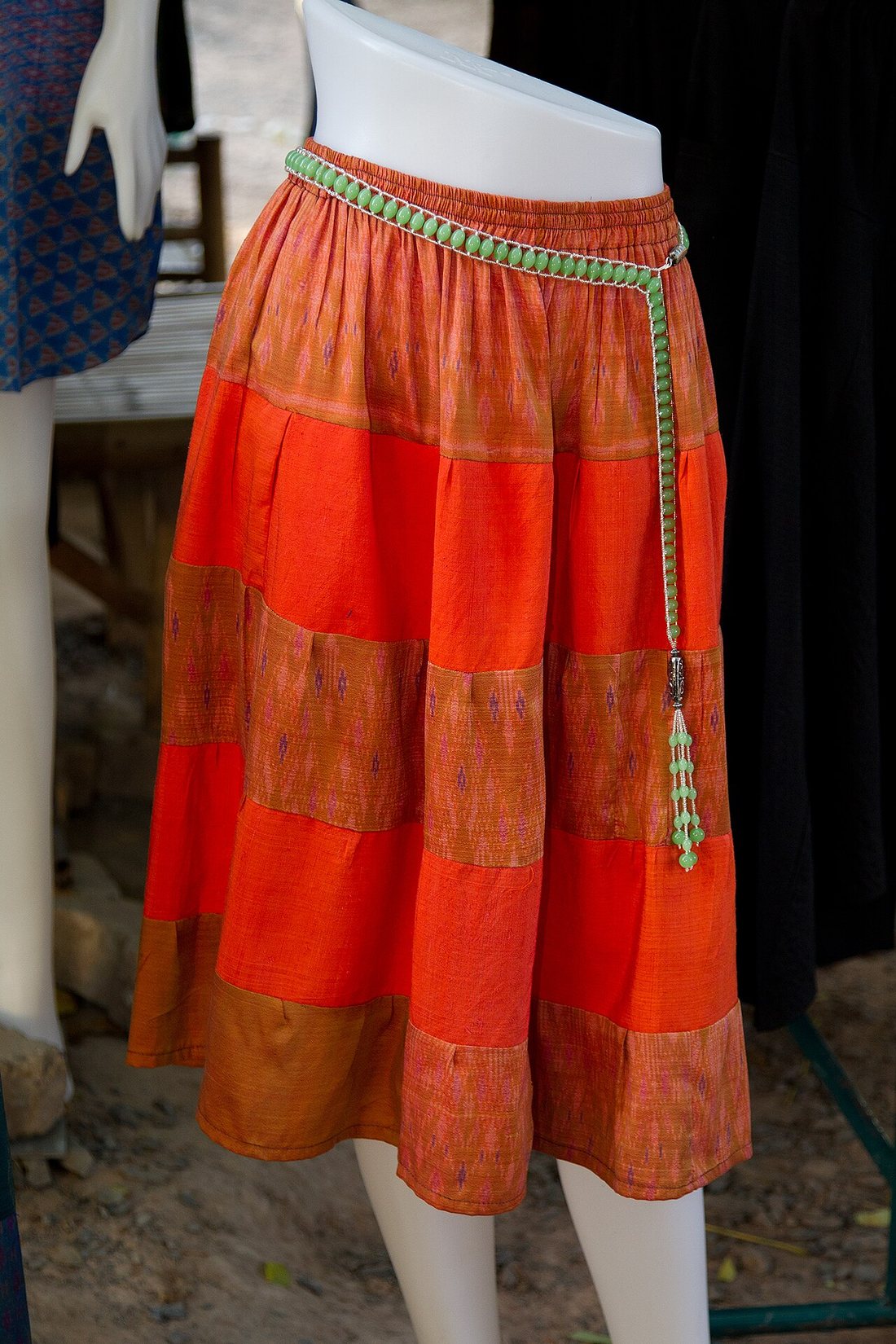
Foreign visitors often assume silk is costume. It is not. ชุดไทย (chút thai), Thai formal dress, comes out for weddings — งานแต่งงาน (ngaan tàeng ngaan) — merit-making days, graduations and official functions, and the สไบ (sà-bai) sash goes across one shoulder with it. Many offices keep one day a week for ผ้าไทย, Thai cloth. Invited to a Thai wedding, a locally bought silk shirt or scarf is a safe and quietly appreciated choice; our guide to Thai clothes and sizes has the words for getting one that fits.
A study tip: split every compound at the seam
Nearly every term in this guide is two plain words glued together — cloth-silk, nest-silk, worm-silk, draw-silk, tie-bundle, lift-flower, cut-shirt, wrap-neck. That is how Thai names the physical world, and it means a long word is rarely a new word; it is usually two you already have. So when you photograph a label, do not file the whole phrase. Split it at the seam, keep the pieces, and the next label will be half-read before you start. It is a far more efficient way to learn Thai vocabulary than memorising strings of syllables whole.
Then give the reading half its ten minutes a day. Our free flashcard trainer drills the Thai consonants and vowels in these very words, and the Thai alphabet chart covers the letters that keep reappearing — ผ, ห and ม do a lot of the work above. Start with ผ้า and ไหม. You will be spotting them on labels inside a week.