Learn Thai Vocabulary: Mookata & Thai BBQ Hot Pot Thailand
Learn Thai vocabulary for mookata and Thai hot pot in Thailand: grill words, buffet signs in Thai script, prices and pronunciation, with real photos.
There is a particular evening that happens to almost everyone who stays in Thailand for more than a month. Somebody drags a plastic stool up to a wooden table with a hole cut in it, a bucket of glowing charcoal goes into the hole, a dented metal dome lands on top, and for the next two hours you cook your own dinner while everyone talks over you. This is หมูกระทะ (mǔu grà-thá), and it is one of the best places in the country to learn Thai vocabulary — because the words arrive attached to objects you are holding.
This guide covers the pan and the fire, the meat on the buffet line, the sauces, the three cousins of mookata that get confused with it, and the handful of sentences that get you fed. Everything comes with Thai script, a Thai transliteration you can read aloud, and a literal translation wherever the literal meaning is what makes the word stick. Every photograph below is a real table in Thailand.
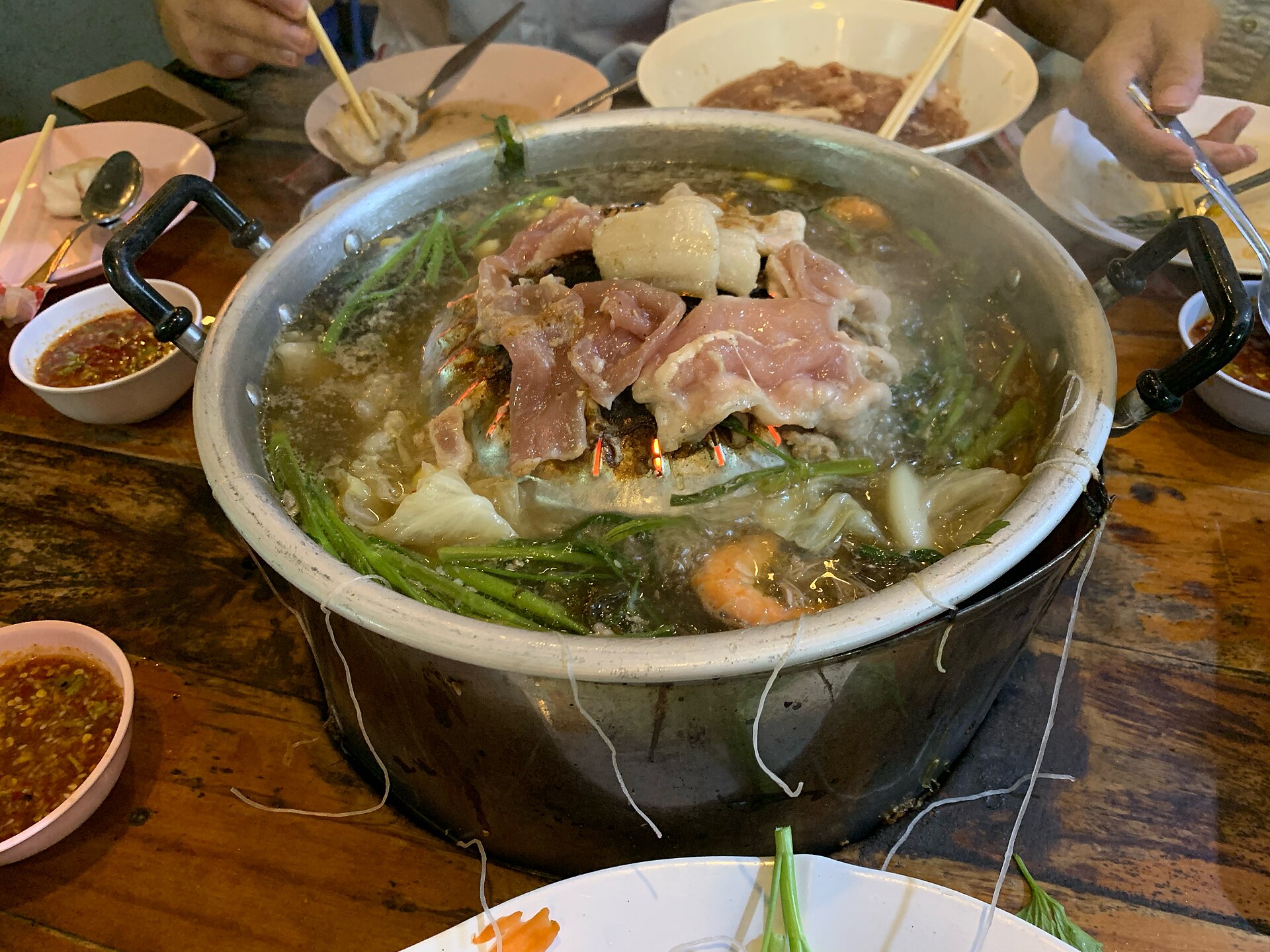
หมูกระทะ: what the word actually says
Pull the name apart and it is a beginner Thai lesson in two syllables. หมู (mǔu) is pork. กระทะ (grà-thá) is a pan or wok — the same word your neighbour uses for frying an egg. So หมูกระทะ is simply “pork pan”, with none of the romance the English menus add. Thai food names are usually this blunt, and that bluntness is a gift: once you know forty nouns you can decode most of a menu without ever having studied it.
- หมู (mǔu) pork · ไก่ (gài) chicken · เนื้อ (núea) beef
- กุ้ง (gûng) prawn · ปลาหมึก (bplaa mùek) squid, literally “ink fish”
- ผัก (phàk) vegetables · เห็ด (hèt) mushrooms
- วุ้นเส้น (wún sên) glass noodles, literally “jelly threads”
- ลูกชิ้น (lûuk chín) meatballs, literally “child pieces”
- น้ำซุป (nám súp) broth · น้ำจิ้ม (nám jîm) dipping sauce, “dipping water”
The fire, the pan and the tongs
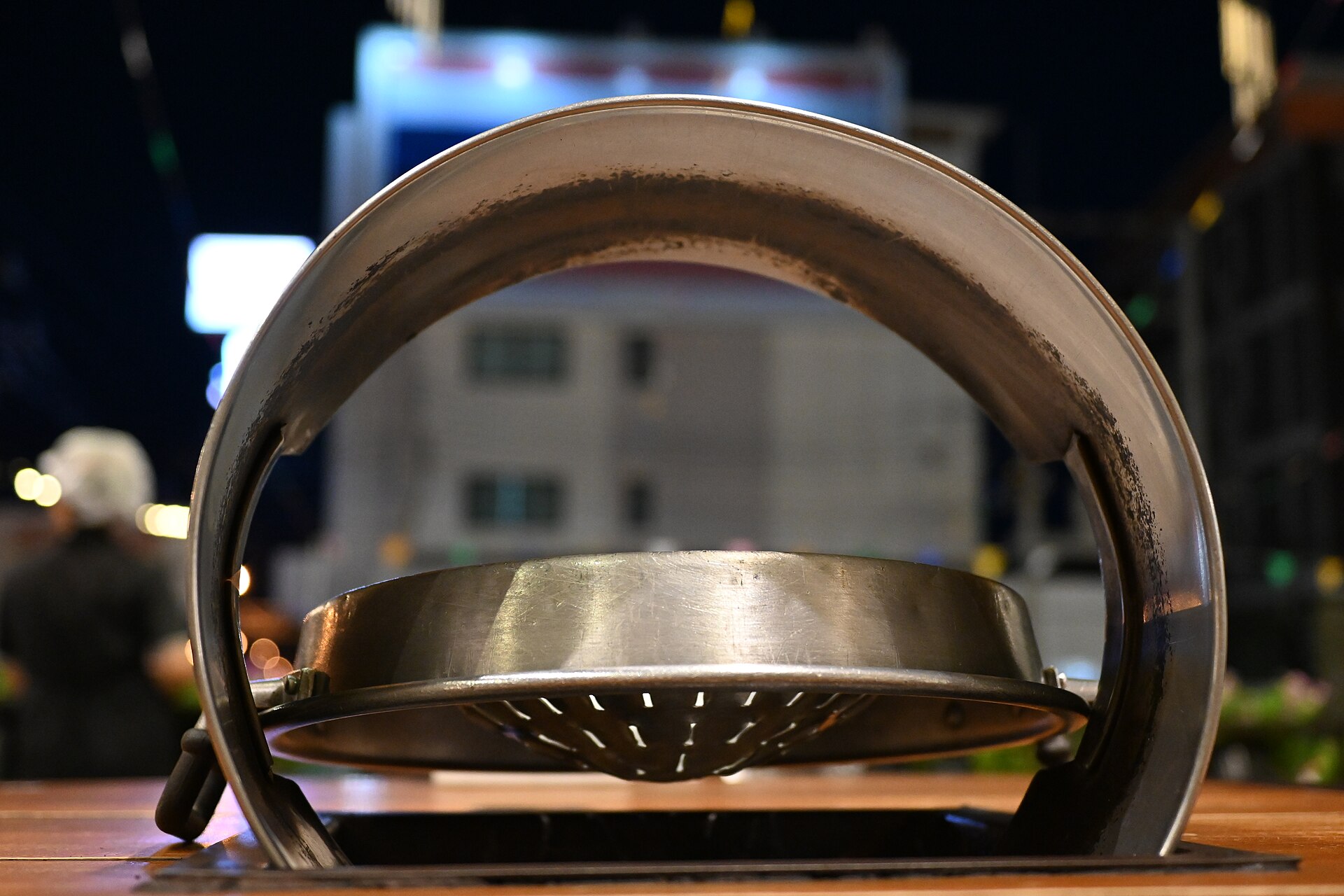
- เตา (dtao) — stove or burner; ถ่าน (thàan) — charcoal
- ไฟ (fai) — fire or heat; ไฟแรง (fai raeng) — high heat, “strong fire”
- ที่คีบ (thîi khîip) — tongs, literally “thing for gripping”
- กรรไกร (gan-grai) — scissors, used at the table to cut meat
- มันหมู (man mǔu) — pork fat, rubbed over the hot dome so nothing sticks
- สุก (sùk) cooked · ดิบ (dìp) raw · ไหม้ (mâi) burnt
- เติมน้ำซุปหน่อยครับ (dtəəm nám súp nàwy khráp) — “more broth, please”, the one request you will make every single time
Two words here are worth slowing down for, because Thai pronunciation decides which one you said. ไหม้ (mâi, burnt), ไม่ (mâi, not) and ไหม (mǎi, the question particle) are three different words built from almost the same Thai letters. Thai readers tell them apart instantly by the tone mark and the class of the leading consonant — which is the real reason it pays to learn Thai alphabet rules rather than relying on romanisation forever.
Read Thai script on the buffet line
The buffet counter is the single best place in the building to learn Thai vocabulary and read it at the same time, because every card is two or three words long, printed in a plain block face, and sitting directly in front of the thing it names. You can check your own answer by looking down.
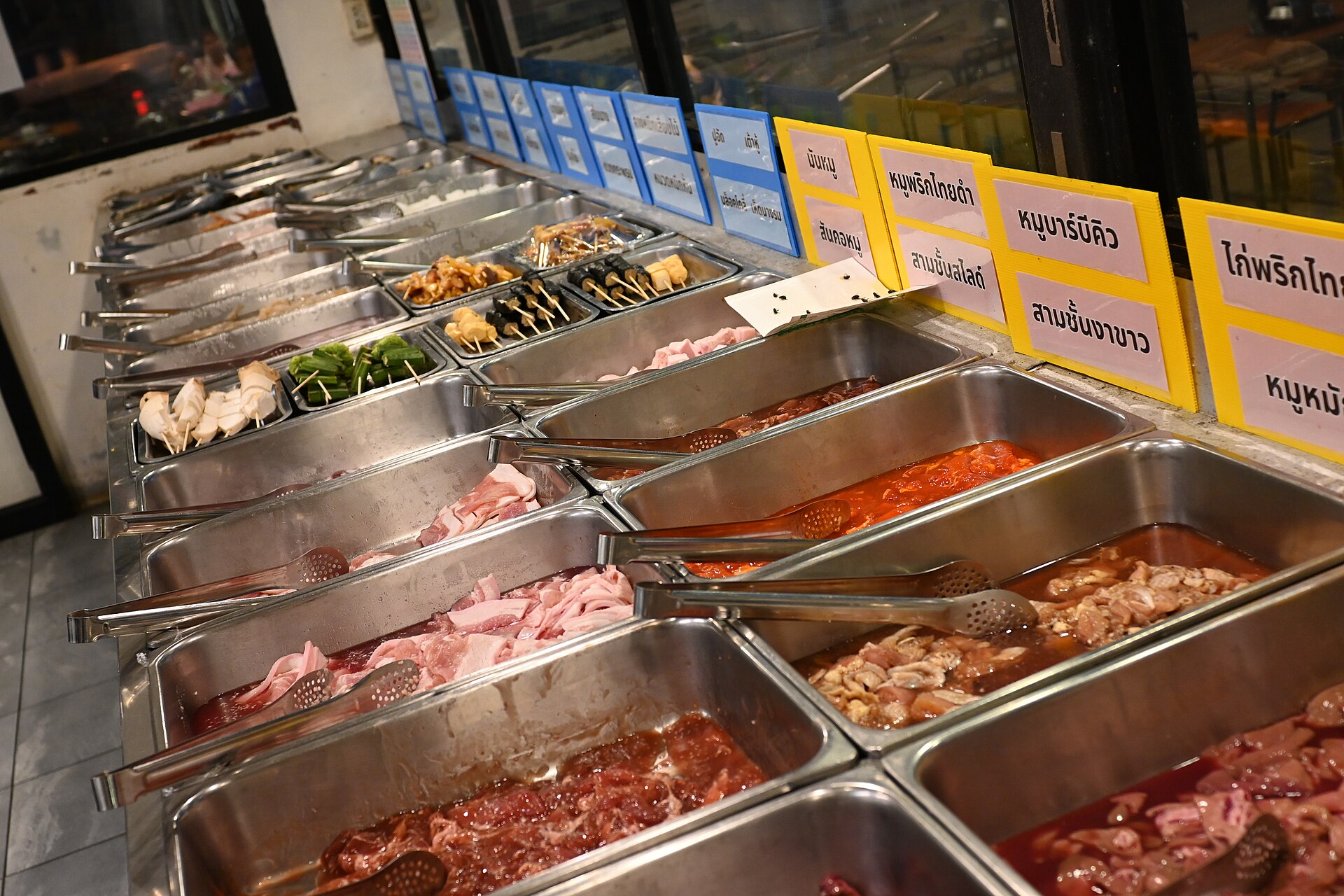
- สันคอหมู (sǎn khaaw mǔu) — pork collar, literally “ridge-neck pork”, the cut most Thais reach for first
- สามชั้น (sǎam chán) — pork belly, literally “three layers”: fat, meat, fat
- สไลด์ (sà-lái) — sliced, borrowed straight from English “slide”
- หมัก (màk) — marinated; หมูหมัก (mǔu màk) marinated pork
- งา (ngaa) — sesame; งาขาว (ngaa khǎao) white sesame
- ปูอัด (bpuu àt) — crab stick, literally “pressed crab”
- เต้าหู้ (dtâo hûu) — tofu; เห็ดนางรม (hèt naang rom) oyster mushroom
One card on that counter hides the best vocabulary trap in Thai. พริกไทย (phrík thai) looks exactly like “Thai chilli” and means nothing of the sort — it is black pepper. พริก alone is chilli; add ไทย and you get the peppercorn, because pepper was the native hot spice here long before chillies arrived from the Americas. Learn it now and you will never again order a dish expecting heat and receiving seasoning. Details like this are why it is worth learning words in groups: the group remembers the exception for you.
สุกี้, ชาบู and จิ้มจุ่ม: the cousins
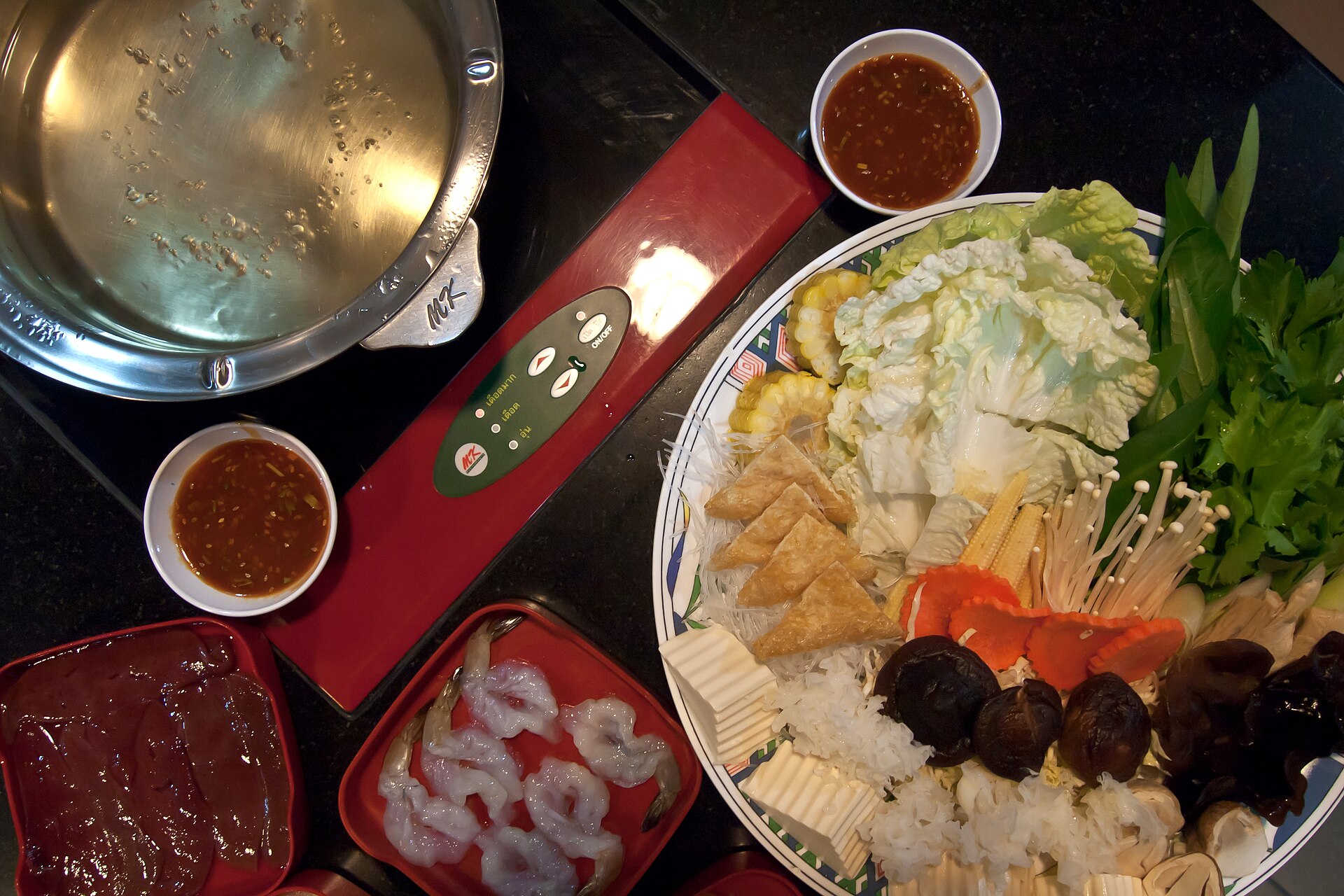
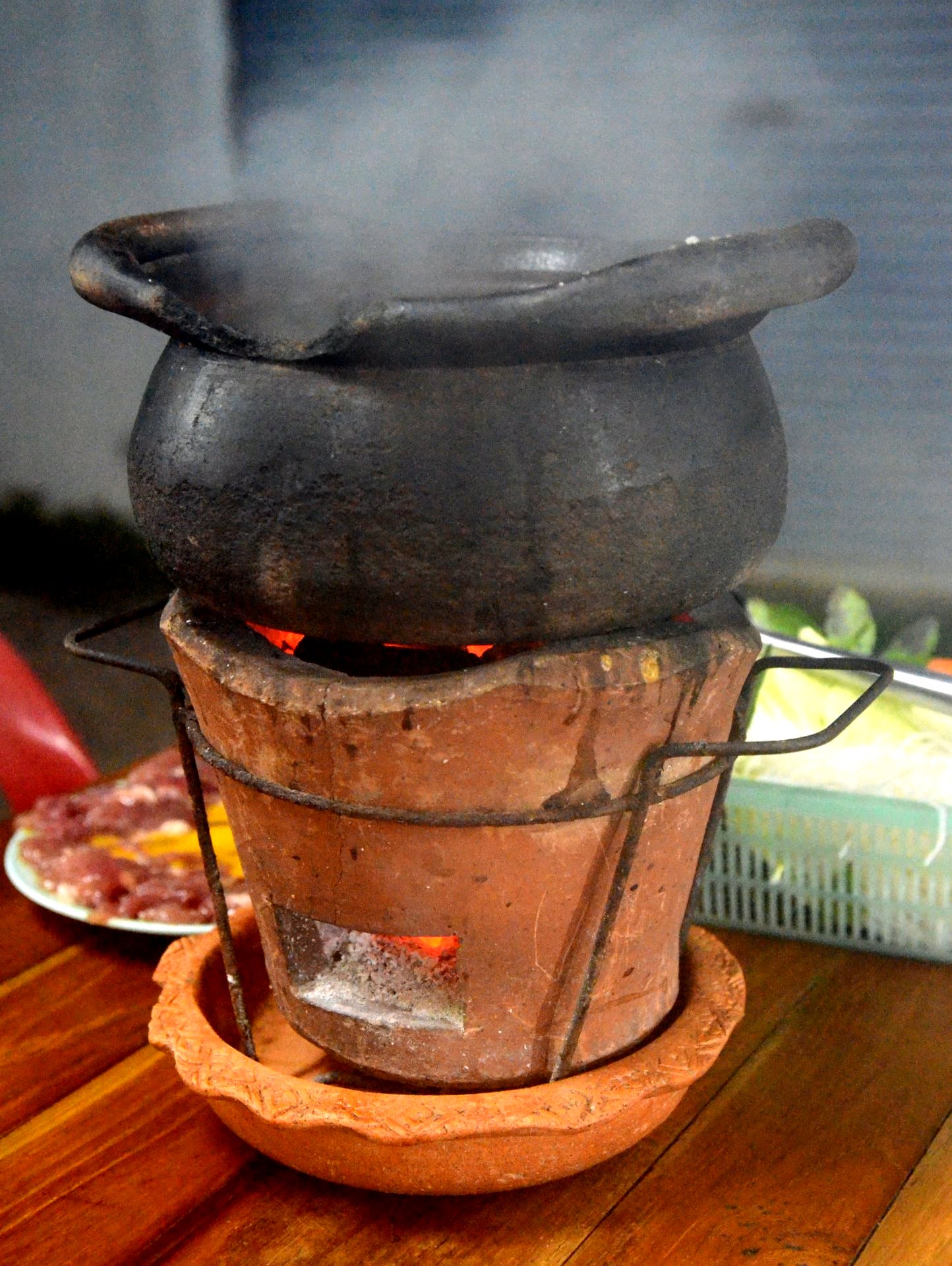
Thais will correct you cheerfully if you call the wrong thing mookata, so these four names are worth keeping apart — and sorting near-neighbours like this is how you learn Thai vocabulary that actually survives contact with a menu. สุกี้ (sù-gîi) is Thai suki: a pot of clear broth, a platter of raw vegetables and a sweet-sour red น้ำจิ้มสุกี้. ชาบู (chaa-buu) is the Japanese-style version, usually dearer and usually indoors. จิ้มจุ่ม (jîm jùm) is the Isan one — a herbal broth in a clay pot, eaten with a tart น้ำจิ้มแจ่ว (nám jîm jàew). And หมูกระทะ is the only one with a grill in the middle.
Prices, buffets and the sign at the door
Most mookata shops are all-you-can-eat, and the board outside says so in four or five words you can learn Thai vocabulary-style in a single evening. A typical one reads บุฟเฟ่ต์ ไม่อั้น ท่านละ 199 บาท — “buffet, unlimited, 199 baht per person”. Prices on signs are written in Arabic numerals far more often than Thai ones, so this is reading practice with training wheels on.
- บุฟเฟ่ต์ (bùp-fêe) — buffet; ไม่อั้น (mâi ân) — unlimited, “not restricted”
- ท่านละ (thân lá) / คนละ (khon lá) — per person; ท่าน is the polite form you see printed
- ห้ามเหลือ (hâam lǔea) — “no leftovers”, often followed by a fine. ห้าม means “forbidden” and heads half the warning signs in Thailand
- กี่คนครับ / คะ (gìi khon khráp / khá) — “how many people?”, the first thing staff will ask you
- เช็คบิล (chék bin) or คิดเงิน (khít ngern) — “the bill, please”
- อิ่มแล้ว (ìm láew) — “I’m full”, the most useful two words at any Thai table
If numbers spoken out loud still ambush you when the bill lands, half an hour with our guide to Thai money words and prices pays for itself on the first round. And because Thai needs a classifier every time you ask for “another one”, remember that plates take จาน (jaan) and trays take ถาด (thàat) — our guide to Thai classifiers has the rest.
Khrap, kha and sharing a grill politely
Mookata is loud, informal food, but the politeness particles stay on: men finish sentences with ครับ (khráp), women with ค่ะ (khâ), switching to คะ (khá) for questions. Call staff older than you พี่ (phîi), “older sibling”, never by waving. You do not need much to speak Thai at a grill — a particle, a please and a number will carry you through the night. The table etiquette is simpler than it looks: cook for the group rather than for yourself, put the fatty cuts on first to grease the dome, and leave the tongs where everyone can reach them. If the particle system is still slippery, our guide to khrap and kha is a twenty-minute fix.
A study tip: one tray, one word
Do not try to memorise this guide as a list. Use the counter instead. Next time you are at a buffet line, give yourself one rule: read the card before you look at the tray. Sound out the Thai consonants and vowels, commit to a guess, then check. Learning to read Thai script is mostly this: hundreds of tiny guesses, corrected fast. You will be wrong about half the time at first, and each time you are wrong the correction lands with a photograph of raw pork attached to it, which is worth ten flashcards.
Five cards an evening, twice a week, and the buffet line stops being decoration. If the Thai letters themselves are still the bottleneck, start with our free Thai alphabet chart and drill them in the ThaiLetters flashcard trainer first — reading signs is far more satisfying once the shapes are automatic. People who learn Thai vocabulary fastest in Thailand are rarely the ones with the best app. They are the ones who order in Thai, get handed the wrong tray, laugh, and remember the word for good. That is the whole of Thailand expat language learning in one sentence — and a grill in the middle of the table is as good a classroom as you will find.