Learn Thai Vocabulary: Floating Market Words in Thailand
Learn Thai vocabulary for a Thai floating market — boats, canals, vendors, fruit and price words in Thai script, with pronunciation and five real photos.
Long before Thailand had roads, it had canals, and the market came to your doorstep in a boat. That is still the fastest way to learn Thai vocabulary that sticks: stand on a wooden walkway for an hour at a ตลาดน้ำ (dtà-làat náam), a floating market, and every word you need is being shouted, weighed, paddled past and painted on a board within arm’s reach. Nothing is abstract. A word arrives attached to a smell and a price.
This Thai language guide gives you about fifty floating-market words three ways — Thai script, a Thai transliteration you can say out loud, and the literal meaning, because with these words the literal meaning is what makes them stay. The five photographs are real ones from Thai floating markets: a carved gate sign in Samut Songkhram, the vendor boats at Tha Kha, a fruit seller at Damnoen Saduak, a woman grilling prawns from a boat in Bangkok, and a row of hand-painted banners at Khlong Lat Mayom.
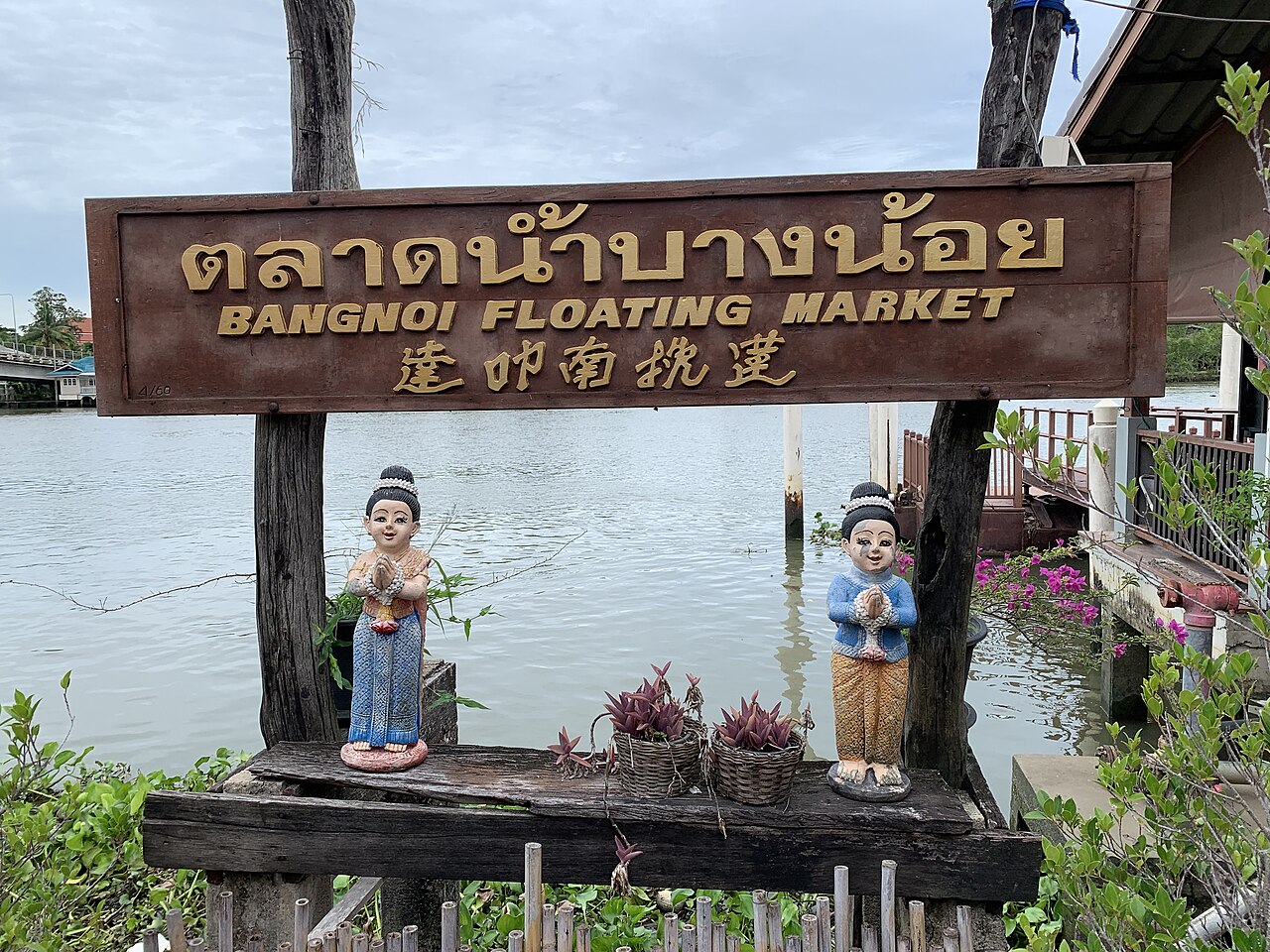
ตลาดน้ำ: the two words that open every sign
ตลาด (dtà-làat) is market and น้ำ (náam) is water, and Thai builds compounds by sticking the describing word on the end. Learn the pattern once and you get a shelf of words free:
- ตลาดน้ำ (dtà-làat náam) — floating market, literally “water market”
- ตลาดสด (dtà-làat sòt) — the fresh market, literally “fresh market”
- ตลาดนัด (dtà-làat nát) — a weekend or appointed-day market, literally “appointment market”
- ตลาดเช้า (dtà-làat cháo) — the morning market, which is what most floating markets really are
- ท่าเรือ (thâa ruea) — the boat landing or pier, literally “boat quay”
A warning worth the ticket price: real floating markets finish early. ตลาดเช้า is not a figure of speech. At Tha Kha and Damnoen Saduak the paddling starts around seven and the good boats are gone by ten, so if you turn up at noon to practise your Thai pronunciation you will be practising it on an empty canal.
คลอง and เรือ: the water words a beginner Thai lesson skips
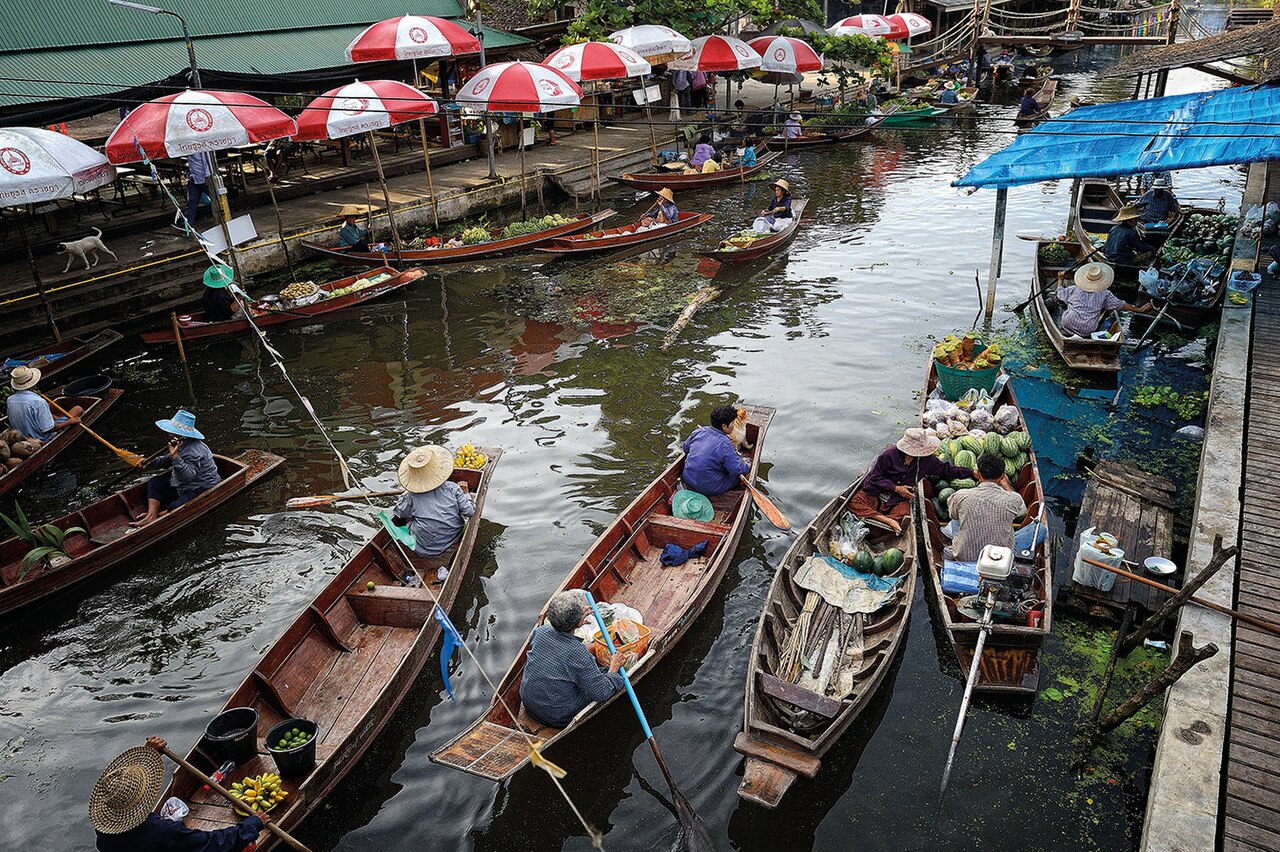
Most courses teach you to order food and then abandon you the moment you reach water. These are the words a floating market actually runs on:
- คลอง (khlawng) — canal. It also starts hundreds of Thai place names, as in คลองลัดมะยม
- แม่น้ำ (mâe náam) — river, literally “mother water”
- เรือ (ruea) — boat · ลำ (lam) — the classifier for boats
- เรือพาย (ruea phaai) — a paddle boat · พาย (phaai) — both the paddle and the verb “to paddle”
- เรือหางยาว (ruea hǎang yaao) — the long-tail boat, literally “long-tail boat”, named for the propeller shaft
- สะพาน (sà-phaan) — bridge · ริมน้ำ (rim náam) — waterside, the word on every riverside café sign in Thailand
Classifiers are where beginners wobble, and a floating market is the gentlest place to fix it, because the objects are large and obvious. One boat is เรือหนึ่งลำ, two boats เรือสองลำ. If the system is still murky, our guide to Thai classifiers is worth twenty minutes before you go.
แม่ค้า and พ่อค้า: who you are actually talking to
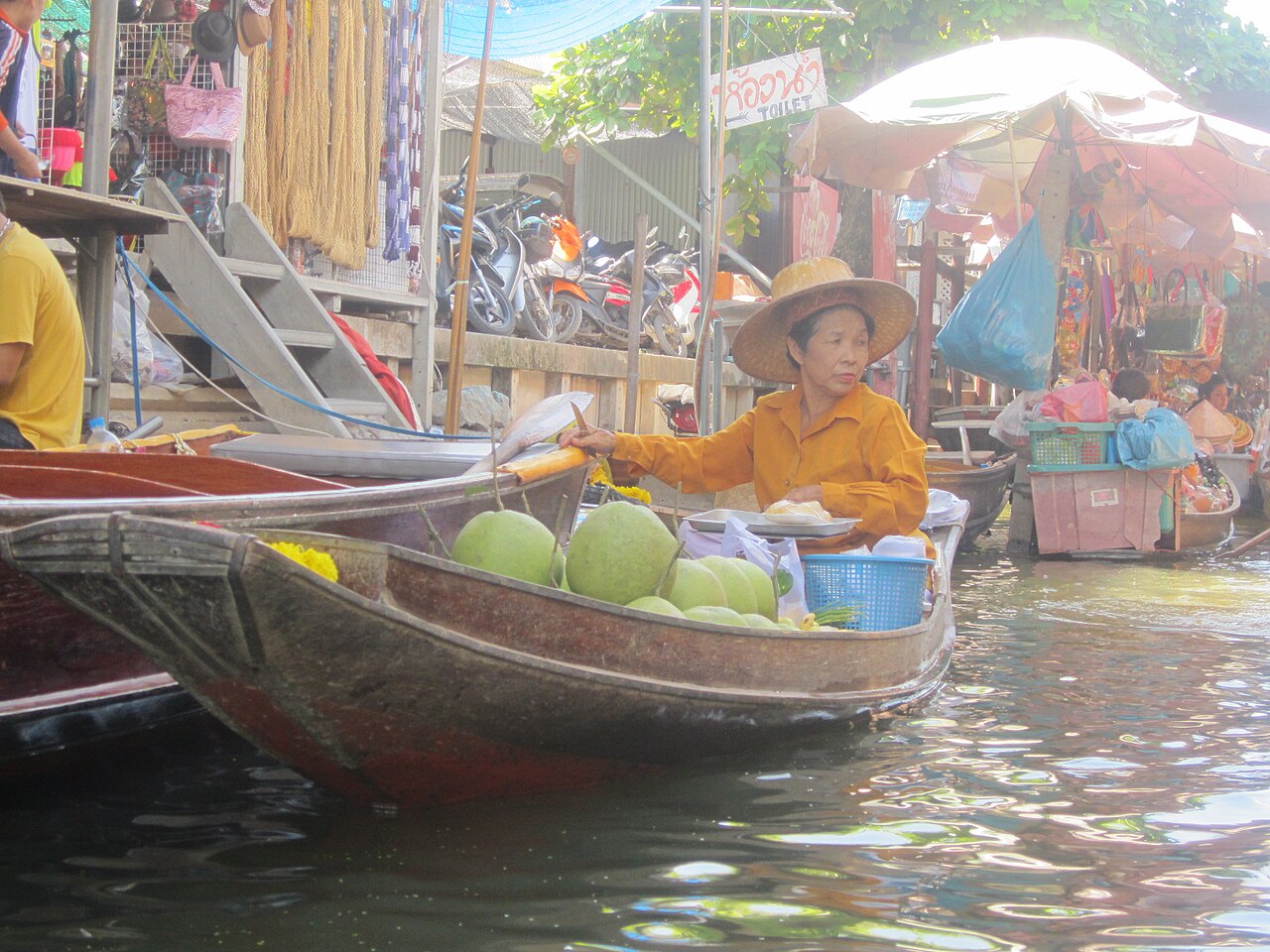
Thai has no neutral word for “shopkeeper” that people actually use out loud. It has two, and which one you pick depends on who is in front of you:
- แม่ค้า (mâe kháa) — a female vendor, literally “trade mother”. Most of the boats you will meet
- พ่อค้า (phâw kháa) — a male vendor, “trade father”
- ชาวสวน (chaao sǔan) — an orchard farmer, which is what many of the fruit sellers are
- ลูกค้า (lûuk kháa) — the customer, “trade child”. That is you
- พี่ (phîi) — “older sibling”, and the normal, warm way to address a vendor who looks older than you · ป้า (bpâa) — auntie, for someone clearly a generation up
Notice ค้า (kháa, trade) sitting inside four of those. That is how Thai vocabulary rewards you later: you are not memorising five words, you are memorising one root and four frames. Calling a vendor พี่ rather than nothing at all is the single cheapest upgrade to how you speak Thai, and it costs one syllable.
Learn Thai vocabulary you can eat
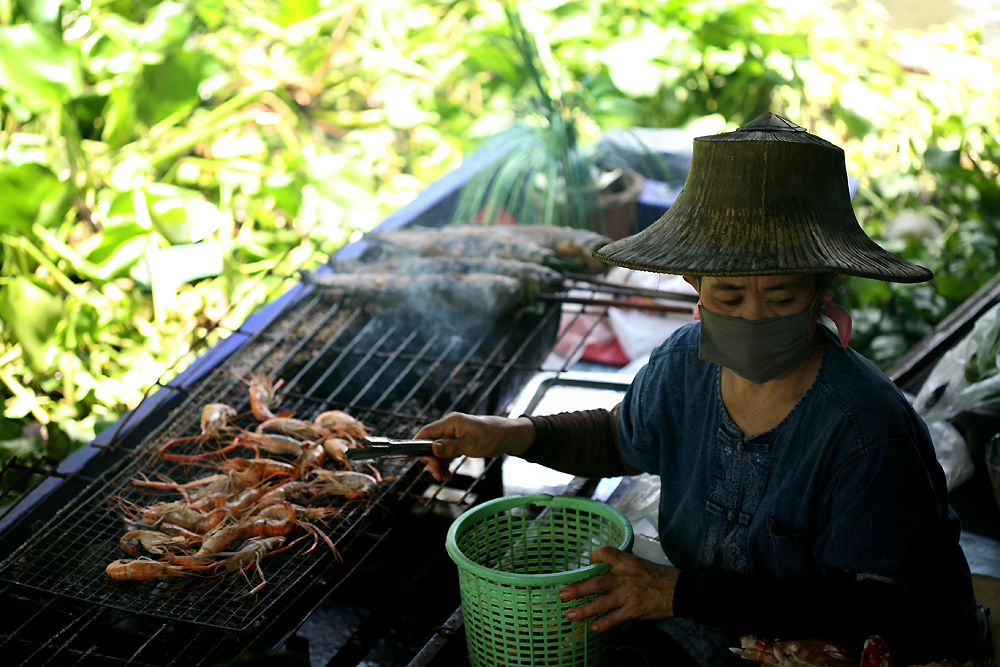
Food is the friendliest classroom there is, and the quickest place on the whole canal to learn Thai vocabulary that survives the flight home, because almost everything is sold by pointing — so you hear the word and see the thing in the same second:
- ก๋วยเตี๋ยวเรือ (gǔay-dtǐao ruea) — boat noodles, a small dark bowl sold from the water
- กุ้งเผา (gûng phǎo) — grilled prawns · ปลาเผา (bplaa phǎo) — salt-crusted grilled fish
- ขนมครก (khà-nǒm khrók) — coconut pancakes cooked in a dimpled iron pan
- ส้มโอ (sôm-oh) — pomelo · มะพร้าว (má-phráao) — coconut · กล้วย (glûay) — banana
- น้ำมะพร้าว (náam má-phráao) — coconut water, served in the shell with a straw
- ใส่ถุง (sài thǔng) — “put it in a bag”, the phrase that ends most transactions
If you want the produce words in bulk before you travel, our guide to Thai fresh market vocabulary covers the same goods on dry land, where nobody is paddling away mid-sentence.
Prices, weighing and haggling on the water
Floating-market prices are spoken, not printed, which makes numbers the one thing you cannot bluff. Get these four phrases solid and you can do the whole exchange:
- อันนี้เท่าไหร่ (an níi thâo-rài) — “how much is this one?”
- กิโลละเท่าไหร่ (gì-loh lá thâo-rài) — “how much per kilo?” · ชั่ง (châng) — to weigh
- ลดหน่อยได้ไหม (lót nàwy dâi mǎi) — “could you come down a little?” Said smiling, once, not three times
- เอาอันนี้ (ao an níi) — “I’ll take this one” · ดูเฉย ๆ (duu chǒie chǒie) — “just looking”
Haggling at a floating market is gentle and nearly ceremonial — a request, a laugh, ten or twenty baht. Pushing hard reads as rude rather than clever. And if the numbers themselves are the bottleneck, spend an evening with our guide to reading Thai numerals on prices and dates first; ๕๐ chalked on a crate is a different experience once you know it says fifty.
Reading the banners: Thai letters in the wild
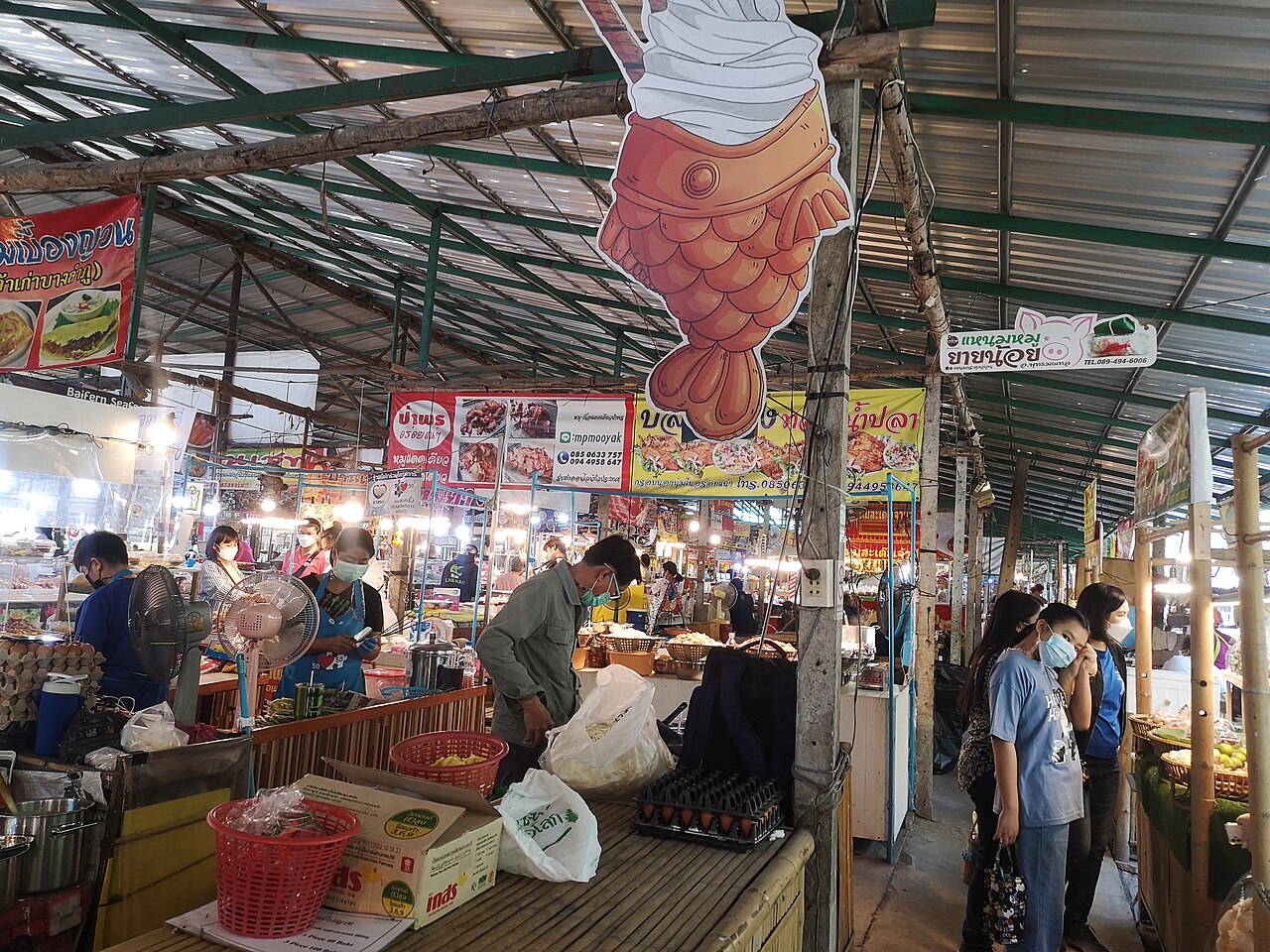
Market banners are the best reading practice in Thailand, and three habits turn them from wallpaper into a lesson:
- Find the digits first. A Thai phone number is ten digits and always at the bottom, so it tells you instantly where the name ends
- Hunt for ร้าน (ráan, shop) and ขนม (khà-nǒm, snacks). Between them they start a startling share of all food signage
- Expect handwriting. Painted Thai consonants and vowels lose their loops, and ด/ค or ย/ผ blur together — which is exactly the skill a textbook cannot give you
If the letters themselves are still slow, fix that before the vocabulary. Keep our free Thai alphabet chart open on your phone to learn Thai alphabet shapes, then drill ten minutes a day in the flashcard trainer. Canal signs are short, repetitive and at eye level — an ideal first real-world read.
Which ตลาดน้ำ to choose for a beginner Thai lesson
Not all floating markets are equally useful. The ones built for coach parties have English menus and staff who answer you in English before you have finished your sentence, which is pleasant and completely useless for practice. The five in the photographs above sit at different points on that scale, and the difference matters if you want to learn Thai vocabulary rather than just photograph a canal:
- ตลาดน้ำท่าคา (thâa khaa), Samut Songkhram — a working morning market on set days, mostly local, almost no English
- ตลาดน้ำบางน้อย (baang náwy), Samut Songkhram — small, quiet, weekend-ish, and the signage is genuinely Thai
- ตลาดน้ำคลองลัดมะยม (khlawng lát má-yom), Bangkok — a city market Bangkokians actually shop at, and the easiest to reach
- ตลาดน้ำตลิ่งชัน (dtà-lìng chan), Bangkok — weekends, food-heavy, friendly to a nervous first attempt
- ตลาดน้ำดำเนินสะดวก (dam-noen sà-dùak), Ratchaburi — the famous one, and the most touristed: go very early or not at all
How to speak Thai politely from a walkway
A floating market is relaxed, but you are standing over somebody’s workplace. End your sentences with ครับ (khráp) if you are a man and ค่ะ (khâ) if you are a woman — and use the rising คะ (khá) when a woman asks a question rather than makes a statement. In Thailand expat language terms this is the difference between sounding abrupt and sounding like someone worth serving.
- ขอชิมได้ไหมครับ/คะ (khǎw chim dâi mǎi khráp/khá) — “may I taste it?” Usually yes
- ถ่ายรูปได้ไหมครับ/คะ (thàai rûup dâi mǎi khráp/khá) — “may I take a photo?” Always ask before photographing someone in their boat
- ห้องน้ำอยู่ไหนครับ/คะ (hâwng náam yùu nǎi khráp/khá) — “where is the toilet?”
- ไม่เป็นไรครับ/ค่ะ (mâi bpen rai khráp/khâ) — “no problem”, the universal Thai exit from any small awkwardness
A study tip: six words, one morning
Do not try to carry this whole page down the walkway. Take six — ตลาดน้ำ, คลอง, เรือ, แม่ค้า, เท่าไหร่ and อร่อย (à-ràwy, delicious) — and use each one out loud at least once before you leave. That is a single morning’s work, and you will learn Thai vocabulary better that way than from a month of app streaks, because every one of those words arrives attached to a face, a price and a bowl of something hot.
Then go back the following week. The same forty words are repeated at every boat, the vendors are patient, entry costs nothing, and the canal is not in a hurry. For anyone trying to learn Thai vocabulary in the place it is actually spoken, there is no cheaper classroom in Thailand.