Learn Thai Vocabulary: Amulet Market Words in Thailand
Learn Thai vocabulary for a Thai amulet market: why Thais rent rather than buy a phra khrueang, with Thai script, pronunciation and five real photos.
There is a shed on the edge of almost every Thai town where men sit all morning over trays of tiny clay and brass Buddha images, squinting through jewellers’ loupes and saying almost nothing. Walk in and you will hear a verb used in a way no textbook prepared you for. If you want to learn Thai vocabulary that opens a door rather than a menu, the amulet market is one of the best classrooms in Thailand — small, repetitive, written in large letters, and absolutely full of words that carry a whole worldview inside them.
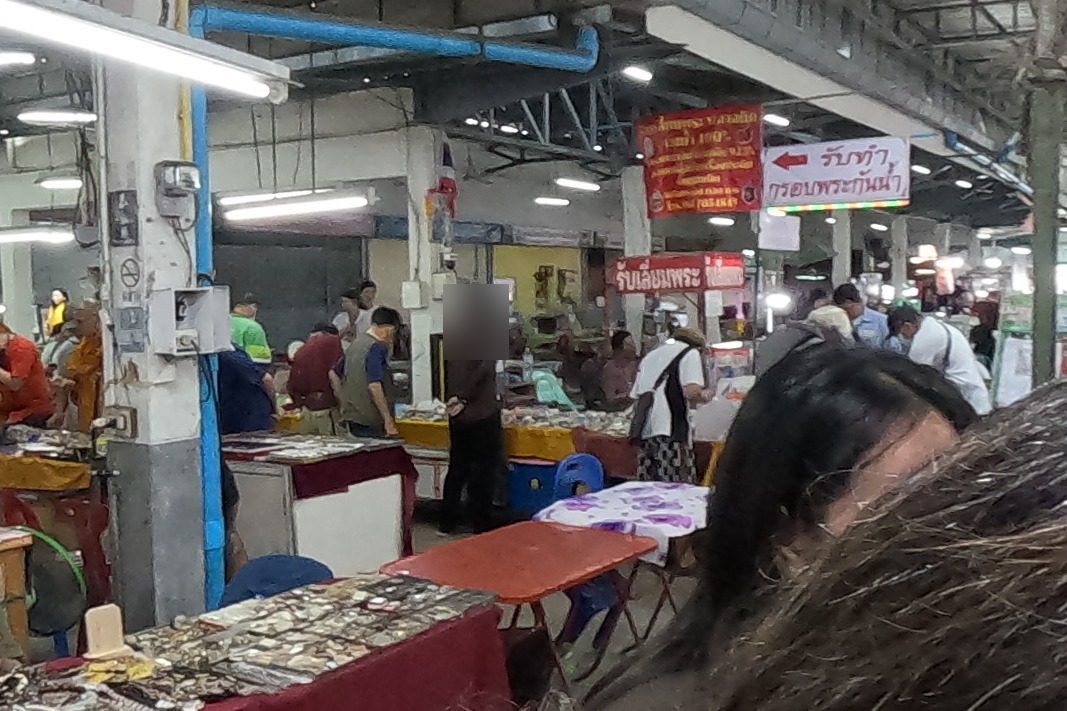
This Thai language guide walks through roughly sixty amulet-market words in three columns: Thai script, a Thai transliteration you can say out loud, and the literal meaning, because here the literal meaning is the entire lesson. The five photographs are real, taken on a Thursday morning in September 2026 at the amulet hall of Kamthieng market (ตลาดคำเที่ยง) in Chiang Mai. Nothing on this page is staged, and every sign in it is one you will meet again.
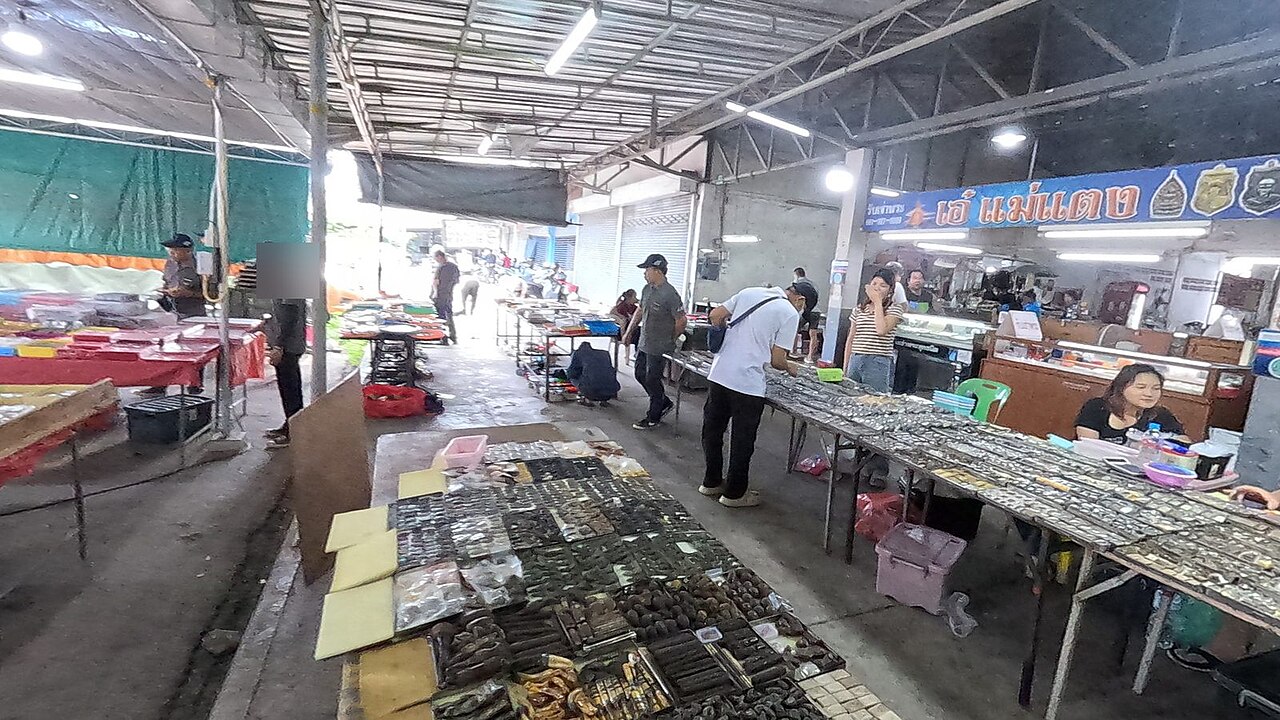
พระเครื่อง: the word for the object
The thing on the table is a พระเครื่อง (phrá khrûeang). Take it apart and it stops being exotic: พระ (phrá) is the word for a monk, a Buddha image and anything sacred, and เครื่อง (khrûeang) means a device or an article of equipment — the same เครื่อง that sits in เครื่องบิน (khrûeang bin), “flying machine”, aeroplane. A พระเครื่อง is literally a “sacred article”. Once you see that, half the vocabulary of the hall becomes guessable.
- พระเครื่อง (phrá khrûeang) — amulet, lit. “sacred article”
- เหรียญ (rǐan) — a coin-shaped medal amulet; the same word as a coin
- ตะกรุด (dtà-grùt) — a rolled metal scroll worn at the waist
- ผ้ายันต์ (phâa yan) — a yantra cloth, lit. “cloth + diagram”
- รุ่น (rûn) — edition, batch, generation; every amulet belongs to one
- องค์ (ong) — the classifier you must use for Buddha images and amulets, never อัน
That last line matters more than it looks. Ask for two amulets with the wrong counting word and you have called them objects. If Thai classifiers are still a fog, our guide to Thai classifiers sorts out which word goes with what — องค์ is one of the few that a learner really cannot fudge.
เช่า, not ซื้อ: the verb that catches everyone out
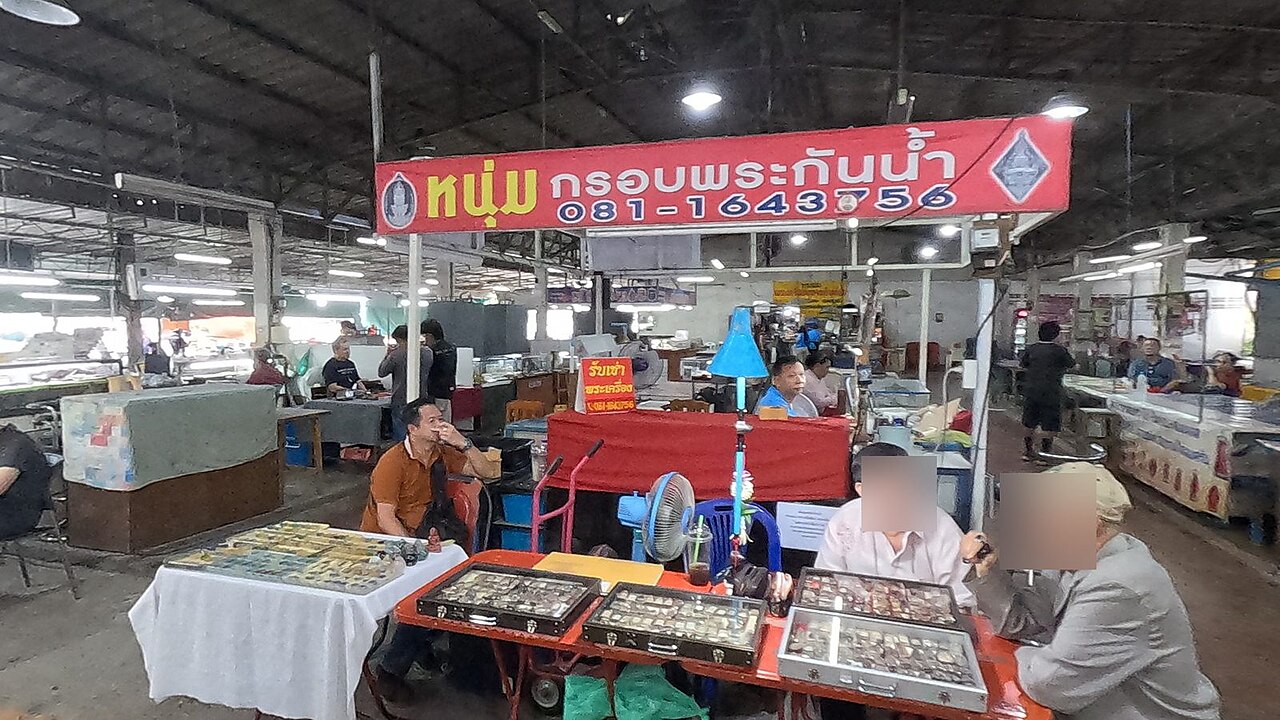
No one in that photograph will tell you they sell amulets. They do not use ซื้อ (séu, to buy) or ขาย (khǎai, to sell) for a พระเครื่อง at all. The verb is เช่า (châo) — to rent. The idea is that a sacred object cannot be owned outright or priced like a mango; you take it into your keeping for a time, and money changes hands as a courtesy rather than as a purchase. Money still changes hands. The politeness is in the grammar, not in the price.
- เช่าพระ (châo phrá) — to acquire an amulet, lit. “to rent a Buddha”
- ให้เช่า (hâi châo) — “available”, what a seller writes instead of “for sale”
- รับเช่า (ráp châo) — “we take them in”, i.e. the dealer buys from you
- ให้บูชา (hâi buu-chaa) — “offered for veneration”, the politest shop wording of all
- ค่าเช่า (khâa châo) — the rental fee, the word used for the price
- ซื้อ (séu) / ขาย (khǎai) — buy / sell, correct everywhere else, wrong here
This is the single most useful thing in the article for anyone working on Thailand expat language: เช่า is not an idiom you learn once and file away. It tells you that Thai keeps a separate register for the sacred, the same instinct that gives monks their own pronouns and gives a Buddha image สรง (sǒng) for “to bathe” instead of everyday อาบน้ำ. Use the right verb at a stall and you will watch the dealer’s face change.
Read Thai script on the market banner
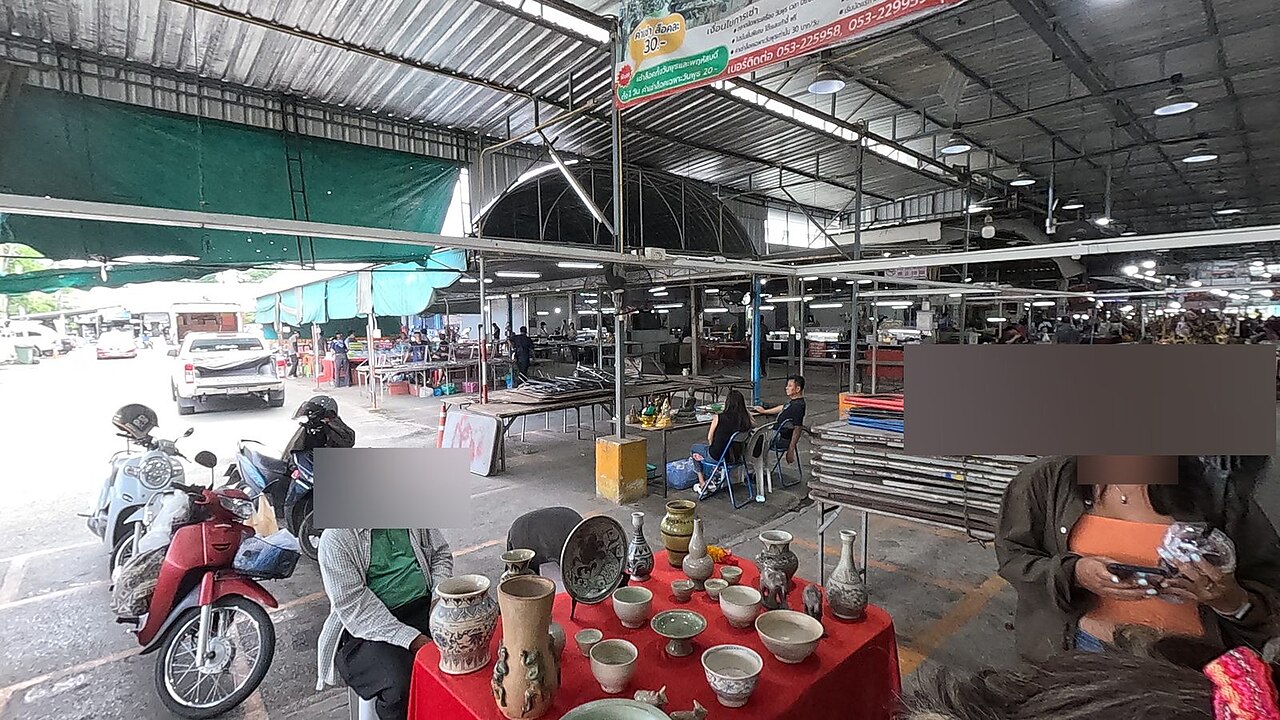
Here is the joke a beginner can now get: the same verb เช่า appears twice in this market with two different weights. On the banner it is a plain commercial rent — thirty baht for a day’s table. On the dealer’s card below it, it is a word chosen to avoid saying “sell”. One syllable, two registers, and you can only hear the difference once you can read Thai script on both signs. A few habits make that quick:
- Learn the digits early. ๐ ๑ ๒ ๓ ๔ ๕ ๖ ๗ ๘ ๙ are 0–9, and prices here are often written in them; our guide to reading Thai numerals and prices covers the shapes in an evening
- ละ (lá) means “per”. ล็อคละ ๓๐ is “30 per lot”, exactly like กิโลละ, “per kilo”, at the fruit stall
- ล็อค (lók) is borrowed English, “lot” — a market pitch. Thai signs are full of such loans and they are the easiest words to decode first
- ตลาดนัด (dtà-làat nát) — an “appointment market” that only opens on set days. At Kamthieng the amulet hall’s big day is วันพุธ (wan phút), Wednesday
Learn Thai vocabulary for the stall: trays, casings and condition
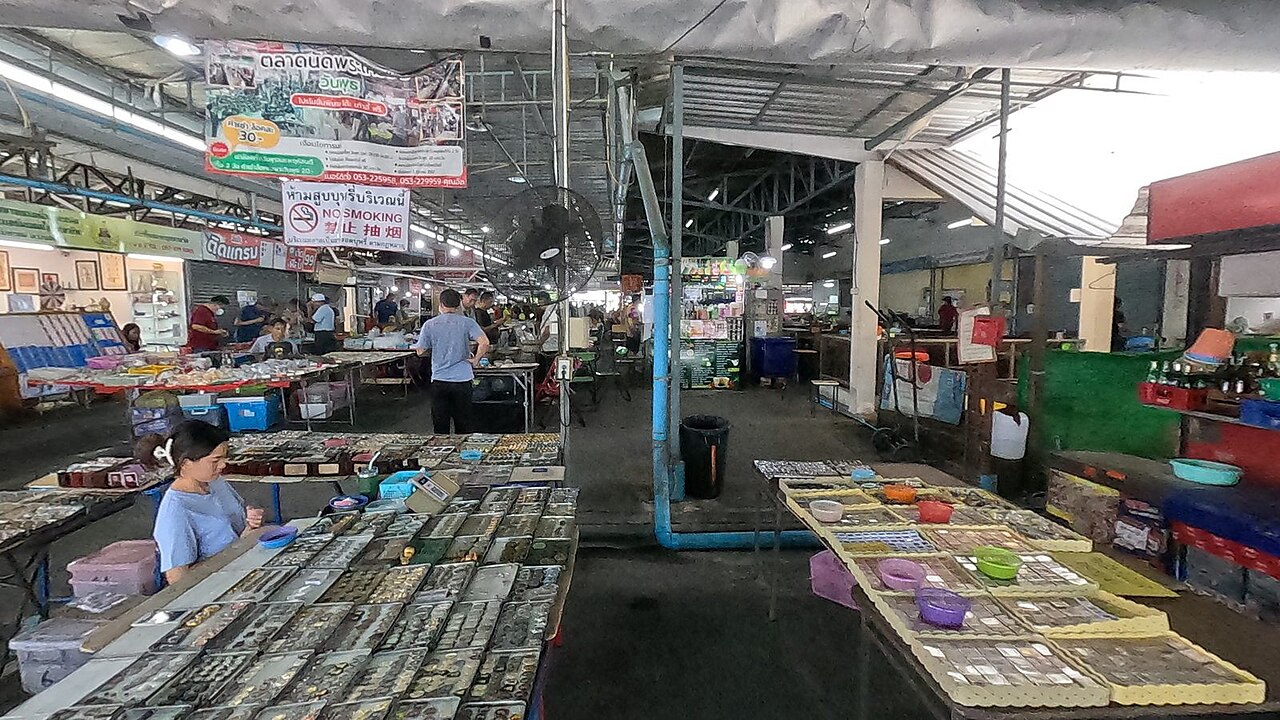
These are the working nouns of the table, and they are a good place to learn Thai vocabulary that recycles across Thai life — กรอบ is a picture frame, สร้อย is any necklace, แท้ and ปลอม apply to handbags and banknotes just as readily:
- แผง (phǎeng) — a display tray or board · ตลับ (dtà-làp) — a small case
- กรอบพระ (gràwp phrá) — amulet casing · กันน้ำ (gan náam) — waterproof
- เลี่ยมทอง (lîam thawng) — to trim or encase in gold
- สร้อย (sâwy) — chain · ห้อยพระ (hâwy phrá) — to wear an amulet round the neck
- ของแท้ (khǎwng tháe) — the real thing · ของปลอม (khǎwng bplawm) — a fake
- ส่องพระ (sàwng phrá) — to examine an amulet under a loupe, กล้องส่องพระ (glâwng sàwng phrá)
- เซียนพระ (sian phrá) — an amulet connoisseur; เซียน is borrowed from Chinese for an immortal or a master
And the words for what an amulet is believed to do, which you will hear a dealer use as plainly as a shoe-seller describes a sole: พุทธคุณ (phút-thá-khun), the sacred quality of the piece; เมตตามหานิยม (mêet-dtaa má-hǎa ní-yom), “loving-kindness and great popularity”, for people who deal with the public; แคล้วคลาด (khláeo-khlâat), narrow escape from danger, favoured by drivers; and โชคลาภ (chôok lâap), luck and windfall.
Who is at the table, and how to speak Thai politely
If you only learn Thai vocabulary for one thing in this hall, make it the names. Those on the amulets themselves are almost always monastic titles, and recognising them turns an unreadable tray into a catalogue. หลวงพ่อ (lǔang phâw) is “venerable father”, หลวงปู่ (lǔang bpùu) “venerable grandfather”, and หลวงพี่ (lǔang phîi) “venerable elder brother” — Thai ranks monks by kinship age exactly as it ranks families. The temple comes next: วัด (wát) plus a name, then a รุ่น and a Buddhist-era year, พ.ศ. ๒๕๒๐ being 1977 once you subtract 543.
Five sentences will carry you through an entire visit. Finish every one with ครับ (khráp) if you are male and คะ/ค่ะ (khá/khâ) if you are female — in a room this quiet, dropping the particle is louder than you think, and our guide to speaking politely with khrap and kha explains when each tone is used:
- ขอดูได้ไหมครับ/คะ (khǎw duu dâi mǎi khráp/khá) — may I look?
- องค์นี้เช่าเท่าไหร่ครับ/คะ (ong níi châo thâo-rài khráp/khá) — how much is this one? lit. “this one rents how much”
- หลวงพ่ออะไรครับ/คะ (lǔang phâw à-rai khráp/khá) — which monk is it?
- รุ่นไหนครับ/คะ (rûn nǎi khráp/khá) — which edition?
- ขอบคุณครับ/ค่ะ ขอดูก่อนนะครับ/คะ (khàwp khun khráp/khâ, khǎw duu gàwn ná khráp/khá) — thank you, I’ll just look for now
Two pieces of etiquette are worth more than any phrase. Do not haggle hard: a small ลดได้ไหมครับ (lót dâai mǎi khráp) is fine, grinding a dealer down over a sacred object is not. And never put an amulet in a back pocket or set it on the floor — nothing sacred in Thailand travels below the waist, which is also why you will see people lift an amulet to the forehead before putting it down.
A study tip: one table, twenty words
Do not try to memorise this page. Go to an amulet market on its วันนัด, its set day, stand at one table for ten minutes and read only the handwritten tags — they are short, repetitive, and written in the plain block hand that is the friendliest possible introduction to Thai letters in the wild. Keep our free Thai alphabet chart open on your phone for the consonants you do not know yet; a tray of fifty tags will teach you more about Thai consonants and vowels, and about Thai pronunciation, than an hour of drilling, because the same dozen syllables keep coming back.
Then take the twenty words you actually met — not sixty — into the flashcard trainer for the week. That is the honest way to learn Thai vocabulary and to start to speak Thai in a room where it matters: one real place, one small word list, and a verb like เช่า that quietly teaches you how Thai thinks about the sacred. It is a beginner Thai lesson that no classroom can hand you, and it is free.