Read Thai Script: Handwritten vs Printed Thai Letters
Two weeks in and you can sound out a shop sign. Then somebody writes you a note by hand, or you walk past a café logo, and the letters you spent a month learning have quietly changed shape.
Almost everyone who sets out to read Thai script learns the letters from a printed chart, and almost everyone gets a small shock the first time they meet those letters out in the world. The reason is one detail the chart never explains: nearly every Thai letter begins with a tiny loop, and that loop is doing far more work than it looks. Once you understand it, handwritten Thai, loopless logo fonts and the marker-pen prices at a market stall stop being a second alphabet and go back to being the one you already know. This Thai language guide covers the loop, the letter pairs it separates, and what changes the moment a Thai person picks up a pen.
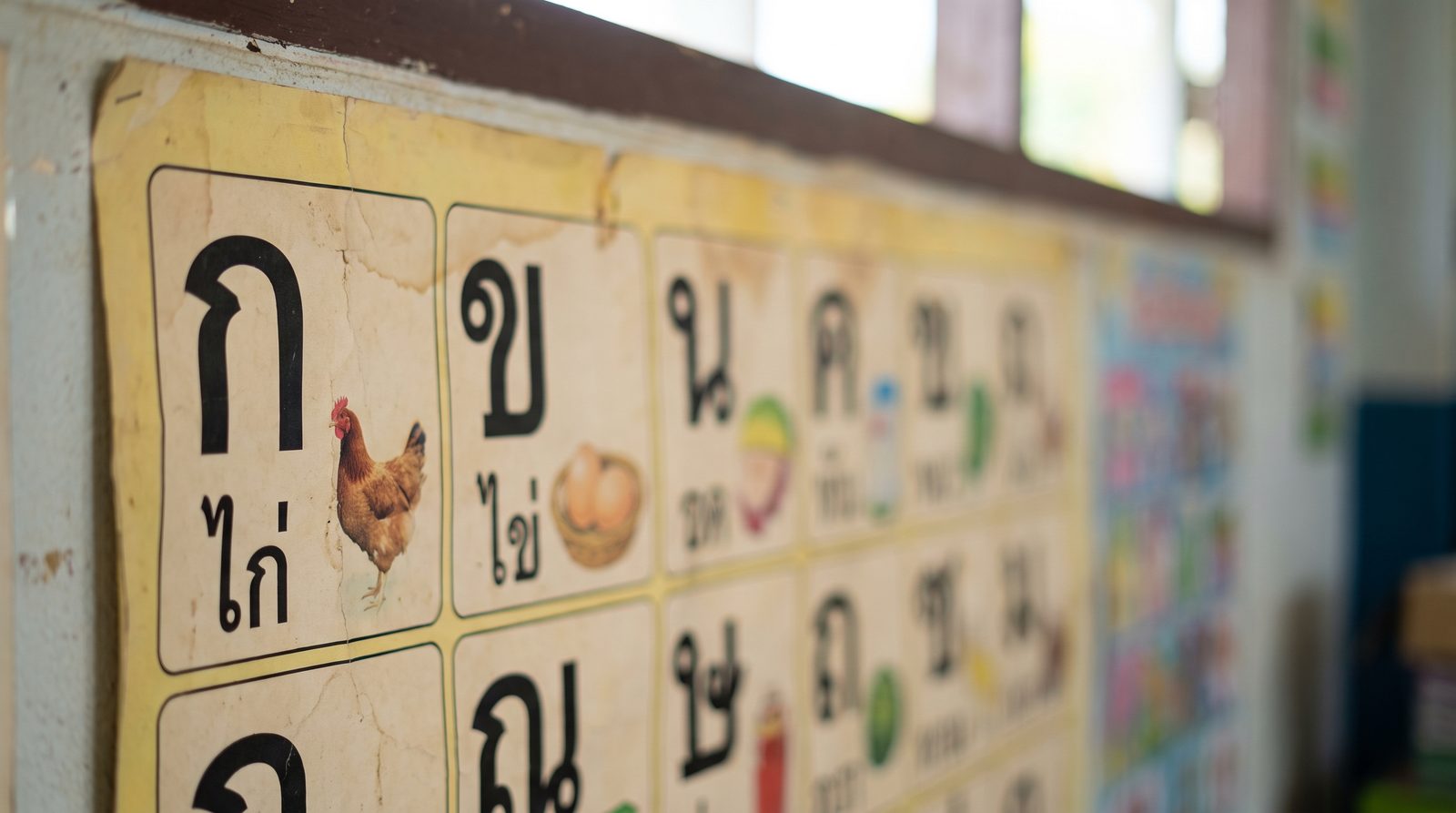
Every Thai letter starts at its หัว
The little loop is called หัว (hua, rising tone), which literally means “head”. It is not decoration. It is the starting point of the stroke, and Thai children are taught to begin there and carry on in one continuous movement wherever possible, lifting the pen as rarely as they can manage.
This is the single most useful thing you can know when you learn the Thai alphabet, because it turns a wall of unfamiliar squiggles into a set of instructions. Find the loop, and you know where the letter begins and which direction the pen is travelling. ก (ko kai) is the famous exception with no loop at all, which is part of why it is the first letter Thai children are given to write.
When the loop is the only difference
Several Thai consonants are identical except for one small feature — a loop, a spike or a tall stroke. These pairs are where beginners lose the most time, so learn them as pairs rather than as twenty-two separate letters.
| Pair | Pronunciation | What actually differs |
|---|---|---|
| ก / ถ | ko kai / tho thung | ถ is ก with a หัว added at the start |
| ด / ต | do dek / to tao | ต adds a small point at the top right |
| บ / ป | bo baimai / po plaa | ป adds a tall stroke above the line |
| ผ / ฝ | pho phueng / fo faa | same tall stroke, same rule |
| พ / ฟ | pho phaan / fo fan | again, the ascender makes it an f |
| ข / ช | kho khai / cho chaang | ข has a small notch on the right; ช is smooth |
Notice the pattern in the middle rows: adding a tall vertical stroke turns a plosive into an f-like sound three separate times, so one visual rule buys you three pieces of Thai pronunciation. That kind of pattern-spotting is the fastest route through a beginner Thai lesson, and the searchable Thai alphabet reference lets you put the pairs side by side at full size.
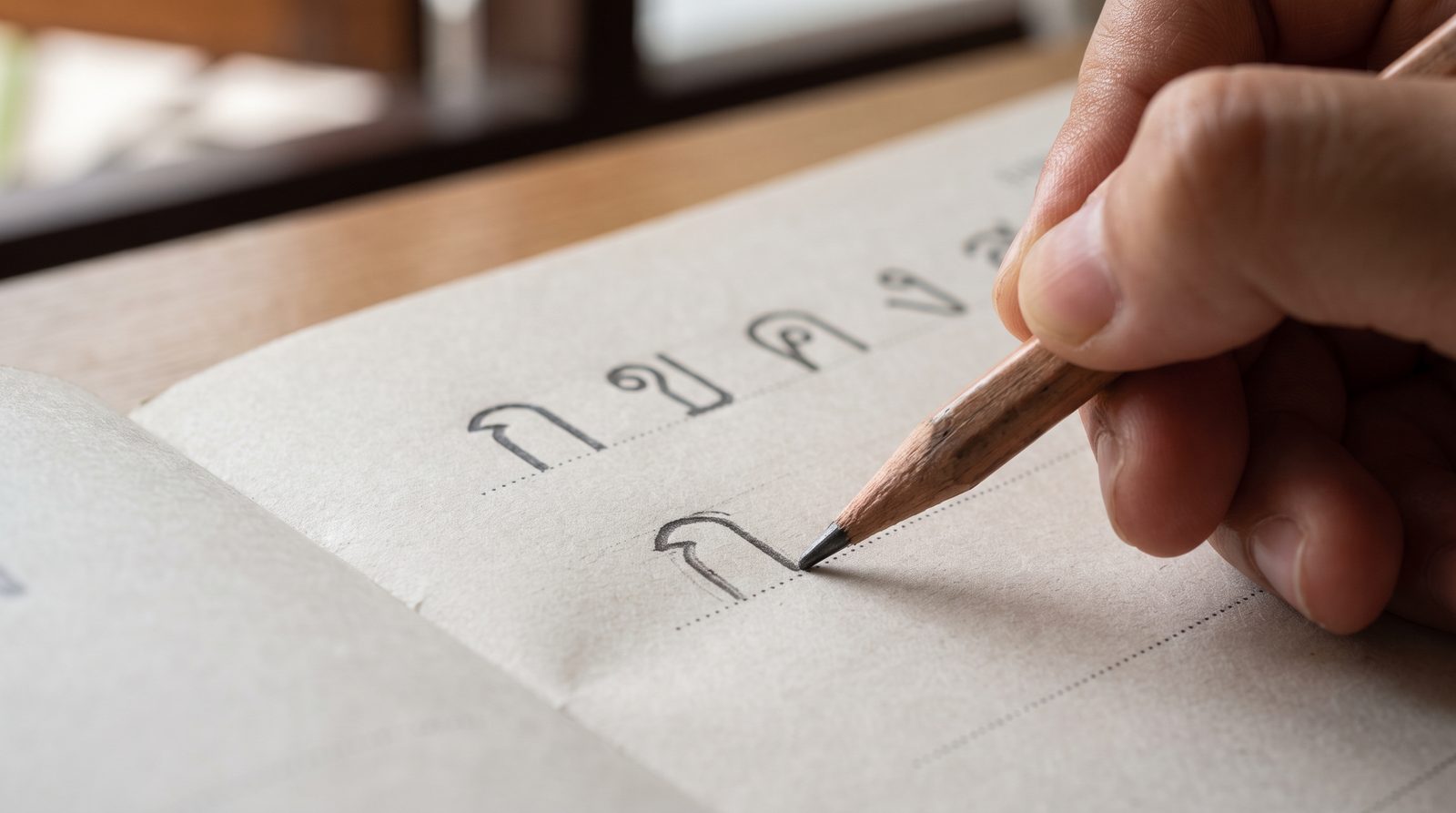
Read Thai script in real Thai handwriting
Printed Thai is patient and evenly spaced. Handwriting is not. Three things happen once a Thai person is writing at speed, and none of them are taught in a textbook:
- The loops shrink. A หัว written quickly becomes a dot, a tick, or a slight thickening where the pen changed direction. It is still there — you just have to accept a smaller version of it.
- Strokes merge. Letters that are drawn in two movements in print often become one loop-and-sweep by hand, so the outline flattens and the internal detail goes soft.
- Proportions drift. Ascenders get shorter, descenders get longer, and the height of the letter body stops being reliable. What stays constant is the starting loop and the overall silhouette.
Reading it is a matter of exposure, not talent. Start with handwritten material whose content you can guess — a market price board, a daily-special sign outside a restaurant. You already know roughly what it says, so you are only decoding the letterforms.
Loopless fonts: when the หัว disappears completely
The other surprise is a modern one. Thai designers love ฟอนต์ไม่มีหัว (font mai mi hua) — “fonts with no heads” — in which the loops are removed entirely for a cleaner, more Latin-looking shape. You will see them on coffee-shop branding, cosmetics packaging, magazine headlines, festival posters and television graphics all over Thailand.
They are harder to read even for Thai people, which is why they appear in short bursts and almost never in body copy. To read Thai script set in one of them, stop hunting for loops and start reading silhouettes: the outline of ก or ม survives even when the loop is gone. Context does more than letter-by-letter decoding ever will.
Thai consonants and vowels: above and below the line
Thai stacks. Consonants sit on the baseline, and around them go the vowels, the tone marks and the occasional silent-letter symbol. A few consonants break the line too: ป, ฝ, ฟ and ฬ reach upwards, while ฎ, ฏ, ฐ and ญ drop a tail below it. When a vowel needs to sit underneath, the tails of ฐ and ญ are simply trimmed off to make room — a piece of tidying that catches out learners who memorised the isolated letter shape and nothing else.
Vowels are the other half of this puzzle: they sit before, after, above or below the consonant they are pronounced after, which is why Thai transliteration can never quite show you what is happening on the page. Our guide to where Thai vowels sit around the consonant works through the positions, and the tone marks guide covers the small symbols that ride on top.
No spaces, no capitals, no full stops
One last structural point that affects everything above. Thai does not put spaces between words. A space marks the end of a clause or a sentence, roughly where English would use a comma or a full stop, so a line of Thai looks like one very long word until you start recognising where units begin and end. There are no capital letters either, which means no visual cue for names, and no full stop at the end of a sentence.
It sounds brutal and is mostly a non-issue in practice, because word boundaries come from recognition rather than punctuation. It does mean the ability to read Thai script arrives in a step rather than a slope: for weeks nothing, then one afternoon the blocks separate themselves. Nearly everyone who has picked up Thailand expat language skills describes the same moment.
A study tip: copy it out, do not just look at it
Reading and writing are the same skill here. Twenty minutes with a pencil, copying one line of Thai off a menu or a receipt, teaches you more about letterforms than an hour of staring at a chart — because writing forces you to decide where each stroke starts, and that decision is the whole lesson. Ten letters a day, ten times each, gets you through the alphabet in a fortnight.
Pair that with recognition drills so the letters stay fast as well as familiar: a few minutes on the flashcard trainer in the morning, a line of handwriting at night. It is an unglamorous routine, and it is the one that works. Learning to read Thai script is not really about memorising forty-four shapes — it is about getting comfortable with the many ways those shapes appear once they leave the chart and go out into Thailand.