Learn Thai Vocabulary: Cooking Words on Menus Thailand
Learn Thai vocabulary for reading menus in Thailand: the cooking verbs phat, thot, ping, tom and nueng in Thai script, with pronunciation and real photos.
Thai menus look impossible until you notice that they are not really lists of dishes. They are lists of verbs. Almost every dish on a Thai menu board is named after the thing that happened to the food — it was stir-fried, deep-fried, grilled, boiled or steamed — and the ingredient is simply bolted onto that verb. Which means the fastest way to learn Thai vocabulary that pays off immediately is not to memorise a hundred dish names. It is to learn about eight cooking words and then read the rest.
This guide covers the cooking verbs that start or finish most Thai dish names, how they are written in Thai letters, how to say them without ordering the wrong thing, and how they slot together into a dish name you can decode cold. Everything comes with Thai script, a Thai transliteration you can read aloud, and a literal translation where the literal meaning is what makes the word stick. Every photograph below is real food in Thailand.
Why Thai dish names are built verb-first
English hides its cooking methods inside nouns. "Omelette", "stew" and "crisps" do not tell a beginner anything about heat or oil. Thai does the opposite: it names the method out loud, every time. ข้าวผัด (khâao phàt) is literally "rice stir-fried". ไก่ทอด (gài thâawt) is "chicken deep-fried". ปลานึ่งมะนาว (bplaa nûeng má-naao) is "fish steamed lime".
Once you can read five or six of these verbs, a menu stops being a wall and becomes a grid: pick a method, pick a protein, and you have ordered dinner. That is why cooking words are such a good beginner Thai lesson, and why they are the first thing to learn Thai vocabulary-wise if you eat out more than you cook: they are short, they repeat constantly, and they are printed on signs you walk past every day.
ผัด (phàt) — stir-fried in a wok
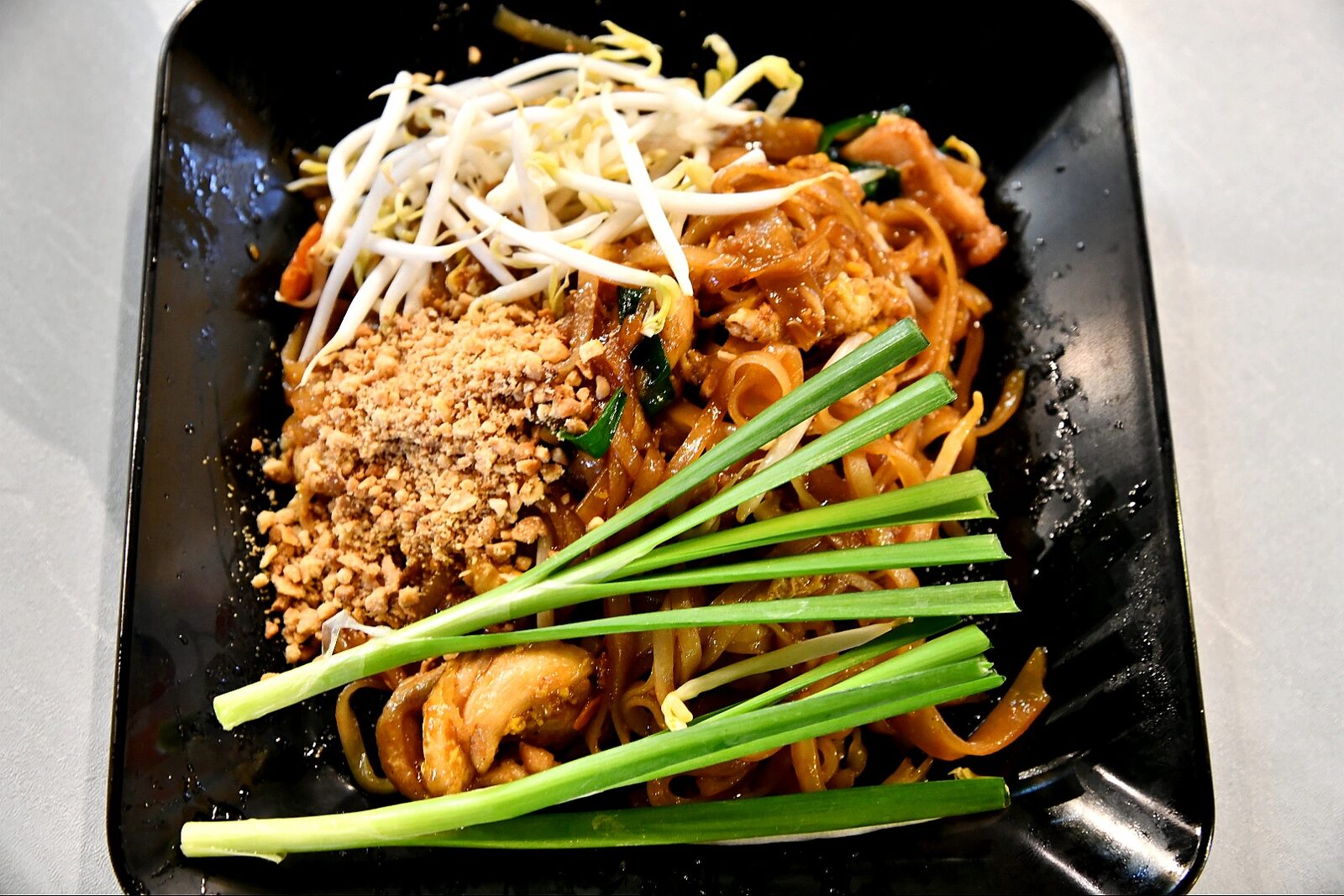
ผัด (phàt) is the single most useful word on this page. It means tossed quickly in a hot wok with a little oil, and it opens or closes a huge share of every menu in the country. Two spelling notes worth banking early: the first letter is ผ, an aspirated ph with a puff of air, not the p that English romanisation keeps suggesting; and the final ด is pronounced as a clipped, unreleased t. Final-consonant rules like that are the part of Thai consonants and vowels that trips up readers longest, so meet them early.
- ข้าวผัด (khâao phàt) — fried rice, literally "rice stir-fried"
- ผัดกะเพรา (phàt gà-phrao) — stir-fried with holy basil, the national hangover lunch
- ผัดซีอิ๊ว (phàt sii-íu) — stir-fried with soy sauce
- คั่ว (khûa) — dry-fried in a pan with no oil, used for nuts, chillies and curry pastes
There is a pattern hiding in that list, and it is worth spelling out because it unlocks dozens of dishes at once. When a dish is named after its main solid ingredient, the ingredient comes first and the verb follows: ข้าวผัด, ไก่ทอด. When the dish is named after the flavouring or style that defines it, the verb leads: ผัดกะเพรา, ผัดซีอิ๊ว. Read the word order and you already know which part of the dish the cook thinks is the point.
ทอด (thâawt) — deep-fried
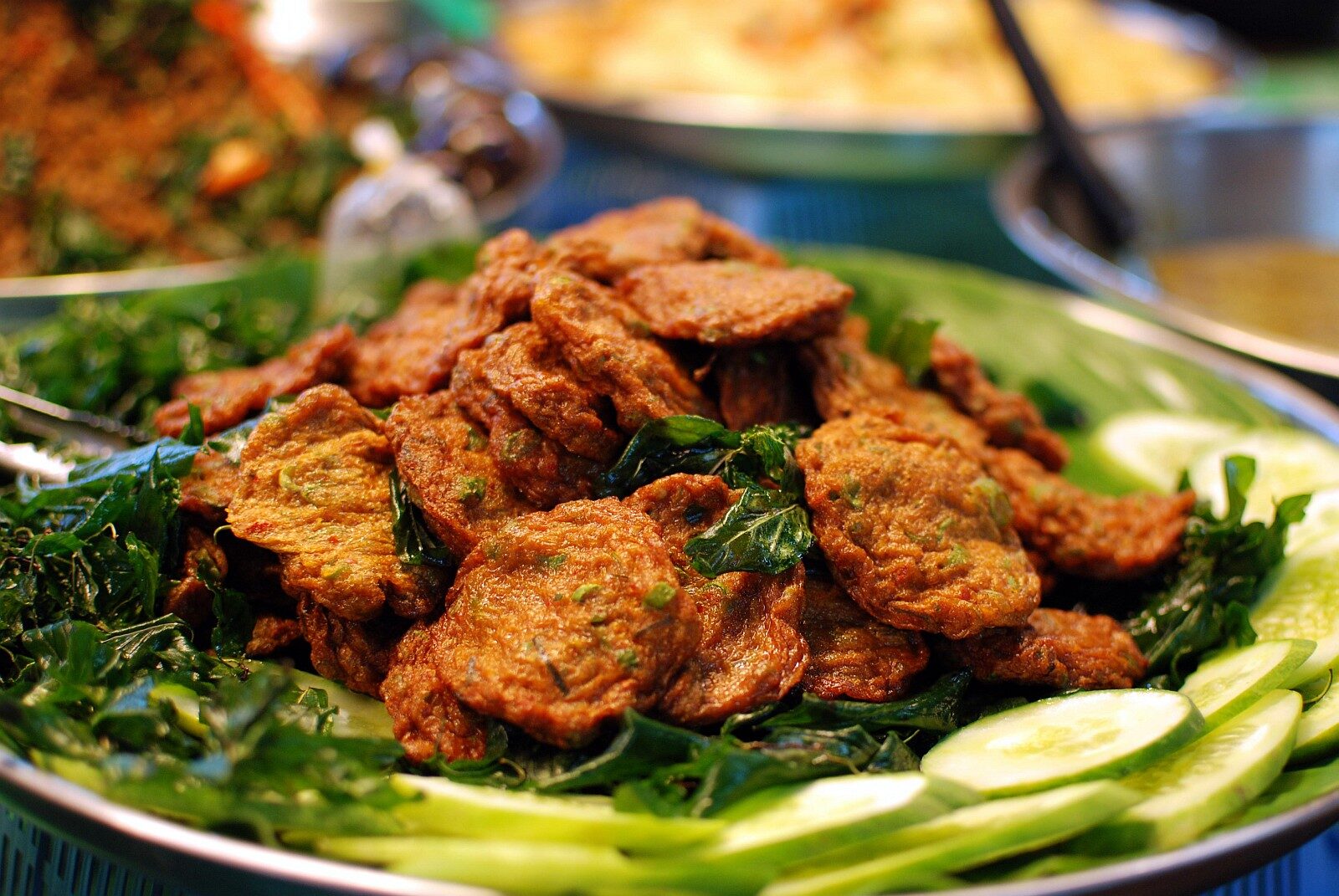
ทอด (thâawt) means submerged in hot oil. Same final ด as ผัด, same clipped t at the end, and the same aspirated start — ท is th, air and all. Pairs like ผัด and ทอด are the cheapest way to learn Thai vocabulary and spelling together, because they differ in exactly the parts a beginner needs to notice. Say ทอด with a hard English "t" and you will usually still be understood, but the long vowel matters more than most learners expect: ทอด has a long aaw, and shortening it drags you toward other words entirely.
- ไก่ทอด (gài thâawt) — fried chicken
- กล้วยทอด (glûay thâawt) — fried banana, sold by the bag at roadside stalls
- ไข่เจียว (khài jiaw) — Thai omelette; เจียว is its own verb, to fry in shallow oil until puffed
- ลวก (lûak) — blanched in boiling water, the opposite technique and a very common menu word
ปิ้ง and ย่าง — grilled over charcoal
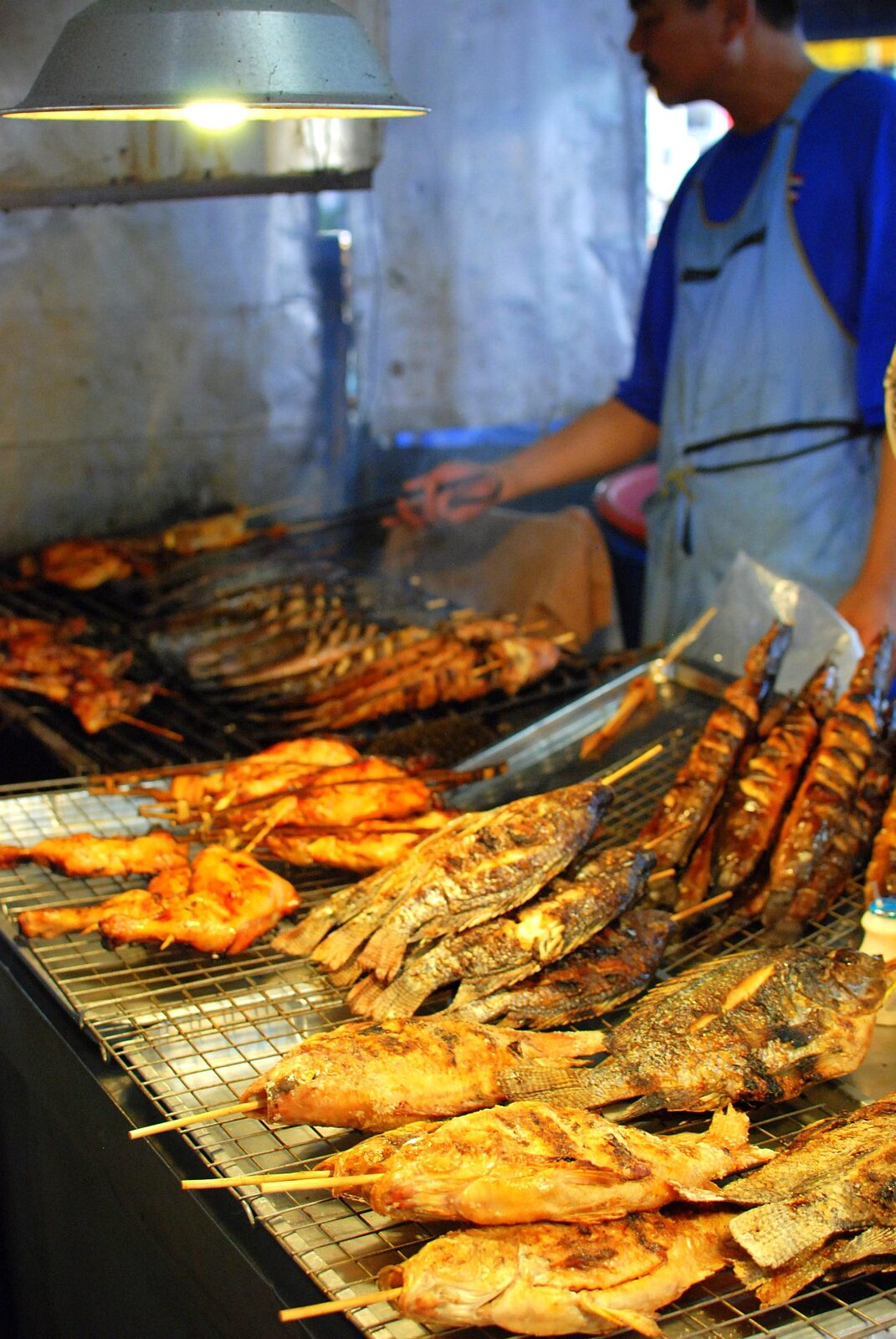
Thai splits grilling into two words where English has one, and the split is about size. ปิ้ง (bpîng) is small things on sticks held close over the coals — pork skewers, sticky rice, sweetcorn. ย่าง (yâang) is bigger things cooked slower and further from the heat — a whole chicken, a whole fish. A third verb, เผา (phǎo), means roasted directly in the fire or embers, which is why salt-crusted grilled fish is ปลาเผา (bplaa phǎo) and not ปลาย่าง.
Both words carry tone marks, so they are a tidy place to learn Thai vocabulary and tone reading in the same breath. ปิ้ง takes mai tho (◌้) and ย่าง takes mai ek (◌่), and because the two words start with consonants from different classes, the same mark does different work in each. If that sentence felt like a wall, our guide to Thai tone marks is the half-hour that fixes it.
- หมูปิ้ง (mǔu bpîng) — grilled pork skewers, the standard Thai breakfast
- ไก่ย่าง (gài yâang) — grilled chicken
- ข้าวโพดปิ้ง (khâao-phôot bpîng) — grilled corn on the cob
ต้ม, แกง and ตุ๋น — boiled, curried, stewed
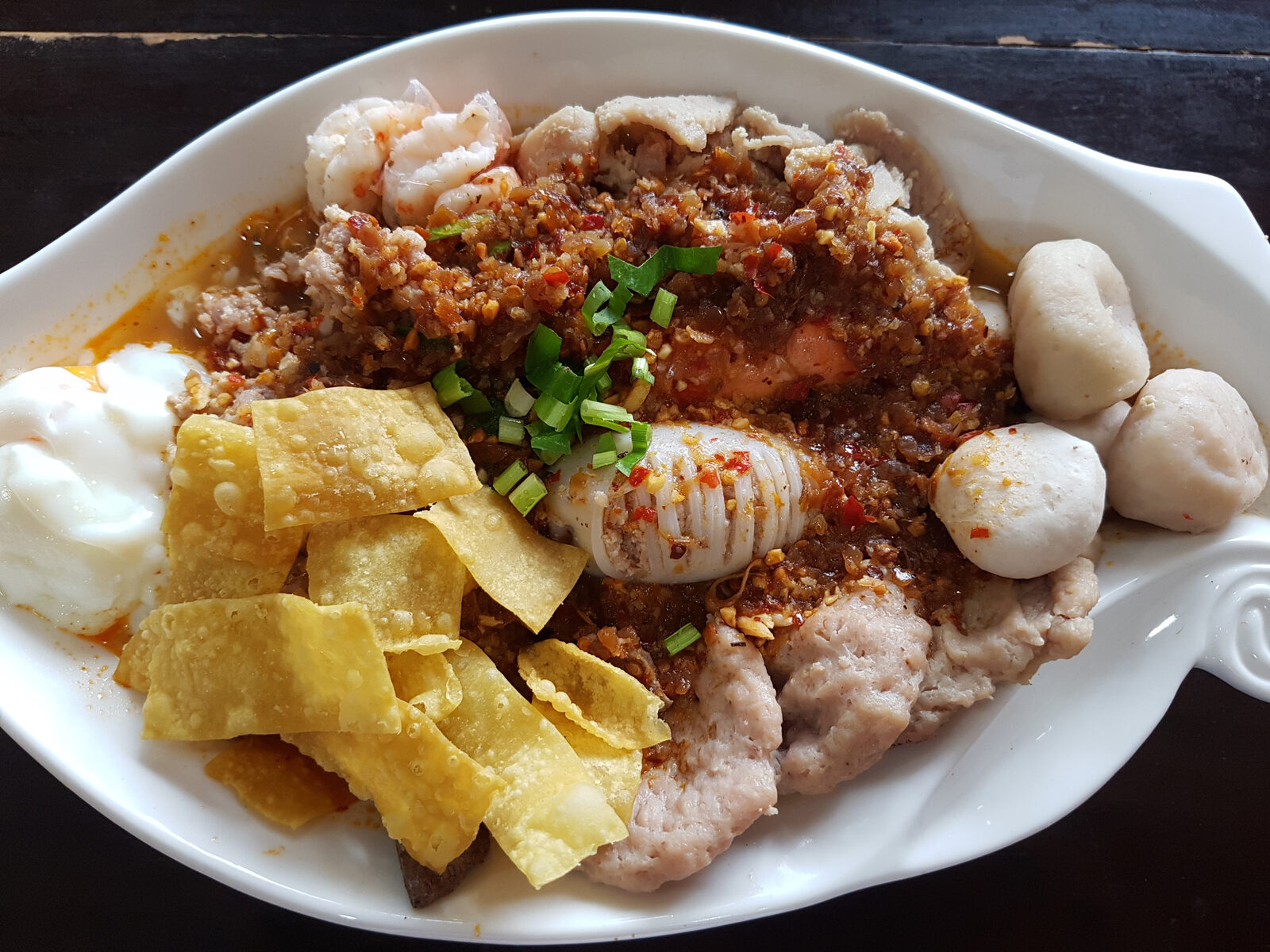
ต้ม (dtôm) is to boil. The initial ต is an unaspirated dt, sitting somewhere between an English d and t with no puff of air at all — one of the genuinely new sounds in Thai pronunciation for English speakers, and worth drilling on its own. ต้มยำ (dtôm yam) is simply "boil" plus ยำ (yam), the word for a sour-spicy dressed salad, so the famous soup is literally a boiled spicy salad.
- ต้มข่าไก่ (dtôm khàa gài) — chicken boiled with galangal in coconut milk
- แกง (gaeng) — curry, and also the verb for making one; แกงเขียวหวาน (gaeng khǐaw wǎan) is "curry green sweet"
- ตุ๋น (dtǔn) — stewed or braised slowly, as in ขาหมูตุ๋น (khǎa mǔu dtǔn) stewed pork leg
- ข้าวราดแกง (khâao râat gaeng) — rice with curry poured over it; ราด (râat) is the pouring
One trap: ยำ (yam) on its own is a cold tossed salad, as in ยำวุ้นเส้น glass noodle salad. Its cousin ตำ (dtam) means pounded in a mortar, which is where ส้มตำ (sôm dtam) green papaya salad gets its name. One letter apart in Thai letters, two completely different plates of food.
นึ่ง and อบ — steamed and baked
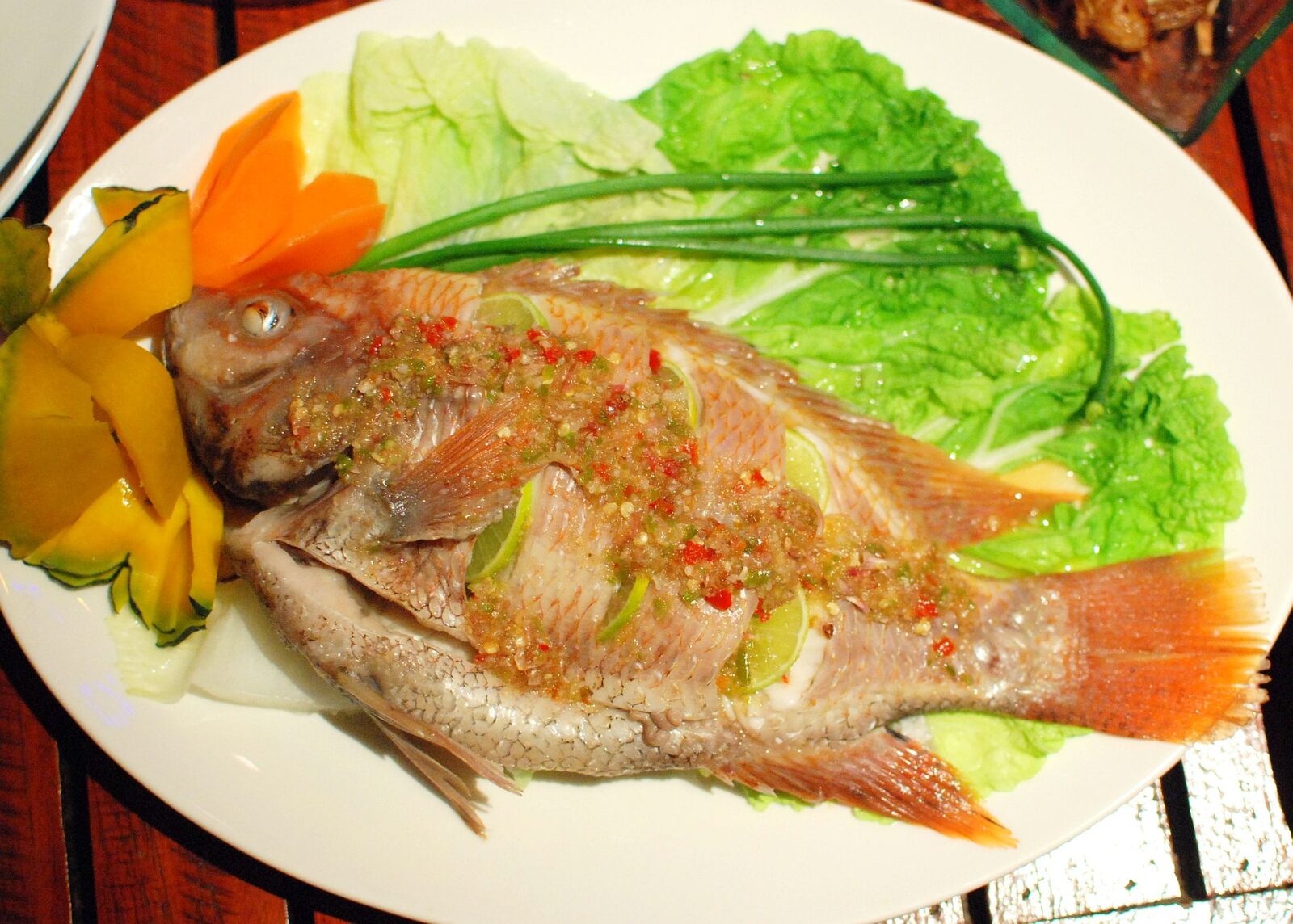
นึ่ง (nûeng) is steamed, and it is the healthiest word on the menu board. อบ (òp) is baked or oven-roasted, less common in street cooking but everywhere in rice-pot dishes like ข้าวอบ (khâao òp). Both are short, both are unmistakable once you have seen them twice, and both turn up constantly on the cards above a food court counter — which is exactly the kind of repetition that makes you learn Thai vocabulary without sitting down to study it.
Ordering: khrap, kha and the four phrases that matter
Thai politeness particles do not come off, even at a plastic table. Men end sentences with ครับ (khráp), women with ค่ะ (khâ), switching to คะ (khá) when asking a question. Call a vendor roughly your age or older พี่ (phîi), older sibling — it is warm, standard and always safe. For anyone living here, that one habit is the difference between tourist Thai and working Thailand expat language.
- ขอ…ครับ/ค่ะ (khǎaw…) — "may I have…", the politest way to order
- ไม่เผ็ด (mâi phèt) — not spicy; เผ็ดน้อย (phèt nói) — a little spicy
- ไม่ใส่… (mâi sài…) — "don't put in…", as in ไม่ใส่ผงชูรส no MSG
- ใส่ถุง (sài thǔng) — "in a bag", the normal way to ask for takeaway from a street cart
Put a verb and a phrase together and you are ordering properly: ขอข้าวผัดไก่ ไม่เผ็ด ครับ — "fried rice with chicken, not spicy, please." If prices are still the hard part when the bill lands, our guide to Thai money words and prices covers the numbers side.
A study tip: read the verb first
Do not try to swallow this guide whole. Use it as a filter instead. The next time you are standing in front of a menu board or a food court counter, give yourself one rule: find the cooking verb before you look at anything else. There are only about eight of them, you now know all eight, and they are the part of the line that repeats. Whatever sits next to the verb is the ingredient, and the ingredient is a word you can ask about, point at or simply risk.
Three boards a week, read verb-first, and Thai menus quietly stop being decoration. If the script itself is still the bottleneck — if you are decoding ผ and ท letter by letter rather than seeing the word — start with our free Thai alphabet chart and drill the shapes in the ThaiLetters flashcard trainer first. The vocabulary sticks much faster once you can read Thai script at a glance, and you can learn Thai vocabulary from every sign you walk past instead of only from a book.